
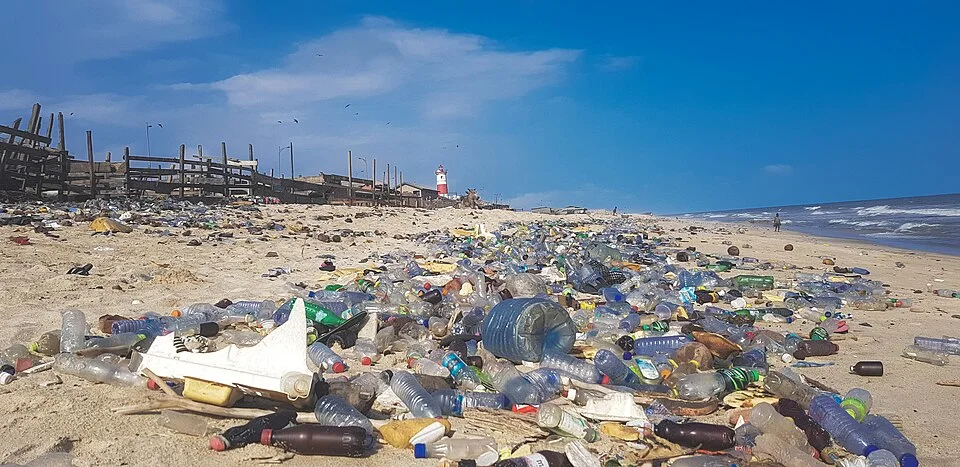
Plastic pollution on an Accra beach, Ghana: a comparative coastal example.
Credit: Muntaka Chasant · CC BY-SA 4.0 · sourceResized and converted to WebP; uncropped.
1. Meaning, sources and environmental movement
Plastics are polymer-based materials valued for low weight, durability and ease of moulding. Common polymers include polyethylene, polypropylene, polyvinyl chloride, polystyrene and polyethylene terephthalate. Plastic pollution arises when products, industrial feedstock or particles escape managed systems. Sources include packaging, synthetic textiles, fishing gear, agricultural films, construction products and tyre wear. Pollution can occur during production, transport, use and disposal, not merely after an item becomes municipal waste.
Macroplastic litter includes bags, bottles and abandoned fishing nets. Microplastics are particles below 5 mm. Primary microplastics are manufactured at small sizes, such as industrial pellets and deliberately added cosmetic microbeads. Secondary microplastics result from the breakdown or wear of larger materials, including synthetic fibres and tyre particles. Nanoplastics occupy a still smaller size range. These categories indicate particle size or origin, not necessarily chemical composition or toxicity.
Wind, storm-water drains and rivers carry plastics from settlements to lakes, estuaries and oceans. Wastewater can transport microfibres, while sewage sludge applied to fields can transfer particles to soils. Ocean currents concentrate floating debris in subtropical gyres. The Great Pacific Garbage Patch is a dispersed accumulation, not a continuous solid island. Plastics also occur on beaches, in sediments, in the deep sea and in remote mountain and polar environments.
Timeline
2016
India notified the Plastic Waste Management Rules, replacing the 2011 framework.
1 January 2021
The Basel Convention’s plastic-waste amendments became effective.
February–March 2022
India notified plastic-packaging EPR guidelines; UNEA adopted Resolution 5/14 on negotiating a global plastic-pollution instrument.
1 July 2022
India’s prohibition on identified single-use plastic items took effect.
31 December 2022
The minimum thickness requirement for conventional plastic carry bags increased to 120 microns.
2. Ecological, health and economic consequences
Wildlife may ingest plastic or become entangled in it. Ingestion can obstruct digestive tracts, reduce feeding and damage tissues. Abandoned, lost or discarded fishing gear can continue trapping organisms, a process called ghost fishing. Plastic debris can smother habitats and transport organisms to new locations. Floating litter threatens turtles, seabirds and marine mammals, while smaller particles expose plankton, benthic organisms and other components of aquatic food webs.
Plastic particles may contain additives such as plasticisers, pigments and flame retardants; they can also carry substances adsorbed from surrounding water. Hazard depends on the polymer, chemical composition, particle characteristics, dose and exposure pathway. Transfer through food webs is documented, but universal biomagnification of all microplastics should not be assumed. Similarly, finding particles in human tissues establishes exposure, not by itself a quantified disease risk. Human-health consequences remain an active field of research.
On land, litter can block drains and aggravate urban waterlogging, although flooding has multiple causes. Agricultural plastic residues can affect soil structure and soil organisms. Open burning releases particulate matter and toxic pollutants; uncontrolled burning of chlorine-containing plastics can generate dioxins and furans. Plastics also impose collection and clean-up costs, damage fishing equipment and reduce tourism value. Their fossil-fuel-based production and end-of-life treatment contribute to greenhouse-gas emissions.
Preferred plastic-waste management sequence
- 1. Eliminate unnecessary products and redesign packaging
- 2. Reduce consumption and establish reuse or refill systems
- 3. Segregate at source and collect through accountable systems
- 4. Sort and recycle suitable material in authorised facilities
- 5. Treat non-recyclable residuals through permitted routes
- 6. Verify outcomes and prevent environmental leakage
3. India’s legal and institutional framework
The Plastic Waste Management Rules, 2016, notified under the Environment (Protection) Act, 1986, provide the principal national framework. They assign responsibilities to waste generators, local bodies, gram panchayats, producers and other actors. Waste generators must segregate plastic waste, avoid littering and hand over waste through authorised arrangements. Urban local bodies organise collection, segregation, processing and disposal. The Central Pollution Control Board and State Pollution Control Boards or Pollution Control Committees have important regulatory functions.
The 2021 amendment prohibited the manufacture, import, stocking, distribution, sale and use of specified single-use plastic items from 1 July 2022. These include plastic sticks for balloons and earbuds; plastic flags; candy and ice-cream sticks; polystyrene for decoration; plates, cups, glasses and cutlery; straws, trays and stirrers; specified wrapping films; and plastic or PVC banners below 100 microns. Packaging as a whole was not prohibited. Carry-bag thickness increased to 75 microns from 30 September 2021 and 120 microns from 31 December 2022.
The 2022 extended producer responsibility guidelines for plastic packaging require producers, importers and brand owners to meet applicable obligations through a regulated system. Packaging categories distinguish rigid, flexible, multilayered and specified compostable packaging. Obligations include recycling, reuse and recycled-content requirements where applicable, with prescribed end-of-life treatment for relevant residual fractions. Registration and reporting through the centralised portal support monitoring. Effective implementation requires genuine processing, traceable material flows and prevention of fraudulent recycling certificates.
| Term | Meaning | Exam caution |
|---|---|---|
| Single-use plastic | Product intended for one use before disposal | Not synonymous with all plastic packaging or all prohibited items |
| Bio-based plastic | Made wholly or partly from biological feedstock | Not necessarily biodegradable |
| Biodegradable plastic | Breaks down biologically under specified conditions | Does not necessarily degrade rapidly in the sea |
| Compostable plastic | Meets specified biodegradation and disintegration criteria under composting conditions | Industrial compostability does not imply home compostability |
| Recyclable plastic | Can be recovered and reprocessed through an appropriate system | Technical recyclability does not guarantee actual collection and recycling |
4. Prevention, recycling and alternative materials
The preferred waste hierarchy begins with avoiding unnecessary products, reducing material use and expanding reuse or refill systems. Source segregation and reliable collection then make recycling feasible. Mechanical recycling sorts, washes and reprocesses suitable plastics, but contamination, mixed polymers and composite packaging can reduce quality and viability. Thermoplastics can generally be remelted, whereas cross-linked thermosets cannot be remelted in the same way. A resin identification code identifies material; it does not guarantee local recyclability.
Chemical recycling covers technologies that break polymers into smaller chemical components. Its environmental performance depends on energy use, yields, emissions and whether outputs replace virgin materials. Incineration with energy recovery and cement-kiln co-processing are not material recycling. They require authorised facilities and pollution controls. Plastic roads may provide a use for specified waste under technical guidelines, but do not eliminate the need for prevention or automatically resolve concerns about additives and long-term particle release.
Bio-based, biodegradable and compostable are different terms. Bio-based describes feedstock origin; such plastic may remain persistent. Biodegradable describes breakdown under specified conditions and timescales. Compostable plastic must meet relevant composting standards, often requiring controlled industrial conditions rather than ordinary soil or seawater. Indian rules prescribe certification and labelling requirements for relevant products. Substitution should use life-cycle assessment: replacing plastic with a heavier disposable material can shift impacts towards water consumption, land use or transport emissions.
5. Global governance and priorities for India
The Basel Convention’s plastic-waste amendments became effective on 1 January 2021. They strengthened controls over transboundary movement of many mixed, contaminated and hazardous plastic wastes, including prior informed consent where applicable; they did not prohibit every plastic-waste shipment. MARPOL Annex V prohibits discharge of plastics from ships into the sea. In March 2022, the United Nations Environment Assembly adopted Resolution 5/14, launching negotiations towards a legally binding instrument addressing plastic pollution across its full life cycle.
India needs coordinated action on product design, collection coverage, litter prevention and market demand for safely recycled material. Deposit-return arrangements, reusable delivery systems, public procurement and retrieval of fishing gear can complement enforcement. Informal waste pickers should be integrated through fair payment, protective equipment and social protection. Swachh Bharat Mission–Urban 2.0 supports scientific solid-waste management. Progress should be assessed through reduced leakage, verified recycling and lower virgin-material demand, rather than collection drives or certificate generation alone.
Coastal Plastic Pollution: Pathways, Impacts and Prevention
The supplied metadata identifies plastic pollution on an Accra beach in Ghana. This is a comparative example of coastal litter, not evidence about an Indian location. Coastal plastic can arrive through rivers, stormwater drains, direct dumping and maritime activities. Its accumulation links land-based waste management with marine ecosystem health. However, the metadata alone cannot establish the litter’s sources, composition, quantity or ecological effects at this site.
Plastic persistence does not mean that discarded items remain unchanged. Sunlight, abrasion and weathering can fragment larger objects into microplastics, generally defined as particles smaller than 5 millimetres; fragmentation is not equivalent to complete biodegradation. Wildlife may ingest plastic or become entangled in it, while smaller particles can move through water, sediments and food webs. In India, the Plastic Waste Management Rules and extended producer responsibility connect this issue to segregation, collection and producer accountability. Preventing leakage requires upstream reduction and reuse alongside sound waste management; beach clean-ups address accumulated litter but cannot substitute for these measures.
- Distinguish primary microplastics, manufactured at small sizes, from secondary microplastics formed through fragmentation of larger plastic products.
- Extended producer responsibility assigns obligations for managing plastic packaging waste; it is neither a blanket plastic ban nor a replacement for municipal responsibilities.
- For Mains, connect coastal pollution to river-basin governance and consumption patterns. Avoid inferring human health outcomes or site-specific contamination levels from a litter photograph’s metadata.
Real-world case studies
Pune: integrating waste pickers
SWaCH, a waste-picker cooperative working with Pune Municipal Corporation, provides door-to-door collection and supports recovery of recyclables. It demonstrates how decentralised collection and worker inclusion can improve segregation. Low-value flexible packaging nevertheless needs stronger producer financing and reliable processing outlets.
Norway: deposit-return packaging
Norway operates a deposit-return system for beverage containers through Infinitum. Consumers recover a deposit when returning eligible containers. Relatively clean, separately collected material improves recycling quality. The lesson is that financial incentives and convenient return infrastructure can reduce litter more effectively than awareness campaigns alone.
Previous year questions
No source-linked PYQ is available here yet. Use the practice questions below.
Practice questions
Practice MCQ 1
Consider the following statements: 1. All bio-based plastics are biodegradable. 2. Industrially compostable plastics may require controlled temperature and moisture. 3. All biodegradable plastics rapidly decompose in seawater. Which of the statements given above is/are correct?
- A. 1 and 2 only
- B. 2 only
- C. 2 and 3 only
- D. 1, 2 and 3
Practice MCQ 2
With reference to plastic-waste governance in India, consider the following statements: 1. The prohibition effective from July 2022 covers every form of single-use plastic packaging. 2. Extended producer responsibility can impose post-consumer obligations on producers, importers and brand owners. 3. Extended producer responsibility removes local bodies’ waste-collection responsibilities. Which of the statements given above is/are correct?
- A. 1 only
- B. 2 only
- C. 1 and 3 only
- D. 2 and 3 only
Practice MCQ 3
Which of the following pairs is/are correctly matched? 1. Ghost fishing — Continued trapping by abandoned fishing gear 2. MARPOL Annex V — Regulation of garbage discharge from ships 3. Basel Convention plastic-waste amendments — Complete prohibition of all international plastic-waste trade
- A. 1 only
- B. 1 and 2 only
- C. 2 and 3 only
- D. 1, 2 and 3
Mains practice · Plastic pollution is a product-design and governance challenge, not merely a waste-disposal problem. Discuss with reference to India’s regulatory framework. Suggest measures beyond bans. (250 words)
- Explain life-cycle sources, persistence, fragmentation and ecological impacts.
- Outline the 2016 Rules, identified single-use plastic prohibition and packaging EPR.
- Identify weak segregation, difficult-to-recycle packaging, leakage and verification gaps.
- Prioritise reduction, reusable systems, design standards and deposit-return arrangements.
- Integrate waste pickers and strengthen municipal collection and producer financing.
- Evaluate substitutes through life-cycle assessment and measure verified environmental outcomes.
Further reading
- MoEFCC: Plastic Waste Management Rules, 2016, and subsequent amendments on the official ministry website.
- Central Pollution Control Board: Plastic Waste Management resources and centralised EPR portal for plastic packaging.
- UNEP: From Pollution to Solution: A Global Assessment of Marine Litter and Plastic Pollution, 2021.
- Basel Convention Secretariat: Plastic Waste Amendments.
- International Maritime Organization: Prevention of Pollution by Garbage from Ships, MARPOL Annex V.
- OECD: Global Plastics Outlook: Economic Drivers, Environmental Impacts and Policy Options, 2022.
- https://commons.wikimedia.org/wiki/File:Plastic_Pollution_in_Ghana.jpg
Preparing for UPSC Civil Services? Get classroom teaching, answer-writing evaluation and mentorship at Pragnya IAS Academy, Ashok Nagar — see why aspirants choose us for IAS coaching in Hyderabad.