
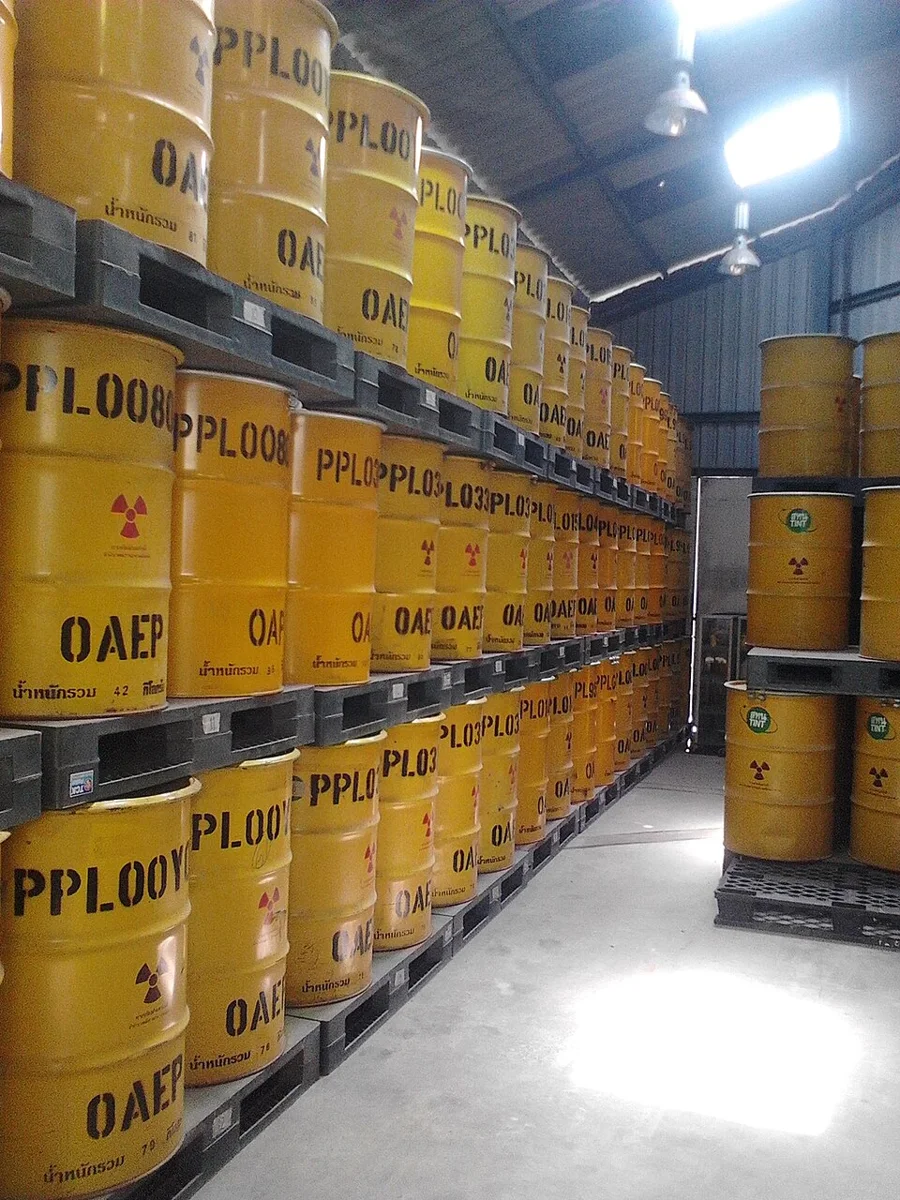
Radioactive-waste barrels, as identified in the supplied metadata; illustrative of waste containment.
Credit: ShinRyu Forgers · CC BY-SA 4.0 · sourceResized and converted to WebP; uncropped.
1. Nature, sources and environmental distribution
Radioactive pollution arises when radionuclides are introduced into the environment, or naturally occurring radioactive materials are concentrated or mobilised, in ways that create undesirable exposure. Radioactivity itself is a natural phenomenon: rocks, soils, the atmosphere and human bodies contain radionuclides. The environmental concern depends on the isotope, activity, chemical behaviour, exposure pathway and duration, rather than merely on whether radiation is detectable.
Natural sources include uranium and thorium in rocks, potassium-40 in soils and organisms, and radon generated within radioactive decay chains. Radon is a radioactive gas that can accumulate in poorly ventilated buildings. Cosmic radiation also contributes to background exposure, although radiation arriving from space is not itself radioactive contamination. Parts of Kerala’s coast have elevated natural background radiation associated with monazite-bearing mineral sands.
Human-related sources include uranium mining and milling, nuclear fuel processing, reactor operations, spent fuel, reprocessing facilities, nuclear weapons tests and accidents. Hospitals, research laboratories, industrial radiography and irradiation facilities also use radioactive sources. Lost or abandoned sources, termed orphan sources, may enter scrap-metal streams. Routine nuclear operations are not equivalent to uncontrolled pollution: authorised discharges require limits, monitoring and regulatory oversight.
- NORM means naturally occurring radioactive material; mining and industrial processing can redistribute or concentrate it.
- Radioactive contamination means radioactive material is present where it is unwanted. Irradiation means exposure to radiation and does not necessarily involve transfer of radioactive material.
- Food irradiation under approved conditions does not make food radioactive.
Timeline
1962
India enacted the Atomic Energy Act.
1983
The Atomic Energy Regulatory Board was constituted.
1986
The Chernobyl accident caused extensive transboundary radioactive contamination.
1987
India notified the Atomic Energy (Safe Disposal of Radioactive Wastes) Rules.
2010
The Mayapuri radiological accident exposed weaknesses in disposal and tracking of radioactive sources.
2011
The Fukushima Daiichi accident followed Japan’s earthquake and tsunami.
2. Radiation types, units and persistence
Alpha radiation consists of helium nuclei and has a short range. Paper or the outer dead layer of skin can stop it, but inhaled or ingested alpha emitters can deliver substantial doses to nearby tissue. Beta radiation consists of electrons or positrons and has intermediate penetration. Gamma rays are high-energy electromagnetic radiation and generally require substantial shielding, such as concrete or lead. Neutrons, important around some nuclear facilities, are effectively moderated by hydrogen-rich materials such as water.
Activity, absorbed dose and biological significance are different quantities. One becquerel equals one nuclear transformation per second. One gray equals one joule of radiation energy absorbed per kilogram. Equivalent dose accounts for radiation type, while effective dose additionally accounts for differences in tissue sensitivity; both use the sievert. Consequently, equal activities of different radionuclides do not necessarily produce equal health risks.
Physical half-life controls radioactive decay, but environmental persistence also depends on transport, chemical form and biological uptake. Iodine-131 has a half-life of about eight days, whereas caesium-137 and strontium-90 have half-lives of approximately 30 and 29 years respectively. Plutonium-239 has a half-life of about 24,100 years. A long half-life alone does not establish the greatest immediate hazard: activity per unit mass and exposure conditions also matter.
- After one, two and three physical half-lives, approximately one-half, one-quarter and one-eighth of the original radioactive nuclei remain.
- Biological half-life describes elimination from an organism. Effective half-life combines radioactive decay and biological elimination.
- Ordinary filtration, burning or chemical treatment does not stop nuclear decay, although treatment can separate, concentrate or immobilise radionuclides.
From radioactive release to risk reduction
- 1. Identify the source and radionuclides
- 2. Measure activity and map environmental contamination
- 3. Assess inhalation, ingestion and external exposure pathways
- 4. Estimate doses and identify vulnerable populations
- 5. Implement justified protective actions and control the source
- 6. Manage waste, monitor recovery and communicate findings
3. Exposure pathways and health and ecological effects
External exposure occurs when a radiation source is outside the body, including contaminated ground or an airborne plume. Internal exposure follows inhalation, ingestion or entry through wounds. Deposited material may move from soil to crops, from pasture to milk, or through aquatic food webs. Radionuclide transfer is element-specific: bioaccumulation can occur, but universal biomagnification across all radionuclides should not be assumed.
Ionising radiation can damage DNA directly or indirectly through reactive chemical species. At sufficiently high doses, tissue reactions such as skin injury, cataracts and acute radiation syndrome may occur; these generally have dose thresholds. Cancer is a stochastic effect: its probability, rather than severity, is treated as increasing with dose for radiation-protection purposes. The linear no-threshold model is a protective assumption for low-dose management, not proof that each minute exposure causes an observable cancer.
Radionuclides differ in organ targeting. Radioiodine can concentrate in the thyroid, strontium behaves broadly like calcium and may enter bone, while caesium behaves broadly like potassium and distributes through soft tissues. Children can be particularly vulnerable to thyroid exposure from radioiodine. Ecological impacts may include impaired reproduction, mortality and changes in populations at sufficiently high exposures. Exclusion zones also demonstrate a complexity: reduced human disturbance can allow wildlife to return despite continuing contamination.
- Important pathways include inhalation of radon decay products, contaminated drinking water, and consumption of contaminated milk, vegetables or fish.
- Exposure assessment must distinguish measured environmental activity from the dose actually received by people or organisms.
- Risk communication should address both radiation injury and indirect harms such as displacement, stigma and loss of livelihoods.
| Radionuclide | Approximate physical half-life | Major environmental or health relevance |
|---|---|---|
| Radon-222 | 3.8 days | Indoor accumulation; inhaled decay products increase lung-cancer risk |
| Iodine-131 | 8 days | Thyroid uptake; important in early food and milk restrictions |
| Cobalt-60 | 5.27 years | Powerful gamma source used in medicine and industry |
| Strontium-90 | 29 years | Bone-seeking radionuclide; long-term contamination concern |
| Caesium-137 | 30 years | Persistent soil and food contamination; external and internal exposure |
4. Prevention, waste management and emergency response
Radiation protection rests on justification, optimisation and dose limitation. A practice should provide a net benefit; exposures should be kept as low as reasonably achievable, taking economic and social factors into account; and applicable dose limits should be respected. Time, distance and shielding reduce external exposure. Containment, ventilation, protective equipment and contamination control reduce the likelihood of radioactive material entering the body or escaping into the environment.
Waste management begins with segregation by radionuclide, activity, half-life and physical form. Suitable short-lived waste may be stored for decay before authorised release or disposal. Other wastes require treatment and immobilisation, for example in cement or glass. Storage is temporary and anticipates retrieval; disposal is intended to provide long-term isolation without reliance on retrieval. Waste unsuitable for near-surface disposal, especially high-level or long-lived waste, requires more robust isolation, with deep geological disposal internationally recognised as a long-term approach.
During an emergency, authorities assess the release and projected doses before prescribing sheltering, evacuation, food restrictions or other measures. Decontamination may involve removing outer clothing and washing exposed skin. Potassium iodide can reduce thyroid uptake of radioactive iodine when appropriately timed and officially advised. It does not protect against other radionuclides or external radiation. Remediation must also manage contaminated soil, water and materials rather than simply relocating the hazard.
- Monitoring tools include survey meters, personal dosimeters, air samplers and laboratory gamma spectrometry.
- Nuclear safety prevents accidents and limits their consequences; nuclear security addresses theft, sabotage and other malicious acts.
- Neither uncontrolled dilution nor incineration that disperses radionuclides is an acceptable substitute for regulated waste management.
5. Indian regulation and international cooperation
India’s principal legal framework includes the Atomic Energy Act, 1962, the Atomic Energy (Safe Disposal of Radioactive Wastes) Rules, 1987, and the Atomic Energy (Radiation Protection) Rules, 2004. The Atomic Energy Regulatory Board regulates radiation and nuclear safety within its remit through consent processes, inspections, standards and enforcement. The Department of Atomic Energy has wider responsibilities for India’s atomic-energy programme; it should not be confused with the regulator.
Radioactive waste is addressed through the atomic-energy regulatory framework rather than treated as ordinary municipal or biomedical waste. Hospitals using radionuclides must therefore distinguish radioactive waste from infectious waste and follow applicable authorisations. Source inventories, secure storage, trained personnel and documented transfer or disposal are essential, particularly when institutions close laboratories or auction equipment.
Internationally, the International Atomic Energy Agency develops safety standards and supports cooperation, while the International Commission on Radiological Protection provides protection recommendations. The United Nations Scientific Committee on the Effects of Atomic Radiation evaluates exposure and effects scientifically. These bodies have distinct roles and do not replace national regulators. India’s National Disaster Management Authority issued guidelines on management of nuclear and radiological emergencies in 2009.
- For examinations, connect radioactive pollution with energy security, environmental surveillance, occupational safety and disaster preparedness.
- Long-lived wastes raise intergenerational equity concerns: present benefits must not impose inadequately managed risks on future generations.
- Transparent monitoring, emergency drills and credible public communication are necessary complements to engineering safeguards.
Radioactive Waste: Containment Is Not Pollution
Radioactive-waste barrels provide a relevant illustration of how radionuclides are managed to prevent environmental contamination. Waste held within an appropriate containment system is not, by itself, evidence of radioactive pollution. Pollution arises when radioactive material escapes or is dispersed into environmental media. The supplied metadata identifies waste barrels but does not establish their contents, activity, shielding, condition or any release. It therefore supports discussion of containment, not a claim that leakage or unsafe handling has occurred.
Waste management depends on radionuclide half-lives, activity concentrations, physical and chemical forms, and heat generation. Treatment, conditioning, containment and disposal serve different purposes; a container alone does not establish long-term safety. In India, this framework applies to waste from nuclear facilities and authorised medical, research and industrial uses, under the relevant regulatory requirements of the Atomic Energy Regulatory Board. Environmental monitoring can assess releases and exposure pathways, but health risk also depends on dose, exposure duration and whether radionuclides enter the body. This is an illustrative image, not evidence about any Indian facility.
- Irradiation means exposure to radiation; contamination means radioactive material is present on or within something. Irradiation does not necessarily cause contamination.
- Activity is measured in becquerels; absorbed dose in grays; equivalent and effective dose in sieverts. These quantities are not interchangeable.
- Half-life describes radioactive decay, not environmental mobility. Dilution may reduce concentration but does not destroy radionuclides; containment must address relevant migration pathways.
Real-world case studies
Mayapuri, Delhi, 2010: an orphan-source accident
A disused gamma irradiator containing cobalt-60 from the University of Delhi entered the Mayapuri scrap market. Dismantling exposed workers; several suffered radiation injuries and one person died. The accident illustrates why radioactive equipment cannot be auctioned as ordinary scrap. Lifecycle source tracking, authorised disposal, worker awareness and radiation detection at scrap-processing facilities are critical safeguards.
Chernobyl, 1986: food pathways and prolonged contamination
The reactor accident in present-day Ukraine released radioactive material across national borders. Radioiodine exposure, notably through contaminated milk, contributed to increased thyroid cancer among those exposed as children or adolescents. Longer-lived radionuclides such as caesium-137 created prolonged land-use and food-monitoring challenges. The case distinguishes urgent protection against short-lived releases from decades-long contamination management.
Previous year questions
No source-linked PYQ is available here yet. Use the practice questions below.
Practice questions
Practice MCQ 1
Consider the following statements: 1. Becquerel measures the activity of a radioactive source. 2. Gray measures absorbed radiation energy per unit mass. 3. Sievert and becquerel are interchangeable units. Which of the statements given above are correct?
- A. 1 and 2 only
- B. 2 and 3 only
- C. 1 and 3 only
- D. 1, 2 and 3
Practice MCQ 2
With reference to radioactive contamination, consider the following statements: 1. Alpha-emitting material can be hazardous if inhaled. 2. Ordinary chemical treatment can eliminate radioactivity by stopping nuclear decay. 3. Potassium iodide protects against all forms of ionising radiation. Which of the statements given above is/are correct?
- A. 1 only
- B. 1 and 2 only
- C. 2 and 3 only
- D. 1, 2 and 3
Practice MCQ 3
A radionuclide has a physical half-life of ten years. Assuming no addition or removal of material, what fraction of its original radioactive nuclei remains after thirty years?
- A. One-half
- B. One-third
- C. One-sixth
- D. One-eighth
Mains practice · Radioactive pollution is as much a challenge of institutional governance as of technology. Discuss with reference to exposure pathways, waste management and India’s regulatory framework. Suggested length: 250 words.
- Define radioactive pollution and distinguish contamination from irradiation.
- Explain external exposure and internal exposure through inhalation and ingestion.
- Discuss source containment, monitoring, optimisation and waste segregation.
- Distinguish temporary storage from long-term disposal and explain intergenerational equity.
- Mention the Atomic Energy Act, AERB and relevant radioactive-waste and radiation-protection rules.
- Use Mayapuri to demonstrate failures in source tracking and disposal.
- Conclude with transparent surveillance, preparedness and accountable lifecycle management.
Further reading
- NCERT, Chemistry Part II, Class XI, Environmental Chemistry chapter in editions containing it.
- Atomic Energy Regulatory Board: official safety codes, radiation-protection guidance and annual reports, aerb.gov.in.
- Department of Atomic Energy: Atomic Energy Act, 1962 and rules issued under it, dae.gov.in.
- National Disaster Management Authority: Management of Nuclear and Radiological Emergencies, 2009.
- IAEA: Radiation Protection and Safety of Radiation Sources, General Safety Requirements Part 3.
- UNSCEAR: scientific reports on radiation sources, exposure and effects, unscear.org.
- WHO: fact sheets on ionising radiation and health effects, and radon.
- https://commons.wikimedia.org/wiki/File:TINT_Radioactive_wastes%27_barrel.jpg
Preparing for UPSC Civil Services? Get classroom teaching, answer-writing evaluation and mentorship at Pragnya IAS Academy, Ashok Nagar — see why aspirants choose us for IAS coaching in Hyderabad.