
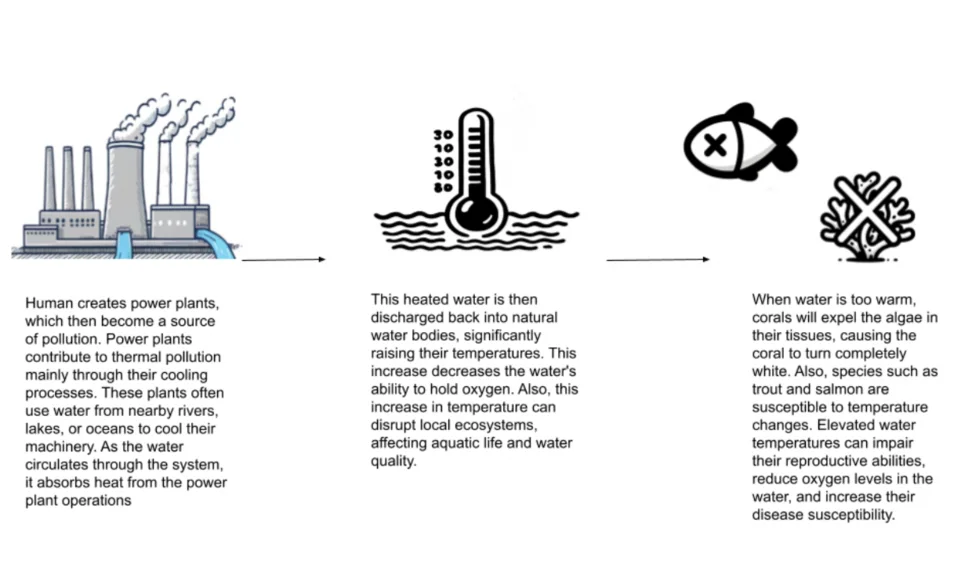
Diagram illustrating the causes and effects of thermal pollution.
Credit: Avidyasa · CC0 · sourceResized and converted to WebP; uncropped.
1. Meaning, sources and spatial characteristics
Thermal pollution occurs when a human activity changes the temperature of a river, lake, estuary or coastal water enough to impair ecological functioning or beneficial uses. Natural daily and seasonal temperature fluctuations are not pollution. The relevant questions are how far an altered temperature departs from the natural regime, how rapidly it changes, how long exposure lasts and which organisms are affected. Both excessive warming and artificial cooling may be harmful.
The best-known source is condenser cooling at steam-electric power stations. Steam drives a turbine and is then condensed using a cooling system. In a once-through arrangement, large quantities of water are withdrawn from a river, reservoir or sea, passed through a condenser and returned at a higher temperature. Coal, gas-fired steam cycles and nuclear stations can all reject heat this way; thermal pollution should therefore not be confused with fossil-fuel emissions alone.
Refineries, steel plants and other manufacturing facilities may also discharge heated water. Reservoir operations can produce cold-water pollution when deep outlets release water from below the thermocline. Removal of streamside vegetation increases solar heating, while runoff from hot roads and roofs can briefly warm urban streams. These diffuse sources matter particularly in small watercourses.
A heated discharge forms a thermal plume, whose extent depends on discharge volume, temperature difference, currents, wind, depth and mixing. Ecological exposure may extend beyond the outfall. Multiple installations along a low-flow river can create cumulative impacts even where each individual plume appears limited.
- Thermal shock means an abrupt temperature change, including sudden cooling after a plant shuts down.
- Temperature change, commonly expressed as ΔT, must be interpreted alongside absolute temperature and exposure duration.
- Waste-heat pollution is distinct from global warming, although a warming climate can intensify its effects.
2. Mechanisms and ecological consequences
Warm water generally holds less dissolved oxygen at equilibrium than cool water under comparable conditions. Meanwhile, respiration in fish, invertebrates and microorganisms often accelerates as temperature rises within their physiological range. This creates an oxygen squeeze: oxygen availability declines while biological demand increases. Severe exposure can cause stress, habitat abandonment or fish mortality, especially at night when photosynthesis stops but respiration continues.
Temperature governs enzyme activity, growth, spawning, egg development and migration. Organisms have different thermal tolerances; warming may replace sensitive species with heat-tolerant ones rather than killing every organism immediately. Eggs, larvae and immobile bottom-dwelling organisms can be particularly vulnerable. Rapid changes may be more damaging than gradual warming because acclimatisation takes time.
Heating can accelerate microbial decomposition of organic matter and aggravate oxygen depletion in waters already receiving sewage. It does not itself add nitrogen or phosphorus, so thermal pollution is not synonymous with eutrophication. Nevertheless, warm, nutrient-rich and slow-moving water may favour nuisance algae or cyanobacteria. Warming can also strengthen stratification under suitable conditions, limiting oxygen replenishment in deeper layers.
Cold releases below a reservoir may suppress growth, delay spawning and favour cold-water organisms over native warm-water species. Consequently, management should aim to preserve an appropriate seasonal temperature regime, not simply to make discharged water as cold as possible. Responses also vary with salinity, background pollution and species composition.
- Dissolved oxygen is oxygen present in water; biochemical oxygen demand measures oxygen used by biological decomposition under specified test conditions.
- Thermal discharge is not automatically radioactive discharge: heat and radioactive contamination are separate environmental concerns.
- Coral bleaching can result from sustained heat stress, but local heated outfalls should not be equated with the primary global driver of mass bleaching.
Typical pathway of heated-discharge stress
- 1. Power station or industry rejects waste heat
- 2. Heated effluent changes receiving-water temperature
- 3. Oxygen solubility falls while respiration often increases
- 4. Sensitive organisms experience physiological and reproductive stress
- 5. Community composition changes; severe conditions can cause mortality
3. Cooling systems, water use and prevention
Once-through cooling generally withdraws much more water than recirculating cooling. Its large intake can trap larger organisms against screens, called impingement, and draw eggs, larvae and plankton through the system, called entrainment. These are intake-related ecological impacts associated with cooling-water use, not thermal effects in themselves. Outfall design must therefore be considered together with intake location and operation.
Wet recirculating systems reuse cooling water after rejecting heat to the atmosphere through cooling towers. They reduce withdrawals and direct thermal loading of natural waters, but evaporation consumes water. Blowdown is needed to control the accumulation of dissolved salts and may require treatment because of concentrated minerals and treatment chemicals. Thus, lower withdrawal does not necessarily mean lower consumptive use.
Dry cooling transfers heat mainly to air and sharply reduces cooling-water demand, but it may involve higher costs and reduced power-generation efficiency during hot weather. Hybrid cooling combines wet and dry approaches. Cooling ponds, waste-heat recovery and cogeneration can also reduce the heat reaching natural waters, depending on land availability, climate and nearby demand for useful heat.
Prevention includes efficient plant design, suitable siting and restoration of riparian shade. Diffusers and well-designed outfalls promote mixing but redistribute heat rather than eliminate it. During hot, low-flow periods, reduced generation or temporary discharge restrictions may be necessary. Reservoir operators can use selective withdrawal from different depths to moderate downstream temperature.
- Assess withdrawal, consumption, thermal discharge and energy efficiency together.
- Protect ecological flows; dilution is not a substitute for preventing excessive heat loads.
- Consider cumulative impacts before approving clusters of water-intensive industries.
| System | Water characteristics | Main environmental trade-off |
|---|---|---|
| Once-through cooling | High withdrawal; relatively low consumption | Heated discharge and intake-related harm |
| Wet recirculating cooling | Lower withdrawal; evaporation requires make-up water | Reduced direct thermal loading but consumptive water use and blowdown |
| Dry cooling | Very low cooling-water requirement | Higher cost and possible efficiency loss in hot weather |
| Hybrid cooling | Variable water use depending on operating mode | Balances water savings, cost and hot-weather performance |
4. Indian regulation and monitoring
The Water (Prevention and Control of Pollution) Act, 1974 defines pollution broadly enough to cover alteration of the physical properties of water that causes, or is likely to cause, specified harmful effects. Thermal effluent therefore falls within the water-pollution framework even without a toxic chemical addition. State Pollution Control Boards and Pollution Control Committees administer relevant consent requirements and monitor compliance.
The Environment (Protection) Act, 1986 and Environment (Protection) Rules, 1986 provide the framework for effluent standards. The general effluent standard for temperature states that wastewater should not exceed the receiving-water temperature by more than 5°C. Power plants are also subject to sector-specific provisions: the cooling-water rules distinguish plant configurations and dates and include a 7°C limit for the inlet-to-outlet condenser cooling-water temperature rise of existing once-through systems. These figures concern different measurement points and must not be treated as interchangeable universal limits.
Environmental appraisal under the EIA Notification, 2006, where applicable, examines water requirements, cooling arrangements, aquatic ecology and discharge impacts. Environmental clearance and consent conditions may impose site-specific requirements. Coastal installations must also account for applicable Coastal Regulation Zone provisions. For any compliance problem, aspirants should distinguish a general standard from the specific rule and conditions governing that installation.
Monitoring should record intake, outfall and receiving-water temperatures, including upstream or unaffected reference locations. Sampling needs to capture depth, tidal stage, seasons and peak operating conditions. Dissolved oxygen, flow, salinity and biological indicators help connect a measured temperature change with ecological consequences. Continuous sensors and thermal-plume modelling complement, rather than replace, field observations.
- An outfall temperature alone cannot establish the full ecological impact.
- A valid comparison requires a representative ambient or reference temperature.
- Compliance assessment must use the applicable standard, location and operating conditions.
5. Climate interaction and examination approach
Heatwaves raise baseline water temperatures, while drought and reduced river flow weaken dilution and heat dispersion. A discharge that caused limited stress during the monsoon may become problematic in summer. Climate change therefore creates a power–water vulnerability: electricity demand for cooling can rise just when power stations face restricted cooling-water availability and tighter thermal constraints.
For Prelims, avoid absolute claims. Not all warm water is polluted, not all thermal pollution is warming, and cooling towers do not eliminate every environmental impact. In an analytical answer, connect the source of waste heat to temperature change, oxygen balance, species-specific effects and appropriate control measures. The strongest management approach combines cleaner design, basin-scale planning, ecological monitoring and enforceable seasonal operating limits.
- Physical pollutant: waste heat.
- Key mechanism: lower oxygen solubility combined with greater biological oxygen demand.
- Key trade-off: once-through withdrawal versus recirculating-system evaporation.
- Key management scale: the receiving ecosystem, not merely the discharge pipe.
Thermal pollution: temperature changes and aquatic stress
Thermal pollution alters a water body’s temperature regime, often when power stations or industries discharge water used for cooling. The supplied metadata identifies this image as a cause-and-effect diagram; it is therefore relevant as a conceptual illustration, not evidence of conditions at a particular site. Warming generally reduces oxygen solubility while increasing the metabolic oxygen demand of many aquatic organisms. This combination can create oxygen stress, especially where organic pollution already raises microbial oxygen consumption.
In India, assessment of cooling-water discharges must consider receiving-water flow, seasonal temperatures, discharge volume and the sensitivity of local aquatic habitats. Low-flow conditions can reduce dilution and heat dispersal, intensifying local impacts. Temperature shifts may disrupt breeding, migration and species composition even without directly killing fish. Sudden temperature changes can produce thermal shock; unusually cold reservoir releases can also disturb downstream ecosystems. Cooling towers, cooling ponds and recirculating systems can reduce direct heat discharge, but involve trade-offs such as evaporation losses, energy requirements and concentrated wastewater. A generic diagram cannot establish regulatory compliance or ecological damage: these require site-specific temperature monitoring, appropriate baseline comparisons and biological evidence.
- Separate heat from toxicity: cooling-water discharge can cause thermal stress without chemical contamination, although both pressures may coexist.
- Distinguish oxygen solubility from measured dissolved oxygen; photosynthesis, respiration, mixing and organic loading also influence field measurements.
- For Mains, connect mitigation to cumulative impacts and seasonal river flows; for Prelims, remember that thermal pollution includes harmful cooling as well as warming.
Real-world case studies
Kalpakkam, Tamil Nadu: coastal cooling-water assessment
The Madras Atomic Power Station at Kalpakkam uses seawater for condenser cooling. Studies around its discharge have examined temperature distribution and aquatic responses. It illustrates why assessment of a coastal thermal plume must account for currents, tides and seasonal conditions. Heat-related effects must be evaluated separately from radiological monitoring.
France: heat and drought constraints on nuclear generation
During European heatwaves, including 2022, high river temperatures and low flows constrained cooling and discharge conditions at some French nuclear stations. French authorities also permitted temporary changes to certain thermal-discharge limits under specified conditions. The episode demonstrates the connection between electricity security, river ecology and climate adaptation.
Previous year questions
No source-linked PYQ is available here yet. Use the practice questions below.
Practice questions
Practice MCQ 1
With reference to thermal pollution, consider the following statements: 1. Heating generally decreases the equilibrium solubility of oxygen in water. 2. Releases of unusually cold water from reservoirs can disturb downstream ecosystems. 3. Thermal pollution necessarily involves the addition of toxic chemicals. Which of the statements given above are correct?
- A. 1 and 2 only
- B. 2 and 3 only
- C. 1 and 3 only
- D. 1, 2 and 3
Practice MCQ 2
Replacing once-through cooling with wet recirculating cooling at a power station would generally have which consequence?
- A. Higher water withdrawal and complete elimination of evaporation
- B. Lower water withdrawal but potentially higher consumptive water use
- C. Elimination of blowdown and all intake-related impacts
- D. Conversion of waste heat directly into dissolved oxygen
Practice MCQ 3
Which condition is most likely to intensify ecological stress from a heated industrial discharge into a river?
- A. High flow and cool ambient water
- B. Low flow, high ambient temperature and substantial organic pollution
- C. Reduced discharge temperature and restored riparian shade
- D. Lower organic loading and improved ecological flows
Mains practice · Thermal pollution illustrates the interdependence of energy security, water management and biodiversity conservation. Discuss its ecological effects and suggest an integrated management strategy. (150 words)
- Define harmful alteration of natural water temperature, including cold reservoir releases.
- Explain oxygen stress, thermal shock and disruption of reproduction and species composition.
- Compare once-through, wet recirculating and dry cooling trade-offs.
- Recommend heat recovery, ecological flows, selective reservoir withdrawal and riparian restoration.
- Emphasise cumulative assessment, temperature and dissolved-oxygen monitoring, and enforceable discharge conditions.
- Conclude with heatwave- and drought-responsive operational planning.
Further reading
- NCERT, Fundamentals of Physical Geography, Class XI: Water (Oceans).
- India Code: Water (Prevention and Control of Pollution) Act, 1974.
- CPCB: General Standards for Discharge of Environmental Pollutants and thermal power plant cooling-water standards.
- MoEFCC: Environment (Protection) Rules, 1986, as amended, and EIA Notification, 2006.
- US Environmental Protection Agency: Cooling Water Intakes and Clean Water Act Section 316 resources.
- https://commons.wikimedia.org/wiki/File:Thermal_Pollution_Diagram.png
Preparing for UPSC Civil Services? Get classroom teaching, answer-writing evaluation and mentorship at Pragnya IAS Academy, Ashok Nagar — see why aspirants choose us for IAS coaching in Hyderabad.