
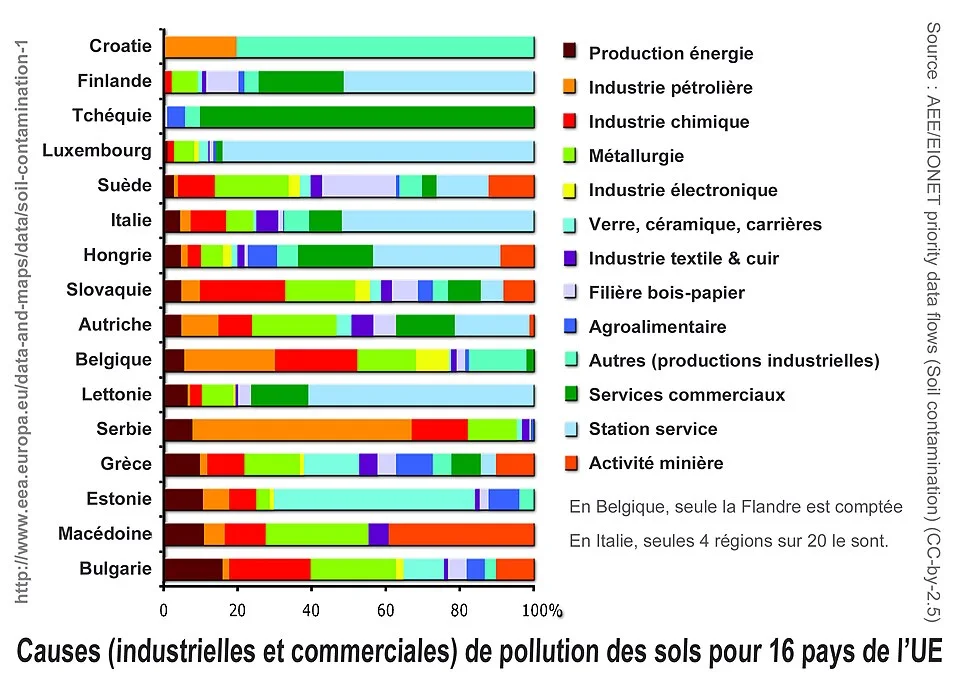
European comparative chart of activities associated with contaminated soil sites, grouped by share of sites.
Credit: Lamiot · CC BY-SA 3.0 · sourceResized and converted to WebP; uncropped.
1. Meaning, significance and major pollutants
Soil is a living system consisting of minerals, organic matter, water, air and organisms. It supports plant growth, decomposes organic residues, stores carbon and regulates water movement. Soil pollution arises when chemical substances, biological agents or waste materials compromise these functions or create unacceptable exposure risks. Because pollutants may remain below the surface and persist for decades, contamination can escape detection until groundwater, crops or nearby populations are affected.
Important inorganic pollutants include lead, cadmium, mercury, arsenic, chromium and excess salts. Arsenic is a metalloid, although it is commonly discussed alongside heavy metals. Organic pollutants include petroleum hydrocarbons, solvents, pesticides, polychlorinated biphenyls and certain pharmaceuticals. Plastics, microplastics and disease-causing organisms can also contaminate soil. The presence of a substance alone does not establish risk: its chemical form, concentration, accessibility and exposure pathway matter.
- Persistent organic pollutants resist degradation and may undergo long-range transport, bioaccumulate and cause serious adverse effects.
- Some potentially toxic elements occur naturally in parent rock; mining, irrigation and industrial activities can redistribute or concentrate them.
- Excess nutrients become pollutants when they exceed crop requirements and soil-retention capacity, even though nitrogen and phosphorus are essential for plant growth.
2. Sources and pathways of contamination
Agriculture can introduce contaminants through excessive or inappropriate pesticide application, fertiliser impurities, polluted irrigation water and inadequately treated manure or sewage sludge. Cadmium may occur as an impurity in phosphate fertilisers. Repeated irrigation with arsenic-bearing groundwater can add arsenic to agricultural soils. However, fertiliser use is not inherently pollution: balanced application based on crop demand and soil conditions supports production while limiting environmental losses.
Industrial sources include metal smelting, electroplating, tanning, chemical manufacture and petroleum processing. Mining and poorly managed tailings expose mineral wastes to weathering. Oxidation of sulphide minerals can generate acid mine drainage, which promotes metal mobilisation. Informal recycling of lead-acid batteries and electronic waste can deposit lead and other hazardous substances through breaking, burning and acid treatment.
Municipal dumps, leaking landfills, discarded batteries, construction debris and untreated wastewater create additional pathways. Leachate is the liquid formed when water passes through waste and dissolves or carries contaminants. Pollutants also reach soil through atmospheric deposition from industry and combustion, while spills and leaking underground storage tanks create concentrated hotspots. Soil pollution may therefore be local and intense or diffuse across large agricultural and urban areas.
- Point sources include a leaking chemical tank, waste lagoon or industrial outfall.
- Diffuse sources include widespread pesticide use, atmospheric deposition and contaminated flood sediments.
- Open burning does not eliminate waste-related pollution; it can redistribute metals in ash and generate toxic organic compounds.
Risk-based management of a contaminated site
- 1. Identify historical activities and stop continuing pollutant releases.
- 2. Develop a source–pathway–receptor model.
- 3. Sample soil, water and relevant exposure media.
- 4. Assess risks and set land-use-specific remediation objectives.
- 5. Implement suitable treatment, removal or containment.
- 6. Verify performance and maintain monitoring and land-use controls where needed.
3. Pollutant behaviour and environmental effects
Soil can retain pollutants through adsorption onto clay and organic matter, but retention is not destruction. Changes in acidity, drainage or redox conditions may release previously bound contaminants. Lower pH generally increases the mobility of many positively charged metals, although this is not a universal rule. Arsenic behaves differently from many metal cations; under reducing conditions, dissolution of iron oxides can release associated arsenic.
Leaching transfers dissolved contaminants down the soil profile and potentially into groundwater. Runoff and erosion carry dissolved pollutants or contaminated particles into streams and reservoirs. Volatile compounds can enter soil gas and, in some settings, migrate into buildings. Microbial degradation may break down organic pollutants, but its effectiveness depends on oxygen, temperature, moisture, nutrients and pollutant characteristics; transformation products are not always harmless.
Ecological effects include disruption of soil microbial communities, reduced enzyme activity, injury to earthworms and impaired nutrient cycling. Human exposure occurs through contaminated food or water, inhalation of dust and accidental soil ingestion, especially among children. Lead can damage neurological development, cadmium can harm kidneys, and chronic inorganic arsenic exposure increases several health risks, including cancer. Pollutants can also reduce crop yield and marketability, creating livelihood losses.
- Bioavailability is the fraction accessible for uptake by organisms; it is not identical to total soil concentration.
- Nitrate is generally mobile in soil water, whereas phosphorus is often retained by soil minerals but can move with eroded particles.
- Bioaccumulation in plants or animals does not automatically establish biomagnification along an entire food chain.
| Pollutant | Typical source | Important characteristic | Major concern |
|---|---|---|---|
| Lead | Battery recycling, smelting and legacy paint | Often retained near the surface; contaminated dust remains important | Neurological harm, particularly in children |
| Cadmium | Smelting, industrial waste and some phosphate fertilisers | Availability often increases in acidic soils | Crop uptake and kidney damage |
| Arsenic | Geological sources, mining and contaminated irrigation water | Mobility depends strongly on redox conditions and mineral associations | Chronic toxicity and carcinogenicity |
| Petroleum hydrocarbons | Oil spills and leaking storage tanks | Persistence and biodegradability vary among compounds | Soil toxicity and groundwater or vapour exposure |
| Persistent organochlorine pesticides | Legacy agricultural use and obsolete pesticide stocks | Many persist and bind to organic matter | Long-term ecological and food-chain exposure |
| Excess nitrate | Overfertilisation, manure and sewage | Highly mobile under many soil conditions | Groundwater contamination and downstream nutrient enrichment |
4. Assessment, prevention and remediation
Assessment begins with the history of land use, likely contaminants and potential receptors such as residents, workers, crops and aquifers. Representative sampling must account for depth, spatial variation and background concentrations. Laboratories measure relevant contaminants alongside properties such as pH and organic carbon. Risk assessment then links the source, exposure pathway and receptor: the same contamination level can imply different risks on a residential playground and a controlled industrial site.
Prevention is usually cheaper and more reliable than cleanup. Measures include cleaner production, secure chemical storage, effluent treatment, waste segregation, engineered disposal and environmentally sound recycling. In agriculture, integrated pest management, balanced fertilisation, safe irrigation water and quality control of organic amendments reduce pollutant loading. Wastewater or compost should not be assumed safe simply because it contains useful nutrients or organic matter.
Remediation is selected according to pollutant properties, depth, land use, cost and time. Excavation removes contaminated soil but requires safe treatment or disposal elsewhere. Capping limits contact and infiltration without destroying pollutants. Soil washing separates or extracts contaminants, while stabilisation and solidification reduce their mobility. Bioremediation uses organisms to transform suitable organic contaminants. Phytoremediation uses plants for extraction, stabilisation or degradation, but is often slow and limited by rooting depth.
- Metal-rich plant biomass from phytoextraction requires controlled handling; it must not enter food or fodder chains.
- Microorganisms can alter metal speciation or mobility but cannot destroy elemental metals.
- Long-term monitoring is necessary when contaminants remain on site or groundwater recovery is slow.
5. Indian regulatory framework and examination linkages
India addresses soil pollution through several environmental and waste-management instruments rather than one comprehensive soil-pollution statute. The Environment (Protection) Act, 1986 provides the umbrella framework. The Water (Prevention and Control of Pollution) Act, 1974 regulates polluting discharges, while the Air (Prevention and Control of Pollution) Act, 1981 addresses emissions that may subsequently deposit on land. CPCB and State Pollution Control Boards or Pollution Control Committees have central roles in implementation.
Relevant instruments include the Hazardous and Other Wastes (Management and Transboundary Movement) Rules, 2016, and rules governing municipal solid waste, biomedical waste and plastic waste. The E-Waste (Management) Rules, 2022 and Battery Waste Management Rules, 2022 strengthen producer responsibility for specified waste streams. Effective collection and authorised recycling are crucial: extended producer responsibility does not justify unsafe recycling or dumping. Pesticide regulation has historically rested on the Insecticides Act, 1968 and associated rules.
The Soil Health Card scheme, launched in 2015, supports nutrient management through assessment of 12 soil parameters. It is not a comprehensive screening programme for pesticides, heavy metals or all industrial contaminants. Internationally, the Stockholm Convention addresses persistent organic pollutants, the Basel Convention addresses transboundary movements and disposal of hazardous wastes, and the Minamata Convention addresses mercury. For Prelims, distinguish these treaty mandates and avoid treating all waste, fertility and contamination programmes as interchangeable.
- The polluter-pays principle links environmental damage with responsibility for prevention and restoration.
- A soil’s suitability for crop growth does not by itself establish food safety.
- Soil organic carbon and nutrient testing cannot substitute for contaminant-specific laboratory analysis.
Soil Contamination: Sources, Site Counts and Risk
The supplied metadata describes a European chart classifying contaminated soil sites by industrial and commercial activity. It directly illustrates how soil pollution can be linked to particular land uses. Such inventories help identify where investigation may be needed, but a sector’s share of recorded sites is not its share of total pollutant mass, contaminated land area or health damage. The metadata does not establish the chart’s numerical values, survey period or inventory coverage; these should not be inferred.
For India, the chart is a comparative example, not evidence of the national distribution of contaminated sites. Relevant sources include industrial discharges, mining and smelting residues, petroleum leaks, poorly managed waste and excessive or inappropriate agrochemical use. Risk depends on the contaminant, its concentration and mobility, soil properties, and exposure pathways. Pollutants may enter crops, leach towards groundwater or reach people through soil ingestion and contaminated dust. Assessment therefore requires site-specific sampling and identification of exposed populations before selecting remediation.
- Distinguish source from pollutant: an industrial activity is a source category; lead, cadmium and petroleum hydrocarbons are contaminants with different behaviour and toxicity.
- Soil pH, organic matter and clay influence pollutant retention and bioavailability. Metals do not biodegrade; immobilisation can reduce exposure without removing them.
- In India, pollution-control boards and waste-management rules are relevant to prevention and oversight. Remediation must match the contaminant and site; bioremediation is not universally effective.
Real-world case studies
Kasaragod, Kerala: endosulfan exposure
Repeated aerial spraying of endosulfan on cashew plantations in Kasaragod generated major environmental and public-health concerns. The episode illustrates how pesticide application can expose surrounding settlements and contaminate multiple environmental media, rather than remaining confined to target crops. In 2011, the Supreme Court ordered an interim nationwide ban on endosulfan’s production, sale and use. Endosulfan was also listed for elimination under the Stockholm Convention in 2011, with specified exemptions. The case highlights precaution, pesticide governance and long-term support for affected communities.
Love Canal, United States: hazardous-waste legacy
At Love Canal in Niagara Falls, New York, residential development occurred around a former chemical-waste disposal site. Chemical migration into surrounding soil and buildings triggered a major crisis and emergency action in 1978. The episode helped catalyse the Comprehensive Environmental Response, Compensation, and Liability Act, 1980, commonly associated with the Superfund programme. It demonstrates the importance of historical land-use records, restrictions on redevelopment and assigning responsibility for legacy contamination.
Previous year questions
No source-linked PYQ is available here yet. Use the practice questions below.
Practice questions
Practice MCQ 1
With reference to pollutants in soil, consider the following statements: 1. Adsorption onto clay necessarily destroys a pollutant. 2. Changes in redox conditions can release arsenic associated with iron oxides. 3. Total metal concentration and the bioavailable metal fraction are always identical. Which of the statements given above is/are correct?
- A. 1 and 2 only
- B. 2 only
- C. 2 and 3 only
- D. 1, 2 and 3
Practice MCQ 2
Which one of the following correctly describes a soil-remediation technique?
- A. Bioremediation destroys cadmium atoms through microbial metabolism.
- B. Capping necessarily eliminates all contaminants from soil.
- C. Phytoextraction uses plants to take up contaminants that may subsequently be removed through harvesting.
- D. Stabilisation always converts contaminated soil into unrestricted agricultural land.
Practice MCQ 3
Consider the following pairs: 1. Stockholm Convention — Persistent organic pollutants 2. Minamata Convention — Mercury 3. Soil Health Card scheme — Comprehensive screening for all industrial soil contaminants. How many of the pairs given above are correctly matched?
- A. Only one
- B. Only two
- C. All three
- D. None
Mains practice · Soil pollution is a food-safety and public-health challenge as much as an environmental problem. Discuss its major pathways in India and suggest a risk-based strategy for prevention and remediation. Answer in 250 words.
- Define soil pollution and distinguish it from general soil degradation.
- Cover industrial waste, informal recycling, pesticides, contaminated irrigation and municipal dumps.
- Explain exposure through crops, groundwater, dust and direct ingestion.
- Use source–pathway–receptor assessment and land-use-specific cleanup objectives.
- Prioritise prevention, authorised recycling, integrated pest management and safe wastewater use.
- Compare biological treatment of suitable organic pollutants with removal or immobilisation of metals.
- Recommend contaminant-specific testing, transparent inventories, polluter accountability and long-term monitoring.
Further reading
- FAO and UNEP: Global Assessment of Soil Pollution, 2021.
- NCERT: Fundamentals of Physical Geography, Class XI, Soils chapter.
- CPCB official website: contaminated-site assessment, hazardous-waste management and remediation guidance.
- Ministry of Environment, Forest and Climate Change: environmental legislation and waste-management notifications.
- Department of Agriculture and Farmers Welfare: Soil Health Card portal and scheme guidance.
- Official Stockholm, Basel and Minamata Convention websites.
- https://commons.wikimedia.org/wiki/File:Pollution_sols_UE_causes.jpg
Preparing for UPSC Civil Services? Get classroom teaching, answer-writing evaluation and mentorship at Pragnya IAS Academy, Ashok Nagar — see why aspirants choose us for IAS coaching in Hyderabad.