

Ktoya, Signature Bridge under construction over Yamuna River, Delhi 71
Credit: Ktoya · CC BY-SA 3.0 · source
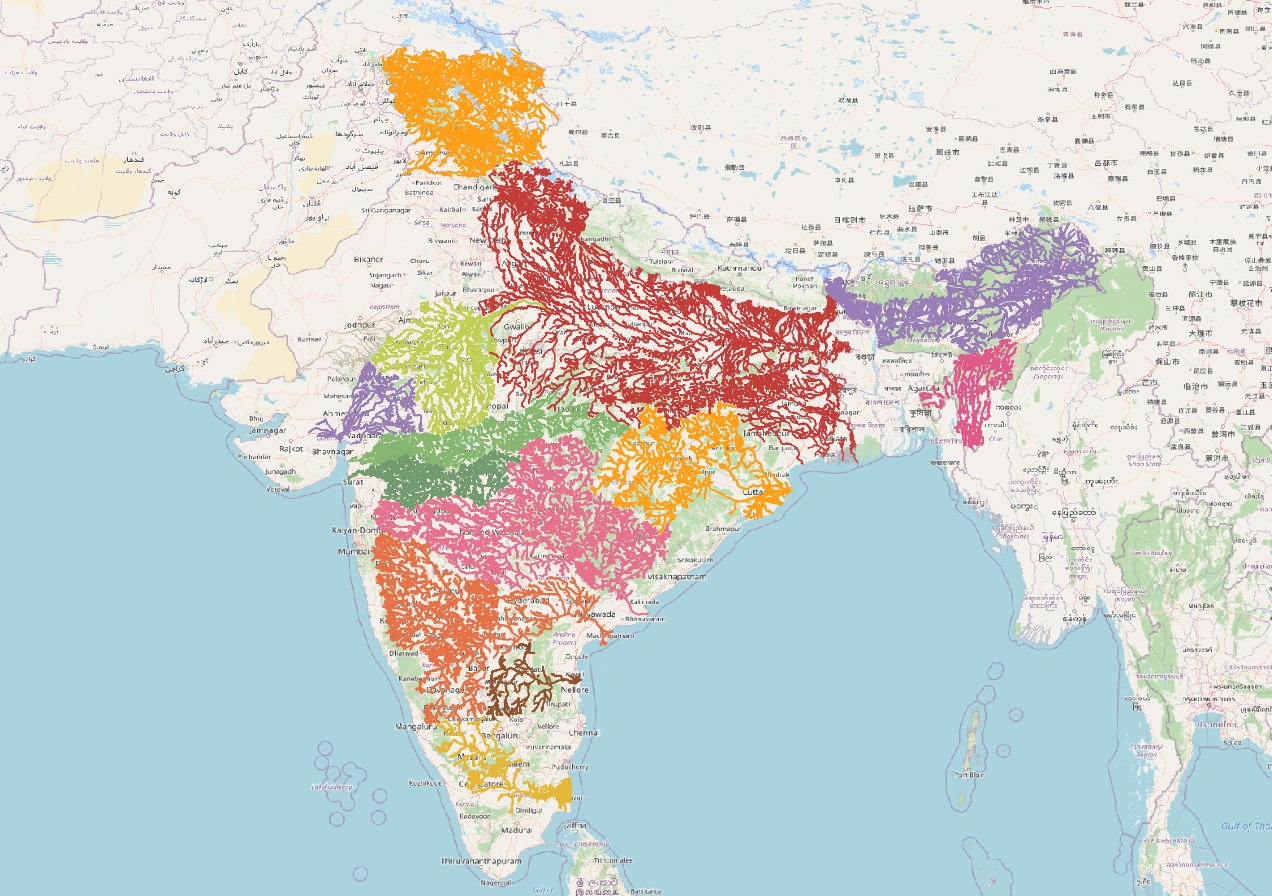
Map study
India river basins: distinguish watershed divides from state boundaries; compare east-flowing and west-flowing drainage.
- Read the source legend, scale and reference period before comparing regions.
- Connect spatial patterns to the processes discussed in this topic; this map is a study reference, not live operational data.
Credit: Heinz OSM · ODbL · sourceConverted to WebP on an opaque white background; proportionally resized without cropping. Original cartography and legend retained.
1. Nature, sources and pathways of water pollution
Water pollution affects rivers, lakes, wetlands, groundwater, estuaries and oceans. Water quality must be assessed against its intended use: water suitable for irrigation may be unsuitable for drinking. Pollution occurs when contaminants or energy enter water at rates exceeding its capacity for dilution, transformation or safe assimilation. Dilution alone does not eliminate pollutants, and persistent substances can accumulate in sediments or enter food chains.
Point sources discharge through identifiable outlets, such as industrial outfalls and sewage pipes. Non-point sources are diffuse: fertiliser and pesticide runoff from fields, sediment from eroding catchments and pollutants washed off urban surfaces. Rainfall can mobilise these contaminants, while low river flows can increase concentrations by reducing dilution. Groundwater receives pollutants through leaching from soils, landfills, septic systems and contaminated recharge.
Major Indian pressures include untreated or inadequately treated sewage, industrial effluents, agricultural runoff and solid-waste dumping. CPCB’s 2021 national inventory estimated urban sewage generation at about 72,368 million litres per day, against installed treatment capacity of about 31,841 million litres per day. Installed capacity is not equivalent to actual treatment: sewer connectivity, plant operation and compliance determine environmental outcomes.
- Physical pollutants: suspended solids, sediment, plastics and excess heat.
- Chemical pollutants: nutrients, salts, acids, pesticides, petroleum hydrocarbons and toxic metals.
- Biological pollutants: disease-causing bacteria, viruses, protozoa and parasitic organisms.
2. Water-quality indicators and ecological effects
Dissolved oxygen, or DO, is oxygen available in water for aquatic respiration. Its concentration depends on temperature, aeration, photosynthesis and biological consumption; warm water generally holds less oxygen than cold water. Biochemical oxygen demand, or BOD, measures oxygen consumed by microorganisms while decomposing biodegradable organic matter under specified test conditions. A widely used test is five-day BOD at 20°C; Indian regulatory testing also uses three-day BOD at 27°C.
Chemical oxygen demand, or COD, measures the oxygen equivalent required to chemically oxidise susceptible substances. It captures many substances not readily biodegraded and is usually higher than BOD for the same sample. Neither test identifies individual toxic chemicals. Faecal coliforms and Escherichia coli indicate faecal contamination, while turbidity measures cloudiness caused by suspended material. Electrical conductivity and total dissolved solids indicate dissolved ionic content rather than pathogen abundance.
Eutrophication is nutrient enrichment that promotes excessive algal or aquatic-plant growth. When biomass dies, microbial decomposition increases oxygen demand, potentially producing hypoxia, fish mortality and altered species composition. Some cyanobacteria also produce toxins. Phosphorus often limits productivity in freshwater, whereas nitrogen frequently limits coastal systems, but this is not universal. Thermal discharges can intensify oxygen stress and alter aquatic communities.
Bioaccumulation is the build-up of a substance within an organism over time. Biomagnification is an increase in its concentration across successive trophic levels. Persistent substances such as methylmercury and certain organochlorine pesticides may biomagnify; nutrients and all metals should not automatically be placed in this category.
- CPCB’s designated Class A use is drinking-water supply without conventional treatment but after disinfection: criteria include DO of at least 6 mg/L and BOD of at most 2 mg/L.
- Class B denotes organised outdoor bathing: criteria include DO of at least 5 mg/L and BOD of at most 3 mg/L. These are not complete drinking-water safety criteria.
Nutrient pollution to oxygen depletion
- 1. Nitrogen and phosphorus enter a waterbody
- 2. Algae or aquatic plants proliferate
- 3. Excess biomass dies and settles
- 4. Microbial decomposition increases oxygen demand
- 5. Dissolved oxygen declines
- 6. Hypoxia causes fish deaths and ecological change
3. Public health, groundwater and emerging contaminants
Faecally contaminated water can transmit cholera, typhoid, hepatitis A and E, and diarrhoeal diseases. Chemical contamination produces different risks: excessive nitrate can cause methaemoglobinaemia, particularly in infants; prolonged arsenic exposure can cause skin lesions and cancers; excessive fluoride can cause dental and skeletal fluorosis. Arsenic contamination occurs in parts of the Ganga–Brahmaputra alluvial plains, while fluoride problems occur in several hard-rock aquifer regions.
Not all contamination is anthropogenic. Arsenic and fluoride may be released naturally from aquifer materials under particular geochemical conditions. Groundwater contamination is difficult to reverse because aquifers often flush slowly and pollutants are hidden from direct observation. Prevention requires wellhead protection, safe sanitation, controlled disposal and monitoring based on local hydrogeology, rather than assuming deeper groundwater is always safe.
Emerging concerns include pharmaceutical residues, antibiotic-resistant microorganisms, microplastics and per- and polyfluoroalkyl substances, or PFAS. Conventional sewage treatment does not reliably remove every such contaminant. Boiling and routine chlorination are not universal purification methods: boiling addresses many microbial hazards but cannot remove dissolved salts or metals, while treatment for chemical contamination must be selected for the specific substance.
| Parameter | What it indicates | Prelims caution |
|---|---|---|
| DO | Oxygen dissolved in water | Generally falls with warming; not a direct measure of drinking-water safety |
| BOD | Oxygen demand from biological degradation | High BOD commonly accompanies organic pollution |
| COD | Oxygen equivalent of chemical oxidation | Usually exceeds BOD; does not identify specific pollutants |
| Faecal coliforms | Possible faecal contamination | Indicator organisms, not a measurement of all pathogens |
| TDS | Dissolved inorganic salts and other dissolved substances | Low TDS does not guarantee absence of pathogens or toxic chemicals |
4. Prevention and wastewater treatment
Pollution control should begin at source through cleaner production, less hazardous inputs, efficient fertiliser application and segregation of industrial and domestic wastewater. Riparian vegetation, erosion control and properly designed wetlands can intercept sediment and nutrients, but cannot substitute for treatment of large untreated discharges. Maintaining environmental flows supports river ecology without excusing pollution.
Preliminary treatment removes screenings and grit. Primary treatment settles suspended solids. Secondary treatment uses microorganisms, through systems such as activated sludge or anaerobic reactors, to reduce biodegradable organic pollution. Tertiary or advanced treatment targets residual solids, nutrients or particular contaminants through filtration, biological nutrient removal, adsorption or membrane processes. Disinfection reduces pathogens.
Treatment must include sludge management, reliable electricity, trained operators and monitoring. Industrial effluents may require source-specific treatment or common effluent treatment plants. Zero liquid discharge recovers water while concentrating pollutants into residual solids or brine; it does not mean zero waste. Treated wastewater reuse should follow fit-for-purpose standards and prevent unsafe exposure or soil salinisation.
5. Indian laws, institutions and programmes
The Water (Prevention and Control of Pollution) Act, 1974 provides the principal statutory framework for preventing and controlling water pollution. CPCB coordinates national activities and provides technical guidance; State Pollution Control Boards and Pollution Control Committees undertake consent administration, monitoring and enforcement within their jurisdictions. The Environment (Protection) Act, 1986 provides additional powers for prescribing standards and regulating discharges.
The Water Amendment Act, 2024 replaced criminal penalties for several contraventions with monetary penalties and introduced provisions concerning consent exemptions and guidelines. Because the legislation operates through the Article 252 framework, the amendment initially applied to Himachal Pradesh, Rajasthan and Union territories; other states may adopt it. It should not be assumed that every amendment automatically applies uniformly across all states.
Namami Gange combines sewage infrastructure, industrial pollution control, river-surface cleaning, ecological conservation and public participation. AMRUT 2.0 supports urban water security, including sewerage and septage management within its programme scope. Jal Jeevan Mission includes drinking-water quality monitoring and surveillance in rural areas. Effective governance requires catchment-based planning, transparent data and verified treatment performance, not merely construction of treatment plants.
Real-world case studies
Minamata disease, Japan
Officially recognised in 1956, Minamata disease resulted from methylmercury contamination associated with industrial wastewater. Consumption of contaminated fish and shellfish caused severe neurological harm. The case illustrates food-chain exposure and biomagnification; the Minamata Convention on Mercury was adopted in 2013.
The Yamuna in Delhi
Sewage-bearing drains, industrial discharges and inadequate freshwater flows create severe pollution in the Delhi stretch. The case demonstrates that treatment capacity alone is insufficient: interception of drains, sewer connections, reliable operations and flow management must work together.
Previous year questions
No source-linked PYQ is available here yet. Use the practice questions below.
Practice questions
Practice MCQ 1
Consider the following statements: 1. High BOD commonly indicates substantial biodegradable organic pollution. 2. COD is generally lower than BOD for the same wastewater sample. 3. Warm water generally holds less dissolved oxygen than cold water. Which statements are correct?
- A. 1 and 2 only
- B. 1 and 3 only
- C. 2 and 3 only
- D. 1, 2 and 3
Practice MCQ 2
Which pair is incorrectly matched?
- A. Excess fluoride — Skeletal fluorosis
- B. Excess nitrate — Infant methaemoglobinaemia
- C. Methylmercury — Minamata disease
- D. Faecal coliforms — Indicator of dissolved salinity
Practice MCQ 3
Consider the following statements: 1. Primary wastewater treatment mainly removes settleable suspended solids. 2. Secondary treatment commonly uses microorganisms. 3. Zero liquid discharge eliminates all solid residuals. Which statements are correct?
- A. 1 only
- B. 2 and 3 only
- C. 1 and 2 only
- D. 1, 2 and 3
Mains practice · River rejuvenation requires more than sewage treatment infrastructure. Discuss with reference to water-pollution management in India. Answer in 250 words.
- Distinguish treatment capacity from actual collection, operation and compliance.
- Address industrial effluents, agricultural runoff and solid-waste dumping.
- Explain environmental flows, floodplain protection and catchment management.
- Include sludge management, safe reuse and decentralised sanitation.
- Recommend basin-level coordination, transparent monitoring and polluter accountability.
Further reading
- NCERT, Chemistry, Class XI: Environmental Chemistry, older editions.
- CPCB: Designated Best Use Water Quality Criteria and National Water Quality Monitoring Programme.
- CPCB: National Inventory of Sewage Treatment Plants, 2021.
- India Code: Water (Prevention and Control of Pollution) Act, 1974 and Amendment Act, 2024.
- National Mission for Clean Ganga: official programme documents.
- WHO: Guidelines for Drinking-water Quality.
Preparing for UPSC Civil Services? Get classroom teaching, answer-writing evaluation and mentorship at Pragnya IAS Academy, Ashok Nagar — see why aspirants choose us for IAS coaching in Hyderabad.