
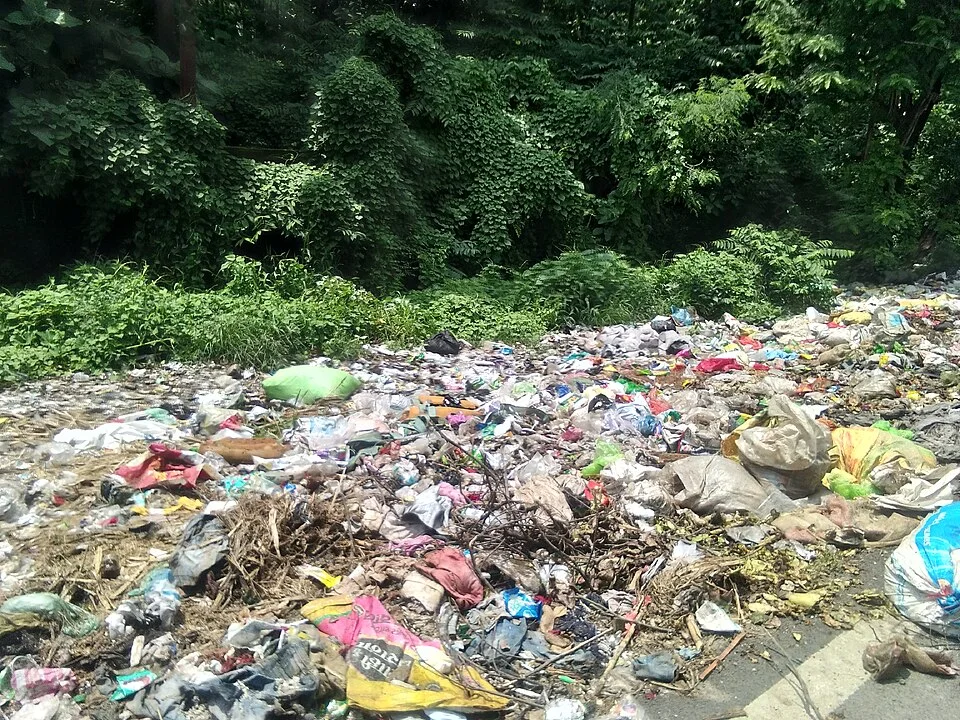
Municipal solid waste dumped beside a forested area, according to the supplied metadata.
Credit: Earthinators · CC BY-SA 4.0 · sourceResized and converted to WebP; uncropped.
1. Meaning, sources and composition
Solid waste comprises discarded materials from households, shops, offices, institutions, markets, street sweeping and other activities. Municipal solid waste commonly contains food residues, garden waste, paper, plastics, textiles, glass, metals and inert material such as dust. Its composition varies with income, consumption, season and collection practices. Indian municipal waste frequently contains substantial biodegradable material and moisture, making segregation particularly important for choosing treatment technologies.
Not every solid discard belongs in the municipal waste stream. Biomedical waste, hazardous industrial waste, electronic waste, batteries and construction and demolition waste require specialised handling under their respective regulatory frameworks. Mixing them with ordinary municipal waste exposes workers to infection, toxic substances and injury, while contaminating compost and recyclable materials.
Biodegradable waste can be decomposed biologically; dry recyclables can be recovered as materials; inert waste undergoes little significant physical, chemical or biological transformation. These categories are not interchangeable. A plastic wrapper may be combustible but difficult to recycle, while glass is recyclable but non-combustible. Thus, neither all dry waste nor all non-biodegradable waste is suitable for incineration.
2. Environmental and public-health impacts
Open dumping transfers the costs of consumption to soil, water, air and nearby communities. Rainwater percolating through mixed waste forms leachate, which may contain organic pollutants, ammoniacal nitrogen, dissolved salts, pathogens and metals. Without liners, collection systems and treatment, this liquid can contaminate groundwater and surface water. Waste entering drains also obstructs stormwater flow and aggravates urban flooding.
Organic waste decomposing under oxygen-deficient conditions generates landfill gas, principally methane and carbon dioxide. Methane contributes to climate change and can create fire and explosion hazards. Open burning releases particulate matter, carbon monoxide and toxic compounds; uncontrolled burning of chlorine-containing materials can contribute to dioxin and furan formation. Large dumpsite fires are difficult to extinguish because combustion may continue below the surface.
Uncollected waste attracts flies, rodents and stray animals. Sharp objects, discarded chemicals and improperly wrapped sanitary waste threaten sanitation workers and waste pickers. Lightweight plastics disperse into rivers and seas, causing ingestion and entanglement hazards for wildlife and eventually fragmenting into microplastics. Environmental justice is therefore integral to waste management: communities near dumps and informal workers often bear disproportionate risks.
Integrated municipal waste-management chain
- 1. Prevent waste and promote reuse
- 2. Segregate waste at source
- 3. Collect and transport streams separately
- 4. Recover recyclables at sorting facilities
- 5. Treat organics and suitable combustible fractions
- 6. Dispose of permitted residuals scientifically and monitor
3. Waste hierarchy and the collection chain
The preferred hierarchy is prevention, reduction, reuse, recycling, recovery and, finally, disposal. Preventing food waste or using refillable packaging avoids impacts that arise before disposal, including resource extraction and manufacturing. Recycling alone cannot solve continually increasing waste generation, particularly where products are multilayered, contaminated or designed for short use.
Source segregation preserves material quality and allows separate treatment of different streams. Under the 2016 framework, generators segregate biodegradable, non-biodegradable and domestic hazardous waste and hand it to authorised collectors. Used sanitary waste must be securely wrapped as prescribed and placed in the dry or non-biodegradable stream. Domestic hazardous items include products such as discarded paint containers, pesticides and certain household chemicals; these need separate collection and safe routing.
Door-to-door collection must be followed by segregated transport: mixing separated waste in a collection vehicle defeats household efforts. Material recovery facilities sort dry waste for recycling and other authorised destinations; they are not synonymous with composting plants. Reliable weighing, route planning, user charges, complaint systems and public reporting improve accountability. Waste pickers should be integrated through recognised organisations, safer working conditions and access to recyclable materials.
| Waste stream | Preferred route | Important caution |
|---|---|---|
| Segregated food and garden waste | Composting or biomethanation | Exclude hazardous contaminants |
| Clean paper, metals and glass | Sorting and recycling | Keep separate from wet waste |
| Suitable non-recyclable combustible fractions | Authorised energy recovery or co-processing | Control emissions and manage residues |
| Domestic hazardous waste | Separate collection and authorised treatment | Do not mix with compost feedstock |
| Permitted inert residues and processing rejects | Engineered landfill | Prevent leachate and gas-related pollution |
4. Treatment technologies and their limitations
Composting is aerobic decomposition of segregated organic waste into a stabilised soil amendment. It requires suitable moisture, aeration and a balanced feedstock; poor operation produces odour and attracts vectors. Vermicomposting uses earthworms under controlled conditions. Neither process destroys heavy metals, so hazardous contamination cannot be corrected merely by composting mixed waste.
Biomethanation is anaerobic digestion of organic feedstock, producing biogas and digestate. It is particularly suited to relatively clean, wet organic waste from markets, kitchens and similar sources. Biogas can provide heat or electricity or be upgraded to compressed biogas. Digestate still needs appropriate handling and quality checks before beneficial use.
Incineration oxidises combustible waste at high temperatures and may recover energy. High moisture and inert content reduce the suitability of mixed municipal waste. Refuse-derived fuel is prepared from selected combustible fractions and may be used in authorised industrial applications, including cement-kiln co-processing. These options require emissions control, consistent feedstock and safe management of residues; they should not displace feasible recycling.
Pyrolysis involves thermal decomposition without oxygen, while gasification uses a restricted supply of oxygen or another gasifying agent. Their performance depends on waste characteristics and operating conditions. No technology eliminates the need for segregation, material recovery or disposal of residual rejects.
5. Indian governance and regulatory responsibilities
The Solid Waste Management Rules, 2016 were notified under the Environment (Protection) Act, 1986, replacing the Municipal Solid Wastes (Management and Handling) Rules, 2000. Their coverage extends beyond municipal areas to specified settlements and premises, including census towns, notified industrial townships, railways, airports, ports and pilgrimage, religious and historical places. Public health, sanitation, conservancy and solid waste management also feature in the Constitution’s Twelfth Schedule.
Waste generators must segregate waste, avoid littering and open burning, and pay prescribed user fees. Local authorities organise collection, transport, processing and disposal; frame bye-laws; and provide systems for separate waste streams. Resident welfare associations, institutions, hotels and restaurants have specified responsibilities for segregation and on-site processing of biodegradable waste as far as possible. State Pollution Control Boards and Pollution Control Committees undertake regulatory functions, while CPCB coordinates and consolidates information.
Swachh Bharat Mission–Urban 2.0 supports scientific waste management, source segregation and legacy-dumpsite remediation. Rural solid and liquid waste management is addressed through Swachh Bharat Mission–Grameen Phase II. Extended producer responsibility shifts specified post-consumer responsibilities towards producers under relevant product-specific frameworks, notably plastic packaging, e-waste and batteries; it is not a blanket replacement for municipal duties.
6. Scientific disposal and legacy waste
A sanitary landfill is an engineered facility for permitted residual waste, not a place for indiscriminate dumping of recoverable materials. Its safeguards include suitable siting, liners, leachate collection and treatment, landfill-gas management, cover, stormwater control and post-closure monitoring. Processing reduces disposal demand but does not make landfills entirely unnecessary.
Legacy waste is accumulated waste from years of dumping. Biomining generally involves excavation, stabilisation and screening to separate recoverable fractions and rejects. Recovered soil-like material is not automatically safe agricultural compost; testing and authorised end uses are essential. Where excavation is unsuitable, scientifically designed containment may be considered. Lasting remediation requires stopping fresh dumping and maintaining a functioning collection and processing system.
Open Dumping: Pollution Pathways and Management Priorities
The supplied metadata describes mixed municipal refuse dumped beside a forested area, directly illustrating improper solid-waste disposal. Such dumping transfers waste-management failures into surrounding ecosystems. Rainwater passing through waste can generate leachate that carries dissolved and suspended contaminants into soil and water. Decomposing organic waste may produce methane under oxygen-poor conditions, while exposed refuse can attract disease vectors. Wildlife may ingest discarded packaging or become entangled in it. These are plausible pollution pathways, not impacts established by the image metadata; confirming contamination requires site investigation and sampling.
For India, the key distinction is between open dumping and an engineered sanitary landfill. A sanitary landfill incorporates containment, leachate management, gas control and monitoring; simply covering a dump with soil does not make disposal scientific. The Solid Waste Management Rules, 2016 provide a foundational framework linking generators’ source-segregation duties with local authorities’ collection, processing and disposal responsibilities. Management should prioritise waste prevention, reuse and material recovery, with suitable biodegradable fractions directed towards composting or biomethanation. Landfilling should principally address residual waste rather than substitute for segregation and recovery.
- Mixed waste undermines recovery: contamination reduces recyclable value and can compromise compost quality; segregation must continue through collection and transport.
- Do not equate waste-to-energy with universal treatment: moisture, calorific value, segregation and emission controls determine suitability and environmental performance.
- Extended producer responsibility addresses specified product and packaging waste streams; it complements, rather than replaces, municipal solid-waste services.
Real-world case studies
Indore: segregated organics to energy
Indore’s Gobar-Dhan Bio-CNG plant, inaugurated in February 2022, was designed to process 550 tonnes of wet organic waste daily. It illustrates how segregated municipal organics can become transport fuel and other useful outputs. Its broader lesson is that treatment capacity must be supported by reliable segregation, collection and product quality.
Pune: integrating waste pickers
The SWaCH cooperative works with Pune Municipal Corporation to provide waste collection through a waste-picker-led model. It links household service delivery with material recovery and livelihoods. The experience demonstrates that informal-sector integration, occupational safety and fair remuneration are central institutional issues, not merely additions to technology-based solutions.
Previous year questions
No source-linked PYQ is available here yet. Use the practice questions below.
Practice questions
Practice MCQ 1
Consider the following statements: 1. Composting is primarily an aerobic process. 2. Biomethanation generates biogas through anaerobic digestion. 3. Composting reliably removes heavy metals from mixed municipal waste. Which statements are correct?
- A. 1 and 2 only
- B. 2 and 3 only
- C. 1 and 3 only
- D. 1, 2 and 3
Practice MCQ 2
Which of the following most clearly distinguishes a sanitary landfill from an open dump?
- A. Acceptance of all waste without segregation
- B. Routine burning to reduce waste volume
- C. Engineered containment, leachate management and environmental monitoring
- D. Location exclusively outside municipal boundaries
Practice MCQ 3
Consider the following pairs: 1. Material recovery facility — Sorting dry waste for recovery. 2. Pyrolysis — Thermal decomposition without oxygen. 3. Gasification — Biological decomposition by earthworms. How many pairs are correctly matched?
- A. Only one
- B. Only two
- C. All three
- D. None
Mains practice · Scientific solid waste management is primarily a challenge of segregation and institutional coordination rather than disposal capacity alone. Discuss with reference to Indian cities. (250 words)
- Explain how mixed waste undermines recycling, compost quality and energy recovery.
- Identify responsibilities of generators, municipalities, regulators and producers.
- Discuss segregated collection, material recovery and decentralised organic-waste treatment.
- Include waste-picker integration, occupational safety, financing and behavioural change.
- Use Indore and Pune as illustrations.
- Conclude with residual landfills, legacy-waste remediation and measurable service outcomes.
Further reading
- MoEFCC: Solid Waste Management Rules, 2016, and subsequent amendments or replacement notifications.
- Central Pollution Control Board: Annual reports on implementation of Solid Waste Management Rules.
- Ministry of Housing and Urban Affairs, CPHEEO: Manual on Municipal Solid Waste Management, 2016.
- Ministry of Housing and Urban Affairs: Swachh Bharat Mission–Urban 2.0 Operational Guidelines.
- Department of Drinking Water and Sanitation: Swachh Bharat Mission–Grameen Phase II Operational Guidelines.
- https://commons.wikimedia.org/wiki/File:Open_dumping_of_municipal_solid_waste_beside_a_forest.jpg
Preparing for UPSC Civil Services? Get classroom teaching, answer-writing evaluation and mentorship at Pragnya IAS Academy, Ashok Nagar — see why aspirants choose us for IAS coaching in Hyderabad.