
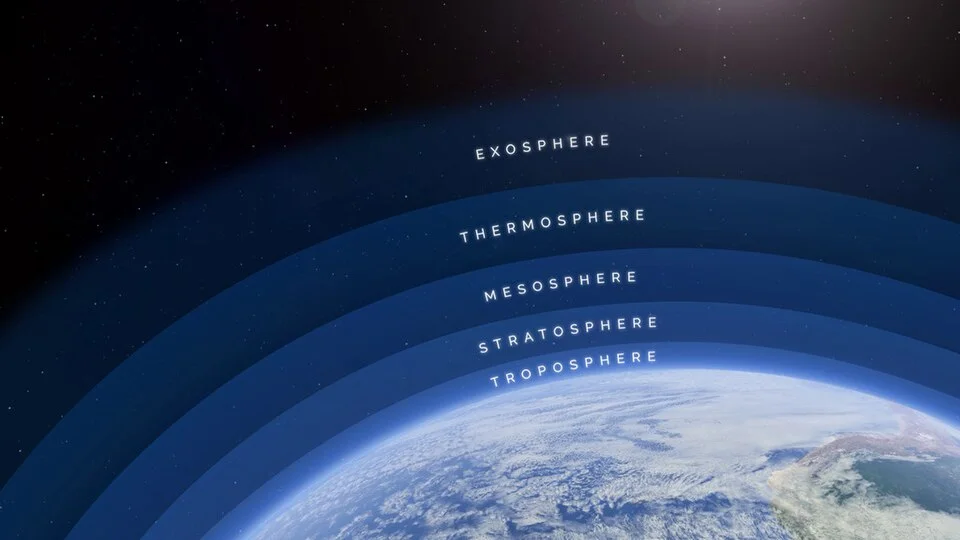
Illustration of named atmospheric layers, from an atmospheric-layers animation.
Credit: NASA's Scientific Visualization Studio - eMITS/Wes D. Buchanan, ADNET Systems, Inc./Aaron E. Lepsch, eMITS/Beth Anthony · Public domain · sourceResized and converted to WebP; uncropped.
1. How atmospheric layers are classified
The atmosphere has no sharp outer edge: it becomes progressively thinner and merges into space. Gravity concentrates most atmospheric mass near the surface. Roughly half lies below about 5.5 km and about 99 per cent below approximately 30–32 km. Mean sea-level pressure is about 1,013.25 hPa. Pressure represents the weight of the overlying air column and declines non-linearly with height.
The standard classification uses the vertical temperature profile. Boundaries separating successive thermal regimes are called pauses: the tropopause, stratopause and mesopause. They are transition zones rather than solid barriers. Their heights differ among textbook approximations and atmospheric conditions, so understanding the temperature trend is more important than memorising one exact altitude.
A second classification concerns composition. The homosphere extends from the surface to roughly 80–100 km, where turbulent mixing maintains broadly uniform proportions of major gases. This does not mean water vapour, ozone or aerosols are uniformly distributed. Above the homopause, molecular diffusion becomes increasingly important in the heterosphere, with heavier gases relatively more abundant below lighter gases.
- Dry air near the surface contains approximately 78.08 per cent nitrogen, 20.95 per cent oxygen and 0.93 per cent argon by volume.
- Water vapour is highly variable and concentrated in the lower atmosphere; carbon dioxide is a trace gas whose concentration changes over time.
- Thermal, compositional and electrical classifications overlap because they describe different atmospheric properties.
2. Troposphere: the weather-producing layer
The troposphere extends from the surface to approximately 8 km over the poles and 16–18 km over the equatorial region, with an average thickness near 12 km. It is generally deeper in warmer conditions because air expands and vigorous convection reaches higher levels. It contains about three-quarters of atmospheric mass and nearly all atmospheric water vapour.
Temperature normally decreases upward at an average environmental lapse rate of about 6.5°C per kilometre. The atmosphere is heated substantially from below: the surface absorbs solar radiation and transfers energy through terrestrial infrared radiation, sensible heat and latent heat. Rising air expands as pressure falls and consequently cools. However, the environmental lapse rate varies with place and time; it is not identical to the dry adiabatic lapse rate of approximately 9.8°C per kilometre.
Cloud formation, precipitation, thunderstorms, cyclones and monsoon circulation occur predominantly within this layer. The lower part, called the atmospheric boundary layer, responds directly to surface friction and daily heating. A temperature inversion occurs when temperature increases with height through a particular layer. Such inversions suppress vertical mixing and can trap pollutants near the ground.
The tropopause marks the transition towards the stratospheric temperature regime and strongly limits ordinary convection. Powerful thunderstorms can nevertheless overshoot it temporarily. Jet streams commonly occur near tropopause level, in the upper troposphere and sometimes the lower stratosphere. Thus, assigning all jet streams exclusively to one layer is misleading.
Why temperature increases through much of the stratosphere
- 1. Solar ultraviolet radiation enters the atmosphere.
- 2. Stratospheric ozone absorbs selected ultraviolet wavelengths.
- 3. Photochemical processes and molecular collisions transfer energy to the surrounding air.
- 4. Heating produces an upward temperature increase through much of the stratosphere.
- 5. Stable stratification restricts vertical convection.
3. Stratosphere: ozone heating and atmospheric stability
The stratosphere extends from the tropopause to approximately 50 km. Its lowest part may be nearly isothermal, while temperature generally increases upward, especially higher in the layer. Ozone absorbs incoming solar ultraviolet radiation and converts part of that energy into heat. The upper boundary, the stratopause, is a temperature maximum relative to adjacent layers.
About 90 per cent of atmospheric ozone occurs in the stratosphere, mainly within roughly 15–35 km. The ozone layer is therefore a region of enhanced concentration, not a distinct thermal layer or a solid shield. Ozone absorbs most UV-B and, together with molecular oxygen, prevents solar UV-C from reaching the surface. Tropospheric ozone, in contrast, is an air pollutant and a greenhouse gas.
The upward increase in temperature promotes static stability and restricts vertical convection. The stratosphere is comparatively dry, with much less ordinary cloud and weather activity than the troposphere. Commercial aircraft may cruise near the tropopause or in the lower stratosphere, depending on latitude, aircraft and operating conditions. This can reduce exposure to much tropospheric weather, but turbulence is not entirely absent.
Polar stratospheric clouds form under exceptionally cold conditions and facilitate reactions that activate ozone-destroying chlorine. The Antarctic ozone hole is a seasonal depletion of stratospheric ozone, not a physical opening. The Montreal Protocol of 1987 controls ozone-depleting substances; its Kigali Amendment of 2016 addresses climate-warming hydrofluorocarbons.
| Layer | Approximate extent | Temperature trend | Key association |
|---|---|---|---|
| Troposphere | Surface to 8–18 km | Generally decreases upward | Weather, water vapour and convection |
| Stratosphere | Tropopause to 50 km | Generally increases upward | Ozone absorption of ultraviolet radiation |
| Mesosphere | 50 to 80–85 km | Decreases upward | Most meteor ablation; cold mesopause |
| Thermosphere | About 85 km to several hundred kilometres | Increases, then may level off | Auroras, ionisation and low-orbit satellite drag |
| Exosphere | Exobase upward; no sharp outer edge | Conventional temperature becomes less intuitive | Rare collisions and gradual transition to space |
4. Mesosphere, thermosphere and exosphere
The mesosphere extends approximately from 50 to 80–85 km. Temperature decreases upward as ozone heating becomes weak and radiative cooling is important. The mesopause is generally the coldest atmospheric region, with temperatures sometimes near −90°C or lower. Most visible meteors ablate in the mesosphere, although their luminous paths can extend outside it. Collisions with atmospheric particles cause intense heating.
Noctilucent clouds are extremely high ice clouds near the summer polar mesopause. They differ from ordinary tropospheric clouds and polar stratospheric clouds. Their visibility after sunset results from illumination by sunlight while the observer and lower atmosphere are already in darkness.
The thermosphere begins above the mesopause and extends to several hundred kilometres, with its upper limit strongly dependent on solar conditions. Temperature rises because sparse gases absorb energetic ultraviolet and X-ray radiation. Kinetic temperatures may exceed 1,000°C, but extremely low particle density means this is not equivalent to the heating experienced in dense air at that temperature. The International Space Station, orbiting near 400 km, encounters the thermosphere and experiences atmospheric drag.
The exosphere begins near the exobase, commonly placed around 500–1,000 km, and gradually merges with interplanetary space. Collisions are rare, hydrogen and helium become important, and some particles escape Earth's gravity. The approximately 100 km Kármán line is a widely used conventional boundary of space, not the physical end of the atmosphere.
5. Ionosphere and examination linkages
The ionosphere is an electrically defined region, extending approximately from 60 km to beyond 1,000 km. Solar radiation ionises atmospheric gases, producing free electrons and ions. It overlaps the upper mesosphere, thermosphere and part of the exosphere. Ionisation changes between day and night and with solar activity.
Its D, E and F regions affect radio waves differently. The daytime D region absorbs some radio frequencies and weakens substantially at night. The E and F regions can refract suitable high-frequency radio waves back towards Earth, enabling communication beyond the horizon. Not all radio waves are returned: satellite communication depends on frequencies that can pass through the ionosphere.
Auroras occur mainly in the thermosphere when energetic charged particles excite atmospheric gases, especially oxygen and nitrogen, along geomagnetic field structures. Solar storms can disturb radio communication and satellite navigation, and heat and expand the upper atmosphere, increasing satellite drag. India's Aditya-L1 mission studies the Sun and processes relevant to understanding space weather.
- Do not equate high thermospheric temperature with high air density or high heat content per unit volume.
- Do not place ordinary weather, the ozone maximum and most meteor ablation in the same layer.
- Distinguish ozone depletion, greenhouse warming and ionospheric disturbance: their mechanisms and principal atmospheric regions differ.
Atmospheric layers: temperature, boundaries and functions
The metadata identifies an illustration of atmospheric layers, directly relevant to understanding vertical atmospheric structure. The temperature-based sequence is troposphere, stratosphere, mesosphere and thermosphere, with the exosphere forming the outermost, extremely rarefied transition towards space. Temperature generally decreases upward through the troposphere, rises through the stratosphere, decreases through the mesosphere and rises again through the thermosphere. These reversals reflect differences in energy absorption and heat transfer; the boundaries are transition zones rather than solid surfaces.
Most weather occurs in the troposphere because it contains most atmospheric water vapour and supports vigorous vertical mixing. Stratospheric ozone absorbs ultraviolet radiation, helping produce warming with altitude. Many incoming meteoroids ablate in the mesosphere, while absorption of high-energy solar radiation heats the thermosphere. For India, the troposphere is central to monsoon circulation, convection and aviation, whereas ionospheric variability affects radio communication and satellite-navigation signals. A labelled schematic supports these relationships but cannot establish exact boundary heights or conditions at a particular place and time.
- The tropopause is generally higher over tropical regions than over polar regions; its height also varies seasonally and with weather. Avoid treating textbook layer heights as universal constants.
- The ionosphere is defined by ionisation and overlaps temperature-defined layers. The homosphere and heterosphere instead describe compositional mixing; these classifications are not interchangeable.
- High thermospheric temperature does not imply dense, furnace-like air: particles have high average kinetic energy, but their scarcity limits heat transfer. Distinguish temperature from thermal energy content.
Real-world case studies
Mount Pinatubo eruption, Philippines, 1991
The eruption injected large quantities of sulphur dioxide into the stratosphere, where sulphate aerosols formed. Because the stratosphere has little precipitation-driven removal, these aerosols persisted much longer than typical tropospheric particles. Increased reflection of sunlight temporarily cooled global surface temperatures by roughly 0.5°C, demonstrating the climatic importance of the altitude of aerosol injection.
Geomagnetic storm and satellite losses, February 2022
A geomagnetic storm heated and expanded the upper atmosphere shortly after a Starlink satellite launch. Increased atmospheric density at the satellites' initially low orbital altitude raised drag, leading to the loss of dozens of satellites. The event illustrates that spaceflight above the conventional boundary of space is still affected by Earth's atmosphere.
Previous year questions
Source-linked detailed analyses are available above.
Practice questions
Practice MCQ 1
Consider the following statements: 1. Atmospheric pressure generally decreases with altitude in all thermal layers. 2. The stratospheric temperature increase is associated with ultraviolet absorption by ozone. 3. The ionosphere lies entirely above the thermosphere. Which statements are correct?
- A. 1 and 2 only
- B. 2 and 3 only
- C. 1 and 3 only
- D. 1, 2 and 3
Practice MCQ 2
Which one of the following pairs is correctly matched?
- A. Troposphere — Principal region of the ozone maximum
- B. Mesopause — Generally the coldest atmospheric region
- C. Stratosphere — Principal region of auroral displays
- D. Exosphere — Principal region of monsoon rainfall
Practice MCQ 3
Why can a geomagnetic storm increase atmospheric drag on satellites in low Earth orbit?
- A. It permanently increases Earth's gravitational attraction.
- B. It transfers the ozone layer into satellite orbits.
- C. It heats and expands the upper atmosphere, increasing density at some orbital altitudes.
- D. It causes tropospheric rain clouds to reach orbital altitudes.
Mains practice · Explain how the vertical thermal structure of the atmosphere influences weather, ultraviolet protection and modern communication systems. Answer in 250 words.
- Introduce temperature-based layering and variable boundary heights.
- Connect tropospheric lapse rates, convection and moisture with weather.
- Explain ozone heating and stability in the stratosphere.
- Identify the mesopause temperature minimum and thermospheric heating.
- Distinguish the electrically defined ionosphere from thermal layers.
- Discuss radio propagation, satellite navigation disturbances and satellite drag.
- Conclude with the importance of atmospheric and space-weather monitoring.
Further reading
- NCERT, Fundamentals of Physical Geography, Class XI: Composition and Structure of Atmosphere; Solar Radiation, Heat Balance and Temperature.
- NASA Science: Earth's Atmosphere and atmospheric layers educational resources.
- NOAA Space Weather Prediction Center: Ionosphere, geomagnetic storms and space-weather impacts.
- WMO and UNEP: Scientific Assessment of Ozone Depletion, 2022.
- ISRO: Aditya-L1 mission overview and scientific objectives.
- https://commons.wikimedia.org/wiki/File:Carruthers_Atmospheric_Layers_Animation_(SVS20405_-_Standard_4k_00360_print).jpg
Preparing for UPSC Civil Services? Get classroom teaching, answer-writing evaluation and mentorship at Pragnya IAS Academy, Ashok Nagar — see why aspirants choose us for IAS coaching in Hyderabad.