
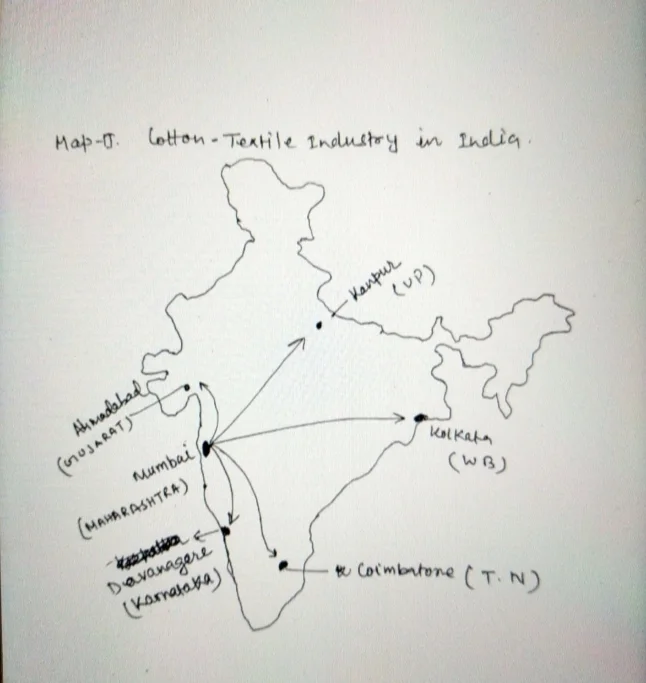
Illustrative context: the cotton textile industry in India.
Credit: सीमा1 · CC BY-SA 4.0 · sourceResized and converted to WebP; uncropped.
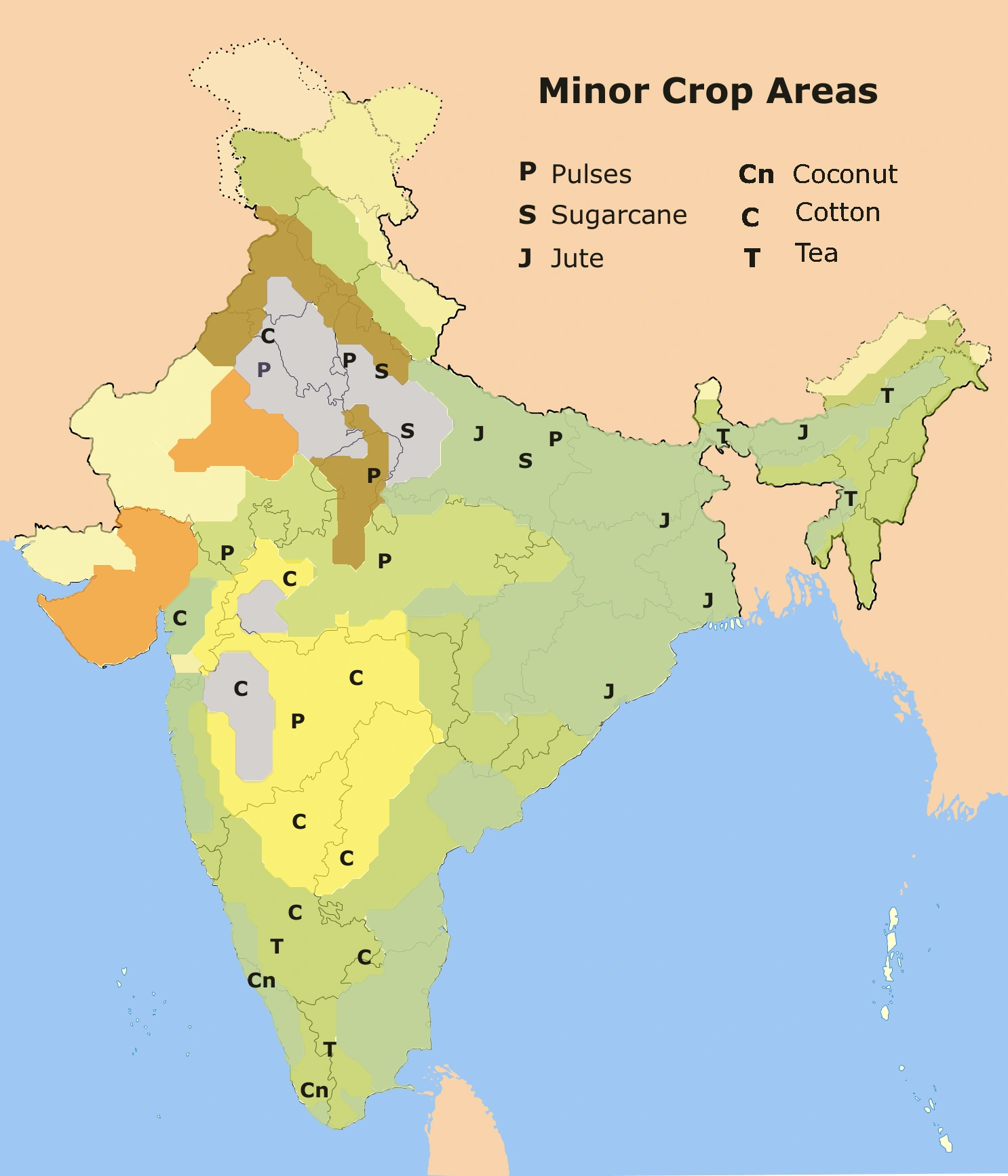
Map study
Selected crop regions of India: identify the legend symbols before comparing patterns. Symbols do not imply exclusive growing areas or current production totals.
- Read the source legend, scale and reference period before comparing regions.
- Connect spatial patterns to the processes discussed in this topic; this map is a study reference, not live operational data.
Credit: Amog · CC BY-SA 2.5 · sourceConverted to WebP on an opaque white background; proportionally resized without cropping. Original cartography and legend retained.
1. Nature of the industry and the cotton-to-cloth chain
Cotton textiles constitute an agro-based manufacturing industry because the principal raw material comes from agriculture. The industry provides employment across farming, trading, transport and manufacturing, while supplying fabrics, garments and household textiles to domestic and export markets. Its importance lies not merely in large factories but also in extensive networks of small enterprises, household production and specialised clusters. Cotton textiles must be distinguished from the wider textile industry, which includes silk, wool, jute and man-made fibres.
The production chain begins with kapas, consisting of cotton lint attached to seeds. Ginning separates the lint from the seeds; pressing compresses the lint into bales for storage and transport. Spinning cleans, aligns and twists fibres into yarn. Weaving interlaces warp and weft yarns, whereas knitting forms fabric through interlocking loops. Bleaching, dyeing, printing and finishing alter the appearance and performance of fabric, after which cutting and stitching produce garments or made-ups.
A composite mill combines several stages, particularly spinning, weaving and processing, within one establishment. In a decentralised production system, different enterprises specialise in individual stages and exchange intermediate products. Handloom and powerloom refer to the method of operating weaving equipment, not to different raw materials. A powerloom unit may weave cotton, synthetic or blended yarn; therefore, a prominent textile centre is not necessarily an exclusively cotton-textile centre.
- Cotton lint is the principal textile input; cottonseed is a valuable by-product used for oil extraction and other purposes.
- Garments are finished clothing, while made-ups include products such as bed linen, towels and curtains.
Timeline
1818
An early cotton textile mill venture was established at Fort Gloster near Calcutta.
1854
India’s first successful modern cotton textile mill began operations in Bombay.
1861
Ahmedabad’s first cotton textile mill was established.
1970
Cotton Corporation of India was established.
2021
The Union government approved PM MITRA for seven integrated textile parks.
2. Agricultural base and factors governing location
Cotton requires a warm growing season, adequate moisture during growth and relatively dry conditions during boll opening and harvesting. Frost and untimely rain can damage the crop. Black soils of the Deccan are important because of their moisture-retaining capacity, but cotton is not restricted to them. It is also cultivated on alluvial soils under irrigation in northwestern India. Major producing states include Gujarat, Maharashtra, Telangana, Madhya Pradesh, Karnataka, Andhra Pradesh, Rajasthan, Haryana and Punjab.
Raw-material proximity encouraged early industrial development in western India. However, processed cotton can be compressed into bales and transported over considerable distances. Consequently, modern spinning and weaving need not remain adjacent to farms. Fibre quality also matters: staple length, strength and cleanliness influence yarn quality and manufacturing requirements. Producers may source cotton from several regions or import particular varieties to meet specifications.
A humid atmosphere reduces yarn breakage and static-related difficulties during processing, helping explain the historical attractiveness of coastal locations. Yet natural humidity is not an indispensable locational condition because factories can use controlled humidification. Reliable electricity, machinery, working capital, skilled workers, transport connections and access to consumers can outweigh proximity to cotton fields.
Water requirements vary along the production chain. Dyeing, bleaching and finishing are particularly water-intensive and generate effluents requiring treatment. Export-oriented clusters benefit from ports, container logistics, testing facilities and buyer networks. Industrial agglomeration creates shared markets for machinery repair, spare parts, labour and subcontracting, enabling established centres to retain advantages even when some original locational factors weaken.
Cotton textile value chain
- 1. Cotton cultivation and harvesting
- 2. Ginning and pressing into bales
- 3. Spinning fibres into yarn
- 4. Weaving or knitting fabric
- 5. Bleaching, dyeing, printing and finishing
- 6. Garment or made-up manufacture
- 7. Domestic distribution or export
3. Historical development and regional distribution
India had a sophisticated tradition of cotton spinning, weaving and international textile trade before mechanised mills. Colonial-era industrial development occurred alongside major changes in trade, competition from machine-made imports and the fortunes of artisanal production. The Fort Gloster venture of 1818 preceded the successful Bombay mill of 1854. Bombay subsequently became the leading early centre of mechanised cotton textiles.
Mumbai’s advantages included proximity to western Indian cotton-growing areas, a humid coastal environment, a major port, merchant capital and a large labour supply. Railways connected the port and mills with the interior. Ahmedabad developed from 1861 through access to Gujarat’s cotton, commercial capital, workers and transport routes. Its concentration of mills earned it the name Manchester of India; the title should not be mistaken for a current statistical ranking.
The industry subsequently spread well beyond Mumbai and Ahmedabad. Maharashtra contains centres such as Solapur, Nagpur, Ichalkaranji and the Bhiwandi powerloom cluster. Gujarat includes Ahmedabad and other textile centres, although Surat is especially associated with man-made-fibre textiles. In central India, Indore and other urban centres developed textile activities through regional markets and transport connections.
Tamil Nadu illustrates how industrial organisation can compensate for limited local raw materials. Coimbatore and Tiruppur form part of a major cotton-textile and garment region supported by spinning capacity, entrepreneurship, labour networks and infrastructure. Tiruppur specialises in knitwear, while Erode and Karur are important for fabrics and home textiles. Kanpur in Uttar Pradesh and centres in northwestern India represent further geographical dispersal. Ludhiana is a broader hosiery and knitwear centre, not exclusively a cotton cluster.
| Centre or cluster | Prominent association | Location lesson |
|---|---|---|
| Mumbai | Historic composite cotton mills | Port, capital, labour and access to western cotton regions |
| Ahmedabad | Historic cotton spinning and weaving | Raw materials and mercantile entrepreneurship |
| Coimbatore | Spinning and textile machinery ecosystem | Industrial networks can offset distant raw-material sources |
| Tiruppur | Export-oriented knitwear | Specialisation and subcontracting support cluster growth |
| Bhiwandi | Decentralised powerloom weaving | Market access and inter-firm production networks |
| Karur | Home textiles | Product specialisation and export connections |
4. Decentralisation, employment and changing industrial geography
Cotton-textile production is highly decentralised because spinning, weaving, processing and garment manufacture can be separated technically and commercially. Specialised enterprises purchase yarn or fabric rather than integrating every production stage. Powerlooms and garment units can operate at smaller scales than large composite mills, encouraging dispersal into medium-sized towns and industrial settlements. Subcontracting connects these units with larger manufacturers and exporters.
Spinning is generally more capital-intensive and organised than much of the decentralised weaving sector. Garment production remains comparatively labour-intensive and can create substantial employment, including for women. Nevertheless, enterprise size, employment conditions and technology vary greatly within each segment. Handloom production also survives through specialised designs, skilled craftsmanship and markets for distinctive fabrics rather than simply competing on volume.
The decline or restructuring of some old metropolitan mills does not imply the disappearance of textile production from India. High urban land costs, ageing machinery, industrial disputes and changes in business organisation encouraged relocation or replacement by other forms of production. Mumbai’s former mill districts demonstrate how industrial land can shift towards housing, offices and retail. Meanwhile, newer clusters have expanded through flexible production networks and improved road, rail and port connectivity.
5. Challenges, sustainability and public policy
The industry faces fluctuating cotton prices, variable fibre quality, contamination, power costs, working-capital constraints and competition from other exporting countries. Fragmentation provides flexibility but can hinder technology adoption, consistent quality and traceability. Export competitiveness depends on delivery times, design, compliance and logistics as well as wages. Competition and substitution between cotton and man-made fibres also influence demand.
Environmental pressures occur at different stages. Cultivation may involve irrigation and substantial chemical inputs, depending on the production system. Wet processing produces wastewater containing dyes, salts and other pollutants. Common effluent treatment plants, water recycling and cleaner processing can reduce impacts, although their operation requires energy, finance and effective monitoring. Zero liquid discharge minimises liquid effluent release but does not eliminate solid residues or energy-related impacts.
Public interventions include cotton price support, technology assistance, skill development and infrastructure creation. The Cotton Corporation of India, established in 1970, undertakes cotton procurement under minimum support price operations when required. PM MITRA, approved in 2021, provides for seven integrated textile parks intended to improve scale and value-chain integration. A crucial examination distinction is that the textile Production Linked Incentive scheme focuses on specified man-made-fibre apparel, man-made-fibre fabrics and technical textiles, rather than conventional cotton textiles generally.
Cotton Textiles: Production Stages and Industrial Location
India’s cotton textile industry connects agriculture with manufacturing, but its stages have distinct locational requirements. Ginning separates cotton fibres from seeds; spinning converts fibres into yarn; weaving or knitting produces fabric; and processing includes bleaching, dyeing and finishing. Garment manufacture is a further activity, not a synonym for textile production. Consequently, cotton-growing regions, spinning centres and fabric-producing clusters need not coincide. The supplied metadata identifies the image with India’s cotton textile industry, but does not establish a particular location, production stage or technology.
Mumbai’s early prominence reflected port access, commercial capital, labour availability and connections with cotton-growing areas of western India. Ahmedabad also benefited from proximity to cotton supplies and entrepreneurial networks. Humid conditions historically helped reduce yarn breakage, but humidity alone cannot explain industrial location: controlled mill environments, electricity and improved transport widened locational choices. Subsequent dispersal, including towards southern and northern India, reflects markets, specialised skills and supplier networks. For Mains, distinguish the industry’s employment and export potential from its uneven environmental burdens: wet processing can generate polluted effluents, while spinning and weaving have different energy and resource requirements.
- Integrated mills combine several production stages; decentralised powerloom and handloom units may depend on yarn supplied by separate spinning mills.
- Cotton cultivation is an agricultural activity, whereas cotton textile manufacturing is agro-based industry; raw-material proximity is only one locational factor.
- Do not infer that all textile centres use cotton exclusively, or that this image documents specific machinery, working conditions or pollution outcomes.
Real-world case studies
Tiruppur: export growth and wastewater management
Tiruppur’s knitwear cluster connects specialised knitting, processing and garment units. Pollution of the Noyyal river system led to judicial intervention and closure directions against non-compliant processing units in 2011. Subsequent operation depended on compliance with zero liquid discharge requirements. The case demonstrates that environmental infrastructure is integral to industrial competitiveness.
Mumbai: transformation of a historic mill district
The 1982 Bombay textile strike marked a major crisis in an industry already facing structural pressures. Over subsequent decades, numerous mills closed or were redeveloped. The transformation of Girangaon illustrates industrial restructuring, changing urban land values and the social consequences of losing established manufacturing employment.
Previous year questions
No source-linked PYQ is available here yet. Use the practice questions below.
Practice questions
Practice MCQ 1
Consider the following statements: 1. Ginning separates cotton fibres from seeds. 2. Knitting produces fabric by interlacing warp and weft. 3. A powerloom can produce fabric using synthetic yarn. Which of the statements given above are correct?
- A. 1 and 2 only
- B. 1 and 3 only
- C. 2 and 3 only
- D. 1, 2 and 3
Practice MCQ 2
Which of the following best explains the development of a major spinning industry in Tamil Nadu despite substantial dependence on cotton from other states?
- A. Cotton textiles can be manufactured only in coastal districts.
- B. Cotton loses nearly all its weight during spinning.
- C. Transportable raw materials combine with power, entrepreneurship and established industrial networks.
- D. Spinning requires neither machinery nor skilled workers.
Practice MCQ 3
With reference to India’s textile sector, consider the following statements: 1. PM MITRA envisages integrated textile parks. 2. The textile Production Linked Incentive scheme is designed exclusively for conventional cotton fabrics. Which of the statements given above is/are correct?
- A. 1 only
- B. 2 only
- C. Both 1 and 2
- D. Neither 1 nor 2
Mains practice · Explain the changing locational pattern of India’s cotton textile industry. How have decentralisation and environmental constraints influenced its geography? Answer in 250 words.
- Begin with the historical concentration in Mumbai and Ahmedabad.
- Explain raw materials, ports, humidity, capital, labour and railway connections.
- Discuss dispersal, particularly towards Tamil Nadu and specialised weaving and garment clusters.
- Distinguish composite mills from decentralised spinning, weaving, processing and garment networks.
- Use Tiruppur to connect wet processing, water pollution and treatment infrastructure.
- Conclude with reliable infrastructure, skill development and environmentally compliant cluster development.
Further reading
- NCERT, Contemporary India II, Class X: Manufacturing Industries.
- NCERT, India: People and Economy, Class XII: Manufacturing Industries, in editions containing this chapter.
- Ministry of Textiles: Annual Report and official information on PM MITRA and the textile PLI scheme.
- Cotton Corporation of India: Official information on cotton procurement and minimum support price operations.
- ICAR–Central Institute for Cotton Research: Publications on cotton cultivation and production systems.
- https://commons.wikimedia.org/wiki/File:Cotton_textile_industry_in_India.jpg
Preparing for UPSC Civil Services? Get classroom teaching, answer-writing evaluation and mentorship at Pragnya IAS Academy, Ashok Nagar — see why aspirants choose us for IAS coaching in Hyderabad.