

Halti Beel, Natore
Credit: Masum-al-hasan · CC BY-SA 4.0 · source
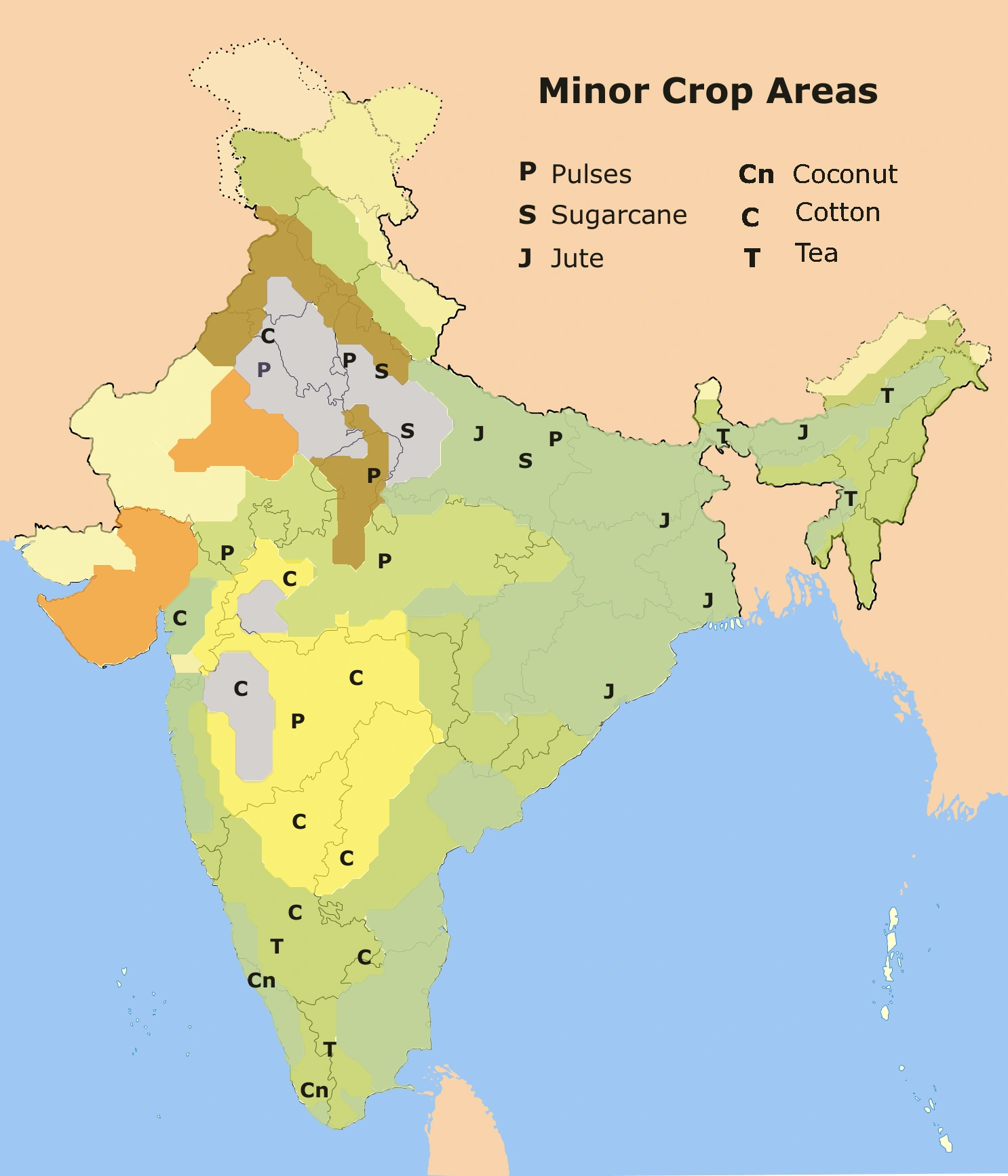
Map study
Selected crop regions of India: identify the legend symbols before comparing patterns. Symbols do not imply exclusive growing areas or current production totals.
- Read the source legend, scale and reference period before comparing regions.
- Connect spatial patterns to the processes discussed in this topic; this map is a study reference, not live operational data.
Credit: Amog · CC BY-SA 2.5 · sourceConverted to WebP on an opaque white background; proportionally resized without cropping. Original cartography and legend retained.
1. Nature, varieties and economic significance
Jute is a natural vegetable fibre popularly called the golden fibre because of its colour and commercial importance. The usable fibres occur in the bast of the stem and are separated from surrounding tissues after harvesting. This distinguishes jute from cotton, a seed fibre, and coir, obtained from the fibrous husk of coconut. Its relatively coarse texture, tensile strength and suitability for spinning make it particularly useful for packaging and industrial fabrics.
The two principal cultivated species are white jute, Corchorus capsularis, and tossa jute, Corchorus olitorius. Tossa generally provides stronger, finer and more lustrous fibre, while white jute is relatively better adapted to wetter conditions. Mesta, comprising related commercial bast-fibre crops such as kenaf and roselle, is often grouped with jute in agricultural statistics. However, it is not botanically the same crop; questions referring to jute and mesta must therefore be read carefully.
Traditional products include gunny bags, sacks, hessian cloth, ropes and carpet backing. Diversified uses include shopping bags, furnishings, handicrafts, composites and geotextiles. The sector connects small cultivators and agricultural workers with traders, mills and industrial labour. Consequently, changes in fibre prices or government procurement affect livelihoods across both rural and urban eastern India.
2. Growing conditions and geographical distribution
Jute is primarily a kharif crop of tropical monsoon regions. It grows well in warm conditions, broadly around 24–35°C, with high relative humidity and adequate rainfall. Annual rainfall of roughly 150–200 cm is commonly associated with favourable jute-growing regions, although distribution during the crop season matters more than the annual total alone. Moisture stress during establishment and prolonged flooding can reduce yield or fibre quality.
Deep, fertile alluvial soils are especially suitable. The floodplains and deltaic tracts of the Ganga–Brahmaputra system provide moisture, fine sediments and extensive cultivable land. Periodic sediment deposition historically renewed soil fertility, but the crop is not restricted to fields flooded every year. Good drainage remains important, especially for tossa jute. The need for substantial water during retting should not be confused with a universal requirement for standing water during crop growth.
In India, cultivation is concentrated in West Bengal, with important production in Bihar and Assam and smaller areas in Odisha, Meghalaya and Tripura. Within West Bengal, the plains of Nadia, Murshidabad, North 24 Parganas, Cooch Behar and neighbouring districts are significant. Across the international boundary, Bangladesh shares the same favourable deltaic environment. Thus, the major producing region is an ecological continuum divided by political boundaries.
Jute is generally sown during the pre-monsoon or early monsoon period and harvested after approximately four months, depending on variety and intended fibre quality. Early harvesting can reduce yield, while excessive delay tends to produce coarser fibre. Jute also competes with rice and other crops for land, labour and seasonal water, making relative prices and cropping-system choices important determinants of its cultivated area.
From jute field to finished product
- 1. Sowing and crop establishment
- 2. Stem growth and harvesting
- 3. Bundling and retting
- 4. Fibre stripping, washing and drying
- 5. Grading, baling and marketing
- 6. Mill preparation, spinning and weaving
- 7. Conversion into sacks or diversified products
3. Retting, processing and environmental implications
After harvesting, stems are bundled and subjected to retting: microbial action breaks down the materials binding the fibres to other stem tissues. Traditionally, bundles are immersed in ponds, channels or other suitable water bodies. Workers then strip the fibres, wash them and dry them before grading and sale. Retting is therefore a biological separation process, not simply mechanical crushing or chemical bleaching.
Water quality, temperature, retting duration and bundle management strongly influence fibre strength, colour and cleanliness. Insufficient water or poorly managed retting can cause uneven separation and inferior fibre. Ribbon retting, which separates the bark ribbon before retting, and microbial retting formulations can improve efficiency under suitable conditions. Timely access to clean water is consequently an important production constraint even where rainfall is adequate for crop growth.
Jute fibre is renewable and biodegradable, and jute products can replace some petroleum-based packaging. Jute geotextiles can temporarily protect exposed soil from erosion while vegetation becomes established. However, environmental benefits are not automatic: retting releases organic matter that can lower dissolved oxygen in confined water bodies, while mills consume energy and may generate polluted effluent. Product coatings and blends also affect whether a finished item is fully biodegradable.
| Component | Key requirement or feature | Geographical implication |
|---|---|---|
| Cultivation | Warm, humid climate and fertile alluvial soils | Concentration in eastern Indian and Bangladeshi plains |
| Retting | Suitable water and controlled microbial decomposition | Local water availability influences fibre quality |
| Manufacturing | Labour, transport, capital, energy and markets | Strong concentration in the Hugli industrial belt |
| Packaging demand | Foodgrain procurement and mandatory-use orders | Government policy strongly influences mill demand |
| Diversification | Geotextiles, furnishings and composites | Potential markets beyond conventional sacks |
4. Why the jute industry is concentrated along the Hugli
India’s first jute mill was established at Rishra, near Kolkata, in 1855. Manufacturing subsequently developed along the Hugli, a distributary of the Ganga. The region combined proximity to the jute-growing delta with river water, navigable waterways, rail connections and access to Kolkata’s port. Colonial trading networks, finance and export demand helped transform this favourable location into a specialised industrial belt.
Coal from the Raniganj coalfield and the wider eastern coal belt supported industrial energy requirements. A large labour supply came from West Bengal and neighbouring regions, including Bihar, eastern Uttar Pradesh and Odisha. Kolkata supplied banking, insurance, machinery services and commercial management. Once mills clustered together, shared labour markets, suppliers, transport infrastructure and accumulated expertise reinforced agglomeration economies.
Partition in 1947 disrupted this integrated geography: much of the jute-growing hinterland became part of East Pakistan, now Bangladesh, while most mills remained in India around Kolkata. India subsequently expanded domestic cultivation, but cross-border fibre trade retained importance. Today, the distinction between the agricultural distribution of raw jute and the industrial concentration of mills remains central to understanding the sector.
The Hugli belt illustrates industrial inertia: established infrastructure, skilled workers and commercial networks can preserve a manufacturing cluster even when its original raw-material relationships change. It also demonstrates that industrial location cannot be explained by raw materials alone; transport, markets, capital, policy and historical development interact.
5. Policy support, challenges and examination relevance
The Jute Packaging Materials Act, 1987 authorises compulsory jute packaging for specified commodities. Government orders have commonly prescribed jute packaging for 100 per cent of foodgrains and 20 per cent of sugar, subject to the relevant order, exemptions and operational conditions. These percentages should not be treated as permanently fixed provisions of the Act itself. Public foodgrain procurement creates a major market for jute sacks.
Raw jute receives minimum support price support, with the Jute Corporation of India undertaking support operations under government arrangements. The National Jute Board promotes sectoral development, market expansion and diversification. ICAR’s Central Research Institute for Jute and Allied Fibres at Barrackpore works on crop improvement and production technologies. These institutions address different stages of the value chain rather than performing identical procurement functions.
Major challenges include fluctuating raw-fibre prices, uneven fibre quality, inadequate retting facilities, ageing machinery in parts of the industry and competition from synthetic packaging. Dependence on government sack orders can also discourage diversification. Priorities include better seed, improved retting, modernised mills, worker skills and development of technically suitable diversified products. For Prelims, distinguish crop conditions from processing needs, raw-fibre production from manufactured-product trade, and statutory powers from periodically notified packaging requirements.
Real-world case studies
Rishra and the Hugli industrial cluster
The establishment of a jute mill at Rishra in 1855 marked the beginning of India’s mill-based jute industry. Nearby cultivation, river transport and Kolkata’s commercial infrastructure supported expansion. The cluster’s persistence after Partition illustrates the importance of agglomeration and industrial inertia.
Improved retting through ICAR research
ICAR–Central Research Institute for Jute and Allied Fibres developed the CRIJAF SONA microbial formulation to assist retting. It illustrates how biological process improvement can address a quality bottleneck between cultivation and manufacturing, although field performance also depends on water conditions and correct application.
Previous year questions
No source-linked PYQ is available here yet. Use the practice questions below.
Practice questions
Practice MCQ 1
With reference to jute, consider the following statements: 1. Its commercial fibre is obtained from the stem bast. 2. Retting uses microbial activity to facilitate fibre separation. 3. All jute varieties require prolonged standing water throughout growth. Which of the statements given above are correct?
- A. 1 and 2 only
- B. 2 and 3 only
- C. 1 and 3 only
- D. 1, 2 and 3
Practice MCQ 2
Which of the following best explains the historical concentration of jute mills along the Hugli?
- A. Proximity to cotton farms and petroleum refineries
- B. An integrated combination of raw jute, water transport, port facilities, labour and capital
- C. Availability of a cool, dry climate required for jute cultivation
- D. Absence of alternative transport routes elsewhere in India
Practice MCQ 3
Consider the following statements about the jute economy: 1. Mesta and true jute are botanically identical. 2. The Jute Packaging Materials Act, 1987 enables compulsory jute packaging for specified commodities. 3. The Jute Corporation of India undertakes raw-jute price-support operations. Which of the statements given above are correct?
- A. 1 only
- B. 1 and 2 only
- C. 2 and 3 only
- D. 1, 2 and 3
Mains practice · Explain the geographical and historical factors behind the concentration of India’s jute industry along the Hugli. Discuss how technological and policy interventions can improve its sustainability. Answer in 250 words.
- Introduce the relationship between deltaic cultivation and the Hugli manufacturing belt.
- Explain raw materials, river and rail transport, Kolkata port, coal, labour and finance.
- Discuss Partition, agglomeration economies and industrial inertia.
- Identify retting constraints, obsolete machinery, synthetic competition and dependence on sack orders.
- Suggest improved retting, mill modernisation, pollution control and diversified products.
- Balance packaging support and farmer protection with competitiveness and environmental safeguards.
Further reading
- NCERT, Contemporary India–II: Agriculture and Manufacturing Industries.
- NCERT, India: People and Economy: Land Resources and Agriculture.
- Ministry of Textiles, Government of India: Annual Report and jute-sector notifications.
- Office of the Jute Commissioner: jute statistics and packaging orders.
- National Jute Board: sector development and diversified jute products.
- ICAR–Central Research Institute for Jute and Allied Fibres: production and retting technologies.
- India Code: Jute Packaging Materials (Compulsory Use in Packing Commodities) Act, 1987.
Preparing for UPSC Civil Services? Get classroom teaching, answer-writing evaluation and mentorship at Pragnya IAS Academy, Ashok Nagar — see why aspirants choose us for IAS coaching in Hyderabad.