
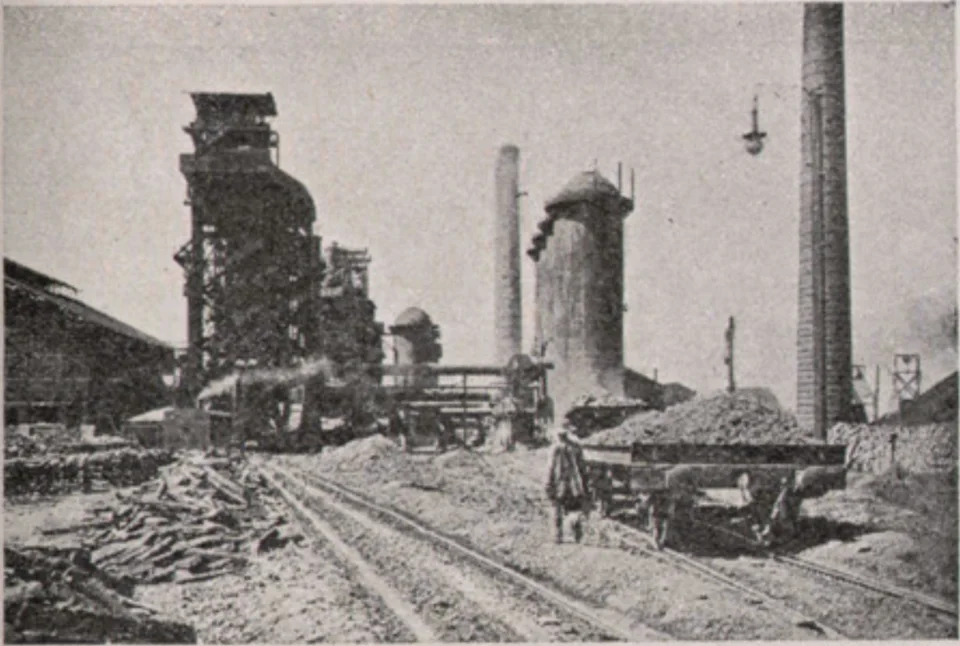
Taganrog iron and steel works, Russia: a comparative industrial example, not an Indian plant.
Credit: Unknown authorUnknown author · Public domain · sourceResized and converted to WebP; uncropped.
1. Industrial importance and essential terminology
Iron and steel is a mineral-based, capital-intensive industry with strong backward and forward linkages. Mining, coal washing, refractories and engineering services supply it, while construction, railways, automobiles, shipbuilding and capital-goods industries consume its output. Steel demand therefore broadly reflects investment and industrial activity. However, crude steel production, finished steel production and installed capacity are different measures and should never be treated as interchangeable.
Ironmaking extracts metallic iron from ore, while steelmaking adjusts carbon content and removes undesirable impurities. A blast furnace produces molten iron, commonly called hot metal; when cast into moulds, it becomes pig iron. Pig iron contains more carbon than steel and is relatively brittle. Steel is an iron-based alloy whose properties can be modified through controlled additions of elements such as manganese, chromium and nickel. Chromium is particularly important for corrosion resistance in stainless steel.
An integrated steel plant combines major production stages at one complex, typically including ironmaking, steelmaking and rolling, often with coke ovens and sinter facilities. Mini steel plants generally operate on a smaller scale using electric furnaces and inputs such as scrap or sponge iron. Sponge iron, also called direct reduced iron or DRI, is produced by removing oxygen from iron ore without melting it. It is an intermediate material, not finished steel.
- Hematite and magnetite are important iron ores; India has substantial hematite resources in its eastern and peninsular mineral belts.
- Manganese is used in steelmaking as an alloying and deoxidising agent.
- Steel is recyclable, but the quality and composition of scrap influence the products that can be manufactured.
2. Locational factors and the eastern industrial concentration
Traditional integrated plants handle large quantities of bulky raw materials. Their location consequently reflects the combined cost of transporting iron ore, coal and fluxes, rather than proximity to any one mineral alone. Reliable water supplies, extensive land, railway connections, power, labour and access to consuming centres are also important. Rivers support cooling and industrial operations, although water availability may become a constraint during dry periods.
The Chota Nagpur Plateau and adjoining belts offer an unusually favourable grouping of resources. Iron ore occurs in the Singhbhum–Keonjhar–Mayurbhanj region, while the Damodar valley contains major coalfields such as Jharia, Bokaro and Raniganj. Limestone, dolomite and manganese are available within the wider eastern and central Indian mineral region. This resource combination, supported by railway development, encouraged the growth of Jamshedpur, Bokaro, Durgapur, Burnpur and Rourkela.
Coal quality is a crucial qualification. India's large overall coal resources do not imply self-sufficiency in suitable metallurgical coal. Domestic coking coal commonly requires beneficiation and blending because of quality limitations, including high ash content. Imported coking coal therefore plays a major role in blast-furnace production. Imported coal moves through ports and inland transport networks, giving port access increasing importance even for mineral-based plants.
Industrial location also reflects historical investment and public policy. Post-independence public-sector plants helped establish major industrial centres beyond existing metropolitan regions. Their influence extended to engineering industries, townships, technical education and transport infrastructure. Thus, present-day concentration is explained by both physical resources and accumulated industrial advantages.
Conventional blast furnace–basic oxygen furnace production
- 1. Mine and beneficiate iron ore; prepare sinter or pellets where required
- 2. Convert coking coal into coke and prepare fluxes
- 3. Reduce iron ore in the blast furnace to produce hot metal
- 4. Refine hot metal with oxygen to produce steel
- 5. Continuously cast steel into slabs, blooms or billets
- 6. Roll and finish products such as sheets, rails and structural sections
3. Major centres and changing spatial patterns
Jamshedpur in Jharkhand developed around the private-sector Tata enterprise, incorporated in 1907, with steel production beginning in 1912. Its location near eastern iron ore and coal resources, and the Subarnarekha–Kharkai river system, illustrates the classical raw-material-oriented model. Bokaro in Jharkhand and Durgapur in West Bengal further strengthened the eastern industrial belt.
Post-independence collaboration is a frequent examination theme. Bhilai in present-day Chhattisgarh was established with Soviet assistance, Rourkela in Odisha with West German assistance, and Durgapur with British assistance. Bokaro was also developed with Soviet collaboration. These associations should be distinguished from the ownership or management arrangements of plants today.
Southern and coastal growth has diversified the pattern. Vijayanagar at Toranagallu in Karnataka is linked to the Ballari–Hosapete iron ore belt. Visakhapatnam in Andhra Pradesh represents a coastal location that combines access to overseas coking coal with inland ore supplies and a large industrial market. Hazira in Gujarat benefits from maritime access and proximity to western India's industrial and consuming centres.
Not every prominent steel centre is a conventional ore-to-steel integrated complex. Salem in Tamil Nadu is especially associated with stainless steel processing, while electric-furnace clusters may depend on scrap, DRI and electricity rather than nearby ore and coking coal. For map-based questions, identify each plant's state, inland or coastal position, resource linkages and specialisation instead of memorising names alone.
| Centre | State | Important locational linkage |
|---|---|---|
| Jamshedpur | Jharkhand | Eastern iron ore and coal belts; Subarnarekha–Kharkai river system |
| Bhilai | Chhattisgarh | Historically linked to Dalli-Rajhara ore; Dallirajhara–Rowghat–Jagdalpur rail corridor supports wider ore connectivity |
| Rourkela | Odisha | Odisha's iron ore belt; Brahmani river system |
| Visakhapatnam | Andhra Pradesh | Coastal access for imported coking coal; Bailadila ore linkage |
| Vijayanagar | Karnataka | Ballari–Hosapete iron ore belt |
4. Technology, transport and emerging location choices
In the conventional blast furnace–basic oxygen furnace route, prepared iron ore, coke and fluxes enter the blast furnace. Hot metal then undergoes oxygen steelmaking, followed by casting and rolling. Coke supports the furnace burden and provides both energy and the reducing conditions needed to extract iron. Sintering and pelletisation prepare fine ore for suitable industrial use.
Electric arc furnaces melt metallic inputs using electricity. Their charge can include scrap and DRI, so they need not depend directly on nearby coking coal. Induction furnaces are also important in India's secondary steel sector. Nevertheless, electric steelmaking is not automatically low-carbon: its emissions depend on the electricity supply and on how inputs such as DRI were produced.
Improved railways, bulk-handling terminals and shipping allow plants to obtain inputs over longer distances. Coastal plants can import coal and ore, handle large consignments and access export markets. Market-oriented units gain from proximity to construction and manufacturing demand. India therefore exhibits overlapping locational patterns: mineral-oriented integrated plants, port-oriented complexes and dispersed secondary producers.
5. Policy, environmental concerns and examination approach
The National Steel Policy, 2017 seeks greater domestic capacity, competitiveness and per capita steel consumption. Its 2030–31 objectives include 300 million tonnes of crude steel capacity and per capita finished steel consumption of 158 kilograms. The Production Linked Incentive scheme for specialty steel aims to encourage higher-value domestic manufacturing. The Steel Scrap Recycling Policy, 2019 promotes an organised framework for scrap collection and processing.
Steel production creates environmental pressures across its supply chain. Mining can affect forests, land and drainage, while plants generate particulate emissions, wastewater, slag and greenhouse gases. Coke ovens and coal-based ironmaking are particularly significant pollution and carbon-management challenges. Resource efficiency measures include waste-heat recovery, water recirculation, improved furnace performance and suitable use of processed slag in cement or construction.
Decarbonisation options include greater scrap recycling, cleaner electricity, improved energy efficiency and hydrogen-based direct reduction. Their feasibility depends on costs, scrap availability, ore quality and access to low-emission energy. Expansion must also address worker safety, rehabilitation of displaced communities and the cumulative ecological burden in mineral districts. In Prelims, beware of absolute claims: all steel plants are not coalfield-based, all electric furnaces are not scrap-only, and recyclable steel is not necessarily produced with low emissions.
Iron and steel: understanding industrial location
The metadata identifies the subject as the Taganrog iron and steel works in Russia. It provides a comparative reference for the industry, not evidence about any Indian steel plant. Iron and steel production links mineral extraction with manufacturing: ore supplies iron, coking coal supports the conventional blast-furnace route, and limestone acts as a flux to help remove impurities. Large requirements for materials, water, energy and freight movement make location a balance of interconnected costs rather than proximity to a single resource.
In India, the traditional eastern concentration reflects access to iron ore, coalfields and transport networks around the Chota Nagpur region. Jamshedpur, Bokaro and Rourkela illustrate this broad mineral-linked geography, although their individual supply arrangements differ. Coastal locations can gain advantages from imported coking coal and shipping, while electric-furnace units may depend more strongly on electricity, scrap or sponge iron and markets. The supplied metadata does not establish the Taganrog plant’s equipment, inputs or environmental performance; these cannot be inferred from its identification alone.
- Prelims distinction: iron ore and coking coal serve different functions; abundant ore does not eliminate dependence on suitable coal supplies.
- Process distinction: blast furnaces produce hot metal; electric furnaces melt metallic feedstocks such as scrap and direct-reduced iron to make steel.
- Mains linkage: assess freight connectivity, water stress, emissions and market access together when explaining changes in India’s steel-industry geography.
Real-world case studies
Bhilai: a steel plant as a regional development centre
Bhilai Steel Plant, commissioned in 1959 with Soviet assistance, illustrates planned industrialisation in mineral-rich central India. Ore supplies from Dalli-Rajhara, water infrastructure and railway connectivity supported its growth. Its production of rails connects the steel industry directly with national transport development. The plant also encouraged an industrial township, ancillary enterprises and skilled employment.
Visakhapatnam: the coastal-location model
Visakhapatnam Steel Plant illustrates how maritime access can complement inland mineral linkages. Imported coking coal can enter through coastal logistics, while ore supplies are linked to the Bailadila region of Chhattisgarh. The example challenges the assumption that an integrated steel plant must be located beside a coalfield.
Previous year questions
No source-linked PYQ is available here yet. Use the practice questions below.
Practice questions
Practice MCQ 1
With reference to iron and steel production, consider the following statements: 1. Limestone helps remove impurities through slag formation. 2. Sponge iron is produced by reducing iron ore without melting it. 3. Electric arc furnaces can operate only with scrap as their metallic input. Which of the statements given above are correct?
- A. 1 and 2 only
- B. 2 and 3 only
- C. 1 and 3 only
- D. 1, 2 and 3
Practice MCQ 2
Which one of the following plant–state pairs is incorrectly matched?
- A. Bokaro — Jharkhand
- B. Rourkela — Odisha
- C. Vijayanagar — Andhra Pradesh
- D. Bhilai — Chhattisgarh
Practice MCQ 3
Which of the following best explains the growing importance of coastal locations for large steel plants in India?
- A. Coastal districts invariably contain India's richest coking coal deposits
- B. Maritime transport facilitates bulk imports of raw materials and access to export markets
- C. Seawater eliminates the need for industrial water treatment
- D. Coastal plants do not require inland transport connections
Mains practice · Explain the traditional concentration of India's iron and steel industry around the Chota Nagpur Plateau and adjoining regions. How have technology and transport modified this locational pattern? Answer in 250 words.
- Introduce steel as a basic industry with substantial material and infrastructure requirements.
- Explain the proximity of eastern iron ore belts, Damodar valley coalfields, fluxes and water sources.
- Discuss railways, historical investment, public-sector development and industrial linkages.
- Use Jamshedpur, Bokaro and Rourkela as traditional examples.
- Explain coastal growth through Visakhapatnam and Hazira, and southern mineral-based growth through Vijayanagar.
- Show how scrap, DRI and electric furnaces enable more dispersed production.
- Conclude that resource proximity remains important but interacts increasingly with logistics, markets and low-carbon energy.
Further reading
- NCERT, Contemporary India–II, Class X: Manufacturing Industries.
- NCERT, India: People and Economy, Class XII: Manufacturing Industries, editions containing the chapter.
- Ministry of Steel: National Steel Policy, 2017; Steel Scrap Recycling Policy, 2019; latest Annual Report, steel.gov.in.
- Joint Plant Committee: official Indian iron and steel statistics, jpcindiansteel.nic.in.
- Steel Authority of India Limited: official plant profiles, sail.co.in.
- World Steel Association: World Steel in Figures, worldsteel.org.
- https://commons.wikimedia.org/wiki/File:%D0%A2%D0%B0%D0%B3%D0%B0%D0%BD%D1%80%D0%BE%D0%B7%D1%8C%D0%BA%D0%B8%D0%B9_%D0%BC%D0%B5%D1%82%D0%B0%D0%BB%D1%83%D1%80%D0%B3%D1%96%D0%B9%D0%BD%D0%B8%D0%B9_%D0%B7%D0%B0%D0%B2%D0%BE%D0%B4_%E2%80%94_Taganrog_iron_and_steel_works.png
Preparing for UPSC Civil Services? Get classroom teaching, answer-writing evaluation and mentorship at Pragnya IAS Academy, Ashok Nagar — see why aspirants choose us for IAS coaching in Hyderabad.