

Monazite Locality: Madagascar (Locality at mindat.org) A rare monazite crystal, SHARP as heck, and complete. This is a very fine example for the species in quality of form and crystallography and is l
Credit: Robert M. Lavinsky · CC BY-SA 3.0 · source
Map study
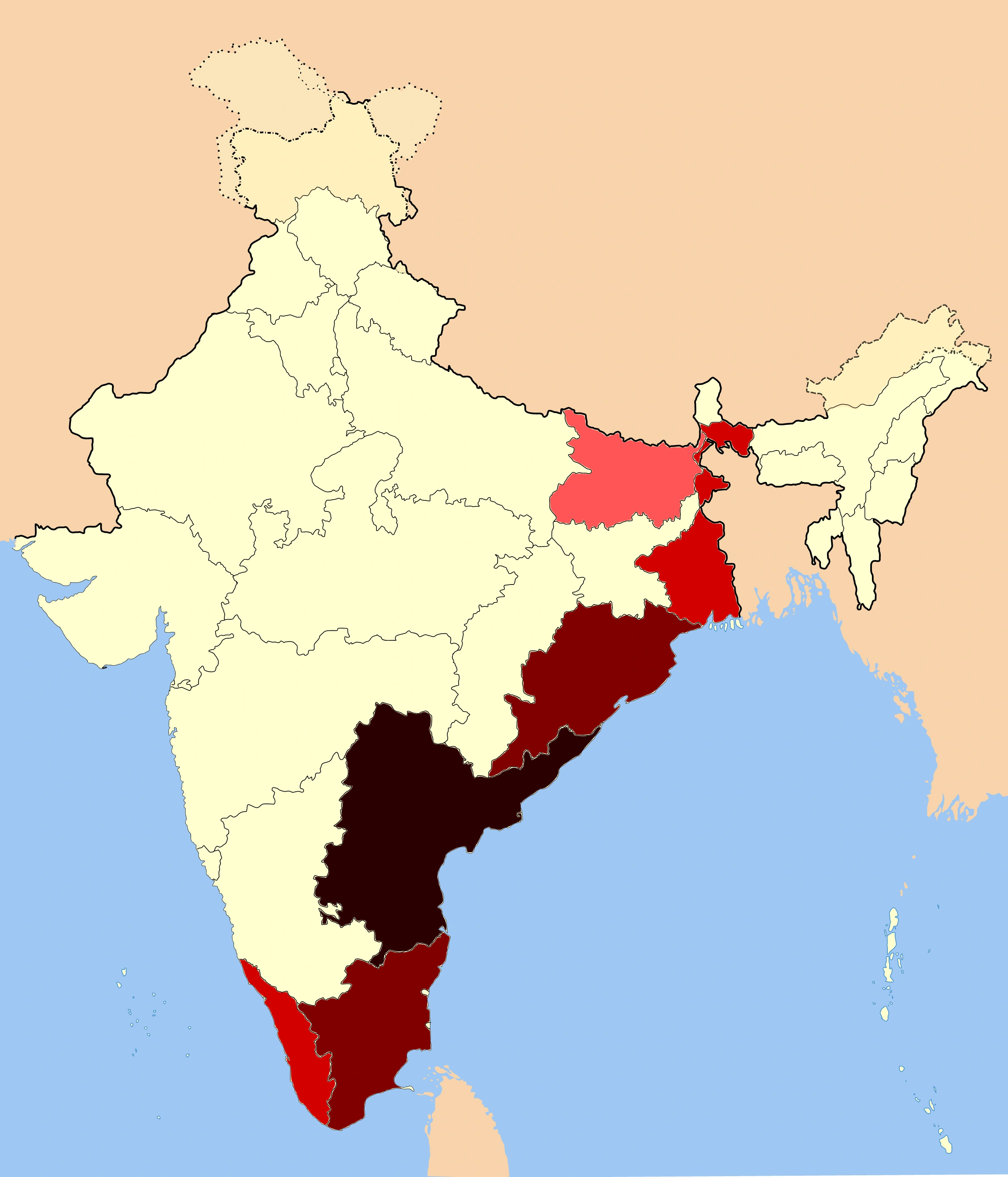
Thorium-bearing deposit locations from the 2012 source map. Thorium is not a rare-earth element; this is not an inventory of all critical minerals or current reserve totals.
- Read the source date and legend; distinguish territory, influence and geographic location.
- Historical boundaries and reference memberships are not live political or operational data.
Credit: Limulus · CC BY-SA 3.0 · sourceConverted to WebP on an opaque white background; proportionally resized without cropping. Original cartography and legend retained.
Map study
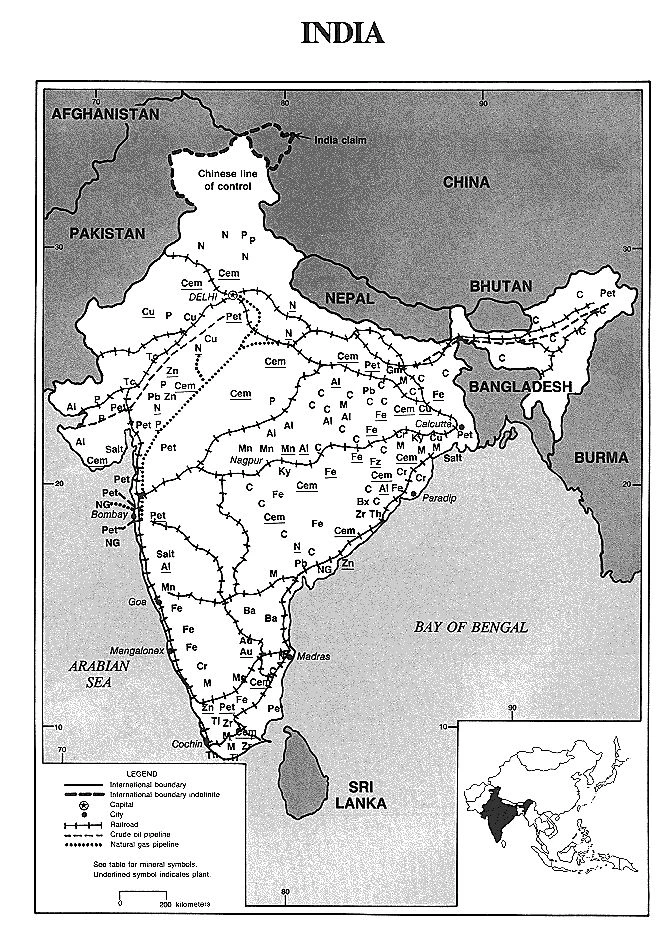
USGS reference map of mineral deposits and mineral industries in India. Historical place names and boundary depiction are retained from the source; not a current official political map, mine inventory or production dataset.
- Locate Fe (iron), Mn (manganese), Al (aluminium/bauxite-related) and C (coal) symbols; underlined symbols denote industrial plants, not deposits.
- Compare the eastern and peninsular mineral belts. The source legend does not establish present reserves, output or operating status.
- For current official boundary depiction and mineral statistics, consult Survey of India and Indian Bureau of Mines publications.
Credit: United States Geological Survey · Public domain (US federal government work) · sourceConverted to WebP without cropping or changing cartography; original legend retained.
1. Meaning, criticality and technological importance
Critical minerals are identified through two broad considerations: their economic or strategic importance and the risk of supply disruption. Risk may arise from concentrated production, dependence on imports, geopolitical instability, limited substitutes, low recycling rates or lengthy mine-development periods. Geological rarity alone does not determine criticality. A relatively abundant element can become critical when commercially viable deposits, processing facilities or specialised technologies are controlled by a small number of countries.
Criticality is country-specific and changes with technology, industrial demand and trade conditions. India’s 2023 list contains 30 entries: antimony, beryllium, bismuth, cobalt, copper, gallium, germanium, graphite, hafnium, indium, lithium, molybdenum, nickel, niobium, phosphorus, potash, rare earth elements, rhenium, selenium, silicon, strontium, tantalum, tellurium, tin, titanium, tungsten, vanadium, zirconium, cadmium and platinum group elements. Some entries represent groups rather than individual elements.
Applications extend beyond electric vehicles. Copper supports electricity networks; lithium and graphite are important battery materials; selected rare earths enable powerful permanent magnets; gallium and germanium serve specialised electronic and optical applications. Potash and phosphorus are important for fertilisers, connecting mineral security with agricultural productivity. Strategic minerals and critical minerals overlap, but the former term particularly emphasises defence and national-security requirements.
- Critical does not necessarily mean rare, radioactive or metallic.
- Rare earth elements are one category within the wider critical-minerals framework.
- Battery chemistries differ: lithium iron phosphate batteries do not require nickel or cobalt in their cathodes.
Timeline
2019
KABIL was incorporated to support acquisition of overseas mineral assets.
2023
India released its list of 30 critical minerals, joined the Minerals Security Partnership and amended the MMDR Act.
January 2024
KABIL signed an agreement with CAMYEN for lithium exploration and development in Catamarca, Argentina.
January 2025
The Union Cabinet approved the National Critical Mineral Mission.
2. World distribution and the geography of supply chains
Mineral supply chains have several geographically distinct stages: exploration, mining, concentration, refining, component manufacture and recycling. A country rich in ore may lack the facilities to produce battery-grade chemicals or high-purity metals. Consequently, diversified mining does not automatically produce a resilient supply chain. Processing concentration can remain a major vulnerability even when raw materials come from several continents.
Australia is a major producer of hard-rock lithium, commonly from spodumene-bearing pegmatites. Chile and Argentina produce lithium from salar brines; together with Bolivia they form the Lithium Triangle. Bolivia possesses substantial lithium resources, but resource size must not be confused with established commercial output. The Democratic Republic of the Congo dominates mined cobalt supply, while Indonesia is central to global nickel production. China has a particularly strong position in rare earth processing, graphite processing and several battery-material supply chains.
Ore characteristics shape both industrial geography and environmental pressures. Nickel occurs in sulphide deposits and tropical laterites, requiring different processing routes. Cobalt is commonly recovered as a by-product of copper or nickel mining, so its supply also responds to markets for those host metals. Several minor critical minerals, including gallium and germanium, are largely by-products, limiting the ability to expand production independently when demand rises.
- Map focus: Australia, China, Indonesia, the Democratic Republic of the Congo, Chile, Argentina and Bolivia.
- Supply concentration should be assessed separately for mining, refining and manufacturing.
- Export controls, transport disruption and rapid demand growth can magnify existing supply risks.
From mineral occurrence to usable industrial material
- 1. Geological mapping and reconnaissance
- 2. Exploration and resource estimation
- 3. Feasibility assessment, reserve evaluation and approvals
- 4. Mining and ore beneficiation
- 5. Refining and production of industrial-grade materials
- 6. Component manufacture and use
- 7. Collection, recycling and safe residual-waste disposal
3. India’s resource base and exploration challenges
India’s varied geology offers potential for several critical minerals, but exploration, processing capabilities and commercial viability remain uneven. In 2023, the Geological Survey of India reported an inferred lithium resource of 5.9 million tonnes in the Salal–Haimana area of Reasi district, Jammu and Kashmir. This was a G3-stage resource estimate, not a proved reserve or evidence of an operating lithium mine. Further exploration, metallurgical testing and economic and environmental appraisal are necessary.
Peninsular pegmatite belts are prospective for lithium, tantalum and related minerals. Graphite occurrences are known in states including Arunachal Pradesh, Odisha and Jharkhand. Odisha’s ultramafic belts, including Sukinda, are associated with nickel-bearing mineralisation. Copper mining centres include Khetri in Rajasthan, Malanjkhand in Madhya Pradesh and the Singhbhum belt in Jharkhand. These locations should be related to geological belts rather than memorised only as isolated points.
Coastal heavy-mineral sands in Kerala, Tamil Nadu, Odisha and Andhra Pradesh contain minerals such as ilmenite, rutile, zircon and monazite. Monazite carries rare earths and thorium, creating an interface between resource development and atomic-mineral regulation. India’s beach-sand rare earth resources are not automatically equivalent to a secure supply of all magnet-grade rare earths: mineral composition, separation technology and downstream manufacturing determine their usefulness.
- Exploration stages progress from G4 reconnaissance to G3 preliminary exploration, G2 general exploration and G1 detailed exploration.
- A reserve is the economically mineable portion established after applying relevant technical, economic, legal and environmental considerations.
- Domestic occurrence alone does not imply import independence or commercial production.
| Mineral | Major application | Important geographical association | Prelims caution |
|---|---|---|---|
| Lithium | Rechargeable batteries | Australian hard-rock deposits; South American salars | Resources are not equivalent to reserves or output |
| Cobalt | Selected battery cathodes; superalloys | Democratic Republic of the Congo | Often a copper or nickel by-product |
| Nickel | Stainless steel; selected battery cathodes | Indonesia | Not required by every lithium-ion battery chemistry |
| Graphite | Battery anodes; refractories | China; Indian occurrences in Arunachal Pradesh and Odisha | Natural and synthetic graphite are distinct supply routes |
| Rare earth elements | Magnets, catalysts and other specialised uses | China; Indian monazite-bearing beach sands | Not all rare earth elements are used in permanent magnets |
| Potash | Potassium fertilisers | Canada, Russia and Belarus | Critical-mineral security also concerns agriculture |
4. Laws, institutions and mineral-security initiatives
The Mines and Minerals (Development and Regulation) Act, 1957 is the principal framework for mineral development. Its 2023 amendment introduced an exploration licence for specified critical and deep-seated minerals. It also empowered the Union government to auction mining leases and composite licences for 24 critical and strategic minerals listed in Part D of the First Schedule. State governments grant the concessions following the prescribed process and receive the relevant mineral revenues.
The amendment removed six mineral categories, including lithium-bearing minerals, from the statutory atomic-minerals list, broadening participation under the amended framework. This did not remove all rare earth or monazite-related restrictions. Another important distinction is that the Ministry’s policy list of 30 critical minerals and the statutory list of 24 critical and strategic minerals are not identical instruments.
The National Critical Mineral Mission, approved in January 2025, seeks to strengthen exploration, mining, beneficiation, processing, recycling and overseas acquisition. The Geological Survey of India undertakes geoscientific exploration, while the Indian Bureau of Mines supports mineral-sector regulation and information. Khanij Bidesh India Limited, or KABIL, is a joint venture of NALCO, Hindustan Copper and MECL for overseas mineral assets. India joined the Minerals Security Partnership in 2023, complementing domestic measures with international cooperation.
- Auctioning a block is not equivalent to commencing production; exploration, clearances, financing and infrastructure remain necessary.
- Resource security requires processing technology and skilled personnel as well as access to deposits.
- Overseas partnerships reduce dependence only when projects become technically and commercially viable.
5. Sustainability, recycling and examination linkages
Critical minerals enable low-carbon technologies but their extraction is not impact-free. Mining can cause habitat fragmentation, waste generation, water contamination and displacement. Lithium-brine extraction raises concerns about water balances in arid basins. Nickel laterite processing can be energy-intensive and generate substantial residues. Some cobalt supply chains raise labour-rights concerns, while monazite processing requires safe management of radioactive constituents.
A sustainable strategy combines responsible domestic mining, diversified imports, efficient material use, substitution and recycling. Urban mining recovers materials from discarded electronics, batteries and other products. India’s Battery Waste Management Rules, 2022 and E-Waste (Management) Rules, 2022 use extended producer responsibility to support collection and recycling. However, recycling cannot immediately replace primary mining because demand is growing and many products have not yet reached the end of their useful lives.
For Prelims, focus on mineral–application pairs, producing countries, Indian deposits, legal distinctions and geological terminology. For analytical questions, connect mineral security with renewable-energy expansion, electric mobility, fertiliser availability, industrial competitiveness and local community rights. Substitution also creates trade-offs: reducing reliance on one mineral may increase requirements for another or alter performance, cost and recyclability. A resilient mineral economy therefore requires lifecycle assessment rather than a simple race to maximise extraction.
- Good governance includes transparent environmental appraisal, community participation, worker protection and mine-closure planning.
- Recycling yields depend on collection systems, product design, material concentration and commercially viable recovery technologies.
- Avoid treating low-carbon technologies as having zero material or environmental footprints.
Real-world case studies
KABIL’s lithium agreement in Argentina
In January 2024, KABIL signed an agreement with Catamarca Minera y Energética Sociedad del Estado, or CAMYEN, covering five lithium brine blocks over approximately 15,703 hectares in Catamarca province. The initiative illustrates overseas resource diversification. Exploration rights, however, do not guarantee immediate production or supplies to Indian battery factories.
Reasi lithium: interpreting a discovery correctly
The 2023 announcement of an inferred lithium resource at Salal–Haimana attracted attention because of India’s battery-material dependence. Its main examination lesson is the distinction between geological potential and commercial availability. Resource confidence, recovery technology, project economics and Himalayan environmental conditions must be evaluated before production can be assumed.
Previous year questions
No source-linked PYQ is available here yet. Use the practice questions below.
Practice questions
Practice MCQ 1
With reference to critical minerals, consider the following statements: 1. Geological rarity is a necessary condition for a mineral to be classified as critical. 2. Concentration of refining capacity can create supply risk even when mining is geographically diversified. 3. A country’s critical-minerals list may change with technological developments. Which of the statements given above are correct?
- A. 1 and 2 only
- B. 2 and 3 only
- C. 1 and 3 only
- D. 1, 2 and 3
Practice MCQ 2
Consider the following pairs: 1. Lithium Triangle — Argentina, Bolivia and Chile 2. Major cobalt mining centre — Democratic Republic of the Congo 3. Salal–Haimana lithium occurrence — Rajasthan. How many pairs are correctly matched?
- A. Only one
- B. Only two
- C. All three
- D. None
Practice MCQ 3
Which one of the following statements is correct?
- A. An inferred mineral resource is necessarily an economically mineable reserve.
- B. All lithium-ion batteries require cobalt in their cathodes.
- C. Monazite can contain both rare earth elements and thorium.
- D. Ownership of mineral deposits guarantees the capacity to produce battery-grade chemicals.
Mains practice · India’s critical-mineral security requires more than the discovery of domestic deposits. Discuss with reference to supply-chain geography, technological capability and environmental governance. Answer in 250 words.
- Define criticality through economic importance and supply risk.
- Distinguish resource discovery, reserve establishment and commercial production.
- Explain geographical concentration in mining and refining using cobalt, nickel, graphite and rare earths.
- Assess domestic exploration, the MMDR amendment, the National Critical Mineral Mission and overseas partnerships.
- Highlight beneficiation, refining, research, skilled personnel and component manufacturing.
- Address community rights, water stress, waste management and responsible mine closure.
- Conclude with diversification, substitution, recycling and lifecycle-based planning.
Further reading
- Ministry of Mines: Critical Minerals for India, Report of the Committee on Identification of Critical Minerals, June 2023.
- India Code: Mines and Minerals (Development and Regulation) Act, 1957, as amended.
- Press Information Bureau: Cabinet approval of the National Critical Mineral Mission, 29 January 2025.
- Geological Survey of India: Official publications on mineral exploration and critical minerals.
- Indian Bureau of Mines: Indian Minerals Yearbook.
- NCERT: India: People and Economy, Class XII, chapter on Mineral and Energy Resources.
- International Energy Agency: Global Critical Minerals Outlook.
Preparing for UPSC Civil Services? Get classroom teaching, answer-writing evaluation and mentorship at Pragnya IAS Academy, Ashok Nagar — see why aspirants choose us for IAS coaching in Hyderabad.