
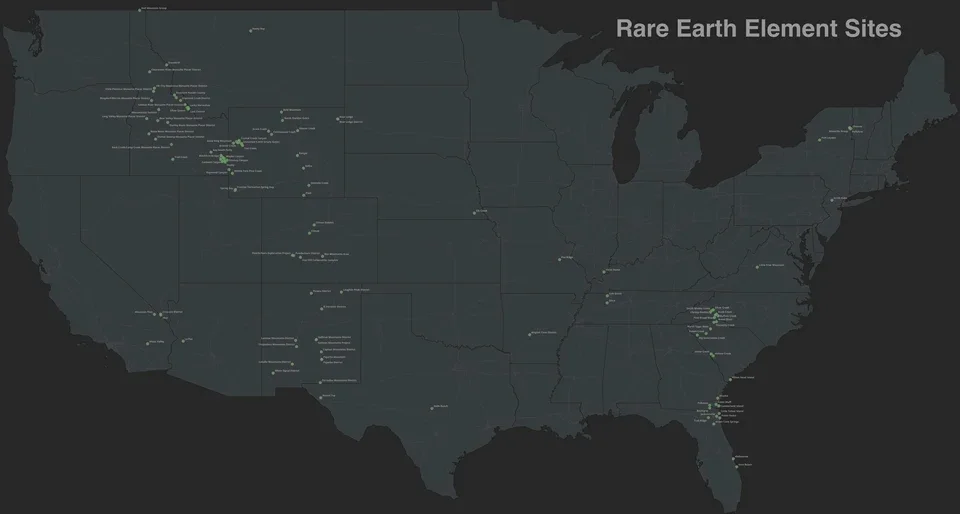
Illustrative rare-earth deposit map; mapped occurrences should not be read as operating mines.
Credit: Wikideas1 · CC0 · sourceResized and converted to WebP; uncropped.
Map study
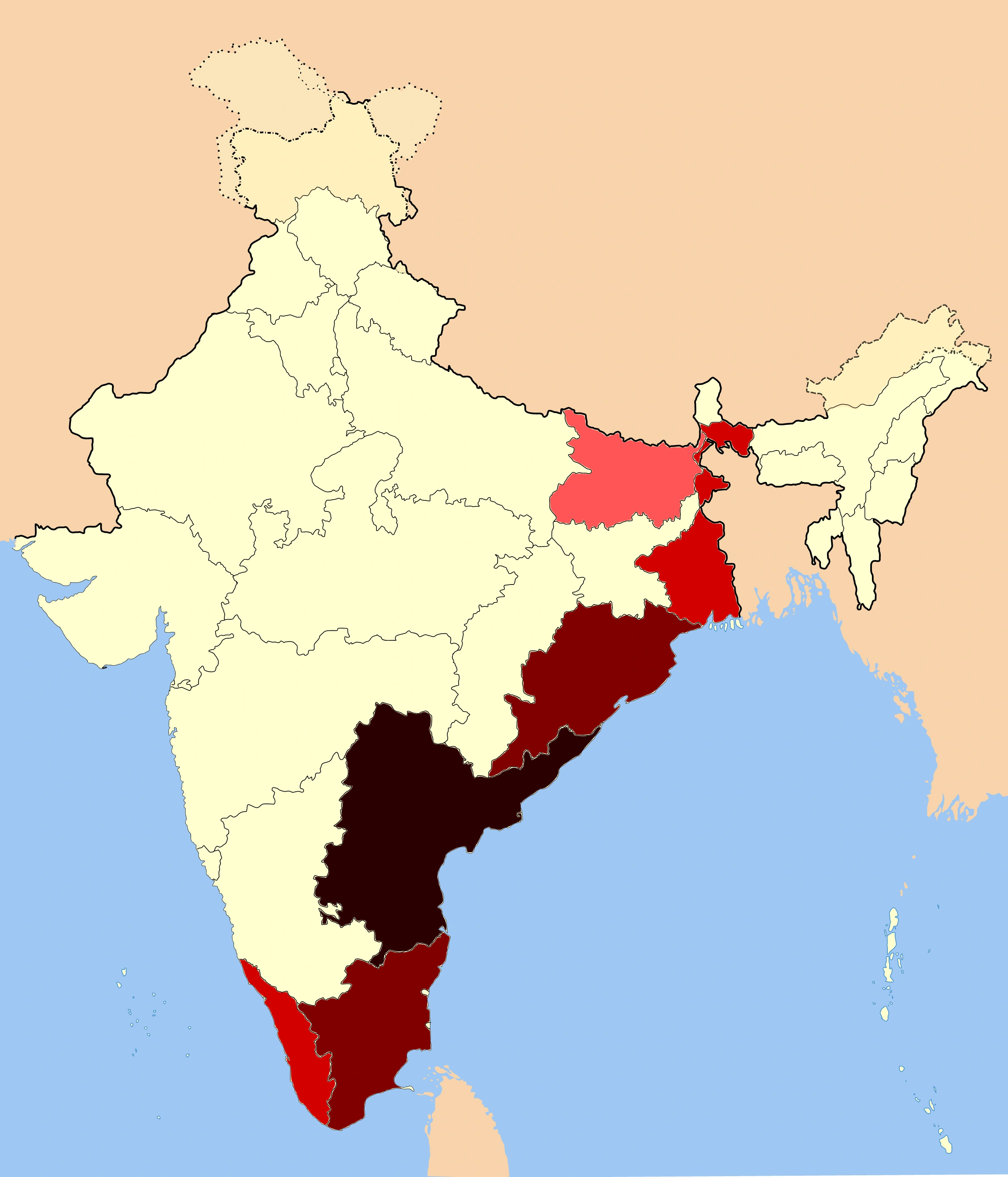
Thorium-bearing deposit locations from the 2012 source map. Thorium is not a rare-earth element; this is not an inventory of all critical minerals or current reserve totals.
- Read the source date and legend; distinguish territory, influence and geographic location.
- Historical boundaries and reference memberships are not live political or operational data.
Credit: Limulus · CC BY-SA 3.0 · sourceConverted to WebP on an opaque white background; proportionally resized without cropping. Original cartography and legend retained.
1. Meaning, classification and technological importance
Rare earth elements, commonly abbreviated as REEs, consist of the 15 lanthanides plus scandium and yttrium. These elements exhibit broadly similar chemical behaviour, and yttrium commonly occurs with lanthanide-bearing minerals. Promethium has no stable isotopes and is not recovered as a conventional mined rare-earth commodity. The expression 'rare earth' is historical: several members, including cerium, are relatively abundant in the crust, but they seldom form easily exploitable concentrations.
REEs are commonly divided into light and heavy rare earths, although the boundary varies between classification systems. Lanthanum, cerium, praseodymium and neodymium are familiar light rare earths. Dysprosium, terbium and lutetium belong to the heavier group; yttrium is usually discussed alongside heavy rare earths because of its geochemical associations. Scandium often has a distinct resource and market profile.
Their value arises from magnetic, optical, catalytic and other specialised properties. Neodymium and praseodymium are important for high-performance permanent magnets used in many electric-vehicle motors and wind-turbine generators. Dysprosium and terbium can improve magnet performance at elevated temperatures. Cerium is used in polishing and catalysts, lanthanum in catalysts and some battery alloys, and europium, terbium and yttrium in phosphors. Not every electric vehicle or wind turbine uses rare-earth permanent magnets.
- Prelims distinction: rare earths form a chemical grouping; critical minerals form a policy category based on economic importance and supply risk.
- Strategic importance depends on the particular element and application, not merely the total tonnage of rare-earth material.
2. Geological occurrence and Indian distribution
Primary rare-earth deposits occur in geological settings such as carbonatites, alkaline igneous complexes and some hydrothermal systems. Secondary deposits arise when weathering, erosion and sedimentary processes redistribute mineral grains or dissolved elements. Important deposit types include beach placers and ion-adsorption clays. Monazite is a rare-earth phosphate commonly containing thorium; bastnäsite is a rare-earth fluorocarbonate; xenotime is a yttrium phosphate.
India's most familiar rare-earth resource is monazite within heavy-mineral beach and dune sands. Weathering releases resistant minerals from source rocks, rivers transport them coastward, and waves and currents repeatedly sort the sediment. Dense grains become concentrated as lighter material is removed. The resulting placer assemblage may contain several economically valuable minerals, but ilmenite and rutile are titanium minerals rather than rare-earth minerals.
Important coastal belts occur in Kerala, Tamil Nadu, Odisha and Andhra Pradesh. Chavara in Kerala, the Manavalakurichi belt in Tamil Nadu and the Chatrapur area of Odisha are prominent mineral-sand localities. Maharashtra and other coastal stretches also contain occurrences. Inland exploration includes carbonatite and alkaline complexes such as Amba Dongar in Gujarat. An occurrence or resource estimate, however, does not automatically establish an economically mineable reserve.
Indian monazite is generally richer in light rare earths than in the heavy rare earths sought for some specialised applications. Resource assessment must therefore consider individual-element composition, grade, recoverability, radioactivity and processing costs. A large aggregate resource cannot by itself demonstrate self-sufficiency in every strategically important rare earth.
From mineral resource to strategic component
- 1. Explore and assess grade, element composition and environmental constraints
- 2. Mine and beneficiate ore or mineral sands
- 3. Chemically treat the concentrate to recover mixed rare-earth compounds
- 4. Separate and purify individual rare-earth oxides
- 5. Produce metals and alloys
- 6. Manufacture magnets or other specialised products
- 7. Collect end-of-life products and recover usable materials
3. Global geography and the processing bottleneck
China occupies the central position in global rare-earth supply chains, particularly separation, refining and magnet manufacturing. Bayan Obo in Inner Mongolia is a major rare-earth-bearing mining district, while deposits in southern China include ion-adsorption clays associated with heavy rare earths. Other significant supply locations include Mountain Pass in the United States and Mount Weld in Australia. Myanmar has also supplied heavy-rare-earth-bearing material to Chinese processors.
Mining is only the first stage of the value chain. Ore must be concentrated, chemically treated and separated into individual rare-earth products. Because neighbouring lanthanides have very similar chemical properties, separation can require many solvent-extraction stages. Producing high-purity metals, alloys and precisely engineered magnets adds further technical complexity, capital requirements and quality-control demands.
Consequently, mineral ownership and manufacturing security are different issues. A country may mine concentrate but depend on another country for separation or magnet production. Conversely, a manufacturer may secure supply through overseas mines and domestic processing. Export restrictions, geopolitical disputes, environmental enforcement and changes in demand can disrupt availability and prices.
Diversification therefore requires more than opening mines. It includes commercially viable separation plants, technical expertise, reliable energy and reagents, downstream manufacturing, long-term purchase agreements and recycling. Substitution and more efficient material use can reduce vulnerability, but alternatives may involve trade-offs in weight, performance or cost.
| Deposit or mineral | Key characteristic | Geographical example |
|---|---|---|
| Monazite-bearing coastal placers | Dense phosphate mineral; commonly contains light rare earths and thorium | Kerala, Tamil Nadu and Odisha coasts |
| Bastnäsite-bearing deposits | Fluorocarbonate mineral; commonly an important light-rare-earth source | Mountain Pass, United States |
| Carbonatite-associated deposits | Rare-earth mineralisation associated with carbonate-rich igneous systems | Mount Weld, Australia |
| Ion-adsorption clays | Rare-earth ions retained on clay surfaces; some deposits are important for heavy rare earths | Southern China and Myanmar |
| Xenotime | Yttrium phosphate commonly associated with heavy rare earths | Certain granitic, pegmatitic and placer settings |
4. India's institutions, regulation and policy priorities
India's rare-earth sector intersects with atomic-mineral governance because monazite commonly contains thorium, with potential relevance to India's long-term nuclear-fuel programme. The Department of Atomic Energy and its Atomic Minerals Directorate for Exploration and Research play important roles in exploration and assessment. IREL (India) Limited, a public-sector enterprise under the Department of Atomic Energy, operates mineral-sand facilities and undertakes rare-earth processing.
The Mines and Minerals (Development and Regulation) Act, 1957, the Atomic Energy Act, 1962, and associated rules form important parts of the legal framework. Applicable controls depend on mineral composition and statutory classification. Coastal mining must also meet environmental, coastal-zone and other regulatory requirements. General liberalisation of critical-mineral exploration should not be interpreted as unrestricted private mining of thorium-bearing monazite.
The Ministry of Mines identified 30 critical minerals for India in 2023, including rare earth elements. The 2023 amendment to the MMDR Act introduced reforms concerning critical and strategic minerals and an exploration-licence framework for specified minerals. In January 2025, the Union Cabinet approved the National Critical Mineral Mission, envisaging government expenditure of ₹16,300 crore and expected investment of ₹18,000 crore from public-sector undertakings and other stakeholders during 2024–25 to 2030–31.
For rare earths, the central policy task is to connect exploration with separation, metal and alloy production, component manufacturing and recycling. International partnerships can diversify access, but domestic capabilities in process technology and high-value products remain essential. Reporting progress only in terms of discovered resources can obscure dependence at later stages of the supply chain.
5. Environmental concerns and sustainable resource strategy
Rare-earth development can generate substantial environmental pressures. Chemical processing uses acids, alkalis and other reagents and produces residues requiring secure management. Where ores contain thorium or uranium, naturally occurring radioactive material creates additional occupational and waste-management obligations. The hazard depends on the deposit and process: not all rare-earth ores have identical radioactive characteristics.
Coastal placer extraction presents distinct geographical concerns. Poorly planned operations can disturb dunes, sediment movement, groundwater conditions and coastal habitats. Fishing communities and other local users may face livelihood impacts. Mining proposals therefore require site-specific assessment rather than the assumption that all beach-sand extraction is either harmless or uniformly damaging.
A sustainable strategy combines environmental baselines, radiation protection, water recycling, secure residue storage, progressive restoration and community participation. Recycling magnets and manufacturing scrap can supplement primary supply, although collection, disassembly and separation remain difficult. The exam-relevant conclusion is that India's opportunity lies in responsible, integrated value-chain development, not simply in possessing monazite-rich sands.
Rare-earth deposits and the geography of supply
A rare-earth deposit map helps distinguish geological occurrence from industrial supply. The supplied metadata explicitly notes that most locations represent deposits rather than active mines. A mapped deposit does not establish economically recoverable reserves, annual production or processing capacity. Commercial viability depends on mineral composition, grade, extraction costs, infrastructure and environmental requirements. The metadata references Mountain Pass in California, but its statement about operating status is time-sensitive and should not be treated as a verified current inventory.
For India, this distinction explains why mineral endowment does not automatically produce strategic self-reliance. Monazite-bearing coastal placer sands are an important rare-earth resource: weathering releases resistant minerals, while waves and currents concentrate heavy grains along suitable coastal stretches. However, mining is only the first link in a chain that includes beneficiation, chemical separation, refining and component manufacture. Associated thorium brings radiological safeguards and atomic-mineral regulation into the discussion. The overseas example offers comparative context, not evidence for the location, size or mineability of Indian deposits.
- The 17 rare earths comprise 15 lanthanides plus scandium and yttrium; “rare” does not mean uniformly scarce in the crust.
- Do not equate resources with reserves, or mine output with separated oxides, metals and magnets: each measures a different supply-chain capability.
- For Mains, connect supply security with coastal ecosystems, radioactive residues, recycling and processing technology; deposit maps alone cannot establish these outcomes.
Real-world case studies
Odisha: connecting coastal minerals with rare-earth processing
IREL's Odisha Sands Complex near Chatrapur in Ganjam district illustrates India's coastal mineral-sand resource base. Its Rare Earth Extraction Plant processes monazite to produce mixed rare-earth chloride. Further separation at IREL's Rare Earths Division in Aluva, Kerala, illustrates how extraction and higher-value processing may occur at different locations within one domestic supply chain.
Australia–Malaysia: a geographically distributed value chain
Lynas mines rare-earth ore at Mount Weld in Western Australia and operates major separation facilities in Malaysia, alongside processing infrastructure in Australia. This arrangement demonstrates that the location of mineral deposits need not coincide with downstream processing. It also highlights the importance of environmental licensing and residue management in diversifying supply beyond China.
Previous year questions
No source-linked PYQ is available here yet. Use the practice questions below.
Practice questions
Practice MCQ 1
Consider the following elements: 1. Yttrium 2. Scandium 3. Lithium 4. Neodymium. Which of the above are rare earth elements?
- A. 1 and 4 only
- B. 1, 2 and 4 only
- C. 2 and 3 only
- D. 1, 2, 3 and 4
Practice MCQ 2
With reference to India's coastal mineral sands, consider the following statements: 1. Wave and current action can concentrate dense minerals into placer deposits. 2. Monazite commonly contains thorium. 3. Ilmenite and rutile are principally rare-earth-bearing minerals. Which of the statements given above are correct?
- A. 1 only
- B. 2 and 3 only
- C. 1 and 2 only
- D. 1, 2 and 3
Practice MCQ 3
Which of the following best explains why substantial domestic rare-earth resources may not ensure strategic self-sufficiency?
- A. Every rare earth element is too scarce to permit commercial mining.
- B. All rare earth elements have identical industrial uses.
- C. Rare earth elements occur exclusively in coastal sands.
- D. Resource composition, separation capacity and downstream manufacturing may not match industrial requirements.
Mains practice · India's rare-earth resource endowment does not automatically translate into strategic mineral security. Discuss with reference to resource geography, processing constraints and environmental governance. Answer in 250 words.
- Define rare earths and distinguish geological abundance from economic availability.
- Map monazite-bearing coastal belts in Kerala, Tamil Nadu, Odisha and Andhra Pradesh.
- Explain light-versus-heavy rare-earth composition and its implications for industrial demand.
- Identify bottlenecks in separation, high-purity metals, alloys and permanent-magnet manufacturing.
- Discuss DAE institutions, monazite's thorium association and the National Critical Mineral Mission.
- Address coastal ecology, radioactive residues, rehabilitation and community participation.
- Conclude with integrated domestic capacity, diversified international partnerships and recycling.
Further reading
- NCERT, India: People and Economy, Class XII, chapter on Mineral and Energy Resources.
- Ministry of Mines, Critical Minerals for India, 2023.
- Indian Bureau of Mines, Indian Minerals Yearbook, chapter on Rare Earths.
- Atomic Minerals Directorate for Exploration and Research, official resources on beach-sand and offshore minerals.
- IREL (India) Limited, official information on operating units and rare-earth products.
- Press Information Bureau, Cabinet approval of the National Critical Mineral Mission, 29 January 2025.
- United States Geological Survey, Mineral Commodity Summaries, Rare Earths.
- https://commons.wikimedia.org/wiki/File:Rare_Earth_Elements_Map_01.webp
Preparing for UPSC Civil Services? Get classroom teaching, answer-writing evaluation and mentorship at Pragnya IAS Academy, Ashok Nagar — see why aspirants choose us for IAS coaching in Hyderabad.