
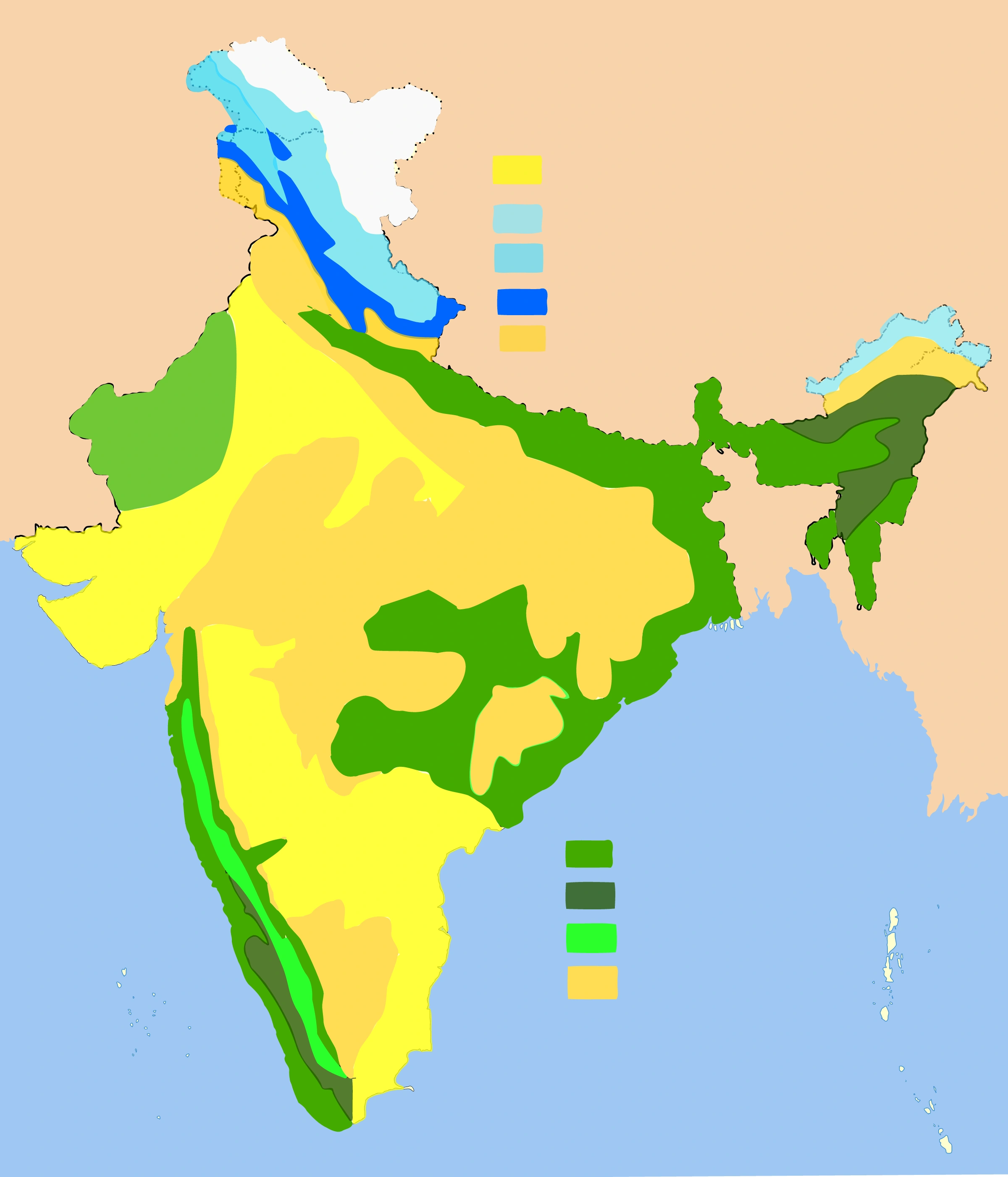
Map study
Natural vegetation zones: relate patterns to rainfall, relief and temperature. Potential natural vegetation differs from measured current forest cover.
- Read the source legend, scale and reference period before comparing regions.
- Connect spatial patterns to the processes discussed in this topic; this map is a study reference, not live operational data.
Credit: Amog · CC BY-SA 3.0 · sourceConverted to WebP on an opaque white background; proportionally resized without cropping. Original cartography and legend retained.
1. What constitutes a forest resource?
Forest resources comprise both tangible products and ecological functions. Provisioning resources include timber, poles, fuelwood, fodder, bamboo, fibres, gums, resins, latex, medicinal plants and edible products. Regulating services include carbon sequestration, local climate moderation, erosion control, groundwater recharge and flood regulation. Forests also support pollination, biodiversity, recreation and cultural practices. Their economic value therefore extends well beyond the market price of harvested wood.
The Forest Survey of India, headquartered at Dehradun under the Ministry of Environment, Forest and Climate Change, publishes the biennial India State of Forest Report. It assesses forest cover primarily through satellite data supported by field verification. Forest cover means land exceeding one hectare with tree-canopy density above 10%, irrespective of ownership, legal status or tree species. Orchards, bamboo and plantations can therefore qualify.
Recorded forest area is land recorded as forest in government records, whether or not it currently has adequate canopy. Conversely, qualifying tree-covered land outside recorded forests can be counted as forest cover. Tree cover accounts for small tree patches and scattered trees outside recorded forest areas that are not captured under forest cover. Consequently, an increase in measured cover does not necessarily indicate recovery of biodiverse natural forests.
- Very dense forest: canopy density of 70% or more.
- Moderately dense forest: canopy density of 40% or more but below 70%.
- Open forest: canopy density of 10% or more but below 40%.
- Scrub: degraded forest land with canopy density below 10%; reported separately from forest cover.
2. Geographical distribution and forest types
Rainfall, temperature, elevation, soils and human intervention shape forest distribution. Tropical evergreen forests occur in warm, humid areas generally receiving over 200 cm of annual rainfall, notably the Western Ghats, northeastern hills and Andaman and Nicobar Islands. Their multilayered canopy and high species diversity contrast with deciduous forests. Evergreen does not mean that individual leaves never fall: leaf replacement occurs without a uniform leafless season.
Tropical deciduous forests are India’s most widespread forest formation. Moist deciduous forests broadly occur in areas receiving 100–200 cm of rainfall, while dry deciduous forests occupy a lower rainfall range, commonly 70–100 cm in school-level classifications. Sal characterises substantial tracts of northern, central and eastern India; teak is prominent in central and peninsular regions. These ranges overlap because local ecological conditions also matter.
Thorn forests and scrub occur in dry northwestern India and rain-shadow interiors of the peninsula. Himalayan forests display altitudinal zonation: subtropical formations give way to temperate broadleaf and coniferous forests, followed by subalpine vegetation and alpine grasslands. Mangroves occupy suitable intertidal coasts and estuaries, especially the Sundarbans and major east-coast deltas.
ISFR 2023 identifies Madhya Pradesh as having the largest forest-cover area, followed by Arunachal Pradesh and Chhattisgarh. Percentage rankings differ: Lakshadweep leads among States and Union Territories, while Mizoram leads among states. Always distinguish absolute area, percentage cover, and combined forest-and-tree cover when interpreting rankings.
- Champion and Seth’s classification recognises 16 major forest-type groups; these are ecological groups, not canopy-density categories.
- India’s mangrove cover in ISFR 2023 is about 4,992 km²; West Bengal has the largest share.
- Mangrove adaptations include salt tolerance and specialised roots; pneumatophores and vivipary occur in particular mangrove species, not universally.
Ecologically sound forest restoration
- 1. Assess degradation, tenure and livelihood dependence
- 2. Identify native ecosystems and causes of damage
- 3. Plan with Gram Sabhas and relevant rights holders
- 4. Protect regeneration and restore where necessary
- 5. Monitor biodiversity, soil, water and livelihood outcomes
3. Livelihoods, industries and ecosystem services
Forests supply raw materials to construction, furniture, paper, handicraft and pharmaceutical industries. Non-timber forest products are particularly important for forest-dependent households because collection often complements agriculture and provides income during lean seasons. Tendu leaves, mahua flowers and seeds, sal seeds, lac, honey, tamarind and medicinal plants are important examples. Excessive extraction, however, can reduce regeneration and future livelihood security.
Bamboo is botanically a grass. The Indian Forest Act was amended in 2017 to remove bamboo from the definition of trees, easing felling and transit restrictions for bamboo grown outside forests. Bamboo in forests remains subject to the relevant forest framework. The restructured National Bamboo Mission promotes plantations, processing and market linkages, particularly on non-forest land.
Forested catchments protect reservoirs and agricultural land by reducing soil erosion and sediment delivery. Roots, litter and soil organisms support infiltration and nutrient cycling, although hydrological outcomes depend on species, rainfall and management. Mangroves can reduce coastal erosion and storm-wave impacts while providing nursery habitats for aquatic organisms. Agroforestry and farm forestry can supply wood and diversify incomes, but plantations cannot fully replace the biodiversity, carbon stores and cultural functions of natural forests.
- The Minimum Support Price mechanism for minor forest produce and Van Dhan initiatives seek to improve collection, value addition and market returns.
- Agroforestry integrates trees with crops and/or livestock; social forestry emphasises trees for community needs outside conventional forestry settings.
| Concept | Basis | Important implication |
|---|---|---|
| Forest cover | Area and canopy thresholds | Can include qualifying plantations and orchards |
| Recorded forest area | Government land records | May include areas without adequate tree canopy |
| Reserved forest | Legal status under forest law | Not synonymous with very dense forest |
| Protected forest | Legal status under forest law | Not synonymous with a national park or sanctuary |
| Community forest resource rights | Rights recognised under the Forest Rights Act | Support community conservation and management |
4. Legal framework and community governance
The Indian Forest Act, 1927 provides the framework for reserved, protected and village forests. These are legal categories, not indicators of canopy density. Reserved forests generally impose more restrictive controls, while protected forests allow the state to regulate specified activities and rights. A protected forest under this Act is not the same as a wildlife protected area.
The Forest (Conservation) Act, 1980, renamed the Van (Sanrakshan Evam Samvardhan) Adhiniyam, 1980 through the 2023 amendment, regulates specified changes in forest-land use and ordinarily requires prior Central approval for diversion to non-forest purposes. Its scope must be read with applicable amendments and judicial directions. Forest approval is distinct from environmental clearance and wildlife approval; one does not automatically replace another.
The Forest Rights Act, 2006 recognises eligible individual and community rights of Scheduled Tribes and other traditional forest dwellers. These include rights over minor forest produce and rights to protect, regenerate, conserve or manage community forest resources. The Gram Sabha initiates the claims process and has important conservation responsibilities. Joint Forest Management, promoted through the 1990 central circular, provides another participatory arrangement, but committee-based benefit sharing is not equivalent to statutory rights under the Act.
- Article 48A directs the State to protect the environment and safeguard forests and wildlife; Article 51A(g) establishes a related fundamental duty of citizens.
- The Compensatory Afforestation Fund Act, 2016 governs funds associated with forest diversion and compensatory measures.
5. Threats, restoration and examination priorities
Forest degradation arises from fragmentation, infrastructure, mining, overharvesting, invasive species, excessive grazing and poorly managed fires. Climate change can intensify heat and moisture stress. A landscape may retain its canopy-cover classification while losing native species, large trees or wildlife connectivity. Assessment should therefore consider ecological quality alongside area.
Restoration should prioritise protection of existing natural forests, assisted natural regeneration, locally appropriate native species and secure community participation. Fire prevention requires early warning, local preparedness and context-sensitive management rather than treating every ecosystem identically. The Green India Mission links increased forest and tree cover with improved ecosystem services and livelihoods. Compensatory plantations are useful mitigation measures, but cannot immediately recreate old-growth ecosystems or eliminate the social costs of diversion.
- Prelims distinction: forest type describes ecological composition; density class describes canopy closure; legal category describes administrative status.
- Policy targets are aspirations, not current achievements or compulsory minimum cover for every state.
- Forest loss and forest degradation are different: degradation can occur without complete conversion to another land use.
Real-world case studies
Mendha-Lekha, Maharashtra
This village in Gadchiroli district is a widely cited example of community forest rights and Gram Sabha-led bamboo management. It demonstrates how recognised rights, collective rules and control over forest-produce marketing can connect conservation with local livelihoods.
Sundarbans, West Bengal
The Indian Sundarbans forms part of the transboundary Ganga–Brahmaputra–Meghna delta. Its mangroves support fisheries, biodiversity and coastal protection. Cyclones, erosion, salinity changes and sea-level rise show why conservation must address tidal hydrology and sediment flows, not merely tree planting.
Previous year questions
No source-linked PYQ is available here yet. Use the practice questions below.
Practice questions
Practice MCQ 1
With reference to forest assessment in India, consider the following statements: 1. Forest cover can include qualifying tree plantations outside recorded forests. 2. Every reserved forest is necessarily classified as very dense forest. 3. Recorded forest area is based on government records. Which statements are correct?
- A. 1 and 2 only
- B. 1 and 3 only
- C. 2 and 3 only
- D. 1, 2 and 3
Practice MCQ 2
Which one of the following pairs is correctly matched?
- A. Very dense forest — Canopy density of 40% to below 70%
- B. Open forest — Canopy density below 10%
- C. Moderately dense forest — Canopy density of 40% to below 70%
- D. Scrub — Canopy density of 70% or more
Practice MCQ 3
Consider the following statements: 1. Bamboo is botanically a grass. 2. The 2017 amendment eased restrictions on bamboo grown outside forests. 3. The Forest Rights Act recognises only individual cultivation rights. Which statements are correct?
- A. 1 only
- B. 2 and 3 only
- C. 1 and 2 only
- D. 1, 2 and 3
Mains practice · An increase in forest and tree cover does not necessarily imply an improvement in forest ecosystem health. Discuss with reference to India. Suggest measures for ecologically sound and socially inclusive forest management. (250 words)
- Distinguish satellite-based cover, recorded forest area and natural forest quality.
- Explain how plantations may increase cover without equivalent biodiversity or ecosystem services.
- Discuss fragmentation, degradation, invasive species and livelihood dependence.
- Link restoration with native species, natural regeneration and wildlife connectivity.
- Emphasise Gram Sabha participation and implementation of community forest resource rights.
- Recommend monitoring biodiversity, carbon, hydrology and livelihood outcomes alongside canopy area.
Further reading
- NCERT, India: Physical Environment, Class XI, chapter on Natural Vegetation.
- Forest Survey of India, India State of Forest Report 2023 and its glossary.
- Ministry of Environment, Forest and Climate Change, National Forest Policy, 1988.
- India Code: Indian Forest Act, 1927; Van (Sanrakshan Evam Samvardhan) Adhiniyam, 1980; Compensatory Afforestation Fund Act, 2016.
- Ministry of Tribal Affairs: Forest Rights Act, 2006, Rules and implementation guidelines.
Preparing for UPSC Civil Services? Get classroom teaching, answer-writing evaluation and mentorship at Pragnya IAS Academy, Ashok Nagar — see why aspirants choose us for IAS coaching in Hyderabad.