

desi punjab
Credit: Olivepaktehi · CC BY-SA 4.0 · source

A view of field with Millet crop in Rajasthan
Credit: राजु सुथार · CC BY-SA 3.0 · source
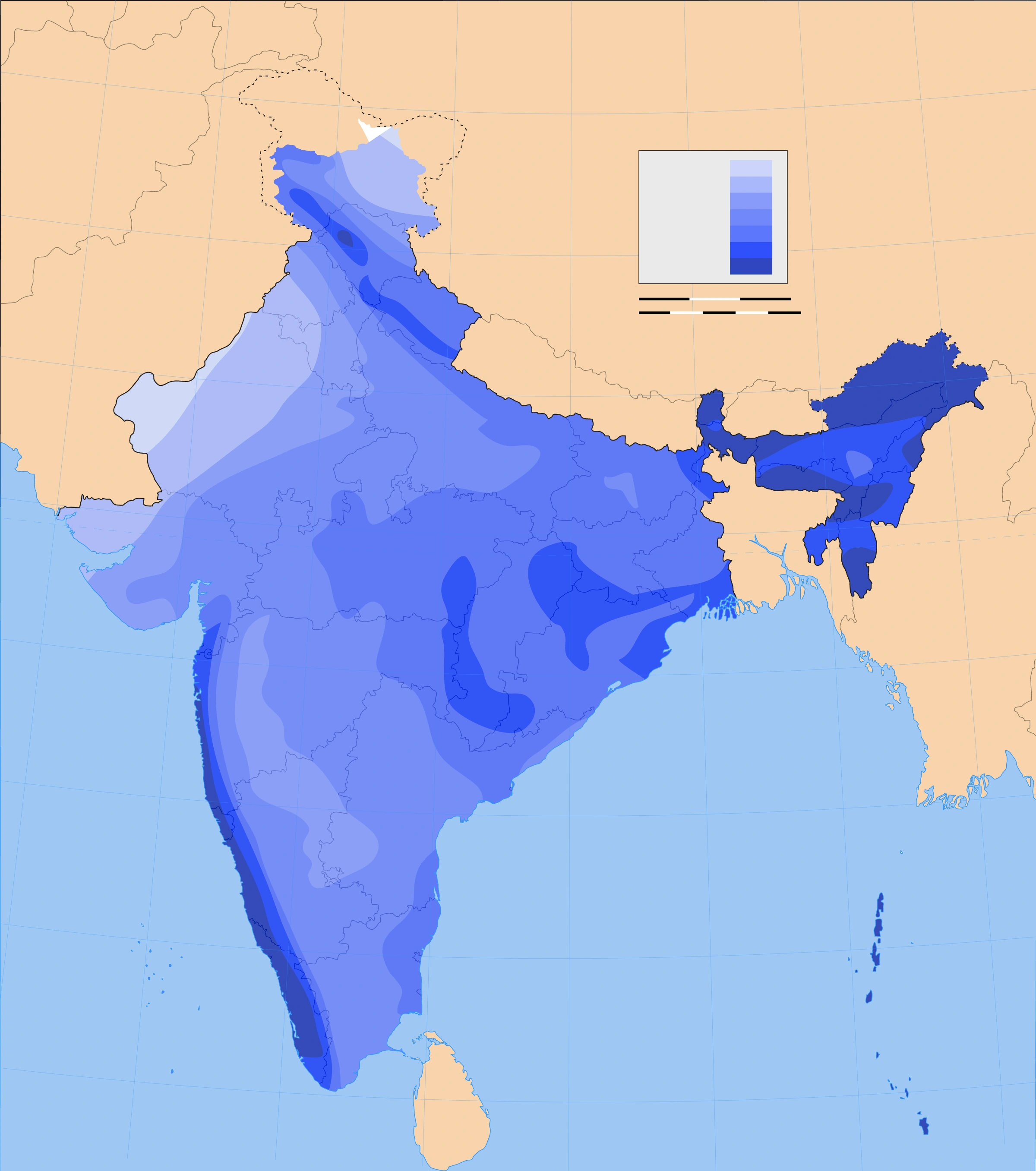
Map study
Annual rainfall distribution: compare the western coast and northeast with the dry northwest and rain-shadow interior. Historical climatological reference, not a current-year forecast.
- Read the source legend, scale and reference period before comparing regions.
- Connect spatial patterns to the processes discussed in this topic; this map is a study reference, not live operational data.
Credit: Planemad · CC BY-SA 3.0 · sourceConverted to WebP on an opaque white background; proportionally resized without cropping. Original cartography and legend retained.
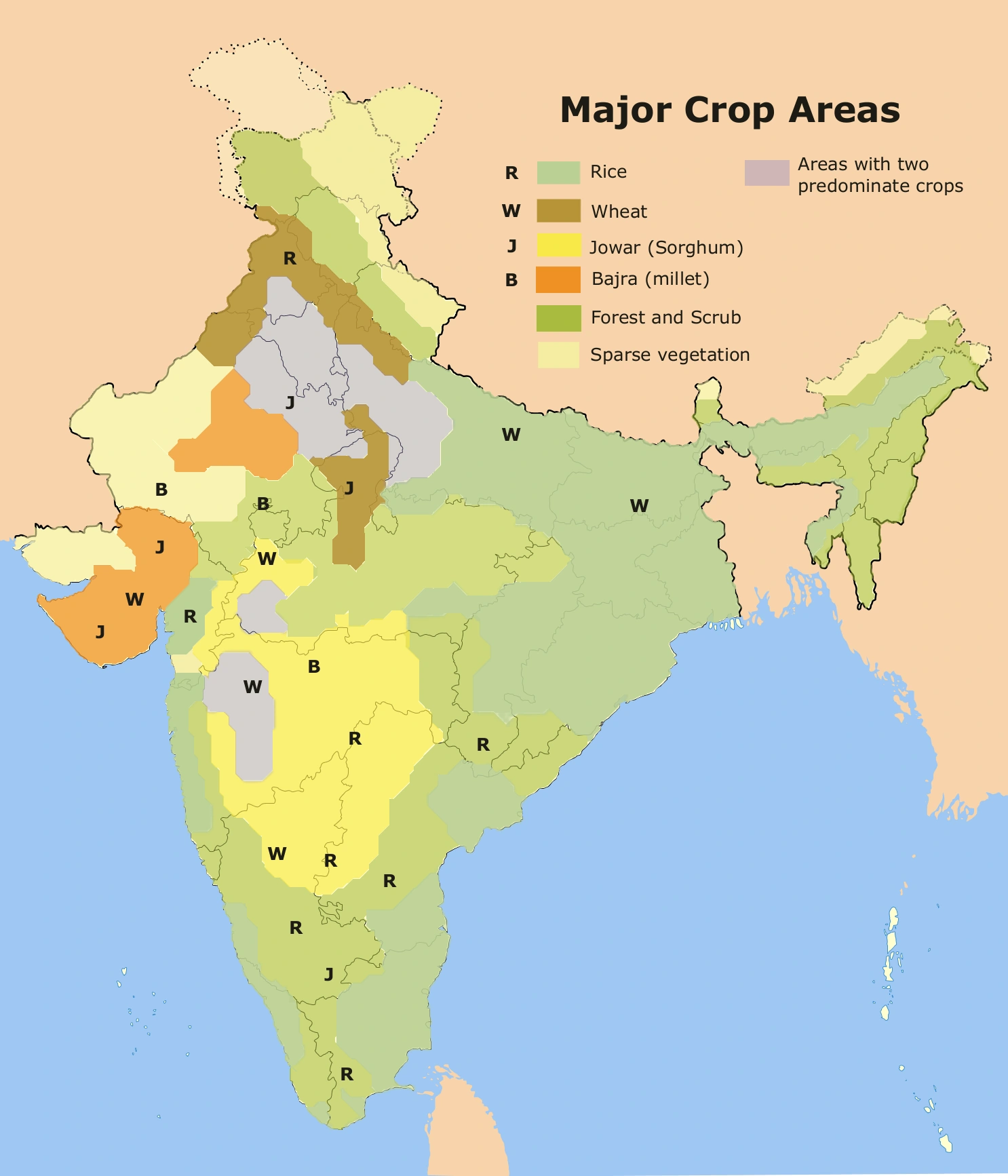
Map study
Major crop regions of India: relate crop belts to rainfall, soils, temperature and irrigation. Schematic historical reference, not current production rankings.
- Read the source legend, scale and reference period before comparing regions.
- Connect spatial patterns to the processes discussed in this topic; this map is a study reference, not live operational data.
Credit: Amog · CC BY-SA 2.5 · sourceConverted to WebP on an opaque white background; proportionally resized without cropping. Original cartography and legend retained.
1. Meaning and measurement
Cropping pattern refers to the proportion of cultivated land devoted to different crops and their spatial and seasonal distribution. A district dominated by rice differs from one combining millets, pulses and oilseeds, even if their total cultivated areas are similar. Patterns can be studied at farm, district, agro-climatic region or national scales. They change with technology, prices, water availability and household requirements.
Net area sown counts land cultivated at least once during an agricultural year. Gross cropped area counts each sowing separately: one hectare growing rice followed by wheat contributes one hectare to net area sown but two hectares to gross cropped area. Consequently, cropping intensity measures repeated cultivation, not yield, profitability or ecological sustainability. An intensity of 150% means gross cropped area is one-and-a-half times net area sown.
Crop diversification means broadening the crop portfolio, often towards pulses, oilseeds, horticulture or fodder. It is distinct from intensification, which may simply involve cultivating the same limited set of crops more frequently. Diversification may reduce exposure to crop-specific risks, although perishable produce requires reliable transport, storage and markets.
2. Agricultural seasons and climatic controls
Kharif crops are generally sown with the southwest monsoon during June–July and harvested during September–October or later. Rice, maize, cotton, soybean, groundnut, jowar, bajra and many pulses are important examples. Monsoon onset determines sowing opportunities, while dry spells, excessive rainfall and early withdrawal affect establishment, flowering and harvest. Cotton and pigeonpea may occupy fields well beyond the main monsoon months.
Rabi crops are generally sown during October–December and harvested during March–April, with regional variation. Wheat, barley, gram, peas, mustard and linseed are prominent. They use residual soil moisture, irrigation or winter rainfall. Wheat benefits from cool growing conditions and comparatively warm, dry ripening weather. Western disturbances provide useful winter rainfall in northwestern India, although hail and unseasonal rain can damage mature crops.
Zaid is the short summer season between the principal rabi harvest and kharif sowing, broadly March–June. Irrigation commonly supports watermelon, muskmelon, cucumber, vegetables, fodder and summer green gram. Seasonal labels must not be treated as absolute: rice can be grown in several seasons in irrigated eastern and southern India, while maize and pulses also have region-specific seasonal calendars.
Sugarcane is a long-duration crop rather than a typical short-season kharif or rabi crop. Tea, coffee and rubber are perennial plantation crops. Their establishment and production cycles cannot be explained adequately through the three-season classification.
Assessing a region’s cropping pattern
- 1. Identify rainfall, temperature, soils and relief
- 2. Assess irrigation and seasonal water availability
- 3. Match crop duration with the available growing period
- 4. Examine labour, inputs, prices, procurement and markets
- 5. Evaluate profitability, production risks and ecological costs
3. Determinants and regional patterns
Rainfall amount, timing and reliability influence crop choice. Rice generally favours warm conditions and abundant moisture, whereas bajra and several other millets tolerate comparatively dry environments. Soil texture, depth, drainage and nutrient availability matter alongside climate. Black soils retain moisture and support cotton in the Deccan, but cotton is not confined to black soils. Jute is associated with the warm, humid conditions and alluvial soils of eastern India.
Rice dominates many humid eastern and coastal plains and irrigated deltaic tracts. Wheat is concentrated in northern and central India, including Uttar Pradesh, Punjab, Haryana and Madhya Pradesh. Western Rajasthan supports bajra and other dryland crops. The Deccan combines cotton, jowar, pulses and oilseeds, while soybean is especially important in Madhya Pradesh and adjoining central India. Groundnut is prominent in Gujarat and parts of peninsular India.
Relief and altitude create further differentiation. Tea is associated with Assam, northern West Bengal and southern hill areas; coffee is concentrated in the southern hill regions, particularly Karnataka. Apples favour suitable temperate hill environments. These associations are broad tendencies, not exclusive boundaries: irrigation, improved varieties and market access allow cultivation beyond traditional centres.
Economic and institutional determinants include input costs, labour, mechanisation, tenancy, credit, processing facilities and expected prices. Minimum Support Prices, procurement and assured market access influence choices, but procurement coverage differs across crops and states. Food Corporation of India and state-agency procurement, combined with irrigation and Green Revolution technologies, helped consolidate rice–wheat systems in northwestern India.
| Arrangement | Identifying feature | Example |
|---|---|---|
| Sequential cropping | Next crop follows the previous harvest | Rice–wheat |
| Mixed cropping | Crops grown together without distinct rows | Wheat and gram mixed together |
| Intercropping | Crops grown together in defined arrangements | Soybean–pigeonpea rows |
| Relay cropping | Next crop sown before the standing crop is harvested | Lentil sown into standing rice |
| Crop rotation | Planned succession across seasons or years | Maize–wheat–green gram |
4. Cropping systems and their distinctions
Multiple cropping means harvesting more than one crop from the same field within a year. Sequential cropping grows crops one after another, such as rice followed by wheat. Relay cropping introduces the next crop before the standing crop is harvested; broadcasting lentil or grass pea into a maturing rice field is an example where local moisture conditions permit.
Mixed cropping grows two or more crops together without a distinct row arrangement, often to spread production risk. Intercropping uses an identifiable arrangement, such as alternating rows of soybean and pigeonpea. Differences in crop height, rooting depth and growth duration can improve resource use, although incompatible combinations may intensify competition for water, nutrients or light.
Crop rotation is the planned succession of different crops on the same land across seasons or years. Including legumes can contribute biologically fixed nitrogen through symbiosis with rhizobia and help interrupt some pest and disease cycles. The benefit to subsequent crops depends on residue management and nutrient removal. Monoculture denotes dominance or repeated cultivation of one crop; it is not synonymous with growing only one crop per year.
5. Changing patterns and sustainability
The Green Revolution increased cereal productivity and encouraged specialisation in irrigated regions. Later growth in urban demand, dairy production, processing and exports created incentives for vegetables, fruits, fodder and commercial crops. However, high-value crops do not automatically guarantee stable incomes: price crashes, perishability and quality requirements can expose farmers to substantial risks.
Ecological suitability can diverge from private profitability. Water-intensive rice in groundwater-stressed northwestern areas and sugarcane in drought-prone parts of Maharashtra illustrate this tension. Repeated cereal cultivation may also contribute to nutrient imbalance and pest pressures. Short turnaround periods between rice harvesting and wheat sowing create residue-management challenges. Climate change adds risks through erratic rainfall, heat stress and changing pest incidence.
Improvement requires region-specific choices rather than uniform crop substitution. Options include pulses and millets in suitable drylands, shorter-duration varieties, legume rotations, improved drainage, efficient irrigation and weather-based advisories. Per Drop More Crop promotes micro-irrigation, while Soil Health Cards support nutrient management. Diversification also requires procurement or dependable buyers, processing, extension and storage; changing crops without changing market incentives may shift rather than reduce farmers’ risks.
Real-world case studies
Punjab: rice–wheat specialisation
Irrigation, high-yielding varieties and assured procurement encouraged rice–wheat cultivation. Groundwater depletion illustrates the costs of concentrating water-demanding crops in stressed areas. The Punjab Preservation of Subsoil Water Act, 2009 regulates rice nursery sowing and transplantation dates to reduce early-season groundwater use.
Eastern India: rice fallows
Some fields in eastern and central India remain fallow after monsoon rice because irrigation is limited and residual moisture declines rapidly. Short-duration pulses, timely sowing and suitable moisture-conservation practices can use these rice fallows, increasing cropping intensity without expanding cultivated land.
Previous year questions
No source-linked PYQ is available here yet. Use the practice questions below.
Practice questions
Practice MCQ 1
A village has 800 hectares of net area sown and 1,200 hectares of gross cropped area. Its cropping intensity is:
- A. 66.7%
- B. 120%
- C. 150%
- D. 200%
Practice MCQ 2
Consider the following statements: 1. Intercropping normally involves a defined crop arrangement. 2. Relay cropping requires harvesting the first crop before sowing the second. 3. Crop rotation may include legumes. Which statements are correct?
- A. 1 and 2 only
- B. 1 and 3 only
- C. 2 and 3 only
- D. 1, 2 and 3
Practice MCQ 3
Which statement best explains why a crop cannot always be assigned exclusively to the kharif or rabi season?
- A. Agricultural seasons are determined only by soil type.
- B. Irrigation eliminates all temperature constraints.
- C. Regional climates, irrigation and varieties permit different sowing calendars.
- D. All food crops are perennial.
Mains practice · India’s cropping patterns reflect both ecological conditions and policy incentives. Explain with examples and suggest measures for sustainable diversification. (250 words)
- Define cropping pattern and distinguish diversification from intensification.
- Discuss rainfall, soils, irrigation, technology, prices and procurement.
- Use northwestern rice–wheat and Maharashtra sugarcane as examples.
- Explain water stress, market risk and infrastructure constraints.
- Recommend region-specific alternatives backed by extension, processing and dependable markets.
Further reading
- NCERT, Class XI, India: Physical Environment, chapter on Climate.
- NCERT, Class XII, India: People and Economy, chapter on Land Resources and Agriculture.
- Ministry of Agriculture and Farmers Welfare, Agricultural Statistics at a Glance.
- ICAR–Indian Institute of Farming Systems Research: cropping and farming systems publications.
- Central Ground Water Board, National Compilation on Dynamic Ground Water Resources of India.
Preparing for UPSC Civil Services? Get classroom teaching, answer-writing evaluation and mentorship at Pragnya IAS Academy, Ashok Nagar — see why aspirants choose us for IAS coaching in Hyderabad.