

मराठवाड्यातील दुष्काळ
Credit: Suhasajgaonkar · CC BY-SA 4.0 · source
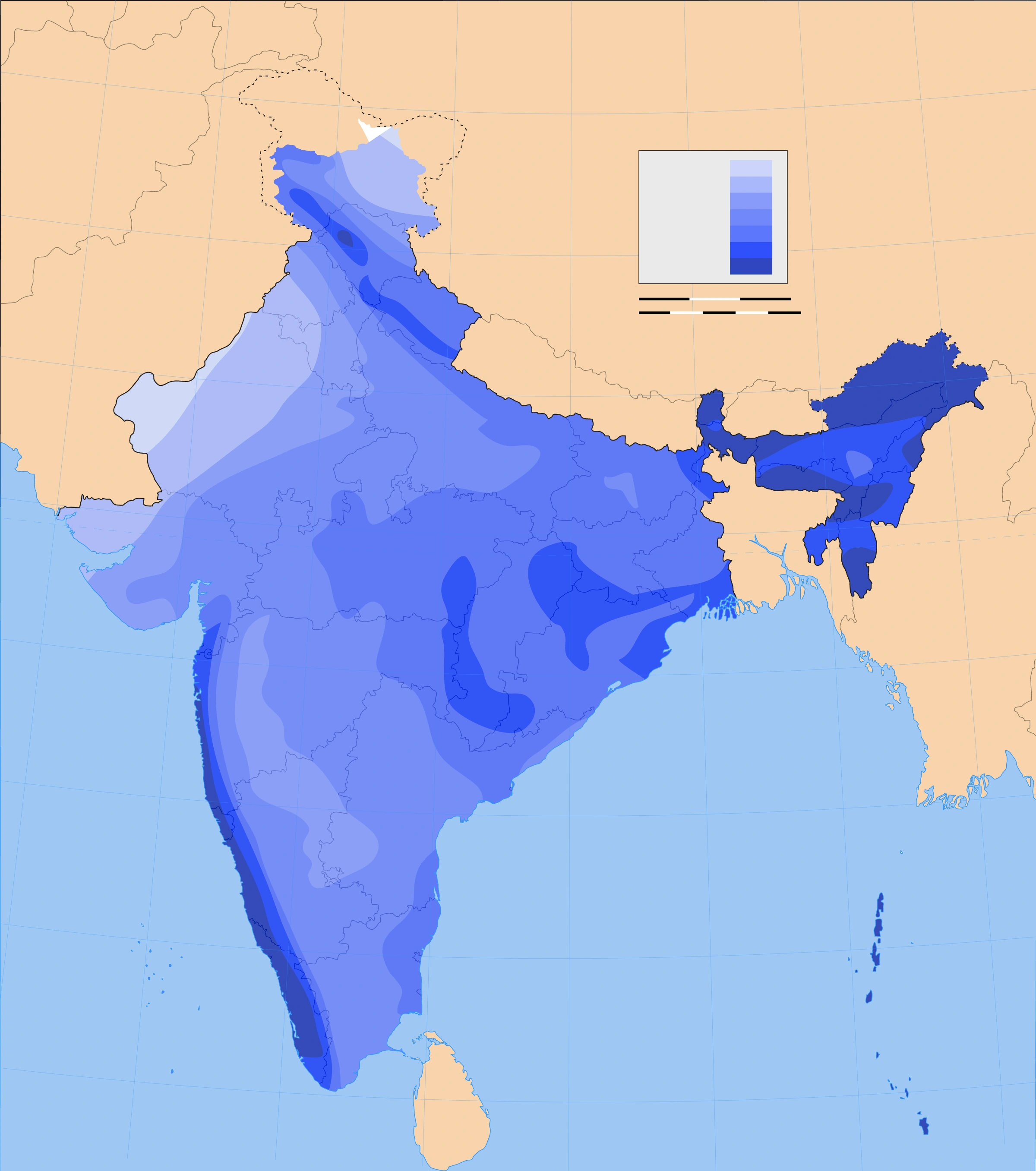
Map study
Annual rainfall distribution: compare the western coast and northeast with the dry northwest and rain-shadow interior. Historical climatological reference, not a current-year forecast.
- Read the source legend, scale and reference period before comparing regions.
- Connect spatial patterns to the processes discussed in this topic; this map is a study reference, not live operational data.
Credit: Planemad · CC BY-SA 3.0 · sourceConverted to WebP on an opaque white background; proportionally resized without cropping. Original cartography and legend retained.
1. Meaning, types and diagnostic indicators
Drought is a slow-onset hazard arising when precipitation and available water remain insufficient for a region’s usual environmental and human requirements. Unlike a flood, it rarely has an obvious beginning or boundary. Its severity depends on the size, duration and timing of the water deficit, as well as exposure and vulnerability. A short dry spell can severely damage rainfed crops even when drinking-water reservoirs remain adequate.
Meteorological drought refers to an abnormal precipitation deficit over a specified period and area. Agricultural drought occurs when root-zone soil moisture cannot meet crop requirements at a particular growth stage. Hydrological drought involves sustained deficits in streamflow, reservoir storage or groundwater. Socio-economic drought emerges when reduced water availability disrupts the supply of goods and services, including food, electricity and drinking water.
The Standardized Precipitation Index, or SPI, expresses rainfall anomalies over different timescales; negative values indicate drier-than-normal conditions. The Standardized Precipitation Evapotranspiration Index, or SPEI, also considers atmospheric evaporative demand. These indices complement, rather than replace, observations of soil moisture, vegetation condition, river discharge and groundwater. Distinguish drought from desertification, which is land degradation in arid, semi-arid and dry sub-humid areas resulting from climatic variations and human activities.
- Flash drought develops unusually rapidly when rainfall shortage combines with high temperatures and strong evaporative demand.
- Agricultural drought can precede hydrological drought; groundwater and reservoir deficits may persist after rainfall recovers.
2. Causes and geographical distribution in India
India’s drought risk is closely linked to the southwest monsoon. Delayed onset, prolonged breaks, early withdrawal and uneven rainfall distribution can interrupt soil-moisture replenishment. The all-India seasonal average can therefore obscure severe district-level stress. Intense rainfall concentrated into a few events may generate substantial runoff without maintaining crop-available moisture through the season.
El Niño, the warming of the central and eastern equatorial Pacific, often increases the probability of a weak Indian summer monsoon. However, the relationship is not deterministic: not every El Niño produces drought, and drought can occur without El Niño. The Indian Ocean Dipole, intraseasonal oscillations and regional circulation also influence rainfall. Rising temperatures can intensify drought impacts by increasing evaporation and plant water demand.
Persistent vulnerability is found in western Rajasthan, Kachchh and other parts of Gujarat, and the rain-shadow interiors of Maharashtra, Karnataka, Telangana, Andhra Pradesh and Tamil Nadu. Marathwada, Rayalaseema and Bundelkhand frequently face combinations of erratic rainfall, limited soil-water storage and livelihood dependence on farming. Tamil Nadu’s substantial dependence on the October–December northeast monsoon makes its drought calendar different from that of much of India.
Physical conditions alone do not determine losses. Shallow soils, degraded catchments and limited groundwater storage increase sensitivity to dry spells. In hard-rock peninsular regions, groundwater occurs mainly in weathered and fractured zones with uneven yields. Excessive pumping, water-intensive crops, loss of tanks and poorly managed urban expansion can turn a rainfall shortfall into a major water crisis.
From monitoring to drought response
- 1. Monitor rainfall, dry spells and forecasts
- 2. Identify emerging moisture and water-storage deficits
- 3. Assess crops, vegetation, reservoirs and groundwater
- 4. Verify local impacts and apply declaration procedures
- 5. Provide targeted drinking-water, livelihood and agricultural relief
- 6. Review outcomes and strengthen long-term resilience
3. Impacts on agriculture, society and ecosystems
Agricultural impacts include delayed sowing, reduced cropped area, poor germination, crop failure and declining yields. Stress during flowering and grain filling is especially damaging. Rainfed farmers are directly exposed, but irrigated agriculture also suffers when reservoirs fail to fill or wells decline. Fodder shortages and reduced drinking water weaken livestock health, affecting pastoralists and mixed crop–livestock households.
Drought reduces farm employment and rural purchasing power, potentially increasing indebtedness and distress migration. Women and children may spend more time collecting water, with consequences for health and education. Poorer households face greater risks because they possess fewer assets, weaker access to irrigation and limited financial buffers. Drinking-water quality can also deteriorate as communities rely on unsafe or concentrated residual sources.
Environmental consequences include declining wetland extent, reduced river baseflow, vegetation stress, habitat degradation and greater wildfire risk where dry fuel is available. Low streamflow weakens the dilution of pollutants. Hydropower generation and water-dependent industries may be disrupted, while thermal power plants can face cooling-water constraints. These effects illustrate why drought management requires coordination beyond the agriculture department.
- A compound drought–heatwave event can simultaneously intensify crop stress, electricity demand and health risks.
- Repeated drought can contribute to land degradation, but drought and desertification are not interchangeable.
| Type | Main deficit | Useful evidence | Important qualification |
|---|---|---|---|
| Meteorological | Precipitation below normal | Rainfall anomalies; SPI | Defined relative to regional climate and timescale |
| Agricultural | Insufficient root-zone moisture | Soil moisture; crop condition; sowing progress | Depends on crop stage, soil and irrigation |
| Hydrological | Reduced surface-water or groundwater availability | Streamflow; reservoir storage; groundwater levels | Often develops and recovers more slowly |
| Socio-economic | Water-related supply unable to meet demand | Drinking-water disruption; production losses | Depends strongly on exposure and management |
4. Monitoring, declaration and institutional response
India’s drought assessment uses multiple indicators because rainfall alone cannot capture agricultural or hydrological stress. The India Meteorological Department monitors rainfall departures, dry spells and drought indices. Satellite-based assessments by institutions including the National Remote Sensing Centre help identify vegetation and surface-moisture anomalies. The Central Water Commission tracks major reservoir storage, while the Central Ground Water Board assesses groundwater conditions.
The Manual for Drought Management, 2016, and subsequent official amendments provide the central framework for assessment. It combines rainfall-related indicators with evidence such as crop sowing, vegetation condition, soil moisture and hydrological conditions, followed by field verification where required. The operational sequence involves identifying a trigger, evaluating impact indicators and checking actual damage. State governments make drought declarations under the applicable procedures.
Disaster governance operates within the Disaster Management Act, 2005, and related national and state arrangements. Relief assistance is available under applicable State Disaster Response Fund and National Disaster Response Fund norms, subject to eligibility and assessment. Such assistance is intended for specified relief needs, not full compensation for every loss. Accurate local data and timely declarations are essential for effective intervention.
- Do not confuse an IMD rainfall-deficiency category with a legal or administrative drought declaration.
- Use district or sub-district evidence: national rainfall averages cannot establish local drought severity.
5. Mitigation and drought-resilient development
Effective management shifts from emergency relief to preparedness. Watershed treatment, contour bunding, vegetative barriers, tank restoration and protection of recharge zones improve infiltration and reduce erosion. Recharge structures must suit local geology and should not intercept essential downstream flows. Groundwater budgets must account for extraction as well as recharge; merely constructing more storage does not ensure water security.
Agricultural adaptation includes locally appropriate short-duration varieties, diversified farming, millets and pulses where suitable, mulching and contingency crop plans. Micro-irrigation can improve application efficiency, but basin-wide savings are not automatic if farmers expand irrigated area or switch to thirstier crops. Atal Bhujal Yojana promotes community participation in groundwater management in selected water-stressed areas, while MGNREGA can support eligible water-conservation and drought-proofing works.
Preparedness also requires protected drinking-water sources, fodder reserves, reliable advisories and social protection. Crop insurance under Pradhan Mantri Fasal Bima Yojana can reduce eligible financial losses but cannot replace ecological adaptation. Long-term resilience depends on aligning cropping patterns and urban demand with dependable water availability, monitoring withdrawals and ensuring equitable access during shortages.
Real-world case studies
Marathwada and Latur, 2015–2016
Repeated poor rainfall produced severe agricultural and drinking-water stress in Marathwada. In 2016, special trains carried water from Miraj to Latur. The episode shows how rainfall failure interacts with limited storage, groundwater depletion and competing demands, and why emergency supply must be paired with demand management.
Chennai water crisis, 2019
Following deficient rainfall, Chennai’s principal reservoirs fell to extremely low levels in 2019. Tankers, groundwater and supplementary supplies helped meet demand. The crisis highlighted the combined importance of monsoon variability, wetland protection, diversified supply, wastewater reuse and regulation of groundwater extraction.
Previous year questions
UPSC Mains 2020 · GS-I
The process of desertification does not have climate boundaries. Justify with examples.
- Distinguish drought, aridity and desertification.
- Discuss climatic stress alongside deforestation, overgrazing and unsuitable irrigation.
- Explain how land-degradation processes extend beyond existing deserts, while retaining the formal dryland definition of desertification.
Practice questions
Practice MCQ 1
Consider the following statements: 1. Agricultural drought can occur despite near-normal seasonal rainfall. 2. Hydrological drought always ends immediately after rainfall returns to normal. 3. Aridity is a long-term climatic characteristic. Which statements are correct?
- A. 1 and 2 only
- B. 1 and 3 only
- C. 2 and 3 only
- D. 1, 2 and 3
Practice MCQ 2
Which statement best describes the difference between SPI and SPEI?
- A. SPI measures only groundwater, whereas SPEI measures reservoirs.
- B. SPI uses precipitation anomalies, whereas SPEI also incorporates evaporative demand.
- C. SPI applies only to deserts, whereas SPEI applies only to humid regions.
- D. SPI measures crop yields, whereas SPEI measures river discharge.
Practice MCQ 3
Consider the following statements about drought in India: 1. Every El Niño necessarily causes an Indian monsoon drought. 2. State governments undertake drought declarations under applicable procedures. 3. Micro-irrigation necessarily reduces total groundwater extraction even if irrigated area expands. Which statements are correct?
- A. 1 only
- B. 2 only
- C. 2 and 3 only
- D. 1 and 3 only
Mains practice · Drought in India is as much a problem of water governance as of rainfall deficiency. Discuss with regional examples and suggest measures for resilience. Answer in 250 words.
- Define drought and distinguish its meteorological, agricultural and hydrological forms.
- Explain monsoon variability, dry spells and evaporative demand.
- Use Marathwada and Chennai to demonstrate management-related vulnerability.
- Discuss groundwater budgets, crop diversification, watershed restoration and urban water reuse.
- Conclude with early warning, equitable allocation and convergence of institutions.
Further reading
- NCERT, India: Physical Environment, Class XI: Climate; Natural Hazards and Disasters.
- Department of Agriculture, Cooperation and Farmers Welfare, Manual for Drought Management, 2016, with subsequent official amendments.
- National Disaster Management Authority, National Disaster Management Guidelines: Management of Drought, 2010.
- India Meteorological Department: rainfall monitoring and drought information.
- Central Water Commission: reservoir storage bulletins.
- Central Ground Water Board: groundwater yearbooks and dynamic groundwater resource assessments.
Preparing for UPSC Civil Services? Get classroom teaching, answer-writing evaluation and mentorship at Pragnya IAS Academy, Ashok Nagar — see why aspirants choose us for IAS coaching in Hyderabad.