
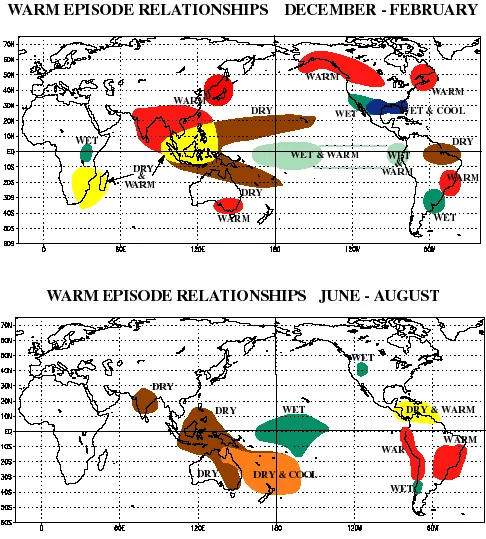
Illustration of regional climatic impacts associated with warm ENSO episodes (El Niño).
Credit: NOAA · Public domain · sourceResized and converted to WebP; uncropped.
1. What El Niño means and how it develops
El Niño originally referred to unusually warm waters observed near Peru and Ecuador around Christmas; its name means “the boy child” in Spanish. In modern climatology, it denotes the warm phase of ENSO, involving linked changes in Pacific sea-surface temperature, winds, pressure and rainfall. La Niña is the cold phase, while neutral conditions form the third broad state.
Normally, easterly trade winds push warm surface water towards Indonesia and the western Pacific. The western Pacific has a deep thermocline, warm water and vigorous convection. Near South America, the thermocline is shallower, and upwelling brings relatively cold, nutrient-rich water towards the surface. The Walker circulation links rising air over the warm western Pacific with sinking air farther east.
During El Niño, trade winds weaken, warm water spreads eastward and the central or eastern equatorial Pacific warms anomalously. The eastern thermocline deepens, reducing the supply of cold, nutrient-rich water to the surface. Convection shifts eastward, reinforcing changes in winds and ocean temperature through the Bjerknes feedback. Trade winds need not reverse everywhere for El Niño to occur.
Monitoring combines oceanic and atmospheric indicators. NOAA’s traditional Oceanic Niño Index uses three-month mean sea-surface temperature anomalies in the Niño 3.4 region, between 5°N–5°S and 170°W–120°W. A threshold of at least +0.5°C for five overlapping seasons is used for historical warm-episode classification. Atmospheric evidence, such as weakened trades and altered pressure, is important for identifying a coupled event.
- The Southern Oscillation is the atmospheric pressure component of ENSO; sustained negative Southern Oscillation Index values generally accompany El Niño.
- Niño 3.4 temperature anomalies are not measurements of warming across the entire Pacific Ocean.
- El Niño is a coupled ocean–atmosphere phenomenon, not simply a warm ocean current.
2. Global rainfall, temperature and cyclone impacts
El Niño produces teleconnections: climatic links between distant regions transmitted through changes in atmospheric circulation. As equatorial Pacific convection shifts, tropical overturning circulations and upper-air wave patterns change. Consequently, rainfall may increase in one region while decreasing in another. Impacts depend on the season, event strength, location of warming and interaction with other climate modes.
Indonesia and parts of Australia commonly experience reduced rainfall and greater drought or wildfire risk. Parts of coastal Ecuador and northern Peru can receive intense rainfall, floods and landslides, especially when nearby waters become unusually warm. El Niño can favour wetter conditions over parts of southern South America and the southern United States during particular seasons. These are broad tendencies, not universal outcomes.
El Niño often raises global mean surface temperature as the tropical Pacific releases more heat to the atmosphere. The largest global temperature response may lag the development of ocean warming. The exceptional warmth of 2016 occurred during and after the strong 2015–16 event, superimposed on human-induced warming. El Niño cannot explain the persistent multidecadal rise in global temperatures.
Tropical cyclone effects differ among ocean basins. In the Atlantic, El Niño generally increases vertical wind shear and suppresses hurricane activity. In the eastern North Pacific, conditions are often more favourable for tropical cyclone activity. Western North Pacific cyclone formation can shift eastward. ENSO therefore redistributes cyclone-favourable conditions rather than uniformly increasing storms worldwide.
- Greater Horn of Africa: El Niño often favours wetter October–December short rains, although the Indian Ocean Dipole also strongly influences outcomes.
- Southern Africa: parts of the region face increased austral-summer drought risk.
- An active or quiet cyclone season cannot be inferred from ENSO alone; regional sea temperatures and atmospheric conditions also matter.
From Pacific warming to Indian livelihood risk
- 1. Trade winds weaken and central/eastern equatorial Pacific waters warm
- 2. Pacific convection and Walker circulation shift
- 3. Tropical circulation changes can suppress Indian monsoon convection
- 4. Rainfall deficits or prolonged dry spells reduce soil moisture and water availability
- 5. Agricultural, water and energy risks rise where exposure and vulnerability are high
3. Impacts on India and the summer monsoon
India receives most of its annual rainfall during the June–September southwest monsoon. El Niño often changes tropical circulation in ways that favour anomalous subsidence and weaker monsoon convection over the Indian region. Historically, many deficient monsoon seasons have coincided with El Niño, making ENSO an important input to seasonal forecasting.
The relationship is not one-to-one. Monsoon rainfall also responds to the Indian Ocean Dipole, Indian Ocean temperatures, Eurasian snow conditions, land–sea thermal contrasts and intraseasonal systems such as the Madden–Julian Oscillation. A positive Indian Ocean Dipole can sometimes offset part of El Niño’s adverse influence, but it does not guarantee normal rainfall. The timing and spatial pattern of Pacific warming also affect the response.
A deficient or poorly distributed monsoon can delay sowing, reduce soil moisture and damage rainfed kharif crops. Paddy, pulses, oilseeds and coarse cereals may be affected differently according to irrigation access and local rainfall. Reduced reservoir inflows can constrain irrigation, hydropower and drinking-water supply. Lower groundwater recharge may increase dependence on pumping and raise cultivation costs.
Food-price pressures, fodder shortages, rural employment losses and higher electricity demand can follow prolonged dry spells. Yet national seasonal rainfall alone is an incomplete indicator: a near-normal total can conceal long breaks, regional drought and destructive short-duration rainfall. El Niño also does not mean reduced rainfall in every Indian season; it is often associated with enhanced northeast monsoon rainfall over parts of southeastern peninsular India.
- Do not equate an all-India rainfall deficit with uniform drought in every state.
- Distinguish meteorological drought, involving deficient precipitation, from agricultural and hydrological drought.
- Use IMD forecasts and district-level advisories rather than ENSO status alone for assessing agricultural risk.
| Region or system | Typical influence | Important qualification |
|---|---|---|
| Indian southwest monsoon | Increased probability of deficient rainfall | Other climate drivers and rainfall distribution modify outcomes |
| Indonesia and parts of Australia | Drier conditions and elevated fire risk | Season, land conditions and ignition sources matter |
| Coastal Peru and Ecuador | Warmer waters and increased heavy-rainfall risk | Local coastal warming strongly affects severity |
| Atlantic tropical cyclones | Generally suppressed activity | Warm Atlantic waters can partly counter unfavourable shear |
| Eastern Pacific marine ecosystems | Reduced nutrient supply and disrupted fisheries | Species responses and fishery management vary |
4. Ocean ecosystems, fisheries and human vulnerability
The Peru–Chile upwelling system supports highly productive marine food webs. During El Niño, a deeper thermocline and reduced nutrient delivery can lower phytoplankton production. This affects zooplankton, fish, seabirds and marine mammals. Peru’s anchoveta fishery is particularly sensitive: fish may move towards cooler refuges, deeper waters or different latitudes, while recruitment and catches can decline.
Marine heat stress associated with strong El Niño events can contribute to widespread coral bleaching. Corals lose symbiotic algae when thermal stress exceeds their tolerance, reducing energy supply and increasing mortality risk if stress persists. Bleaching is not restricted to El Niño years; anthropogenic ocean warming increasingly raises the background risk.
On land, drought can dry vegetation and peatlands, increasing fire risk where ignition sources exist. Heavy rainfall can contaminate water supplies and damage sanitation infrastructure. Disease effects vary with local ecology, vector behaviour and public-health capacity. The same climatic anomaly may therefore produce very different losses in regions with different exposure, infrastructure and adaptive capacity.
- Fishery impacts reflect both ecosystem changes and management decisions such as catch limits or temporary closures.
- Flood risk depends on rainfall intensity, drainage, land use and settlement patterns, not ENSO alone.
- El Niño-related drought can amplify fire emissions, but land clearing and human ignition remain important drivers.
5. Forecasting, preparedness and examination approach
ENSO monitoring uses satellites, drifting and moored buoys, ocean profiles and coupled climate models. Subsurface heat content provides information beyond surface temperature. Forecast confidence varies by season; predictions made across the boreal spring predictability barrier can be particularly challenging. A seasonal outlook states probabilities, not the exact dates or locations of droughts and storms.
In India, preparedness should combine IMD seasonal and extended-range forecasts with reservoir monitoring, crop-weather advisories and district agricultural contingency plans. Measures include adjusting sowing windows, selecting suitable short-duration varieties, conserving soil moisture, planning irrigation and securing fodder and drinking water. Reservoir operation must retain flexibility because seasonal rainfall deficits can coexist with individual extreme-rainfall events.
- For Prelims, trace the chain from Pacific warming to circulation changes and then to regional impacts.
- Treat statements using “always”, “only” or “everywhere” cautiously when describing El Niño impacts.
- Separate ENSO from the Indian Ocean Dipole, which concerns the east–west temperature contrast within the tropical Indian Ocean.
- Warming confined near the Peru–Ecuador coast need not represent a fully developed basin-wide El Niño.
El Niño: Regional Impacts and India’s Monsoon Risk
El Niño affects distant regions through atmospheric teleconnections, not simply through the spread of warm seawater. Warming in the central and eastern equatorial Pacific shifts tropical convection and reorganises the Walker circulation. Consequently, rainfall and temperature anomalies differ across regions and seasons: parts of the western tropical Pacific commonly face drier conditions, while some areas near the eastern Pacific experience increased rainfall. The supplied metadata identifies this illustration as a regional-impact overview; it should not be interpreted as a forecast for any particular event.
For India, El Niño is often associated with weaker summer monsoon rainfall, increasing risks to rain-fed agriculture, reservoir replenishment and hydropower. However, an El Niño year does not automatically mean an all-India drought. The Indian Ocean Dipole, other ocean–atmosphere conditions and intraseasonal monsoon variability can modify the outcome. National seasonal rainfall totals can also conceal substantial regional differences and damaging dry spells. Beyond land rainfall, reduced nutrient-rich upwelling in the eastern equatorial Pacific can lower marine productivity and affect fisheries; warmer conditions can also increase coral heat stress.
- Distinguish mechanism from impact: ENSO is a coupled ocean–atmosphere phenomenon; drought, flooding and fisheries disruption are possible consequences, not defining criteria.
- Avoid deterministic answers: impact depends on event strength, Pacific warming pattern, season and interacting climate drivers; Indian drought cannot be inferred from El Niño alone.
- Separate hazard from disaster: rainfall anomalies become agricultural or water-security crises through exposure and vulnerability, including irrigation access, crop choices, storage and preparedness.
Real-world case studies
India, 1997: a strong event without nationwide monsoon failure
The strong 1997–98 El Niño did not cause an all-India monsoon drought in 1997. Summer monsoon rainfall was above its long-period average. A strong positive Indian Ocean Dipole and other circulation influences helped counter the expected adverse ENSO influence. The case demonstrates why an El Niño forecast is a risk signal rather than a certain drought prediction.
Indonesia, 2015: drought and peatland fires
The strong 2015–16 El Niño intensified dry conditions in Indonesia. Fires in drained peatlands and other landscapes produced severe transboundary haze and health and economic losses. The World Bank estimated Indonesia’s 2015 fire losses at about US$16 billion. Climatic drought interacted with land-use change and ignition practices; El Niño was an amplifier, not the sole cause.
Previous year questions
No source-linked PYQ is available here yet. Use the practice questions below.
Practice questions
Practice MCQ 1
With reference to El Niño, consider the following statements: 1. It commonly involves weakening of equatorial Pacific trade winds. 2. It generally increases nutrient delivery to surface waters off Peru. 3. It can affect rainfall far beyond the Pacific through atmospheric teleconnections. Which of the statements given above are correct?
- A. 1 and 2 only
- B. 1 and 3 only
- C. 2 and 3 only
- D. 1, 2 and 3
Practice MCQ 2
Which one of the following best describes the relationship between El Niño and the Indian southwest monsoon?
- A. Every El Niño produces nationwide meteorological drought
- B. El Niño affects only winter rainfall in India
- C. El Niño raises the risk of deficient monsoon rainfall, but other climatic factors can modify the outcome
- D. A positive Indian Ocean Dipole invariably eliminates El Niño’s monsoon influence
Practice MCQ 3
El Niño generally suppresses Atlantic hurricane activity primarily because it:
- A. increases vertical wind shear over the tropical Atlantic
- B. removes the Coriolis force from the Atlantic basin
- C. permanently cools all tropical Atlantic surface waters
- D. prevents evaporation from tropical oceans
Mains practice · El Niño is a global climate risk multiplier rather than a deterministic predictor of Indian drought. Explain its major impacts and suggest preparedness measures for India. Answer in 250 words.
- Define ENSO and explain weakened trades, Pacific warming and shifted convection.
- Discuss monsoon teleconnections while recognising the Indian Ocean Dipole and intraseasonal variability.
- Use the 1997 Indian monsoon as a counterexample to inevitable drought.
- Cover agriculture, water, fisheries, heat, fires and basin-specific cyclone effects.
- Recommend probabilistic forecasting, district contingency plans, water management and crop advisories.
- Conclude that exposure and adaptive capacity determine how climatic anomalies translate into losses.
Further reading
- NCERT, Fundamentals of Physical Geography, Class XI: Atmospheric Circulation and Weather Systems; Movements of Ocean Water.
- India Meteorological Department: ENSO and Indian Ocean Dipole updates and southwest monsoon seasonal forecasts, mausam.imd.gov.in.
- NOAA Climate Prediction Center: ENSO Diagnostic Discussion and historical Oceanic Niño Index records, cpc.ncep.noaa.gov.
- World Meteorological Organization: El Niño/La Niña Updates, wmo.int.
- World Bank, The Cost of Fire: An Economic Analysis of Indonesia’s 2015 Fire Crisis.
- https://commons.wikimedia.org/wiki/File:El_Nino_regional_impacts.png
Preparing for UPSC Civil Services? Get classroom teaching, answer-writing evaluation and mentorship at Pragnya IAS Academy, Ashok Nagar — see why aspirants choose us for IAS coaching in Hyderabad.