
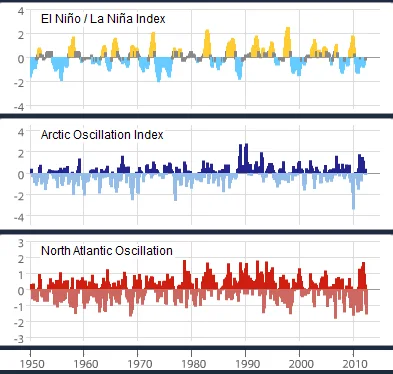
ENSO, Arctic Oscillation and North Atlantic Oscillation indices, 1950–2012; a comparative climate-variability graphic attributed to NOAA.
Credit: NOAA · Public domain · sourceResized and converted to WebP; uncropped.
1. Meaning, geographical setting and basic terminology
ENSO combines an oceanic component, represented by changing sea-surface temperatures across the equatorial Pacific, with an atmospheric component called the Southern Oscillation. El Niño is the warm phase, La Niña the cold phase, and ENSO-neutral describes conditions without a sufficiently developed warm or cold event. Neutral does not mean that weather everywhere is normal: other climate drivers remain active.
The expression El Niño, meaning the boy child in Spanish, was originally used by fishers along the coasts of Peru and Ecuador for a warm current appearing around Christmas. Modern usage refers to a much broader tropical Pacific climate phenomenon. Sir Gilbert Walker identified the large-scale pressure oscillation while investigating seasonal climate variability; Jacob Bjerknes subsequently explained the feedback linking equatorial ocean temperatures and atmospheric circulation.
An anomaly is a departure from a reference climatological average, not an absolute temperature. Consequently, a region described as anomalously cool during La Niña can still have warm tropical waters. ENSO should also be distinguished from the annual seasonal cycle and from long-term global warming.
- Main geographical anchors: Indonesia and northern Australia in the western Pacific; Peru and Ecuador along the eastern Pacific margin.
- ENSO is irregular rather than a fixed-period cycle. Events often last about nine to twelve months, but some persist longer, especially La Niña.
- The Southern Oscillation Index is generally negative during El Niño and positive during La Niña, although short-term fluctuations occur.
2. Normal Pacific circulation and the ENSO mechanism
Under normal equatorial Pacific conditions, easterly trade winds blow from the Americas towards the western Pacific. They help accumulate warm surface water near Indonesia, creating the western Pacific warm pool. Warm, moist air rises over this region, moves eastward aloft and descends over the relatively cooler eastern Pacific. This east–west overturning forms the Pacific branch of the Walker circulation.
The thermocline, the layer across which temperature falls rapidly with depth, lies deeper in the west and shallower in the east. Equatorial divergence and wind-driven coastal upwelling bring relatively cold, nutrient-rich water towards the surface in the eastern Pacific. These nutrients sustain high biological productivity and major fisheries associated with the Peru–Humboldt Current system.
During El Niño, weakened trade winds allow warm water and the zone of strongest convection to extend eastward. The eastern Pacific thermocline deepens, reducing the supply of cold water to the surface. Warmer eastern waters weaken the east–west temperature and pressure gradients further, reinforcing the wind changes. This self-reinforcing interaction is the Bjerknes feedback. Complete reversal of the trade winds is not necessary for an event.
During La Niña, stronger trade winds reinforce the normal pattern: warm water is concentrated farther west, the thermocline tilt increases, and colder water more readily influences the eastern equatorial surface. Oceanic Kelvin and Rossby waves, together with changes in equatorial upper-ocean heat content, help events develop and terminate. ENSO therefore cannot be understood from surface temperatures alone.
- Walker circulation is primarily zonal, or east–west; Hadley circulation is primarily meridional, or north–south.
- El Niño usually weakens and shifts the Pacific Walker circulation; La Niña usually strengthens its normal configuration.
- Reduced nutrient supply during El Niño can disrupt food webs and fisheries, although impacts vary by location and event.
Typical El Niño reinforcing feedback
- 1. An initial disturbance weakens equatorial Pacific easterly trade winds.
- 2. Warm surface water extends eastward and the eastern thermocline deepens.
- 3. The cooling influence of cold subsurface water diminishes.
- 4. Central and eastern equatorial Pacific surface waters warm.
- 5. Convection shifts eastward and the zonal pressure gradient weakens.
- 6. Trade winds weaken further, reinforcing the coupled anomaly.
3. Monitoring, indices and prediction
Scientists monitor ENSO through sea-surface temperature anomalies, sea-level pressure, trade winds, tropical cloudiness, rainfall and subsurface ocean temperatures. Satellites, drifting and moored buoys, ships and other observing systems supply complementary information. The tropical Pacific moored buoy network is particularly valuable for tracking ocean–atmosphere coupling.
The Niño 3.4 region extends from 5°N to 5°S and 170°W to 120°W. NOAA's widely used Oceanic Niño Index, or ONI, measures the three-month running mean sea-surface temperature anomaly in this region. Its conventional historical classification identifies warm or cold episodes when anomalies reach at least +0.5°C or −0.5°C respectively for five consecutive overlapping three-month seasons. Operational assessments also examine atmospheric coupling; one warm month is not sufficient evidence of a mature ENSO event.
The conventional Southern Oscillation Index uses the standardised sea-level pressure difference between Tahiti in the central South Pacific and Darwin in northern Australia. A sustained negative index supports an El Niño interpretation; a sustained positive index supports La Niña. Monitoring agencies may use different baselines, indicators and operational thresholds, so their declarations need not be identical.
ENSO forecasts are probabilistic. Skill varies with lead time and season, and forecasts crossing the boreal spring often encounter a spring predictability barrier. A forecast of elevated El Niño probability should therefore inform preparedness rather than be treated as a deterministic forecast of drought in a particular Indian district.
| Feature | Neutral | El Niño | La Niña |
|---|---|---|---|
| Central/eastern Pacific surface temperature | Near reference conditions | Anomalously warm | Anomalously cool |
| Easterly trade winds | Usual strength | Generally weaker | Generally stronger |
| Eastern Pacific thermocline | Relatively shallow | Deeper than usual | Shallower than usual |
| Eastern Pacific cold-water supply | Normal upwelling influence | Reduced | Enhanced |
| Southern Oscillation Index | No sustained strong phase signal | Generally negative | Generally positive |
| Indian summer monsoon tendency | Other drivers remain important | Greater deficient-rainfall risk | Often favours stronger rainfall |
4. Global effects and the Indian monsoon connection
ENSO influences distant regions through atmospheric teleconnections. Changes in tropical convection alter large-scale circulation and atmospheric wave patterns, shifting rainfall and storm tracks. El Niño often brings drought risk to Indonesia and parts of Australia and wetter conditions to parts of coastal Ecuador and Peru. La Niña frequently produces broadly opposite tendencies, but its impacts are not exact mirror images.
El Niño commonly raises global mean surface temperature temporarily by changing ocean–atmosphere heat exchange, superimposed on human-caused warming. La Niña can temporarily moderate the global average without reversing the long-term warming trend. ENSO also affects tropical cyclones: El Niño typically increases vertical wind shear over the tropical Atlantic, suppressing hurricane activity there, while La Niña tends to favour Atlantic activity.
For India, El Niño is statistically associated with a weaker June–September southwest monsoon. Changes in Walker circulation and tropical convection can favour subsidence and reduced rainfall over the Indian region. La Niña often supports stronger monsoon rainfall, but national totals conceal substantial differences between regions and within the season.
The Indian Ocean Dipole, or IOD, describes the sea-surface temperature contrast between the western equatorial Indian Ocean and the southeastern equatorial Indian Ocean near Sumatra–Java. A positive IOD can sometimes counteract El Niño's adverse monsoon influence. The Madden–Julian Oscillation, monsoon depressions and other circulation features also affect active and break spells. ENSO and IOD are distinct phenomena that can interact.
- Do not equate every El Niño with an Indian drought or every La Niña with nationwide floods.
- An ENSO event's strength, spatial pattern and timing all influence its impacts.
- Seasonal rainfall forecasts must be combined with regional forecasts and soil-moisture information for agricultural decisions.
5. Significance for preparedness and examination
ENSO outlooks provide advance information for agriculture, water management, public health and disaster preparedness. In India, IMD's seasonal forecasts and climate updates support contingency planning. Useful responses include locally appropriate crop choices, flexible sowing decisions, irrigation scheduling and reservoir operation based on updated rainfall expectations rather than ENSO status alone.
For Prelims, the central task is to connect the phase with winds, thermocline depth, upwelling and pressure anomalies. Also separate mechanism from consequence: eastern Pacific warming defines the oceanic signal of El Niño, whereas drought in India is a possible teleconnected consequence, not a defining condition. Avoid claims that ENSO occurs annually, affects only the Pacific or is caused solely by climate change.
- Read ENSO forecasts as changes in risk, not guarantees of particular weather outcomes.
- Distinguish seasonal climate outlooks from short-range forecasts of individual storms.
- For adaptation, combine global climate signals with local exposure, crop stage, reservoir storage and disaster vulnerability.
Reading ENSO as coupled ocean–atmosphere variability
The metadata identifies an ENSO record measured by the Oceanic Niño Index (ONI), alongside Arctic Oscillation and North Atlantic Oscillation records. This makes the graphic directly useful for distinguishing ENSO from other modes of internal climate variability. ONI measures three-month running mean sea-surface temperature anomalies in the Niño 3.4 region of the equatorial Pacific. Positive and negative anomalies indicate warmer and cooler conditions relative to a reference climatology; identifying an ENSO episode requires persistence and consideration of atmospheric coupling, not merely one anomalous month.
ENSO involves feedbacks among trade winds, equatorial ocean temperatures, the thermocline and Walker circulation. During El Niño, weakened trades generally reduce eastern-Pacific upwelling and shift tropical convection eastward; La Niña broadly strengthens the opposite configuration. These changes influence distant regions through atmospheric teleconnections. For India, El Niño often raises the risk of deficient summer monsoon rainfall, but the Indian Ocean Dipole, intraseasonal variability and other influences can modify outcomes. This historical comparison alone cannot establish causation, quantify Indian rainfall impacts or predict a particular monsoon.
- ONI is an ocean-temperature index; the Southern Oscillation Index tracks atmospheric pressure contrasts associated with ENSO. They are related, not interchangeable.
- AO and NAO are distinct atmospheric variability patterns, not ENSO phases; similar index fluctuations do not demonstrate identical mechanisms.
- Internal variability differs from long-term externally forced warming. ENSO redistributes heat and affects annual global temperatures without explaining the sustained warming trend.
Real-world case studies
1997: A strong El Niño without an all-India monsoon drought
The exceptionally strong 1997–98 El Niño did not produce an all-India summer monsoon drought in 1997. A strong positive Indian Ocean Dipole and other circulation influences helped offset the expected adverse effect. The episode demonstrates why ENSO alone cannot determine India's seasonal rainfall.
2020–2023: Prolonged La Niña and Australian floods
A prolonged La Niña episode spanned three consecutive boreal winters from 2020–21 to 2022–23. Repeated wet conditions increased flood risk in eastern Australia, including during 2022. La Niña contributed to the background climate conditions, while individual weather systems, antecedent soil saturation and other climate drivers shaped specific flood events.
Previous year questions
No source-linked PYQ is available here yet. Use the practice questions below.
Practice questions
Practice MCQ 1
With reference to a typical El Niño event, consider the following statements: 1. Equatorial Pacific easterly trade winds weaken. 2. The thermocline in the eastern equatorial Pacific becomes deeper. 3. Nutrient-rich cold-water supply to eastern Pacific surface waters generally increases. Which statements are correct?
- A. 1 and 2 only
- B. 2 and 3 only
- C. 1 and 3 only
- D. 1, 2 and 3
Practice MCQ 2
The conventional Southern Oscillation Index is based on the difference in sea-level pressure between which locations?
- A. Mumbai and Darwin
- B. Tahiti and Darwin
- C. Lima and Jakarta
- D. Tahiti and Cape Town
Practice MCQ 3
Consider the following statements: 1. El Niño necessarily causes an all-India summer monsoon drought. 2. A positive Indian Ocean Dipole can sometimes offset an adverse El Niño influence on the Indian monsoon. 3. ENSO-neutral conditions rule out severe regional weather anomalies. Which statements are correct?
- A. 1 only
- B. 2 only
- C. 2 and 3 only
- D. 1, 2 and 3
Mains practice · Explain the ocean–atmosphere feedback responsible for ENSO. Why is ENSO status alone insufficient to predict the Indian summer monsoon? Answer in 250 words.
- Define ENSO and identify its warm, cold and neutral phases.
- Explain normal trade winds, Walker circulation, thermocline tilt and upwelling.
- Describe the Bjerknes feedback during El Niño and the strengthened normal circulation during La Niña.
- Explain ENSO teleconnections with Indian monsoon circulation.
- Discuss IOD, intraseasonal variability, event timing and regional rainfall differences.
- Use 1997 as an example of a strong El Niño without an all-India monsoon drought.
- Conclude with probabilistic forecasting and locally informed preparedness.
Further reading
- NCERT, Fundamentals of Physical Geography, Class XI: Atmospheric Circulation and Weather Systems; Movements of Ocean Water.
- NCERT, India: Physical Environment, Class XI: Climate.
- India Meteorological Department: ENSO and IOD bulletins and seasonal monsoon forecasts, imd.gov.in.
- NOAA Climate Prediction Center: ENSO Diagnostic Discussion and historical Oceanic Niño Index, cpc.ncep.noaa.gov.
- World Meteorological Organization: El Niño/La Niña Updates, wmo.int.
- https://commons.wikimedia.org/wiki/File:3_examples_of_internal_climate_variability_(1950-2012),_the_El_Ni%C3%B1o_%E2%80%93_Southern_Oscillation,_the_Arctic_Oscillation,_and_the_North_Atlantic_Oscillation_(NOAA).png
Preparing for UPSC Civil Services? Get classroom teaching, answer-writing evaluation and mentorship at Pragnya IAS Academy, Ashok Nagar — see why aspirants choose us for IAS coaching in Hyderabad.