
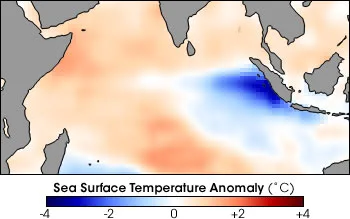
Sea-surface temperature anomalies associated with the November 1997 Indian Ocean Dipole, based on IRI/LDEO data.
Credit: Image based on data from the IRI/LDEO Climate Data Library · Public domain · sourceResized and converted to WebP; uncropped.
1. Meaning, geography and measurement
The Indian Ocean Dipole is a coupled mode of tropical climate variability: ocean temperatures modify winds and rainfall, while winds alter ocean temperatures through currents, mixing and upwelling. Unlike a uniform warming or cooling of the Indian Ocean, it involves an east–west contrast. Its western pole lies broadly in the tropical western Indian Ocean, while its eastern pole lies in the southeastern equatorial Indian Ocean adjoining Indonesia, particularly Sumatra and Java.
The standard Dipole Mode Index, or DMI, is calculated by subtracting the area-averaged sea-surface temperature anomaly of the eastern box, 90°E–110°E and 10°S–0°, from that of the western box, 50°E–70°E and 10°S–10°N. An anomaly is a departure from the climatological average for the corresponding time of year. Thus, the index measures anomalous contrast, not simply which region has the higher absolute temperature.
A persistently positive DMI indicates a positive IOD, while a negative DMI indicates a negative IOD. Operational agencies use defined thresholds and persistence criteria; the Australian Bureau of Meteorology commonly uses approximately +0.4°C and −0.4°C as index thresholds. A brief threshold crossing alone does not establish a mature coupled event. Wind, cloudiness and subsurface ocean conditions also help determine whether the ocean and atmosphere are reinforcing each other.
- The eastern IOD pole lies in the Indian Ocean, not the eastern Pacific Ocean.
- Neutral IOD means the dipole contrast is weak; it does not mean that temperatures or rainfall everywhere are normal.
2. Formation and ocean–atmosphere feedback
During a positive IOD, anomalous easterly winds develop over the equatorial Indian Ocean, meaning the wind anomaly is directed from east to west. Near Sumatra and Java, favourable wind anomalies strengthen coastal upwelling and help shoal the thermocline, the layer where temperature decreases rapidly with depth. Cooler subsurface water then more readily affects the surface, reinforcing the eastern cold anomaly. In the west, ocean dynamics tend to deepen the thermocline and favour warmer surface conditions.
The changing temperature gradient shifts deep atmospheric convection towards the relatively warmer western basin. Rising motion and rainfall increase there, while convection is suppressed near Indonesia. The resulting atmospheric pressure and wind anomalies can further strengthen eastern cooling and the east–west temperature contrast. This self-reinforcing interaction is a Bjerknes-type feedback, comparable in principle to the coupling involved in ENSO, although the geography and seasonal constraints differ.
A negative IOD broadly reverses this arrangement. Waters near Indonesia become anomalously warm relative to the western basin, anomalous equatorial westerlies develop, and a deeper eastern thermocline tends to reduce the cooling influence of upwelling. Convection shifts towards the eastern Indian Ocean. However, positive and negative events are not perfectly symmetrical: their strength, evolution and regional impacts vary with background ocean conditions and interactions with other climate systems.
- Upwelling brings subsurface water towards the surface; downwelling pushes surface water downward.
- IOD wind anomalies must be distinguished from the actual prevailing winds, which also reflect the seasonal monsoon circulation.
Positive IOD feedback
- 1. Initial east–west temperature and wind anomalies develop
- 2. Anomalous easterlies and coastal winds favour eastern thermocline shoaling and upwelling
- 3. Cooling strengthens near Sumatra and Java relative to the western basin
- 4. Convection shifts westward and weakens near Indonesia
- 5. Atmospheric circulation reinforces the wind and temperature anomalies
3. Seasonality and distinction from ENSO
IOD events usually emerge during late boreal spring or summer, intensify through the summer monsoon season and peak in boreal autumn, particularly September–November. They normally weaken as the seasonal winds reverse and the southern summer monsoon becomes established. Consequently, the IOD is strongly seasonally locked and generally does not persist through several consecutive seasons in the same manner as some ENSO episodes.
ENSO originates in the tropical Pacific and involves coupled changes in sea-surface temperature and atmospheric circulation. The IOD belongs to the Indian Ocean. El Niño can favour positive IOD development through atmospheric connections, while La Niña can favour negative IOD conditions, but these are tendencies rather than fixed pairings. IOD events can develop independently, and simultaneous events do not necessarily have matching strengths.
Another distinction is from Indian Ocean basin-wide warming, in which much of the tropical basin warms together, often following El Niño. A basin-wide anomaly and an east–west dipole are different spatial patterns, although they can coexist. For examination purposes, identify the ocean basin, direction of the temperature-anomaly gradient, affected circulation and season before linking an event to its rainfall consequences.
- ENSO and IOD are interacting modes, not alternative names for the same phenomenon.
- The Madden–Julian Oscillation and monsoon intra-seasonal oscillations can modify rainfall within a season even when the seasonal IOD phase is established.
| Feature | Positive IOD | Negative IOD |
|---|---|---|
| Temperature-anomaly contrast | Western pole warmer relative to eastern pole | Eastern pole warmer relative to western pole |
| Equatorial wind anomaly | Easterly | Westerly |
| Eastern thermocline | Generally shallower | Generally deeper |
| Convection | Favoured towards western basin | Favoured towards Indonesia |
| Typical rainfall tendency | Wetter East African short rains; drier Indonesia | Drier East African short rains; wetter Indonesia |
4. Influence on India and surrounding regions
A positive IOD is often associated with conditions favourable for Indian summer monsoon rainfall. Changes in tropical convection and atmospheric circulation can support moisture transport and rainfall over parts of India. It may therefore partly counter the unfavourable monsoon influence of El Niño. Conversely, a negative IOD can favour convection nearer Indonesia and create less favourable conditions for Indian rainfall. These are statistical associations, not deterministic rules for every event or district.
India’s June–September monsoon does not fully overlap the usual autumn peak of the IOD. The timing of development therefore matters: an event strengthening late in the season may have a different effect from one established earlier. All-India seasonal rainfall also conceals large spatial and temporal differences. Monsoon depressions, active and break spells, the monsoon trough, ENSO and other circulation features jointly determine agricultural and hydrological outcomes.
Outside India, positive IOD events commonly favour enhanced East African short rains during October–December and drier conditions in Indonesia. They are also associated with reduced cool-season and spring rainfall over parts of Australia. Negative IOD events tend towards opposite rainfall patterns. Strong events can raise the risks of floods, drought, crop losses, forest fires and marine ecosystem stress, but local exposure, land management and other climate drivers shape the eventual disaster.
- Do not infer a normal Indian monsoon solely from a positive IOD forecast.
- Effects on the northeast monsoon over southeastern India require separate assessment; southwest monsoon associations cannot simply be transferred to it.
5. Monitoring, forecasting and relevance for public policy
IOD monitoring combines satellite observations with ships, drifting and moored buoys, and Argo profiling floats. Satellites provide information on sea-surface temperature, winds, sea level and clouds, while in-situ instruments reveal subsurface temperature and salinity. The RAMA moored buoy array supports research and forecasting of Indian Ocean climate variability. Subsurface observations are particularly valuable because thermocline changes may provide evidence of development before the surface pattern becomes fully established.
The India Meteorological Department incorporates global ocean–atmosphere conditions into monsoon assessments. Indian institutions, including INCOIS and IITM, contribute ocean information and climate research. International monitoring by the Australian Bureau of Meteorology, NOAA and other agencies enables comparison of observed indices and model outlooks. Forecasts should be interpreted probabilistically: uncertainty depends on lead time, season and whether a coherent coupled event has emerged.
For governance, IOD information can inform reservoir operation, agricultural advisories, flood preparedness and drought contingency planning. It should be combined with regional and short-range forecasts rather than used as a stand-alone warning. Climate change adds another layer of complexity: the Indian Ocean is warming, and research examines changes in dipole behaviour and extreme-event risks. An individual IOD event, however, should not automatically be attributed entirely to anthropogenic warming.
- Exam approach: connect the index to ocean processes, then atmospheric circulation, rainfall patterns and socioeconomic impacts.
- Policy approach: distinguish a seasonal probability of excess rainfall from a location-specific flood forecast.
Indian Ocean Dipole: Temperature Contrast and Monsoon Linkages
The supplied metadata identifies a sea-surface temperature anomaly map associated with the November 1997 Indian Ocean Dipole (IOD). It describes cooling near the Mentawai Islands and Sumatra, illustrating the eastern pole of a positive IOD. In this phase, the western equatorial Indian Ocean is anomalously warmer relative to the southeastern equatorial Indian Ocean. Enhanced easterly wind anomalies favour westward movement of warm surface water and strengthen cooling through coastal upwelling near Sumatra and Java. Ocean temperatures and atmospheric circulation reinforce one another through coupled feedbacks.
This temperature contrast shifts tropical convection and rainfall towards the warmer western basin, while suppressing convection near Indonesia. A positive IOD can favour Indian southwest monsoon rainfall and sometimes moderate the adverse influence of El Niño, but neither outcome is guaranteed. ENSO, monsoon circulation and intra-seasonal variability also shape rainfall distribution. Importantly, this November example illustrates the oceanic mechanism; it cannot by itself establish the IOD’s contribution to India’s preceding June–September monsoon. An anomaly map shows departures from a reference climatology, not absolute water temperatures or direct measurements of rainfall.
- The Dipole Mode Index subtracts southeastern equatorial Indian Ocean temperature anomalies from western equatorial anomalies; positive values indicate a positive IOD.
- A negative IOD reverses the temperature contrast; neutral conditions indicate a weak dipole, not necessarily normal temperatures throughout the basin.
- IOD and ENSO are distinct but interacting phenomena. Assess Indian monsoon impacts using seasonal evolution, regional rainfall and atmospheric evidence—not phase labels alone.
Real-world case studies
1997: Strong positive IOD alongside El Niño
A strong positive IOD accompanied the major 1997 El Niño. India avoided the severe nationwide monsoon deficit that might have been expected from El Niño alone. The episode illustrates how Indian Ocean variability can modify Pacific influences, although the IOD was not the sole determinant. East Africa experienced exceptionally heavy short rains, while Indonesia faced drought and extensive fires.
2019: Positive IOD and contrasting regional risks
An exceptionally strong positive IOD developed in 2019. India’s southwest monsoon rainfall was about 110% of the long-period average then used by IMD, despite a deficient June. East Africa experienced heavy autumn rainfall and flooding. In Australia, the IOD contributed to dry conditions that increased fire-weather vulnerability; extreme heat, long-term warming and other drivers also mattered.
Previous year questions
No source-linked PYQ is available here yet. Use the practice questions below.
Practice questions
Practice MCQ 1
With reference to the Dipole Mode Index, consider the following statements: 1. It uses sea-surface temperature anomalies from two regions of the Indian Ocean. 2. A positive value means that the western-box anomaly exceeds the eastern-box anomaly. 3. It measures the temperature contrast between the Indian Ocean and the eastern Pacific. Which statements are correct?
- A. 1 and 2 only
- B. 2 and 3 only
- C. 1 and 3 only
- D. 1, 2 and 3
Practice MCQ 2
Which combination is most consistent with a mature positive Indian Ocean Dipole?
- A. Eastern warming, equatorial westerly anomalies and enhanced Indonesian convection
- B. Eastern cooling, equatorial easterly anomalies and enhanced western-basin convection
- C. Uniform basin warming with no anomalous wind response
- D. Eastern cooling, a deeper eastern thermocline and suppressed western-basin convection
Practice MCQ 3
Consider the following statements: 1. An IOD event can develop without an El Niño event. 2. A positive IOD guarantees above-normal monsoon rainfall in every Indian state. 3. IOD events typically peak during boreal autumn. Which statements are correct?
- A. 1 only
- B. 2 and 3 only
- C. 1 and 3 only
- D. 1, 2 and 3
Mains practice · Explain the mechanism of the Indian Ocean Dipole. Why should its influence on the Indian southwest monsoon be assessed jointly with ENSO and intra-seasonal variability? Answer in 250 words.
- Define the east–west anomaly contrast and identify both index regions.
- Explain thermocline changes, upwelling, convection and reinforcing wind feedback.
- Distinguish the Indian Ocean mode from Pacific ENSO while noting their interaction.
- Discuss potential positive-IOD moderation of El Niño effects without presenting it as inevitable.
- Account for autumn peaking, regional rainfall variation and active–break monsoon spells.
- Use 1997 or 2019 and conclude with probabilistic, multi-driver forecasting.
Further reading
- NCERT, Fundamentals of Physical Geography, Class XI: atmospheric circulation and movements of ocean water.
- NCERT, India: Physical Environment, Class XI: Climate.
- India Meteorological Department: seasonal monsoon forecasts and annual southwest monsoon reports, mausam.imd.gov.in.
- Australian Bureau of Meteorology: Indian Ocean Dipole explainer and climate monitoring.
- NOAA Pacific Marine Environmental Laboratory: RAMA Indian Ocean observing array.
- Saji et al., 1999, A dipole mode in the tropical Indian Ocean, Nature.
- https://commons.wikimedia.org/wiki/File:Sstanom_199711_krig.jpg
Preparing for UPSC Civil Services? Get classroom teaching, answer-writing evaluation and mentorship at Pragnya IAS Academy, Ashok Nagar — see why aspirants choose us for IAS coaching in Hyderabad.