
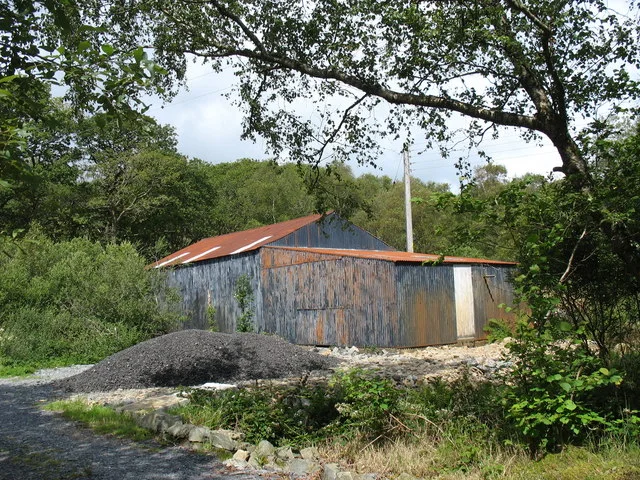
Llyn Trawsfynydd Fishery, Wales: a comparative example for studying inland fisheries.
Credit: Eric Jones · CC BY-SA 2.0 · sourceResized and converted to WebP; uncropped.
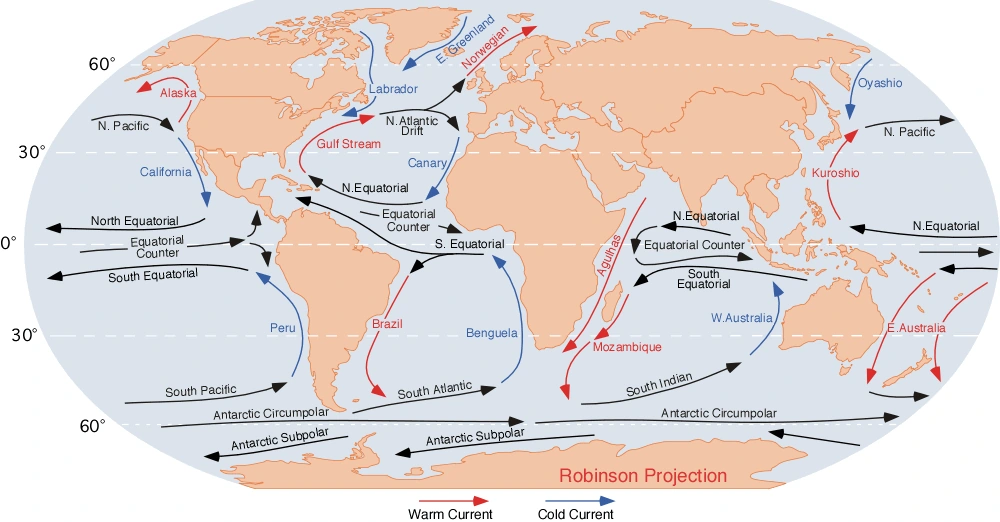
Map study
Global ocean currents: compare warm and cold current pathways and major gyres. Arrow directions and legend matter; local and seasonal currents can differ.
- Read the source legend, scale and reference period before comparing regions.
- Connect spatial patterns to the processes discussed in this topic; this map is a study reference, not live operational data.
Credit: Dr. Michael Pidwirny · Public domain · sourceConverted to WebP on an opaque white background; proportionally resized without cropping. Original cartography and legend retained.
1. Classification and geographical significance
Fisheries include activities involving finfish, crustaceans such as prawns and crabs, and molluscs such as oysters and mussels. Capture fisheries harvest naturally occurring stocks, whereas aquaculture involves farming aquatic organisms through interventions such as stocking, feeding and protection. Culture-based fisheries occupy an intermediate position: water bodies such as reservoirs may be stocked, but subsequent production depends substantially on natural food and ecosystem conditions.
Marine fisheries operate in seas and oceans. Inland fisheries use rivers, canals, reservoirs, lakes, ponds and wetlands. Brackish-water fisheries occupy transitional environments such as estuaries, lagoons and coastal backwaters. These categories should not be confused: aquaculture can occur in freshwater, brackish water or seawater. Mariculture specifically refers to cultivation in marine environments, including sea cages and mussel or oyster farms.
Fisheries supply animal protein, micronutrients, employment and export earnings. They support boatbuilding, ice plants, transport, processing and retailing alongside fishing itself. Women are particularly important in vending and post-harvest activities, although access to assets and formal credit remains unequal. For examinations, distinguish total fish production from marine landings, capture from culture, and production rankings from seafood-export rankings.
- Finfish examples: Indian major carps, sardines, mackerel and tuna.
- Shellfish examples: shrimp and crabs are crustaceans; mussels and oysters are molluscs.
2. Marine fisheries: environmental controls and regional distribution
Marine productivity depends on nutrient availability, sunlight, temperature, salinity, currents and habitat. Continental shelves often support productive fisheries because shallow waters receive light and nutrients from land and seabed mixing. Upwelling brings nutrient-rich subsurface water into the illuminated surface layer, stimulating phytoplankton and aquatic food webs. On India’s southwest coast, seasonal monsoon-driven upwelling supports productive pelagic fisheries, although oxygen depletion can also affect organisms.
India’s west coast includes major fishing centres in Gujarat, Maharashtra, Goa, Karnataka and Kerala. The broad shelf off Gujarat and Maharashtra, estuaries and productive coastal waters support diverse fisheries. Kerala and Karnataka are associated with oil sardine and Indian mackerel; Gujarat has important pomfret, croaker and Bombay duck fisheries. Bombay duck is a fish, not a bird. Mumbai, Veraval, Mangaluru and Kochi are important landing or processing centres.
The east coast includes the deltaic and estuarine environments of the Mahanadi, Godavari, Krishna and Cauvery, alongside the Sundarbans. Andhra Pradesh, Tamil Nadu, Odisha and West Bengal support marine fishing and coastal aquaculture. The shelf is generally narrower than on much of the west coast, but local productivity varies substantially. Visakhapatnam, Paradip and Chennai are prominent centres. Cyclones, storm surges and harbour disruption create significant livelihood risks.
Lakshadweep is associated with tuna fishing, notably pole-and-line methods, while the Andaman and Nicobar Islands possess substantial oceanic fishery resources. Territorial waters extend up to 12 nautical miles; the exclusive economic zone extends up to 200 nautical miles. In the EEZ, India has sovereign rights over resources, not complete territorial sovereignty. Resource potential does not automatically imply ecologically or commercially viable harvesting.
- Pelagic fish inhabit the water column; demersal fish live on or near the seabed.
- Estuaries, mangroves and seagrass beds provide feeding, breeding and nursery habitats.
Fish value chain
- 1. Resource assessment or farm-site selection
- 2. Responsible capture or aquaculture production
- 3. Hygienic landing, harvesting and sorting
- 4. Rapid icing and cold-chain transport
- 5. Processing, testing and traceability
- 6. Domestic marketing or export
3. Inland fisheries and aquaculture
Inland fisheries have become the dominant component of Indian fish production, largely through aquaculture expansion. Andhra Pradesh combines pond farming, commercial inputs and marketing networks; West Bengal has extensive pond fisheries and strong consumer demand. Bihar, Uttar Pradesh, Odisha and Assam also have important inland resources. Floodplain wetlands, including beels in Assam, connect fisheries with seasonal river flooding and local food security.
Freshwater aquaculture commonly uses Indian major carps: catla, rohu and mrigal. Composite fish culture combines species with complementary feeding habits and pond-use patterns. Catla primarily feeds near the surface, rohu mainly in the water column and mrigal near the bottom. Other combinations may include grass carp, silver carp and common carp. Complementarity improves resource use, but suitable stocking density, water quality and disease prevention remain essential.
Brackish-water aquaculture is concentrated in coastal belts, especially Andhra Pradesh and other east-coast states. Pacific whiteleg shrimp, Litopenaeus vannamei, is a major cultured export species; black tiger shrimp, Penaeus monodon, is also important. Shrimp aquaculture is not the same as harvesting wild marine shrimp. Hatchery quality, biosecurity, traceability and responsible effluent management strongly influence its economic and environmental performance.
Reservoir cage culture, rice–fish farming and recirculating aquaculture systems offer additional options. Cage farming requires assessment of carrying capacity and competing water uses. Recirculating systems treat and reuse water but require energy, technical skill and investment; they are not universally low-cost solutions. River fisheries face particular difficulties because dams, altered flows, pollution and sand mining can disrupt migration, spawning grounds and floodplain connectivity.
| Environment | Examples | Characteristic resources | Important constraint |
|---|---|---|---|
| Marine coastal waters | Gujarat, Karnataka and Kerala coasts | Sardine, mackerel, pomfret and marine shrimp | Fishing pressure and bycatch |
| Freshwater ponds | Andhra Pradesh and West Bengal | Catla, rohu and mrigal | Water quality and disease |
| Rivers and floodplain wetlands | Ganga–Brahmaputra plains | Carps, catfish and other indigenous species | Flow alteration and habitat fragmentation |
| Brackish-water farms and lagoons | Andhra Pradesh coast and Chilika | Cultured shrimp; lagoon fish and crustaceans | Salinity changes and pollution |
| Oceanic island waters | Lakshadweep | Tuna | Logistics, weather and stock management |
4. Institutions, schemes and economic infrastructure
Fisheries governance is divided between the Union and states. States regulate fishing within their territorial jurisdiction through legislation including Marine Fishing Regulation Acts, while the Union has responsibility for fisheries beyond territorial waters. The Coastal Aquaculture Authority Act, 2005, amended in 2023, provides a regulatory framework for coastal aquaculture. The National Fisheries Development Board and Indian Council of Agricultural Research institutions support development, research and training.
Pradhan Mantri Matsya Sampada Yojana was launched in 2020 with a planned investment of ₹20,050 crore for 2020–21 to 2024–25. Its interventions cover production, productivity, infrastructure, value chains and fisher welfare. The Fisheries and Aquaculture Infrastructure Development Fund, established in 2018–19, supports infrastructure through concessional finance. Kisan Credit Card facilities have also been extended to fisheries for eligible working-capital needs.
Pradhan Mantri Matsya Kisan Samridhi Sah-Yojana, approved in 2024 as a Central Sector sub-scheme under PMMSY, has an investment framework of ₹6,000 crore for 2023–24 to 2026–27. It emphasises formalisation, access to finance, aquaculture insurance and value-chain efficiency. Cold chains, hygienic landing centres, ice availability and affordable transport are crucial because fish deteriorate rapidly. Export value, led by products such as frozen shrimp, should not be treated as a measure of nutritional access or fisher welfare.
5. Sustainability and disaster resilience
Major pressures include excessive fishing effort, juvenile catch, destructive gear, bycatch, discarded fishing nets and habitat loss. Bottom trawling can disturb seabed habitats, depending on location and intensity. Coastal aquaculture can create salinisation, disease and waste-disposal problems when poorly planned. Antibiotic misuse threatens public health and export compliance. Warming seas, marine heatwaves and changing oxygen conditions can alter species distribution and fishing seasons.
Sustainable management combines scientific stock assessment, seasonal closures, mesh-size rules, protection of breeding habitats and community participation. Fishing-ban periods differ across coasts and jurisdictions; they are not one uniform nationwide closure. INCOIS provides Potential Fishing Zone advisories and ocean-state forecasts, helping improve search efficiency and safety. Advisories do not guarantee catches or replace conservation limits. Ecosystem-based management should protect habitats, maintain environmental flows and secure small-scale fishers’ access, insurance and disaster preparedness.
Inland fisheries: water bodies, production systems and management
The metadata identifies Llyn Trawsfynydd Fishery in Wales, making this a comparative example rather than evidence about Indian fisheries. A fishery is an activity or resource system involving aquatic organisms, not necessarily a fish farm. The title alone does not establish whether production involves naturally reproducing stocks, stocking, controlled breeding or supplementary feeding. These distinctions matter because a water body’s name cannot reliably identify its production system or economic function.
In India, inland fisheries draw on rivers, reservoirs, lakes, ponds and other inland waters. Capture fisheries harvest aquatic stocks, whereas aquaculture involves deliberate intervention in rearing, such as stocking, feeding or protection. Culture-based fisheries can occupy an intermediate position: fish are stocked into a water body and subsequently harvested without the intensive control typical of pond farming. Productivity depends on water availability, temperature, dissolved oxygen, nutrients and habitat quality. Management must therefore connect fish production with competing water uses, pollution control and the livelihoods of fishing communities.
- Distinguish location from production method: inland does not automatically mean aquaculture, and marine does not automatically mean capture fishing.
- For Indian geography, explain reservoir and river fisheries through seasonal flows, connectivity, breeding habitats and access rights, not merely the extent of water surface.
- Avoid treating stocking as universally beneficial: species choice, ecological compatibility and carrying capacity determine whether interventions support sustainable yields or create ecological risks.
Real-world case studies
Chilika Lake: hydrological restoration and fisheries
Chilika in Odisha is a brackish-water lagoon and Ramsar site. Restricted exchange with the sea contributed to ecological deterioration and declining fisheries. Opening a new sea mouth in 2000 helped restore water exchange and the salinity regime, supporting fish and prawn recruitment. Chilika was removed from the Montreux Record in 2002. The case demonstrates why fisheries restoration must address hydrology and habitats, not merely stocking.
Lakshadweep: pole-and-line tuna fishing
Lakshadweep’s traditional pole-and-line fishery targets tuna, especially skipjack, using live bait. Compared with many large-scale net fisheries, it can have low bycatch and high selectivity. Sustainability nevertheless depends on responsible management of both tuna and baitfish, alongside reefs that support bait resources. Improved cold storage and marketing can raise fisher incomes without necessarily increasing fishing pressure.
Previous year questions
No source-linked PYQ is available here yet. Use the practice questions below.
Practice questions
Practice MCQ 1
Consider the following statements: 1. Aquaculture may be practised in freshwater, brackish water and seawater. 2. Inland fisheries consist exclusively of capture fisheries. 3. Mariculture is cultivation in marine environments. Which of the statements given above are correct?
- A. 1 and 2 only
- B. 1 and 3 only
- C. 2 and 3 only
- D. 1, 2 and 3
Practice MCQ 2
Which one of the following best explains the role of coastal upwelling in supporting fisheries?
- A. It permanently eliminates oxygen deficiency in coastal waters.
- B. It supplies nutrient-rich subsurface water to the sunlit surface zone.
- C. It converts seawater into freshwater suitable for carps.
- D. It prevents all seasonal fluctuations in fish abundance.
Practice MCQ 3
Consider the following pairs: 1. Catla — Predominantly surface feeder 2. Mrigal — Predominantly bottom feeder 3. Pacific whiteleg shrimp — Major species in Indian brackish-water aquaculture. How many of the above pairs are correctly matched?
- A. Only one
- B. Only two
- C. All three
- D. None
Mains practice · India’s fisheries development requires more than increasing production. Discuss with reference to geographical diversity, ecological sustainability and fisher livelihoods. Answer in 250 words.
- Distinguish marine capture, inland capture and aquaculture, noting inland production dominance.
- Explain regional differences using the west coast, east-coast shrimp farming, floodplain wetlands and island tuna fisheries.
- Discuss habitat degradation, excessive fishing effort, disease, climate risks and unequal access to infrastructure.
- Evaluate PMMSY, cold-chain development, biosecurity, scientific advisories and social protection.
- Recommend ecosystem-based regulation, community participation, traceability and value addition.
- Use Chilika restoration to illustrate the connection between ecosystem health and livelihoods.
Further reading
- NCERT, India: Physical Environment, Class XI: drainage systems and coastal geography.
- Department of Fisheries, Government of India: Handbook on Fisheries Statistics 2023.
- Department of Fisheries: PMMSY guidelines and annual reports, dof.gov.in.
- ICAR–Central Marine Fisheries Research Institute: marine fish landings and fisheries research, cmfri.org.in.
- Indian National Centre for Ocean Information Services: Potential Fishing Zone advisories and ocean-state forecasts, incois.gov.in.
- Coastal Aquaculture Authority: legislation and aquaculture guidelines, caa.gov.in.
- https://commons.wikimedia.org/wiki/File:Pysgotfa_Llyn_Trawsfynydd_Fishery_-_geograph.org.uk_-_511828.jpg
Preparing for UPSC Civil Services? Get classroom teaching, answer-writing evaluation and mentorship at Pragnya IAS Academy, Ashok Nagar — see why aspirants choose us for IAS coaching in Hyderabad.