

A view of landscape with pre harvest wheat crop in Punjab
Credit: Harvinder Chandigarh · CC BY-SA 4.0 · source
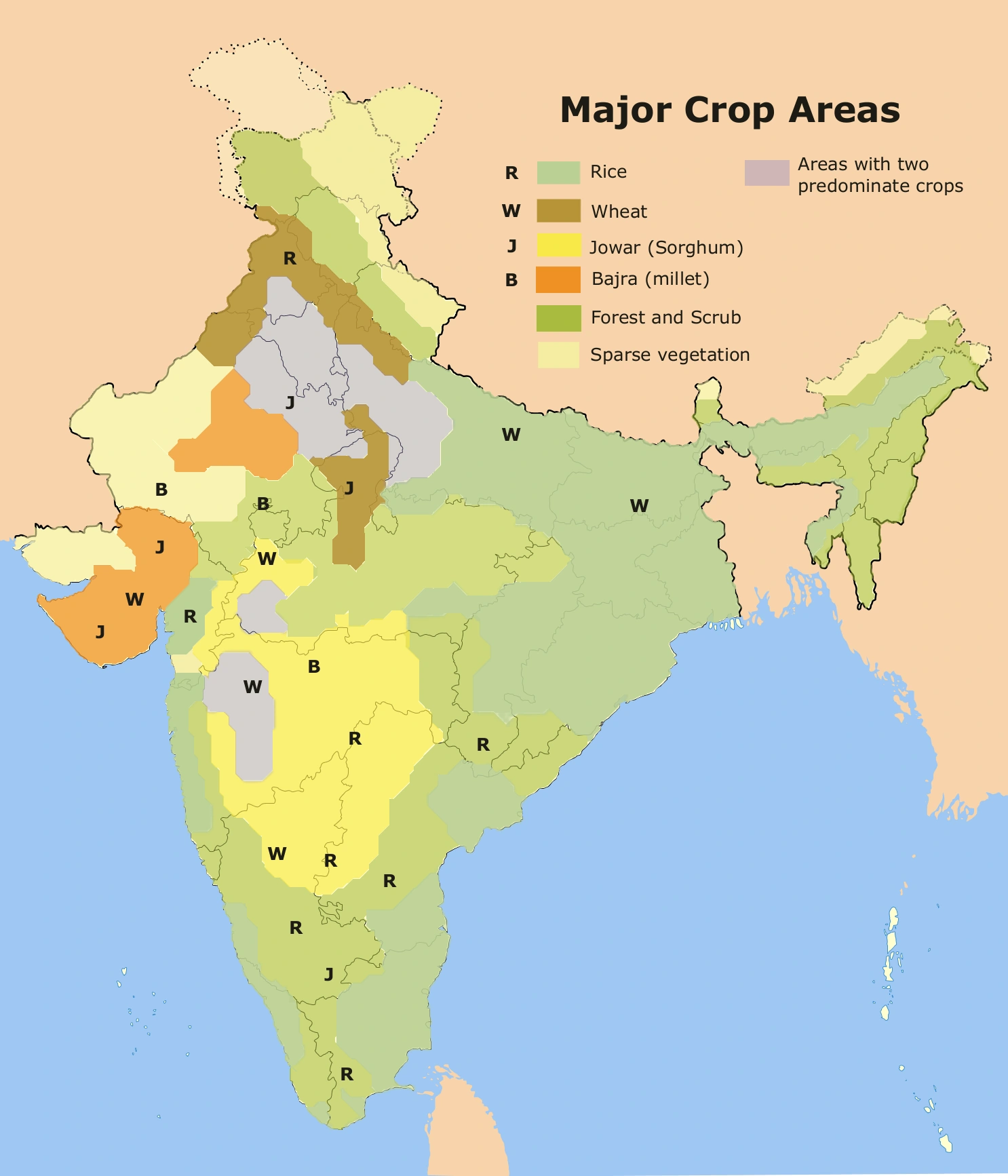
Map study
Major crop regions of India: relate crop belts to rainfall, soils, temperature and irrigation. Schematic historical reference, not current production rankings.
- Read the source legend, scale and reference period before comparing regions.
- Connect spatial patterns to the processes discussed in this topic; this map is a study reference, not live operational data.
Credit: Amog · CC BY-SA 2.5 · sourceConverted to WebP on an opaque white background; proportionally resized without cropping. Original cartography and legend retained.
1. Meaning, origins and historical setting
The Green Revolution refers to a major increase in crop productivity through improved varieties and the coordinated use of water, nutrients, plant protection and modern farm practices. Globally, its scientific foundations included semi-dwarf wheat developed through research associated with Norman Borlaug in Mexico and improved rice varieties developed at the International Rice Research Institute in the Philippines. William S. Gaud popularised the expression Green Revolution in 1968.
India entered the 1960s with low agricultural yields, rapid population growth and vulnerability to monsoon failure. Food imports, including supplies under the United States’ Public Law 480 programme, helped meet shortages. The droughts of 1965–66 and 1966–67 exposed the risks of dependence on uncertain domestic harvests and external supplies. Raising food production became a national strategic priority.
Earlier initiatives laid the groundwork. The Intensive Agricultural District Programme, introduced in 1960–61, concentrated inputs and services in selected districts. The High Yielding Varieties Programme followed in 1966–67. Agricultural scientists, public research institutions, extension workers and farmers adapted imported material to Indian conditions. Indian wheat varieties such as Kalyan Sona and Sonalika became important to the transformation.
Unlike land expansion alone, this strategy sought more output per hectare and, where possible, more crops per year. It was therefore a form of agricultural intensification. However, yield growth cannot be attributed to seed technology alone: irrigation, public investment, prices and market access were essential enabling conditions.
Timeline
1960–61
Intensive Agricultural District Programme begins, concentrating agricultural inputs and services in selected districts.
1965
Food Corporation of India and Agricultural Prices Commission are established.
1965–67
Successive droughts intensify food-security concerns.
1966–67
High Yielding Varieties Programme is launched in India.
1968
William S. Gaud popularises the term Green Revolution.
2010–11
Bringing Green Revolution to Eastern India is introduced under the Rashtriya Krishi Vikas Yojana framework.
2. The technological and institutional package
Semi-dwarf wheat and rice varieties had shorter, stronger stems and a higher harvest index, meaning a larger share of total plant biomass became grain. Their reduced tendency to lodge, or fall over, allowed them to respond better to fertiliser application. Many improved varieties also had shorter duration, helping farmers fit an additional crop into the agricultural year.
Assured irrigation was crucial because moisture stress could prevent crops from responding to fertilisers and improved seeds. Canal networks, wells and tubewells supported the new system. Chemical fertilisers supplied nitrogen, phosphorus and potassium; pesticides and improved crop management reduced losses. Tractors, threshers and later combine harvesters enabled timely operations, especially where the interval between successive crops was short.
Institutional arrangements reduced the risks of adoption. Minimum support prices, procurement and public food distribution provided an important demand framework. The Food Corporation of India, established in 1965, supported procurement, storage and distribution. The Agricultural Prices Commission, also established in 1965 and renamed the Commission for Agricultural Costs and Prices in 1985, advised on agricultural prices. Cooperatives, banks, extension services and agricultural universities helped supply credit and knowledge.
For examination purposes, distinguish an HYV from a hybrid. High yield describes performance under suitable conditions; hybrid describes the offspring of genetically distinct parental lines. Many Green Revolution wheat and rice varieties were conventional improved varieties, not hybrids. They were also not genetically modified crops.
How the Green Revolution package raised production
- 1. Develop and distribute locally suitable high-yielding varieties
- 2. Provide assured irrigation and balanced nutrient supply
- 3. Support adoption through credit, extension and timely farm operations
- 4. Reduce market risks through prices, procurement and infrastructure
- 5. Increase yields, cropping intensity and marketable surplus
- 6. Reinvest while managing water, soil and biodiversity pressures
3. Geographical spread and uneven adoption
The earliest and strongest gains occurred in Punjab, Haryana and western Uttar Pradesh. These areas combined relatively dependable irrigation, suitable wheat-growing conditions, transport infrastructure, market access and active public procurement. Their cool winter growing season and irrigated alluvial plains suited the new wheat varieties. Existing commercial farming and institutional support accelerated adoption.
Rice productivity subsequently improved in irrigated parts of Andhra Pradesh, Tamil Nadu and other regions, while wheat cultivation intensified elsewhere in northern India. The geographical pattern evolved over time: the Green Revolution was neither permanently confined to northwestern India nor equally successful throughout the country. Rice presented greater ecological diversity than wheat, including irrigated, rainfed, flood-prone and deepwater environments.
Eastern India initially benefited less despite fertile alluvial soils and substantial water resources. Flooding, waterlogging, inadequate drainage, weak irrigation control, fragmented holdings, limited credit and weaker procurement and infrastructure constrained adoption. Abundant annual rainfall did not necessarily provide dependable water at the correct stage of crop growth.
Rainfed and dryland regions of central and peninsular India also experienced slower early gains. Pulses, oilseeds and many coarse cereals received less effective technological and procurement support than wheat and rice. The contrast illustrates a central geographical principle: agricultural outcomes depend on the interaction of natural resources, usable infrastructure and institutions, not on soil fertility or rainfall alone.
| Region | Enabling conditions or constraints | Broad outcome |
|---|---|---|
| Punjab, Haryana and western Uttar Pradesh | Assured irrigation, wheat suitability, procurement and infrastructure | Early, strong gains; later groundwater and diversification concerns |
| Irrigated southern and coastal plains | Canal and delta irrigation; suitable rice environments | Important rice productivity gains |
| Eastern alluvial plains | High potential but flooding, drainage and institutional constraints | Slower initial adoption; substantial scope for later gains |
| Central and peninsular drylands | Rainfall uncertainty and limited assured irrigation | Smaller initial gains from the wheat–rice-centred package |
4. Achievements and socioeconomic consequences
The principal achievement was a sustained expansion of cereal production and a stronger foundation for national food security. Official agricultural statistics show foodgrain production increasing from approximately 82 million tonnes in 1960–61 to 130 million tonnes in 1980–81. Wheat production rose especially rapidly. These changes reflected both yield improvement and other factors, including irrigation expansion and changes in cropped area.
Higher marketable surpluses supported buffer stocks and the Public Distribution System, reducing vulnerability to food shortages and import dependence. Demand increased for machinery, fertilisers, transport, storage and processing, strengthening links between agriculture and the wider rural economy. Multiple cropping also generated employment in several operations and regions.
Benefits were unevenly distributed. Farmers with irrigation, larger marketable surpluses and access to credit could adopt the package more easily. Smaller farmers also benefited where inputs and institutions were accessible; therefore, describing the transformation as exclusively benefiting large landowners is inaccurate. Its distributional effects varied with tenancy arrangements, farm size and local public support.
Employment effects were similarly mixed. Intensification could raise labour demand, while mechanisation displaced labour in particular tasks. Increased cereal availability also did not automatically eliminate hunger or malnutrition, which depend on incomes, distribution, health and dietary diversity. National foodgrain self-sufficiency must therefore be distinguished from household food and nutrition security.
5. Environmental limits and the next transition
Intensive rice–wheat systems created serious sustainability pressures in some regions. Groundwater extraction exceeding recharge caused declining water tables, particularly in parts of northwestern India. Excessive irrigation and poor drainage contributed to waterlogging and secondary salinisation elsewhere. Imbalanced fertiliser use, especially excessive emphasis on nitrogen, aggravated nutrient imbalances; inappropriate pesticide use created ecological and health risks.
Specialisation in a narrow range of crops reduced on-farm diversity. Irrigated paddy cultivation in relatively water-stressed areas increased pressure on water and electricity supplies. Flooded rice fields emit methane, while nitrogen fertilisers can contribute to nitrous oxide emissions. In northwestern rice–wheat systems, the short interval between paddy harvesting and wheat sowing also contributes to the problem of residue burning.
M. S. Swaminathan’s concept of an evergreen revolution emphasised sustained productivity growth without ecological harm. Relevant approaches include crop diversification, pulses and millets, integrated nutrient and pest management, improved drainage, climate-resilient varieties and location-specific water management. Diversification requires reliable markets and incentives; advising farmers to change crops without addressing price and income risks is insufficient.
Policy connections include the Soil Health Card scheme, Pradhan Mantri Krishi Sinchayee Yojana and efforts to extend productivity gains to eastern India. The objective should be resource-efficient, remunerative and nutrition-sensitive farming. Higher water-use efficiency at field level must also be accompanied by groundwater governance, because efficiency improvements alone do not guarantee lower total extraction.
Real-world case studies
Punjab: food-security success and groundwater stress
Punjab’s irrigation network, agricultural research and procurement system enabled major wheat and rice gains. Subsequent paddy expansion increased groundwater pressure. The Punjab Preservation of Subsoil Water Act, 2009 regulates early paddy nursery sowing and transplantation to reduce pre-monsoon groundwater use. The experience demonstrates why technological progress must be accompanied by crop incentives and resource governance.
Bringing Green Revolution to Eastern India
Introduced in 2010–11, BGREI targeted Assam, Bihar, Chhattisgarh, Jharkhand, Odisha, eastern Uttar Pradesh and West Bengal. It supported measures such as crop demonstrations, seed improvement and water-resource development. Its rationale was to use eastern India’s agricultural potential while correcting the regional imbalance of earlier productivity growth.
Previous year questions
UPSC Mains 2014 · GS-I
Why did the Green Revolution in India virtually bypass the eastern region despite fertile soil and good availability of water?
- Distinguish water availability from controlled, timely irrigation.
- Explain flooding, waterlogging, drainage problems and diverse rice ecologies.
- Discuss fragmented holdings, limited credit, infrastructure and extension.
- Contrast procurement and public investment with northwestern India.
- Qualify the initial imbalance by acknowledging subsequent eastern-region gains.
Practice questions
Practice MCQ 1
With reference to Green Revolution varieties, consider the following statements: 1. Semi-dwarf stature helped reduce lodging under fertiliser application. 2. All high-yielding varieties are hybrids. 3. Their performance depended partly on irrigation and nutrient availability. Which statements are correct?
- A. 1 and 2 only
- B. 1 and 3 only
- C. 2 and 3 only
- D. 1, 2 and 3
Practice MCQ 2
Which of the following best explains the early concentration of Green Revolution gains in northwestern India?
- A. The region received India’s highest annual rainfall.
- B. Improved seeds required no complementary inputs there.
- C. Irrigation, suitable wheat-growing conditions, procurement and infrastructure reinforced one another.
- D. Eastern India lacked fertile alluvial soils.
Practice MCQ 3
Consider the following pairs: 1. Food Corporation of India: procurement, storage and distribution of foodgrains. 2. Commission for Agricultural Costs and Prices: recommendations on minimum support prices. 3. Evergreen revolution: productivity growth without ecological harm. How many pairs are correctly matched?
- A. Only one
- B. Only two
- C. All three
- D. None
Mains practice · The Green Revolution resolved an immediate food-security challenge but created a new geography of agricultural vulnerability. Discuss with reference to regional inequalities and environmental sustainability. Suggest a way forward. Answer in 250 words.
- Introduce the seed–water–fertiliser–institutions package.
- Explain cereal output gains, buffer stocks and reduced import dependence.
- Contrast northwestern gains with initial eastern and dryland disadvantages.
- Discuss groundwater depletion, salinity, nutrient imbalance and reduced crop diversity.
- Avoid treating impacts as uniform across regions or farm sizes.
- Recommend diversified markets, suitable procurement incentives, balanced inputs and groundwater governance.
- Conclude with an evergreen revolution focused on productivity, incomes and nutrition.
Further reading
- NCERT, India: People and Economy, Class XII, chapter on Land Resources and Agriculture.
- NCERT, Indian Economic Development, Class XI, chapter on Indian Economy 1950–1990.
- Department of Agriculture and Farmers Welfare, Agricultural Statistics at a Glance.
- Commission for Agricultural Costs and Prices, Price Policy Reports.
- Central Ground Water Board, National Compilation on Dynamic Ground Water Resources of India.
- Food Corporation of India, official material on procurement, storage and food security.
Preparing for UPSC Civil Services? Get classroom teaching, answer-writing evaluation and mentorship at Pragnya IAS Academy, Ashok Nagar — see why aspirants choose us for IAS coaching in Hyderabad.