
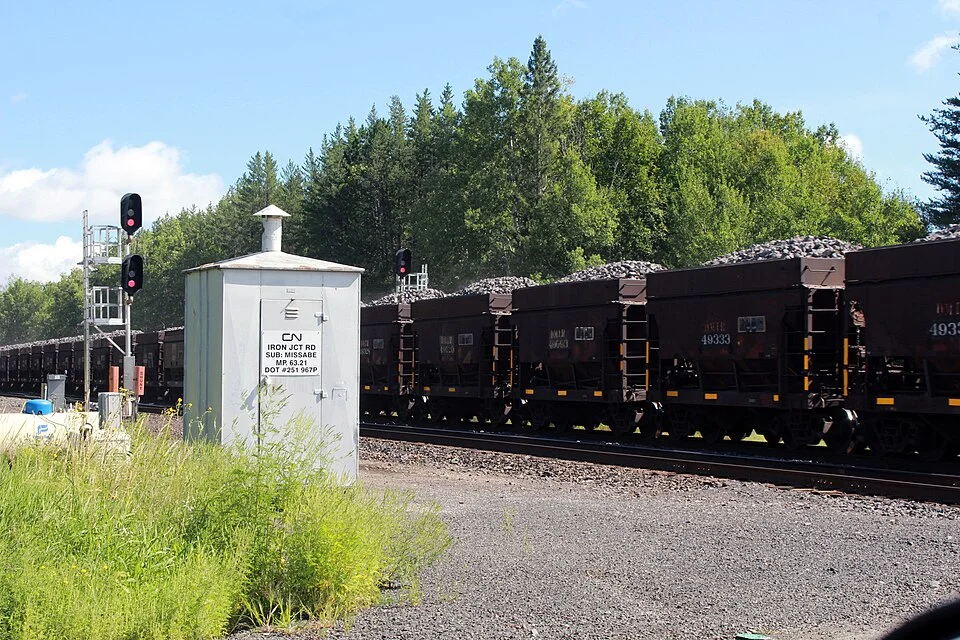
Iron ore transported in ore cars at Iron Junction, Minnesota: a comparative example of bulk mineral transport.
Credit: Myotus · CC BY 4.0 · sourceResized and converted to WebP; uncropped.
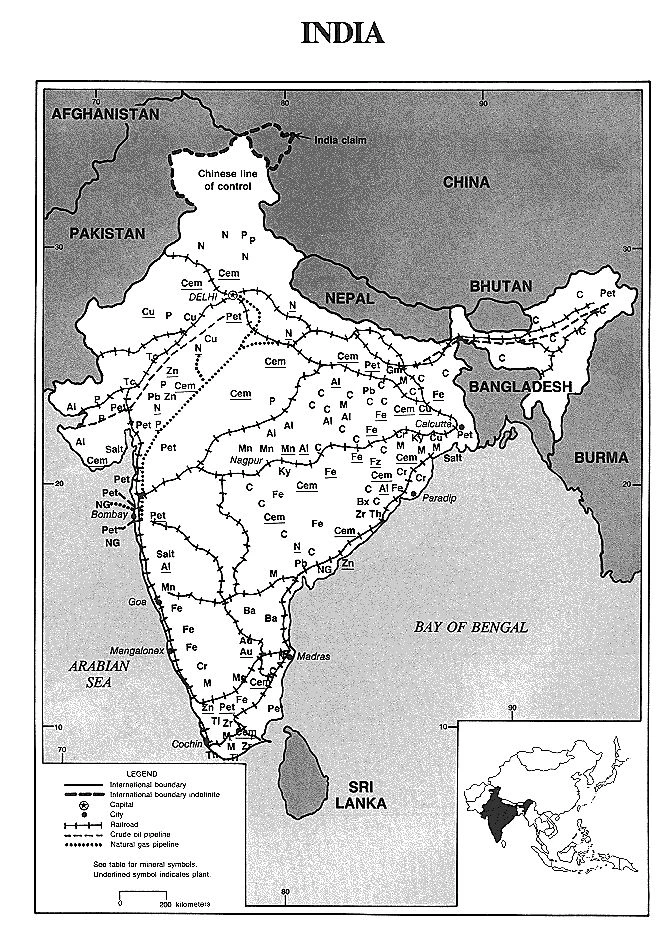
Map study
USGS reference map of mineral deposits and mineral industries in India. Historical place names and boundary depiction are retained from the source; not a current official political map, mine inventory or production dataset.
- Locate Fe (iron), Mn (manganese), Al (aluminium/bauxite-related) and C (coal) symbols; underlined symbols denote industrial plants, not deposits.
- Compare the eastern and peninsular mineral belts. The source legend does not establish present reserves, output or operating status.
- For current official boundary depiction and mineral statistics, consult Survey of India and Indian Bureau of Mines publications.
Credit: United States Geological Survey · Public domain (US federal government work) · sourceConverted to WebP without cropping or changing cartography; original legend retained.
1. Nature, composition and economic significance
Iron ore is naturally occurring mineral material from which iron can be extracted economically. Its importance arises from the central role of steel in construction, railways, machinery, automobiles, defence equipment and infrastructure. An iron-rich rock does not automatically constitute a workable ore: grade, impurities, deposit size, accessibility, processing costs and market conditions determine whether extraction is commercially viable.
Haematite and magnetite are the most important ore minerals. Magnetite is strongly magnetic and, in its pure form, contains more iron than haematite. Nevertheless, India’s commercial iron-ore mining is dominated by haematite because many deposits are extensive, relatively accessible and suitable for established steelmaking routes. High theoretical iron content alone does not establish the economic superiority of an ore.
Goethite is an iron oxyhydroxide, while limonite is a traditional term for mixtures of hydrated iron oxides rather than a single precisely defined mineral. Siderite is iron carbonate. These terms appear in standard geographical classifications, but they should not be treated as equally important sources of Indian commercial production.
Ore quality depends on iron content and unwanted constituents, collectively called gangue. Silica and alumina influence processing and furnace performance; phosphorus and sulphur can impair steel quality unless controlled. Iron ore is distinct from manganese ore: manganese is used in steelmaking, but it is not a principal source of iron.
- Ore grade means the concentration of the valuable constituent, usually expressed as percentage iron.
- Lumps and fines are size categories; they are not different iron-bearing minerals.
- Pellets are manufactured agglomerates of fine iron-bearing material, not naturally occurring ore bodies.
2. Geological occurrence and resource terminology
Many important Indian iron-ore deposits are associated with ancient Precambrian rocks of the Peninsular Plateau. A major geological setting is banded iron formation, characterised by alternating iron-rich and silica-rich layers. Banded haematite quartzite and banded magnetite quartzite are familiar Indian examples. Weathering and enrichment have helped produce economically valuable ore bodies in several regions.
This geological association explains why India’s principal iron-ore belts lie in the eastern, central and southern plateau rather than in the recent alluvial deposits of the northern plains. The spatial pattern is not accidental: mineral distribution reflects geological history, whereas the location and scale of mining also depend on infrastructure, investment and regulatory conditions.
A mineral resource is a concentration of material with prospects for eventual economic extraction. A reserve is the economically mineable part established through sufficiently detailed assessment and consideration of technical, economic and other modifying factors. India’s mineral inventories use the United Nations Framework Classification framework. Exploration, prices, technology and feasibility studies can alter the classification of a deposit over time.
Annual production is the quantity actually mined during a specified period. A state with very large resources need not have the highest output. Karnataka has substantial magnetite resources, but national commercial production relies heavily on haematite-bearing areas. When comparing states, always identify the mineral category, reporting year and whether the figure concerns resources, reserves or production.
- Do not infer current output directly from a geological resource map.
- Do not confuse the total mass of ore with the quantity of contained iron.
- For changing statistics, use the Indian Bureau of Mines and Ministry of Mines rather than undated rankings.
Typical iron-ore value chain
- 1. Exploration and geological assessment
- 2. Feasibility studies, mineral concession and applicable clearances
- 3. Mining, crushing and screening
- 4. Beneficiation where required
- 5. Agglomeration of suitable fines into sinter or pellets
- 6. Transport and reduction to produce iron
- 7. Steelmaking and downstream manufacturing
3. Major Indian belts and mining centres
The Odisha–Jharkhand belt is India’s foremost iron-ore region. In Odisha, the mineral-rich districts of Keonjhar, also called Kendujhar, Sundargarh and Mayurbhanj contain important deposits. Badampahar lies in Mayurbhanj, while the Joda–Barbil area is a major mining centre. In Jharkhand, Noamundi and Gua are important centres in West Singhbhum. These deposits support steelmaking within the eastern industrial region and supply plants elsewhere.
The Durg–Bastar–Chandrapur belt is the standard NCERT designation for a broad central Indian belt. In Chhattisgarh, Bailadila in Dantewada district is especially important for high-grade haematite. Dalli–Rajhara has historically supplied the Bhilai Steel Plant. Rowghat deposits are important for sustaining Bhilai’s ore supply. The name of the broad belt must not be confused with the location of each individual mining complex.
The Ballari–Chitradurga–Chikkamagaluru–Tumakuru belt lies in Karnataka; older textbooks use Bellary, Chikmagalur and Tumkur. Ballari–Hospet is a major producing area associated with the state’s steel industry. Kudremukh, in the Western Ghats, is notable for magnetite-bearing deposits and its history of beneficiation and slurry transport. It is not a currently operating iron-ore mine: mining ceased in 2005.
The Maharashtra–Goa belt includes deposits in Goa and Maharashtra’s Konkan region, including Ratnagiri. Goa became closely associated with exports of lower-grade iron ore through Mormugao port, supported by river-barge transport. Its mining history also illustrates how judicial decisions, environmental regulation and lease administration can disrupt output. Any claim about operating mines or production must therefore be tied to a particular year.
- Map pairs: Bailadila–Chhattisgarh; Noamundi–Jharkhand; Badampahar–Odisha; Kudremukh–Karnataka.
- Odisha leads national iron-ore production; Chhattisgarh, Karnataka and Jharkhand are also major producers.
- Learn mining centres together with nearby steel plants, railway corridors and ports.
| Belt | Important centres | Exam-relevant association |
|---|---|---|
| Odisha–Jharkhand | Joda–Barbil, Badampahar, Noamundi, Gua | Major haematite deposits; eastern steel-producing region |
| Durg–Bastar–Chandrapur | Bailadila, Dalli–Rajhara | Chhattisgarh mining centres; Bhilai linkage |
| Ballari–Chitradurga–Chikkamagaluru–Tumakuru | Ballari–Hospet, Kudremukh | Karnataka; Kudremukh mining ceased in 2005 |
| Maharashtra–Goa | Goa and parts of Ratnagiri | Historical export orientation; Mormugao port |
4. From mine to steel: processing and industrial linkages
Most large Indian iron-ore operations use opencast methods. Mining involves removal of overburden, drilling, blasting, excavation and transport. Crushing and screening separate material by size. Beneficiation improves ore quality by removing unwanted material; techniques can include washing, gravity separation, flotation and magnetic separation, depending on the mineral and gangue characteristics.
Fine ore often requires agglomeration. Sintering produces a porous furnace feed from fine materials, while pelletisation forms small balls that are hardened through thermal treatment. These processes help utilise fines and beneficiated concentrates. Magnetite’s magnetic properties can assist separation, but the energy needed for fine grinding may remain substantial.
In the conventional blast furnace route, iron ore is reduced mainly using coke, with limestone serving as a flux. The hot metal is subsequently converted into steel. Direct reduced iron is produced without melting the ore during reduction, using suitable reducing agents such as coal or gas. Ore quality requirements differ across processes, and hydrogen-based direct reduction generally requires high-quality feed.
Iron ore is bulky, so freight costs strongly influence mine competitiveness and industrial location. Railways, ports and slurry pipelines connect deposits with processing plants and markets. Steel plants also require energy, water, labour and other inputs; proximity to iron ore alone does not explain their location. India’s dependence on imported coking coal is compatible with its strong domestic iron-ore endowment.
- Beneficiation raises usable ore quality; it does not create additional iron.
- A slurry pipeline transports finely ground ore or concentrate mixed with water.
- Export and domestic supply patterns change with demand, freight costs, duties and policy.
5. Governance, environmental concerns and sustainable use
Iron ore is governed as a major mineral under the Mines and Minerals (Development and Regulation) Act, 1957. Amendments in 2015 established auction-based allocation as the principal route for mineral concessions. A mining lease does not substitute for other applicable requirements, including environmental clearance and forest-related approvals where relevant. The Indian Bureau of Mines is important for mineral conservation, systematic mine development and statistical reporting.
Mining can remove vegetation, fragment habitats, generate dust and noise, and increase sediment loads in streams. Waste dumps and tailings require stable design and monitoring. These concerns are particularly significant where deposits overlap with forests, biodiversity-rich landscapes or areas inhabited by Scheduled Tribes. Land acquisition, displacement, forest rights and community participation are therefore integral to resource governance.
District Mineral Foundations, introduced through the 2015 amendments, are intended to benefit people and areas affected by mining. The Pradhan Mantri Khanij Kshetra Kalyan Yojana provides a framework for using these funds for welfare and development. Their effectiveness depends on identifying affected communities, planning appropriate projects, transparency and measurable outcomes.
Sustainable management includes progressive reclamation, safe waste storage, dust suppression, water recycling, biodiversity protection and credible mine closure. Better utilisation of low-grade ores and fines can improve resource efficiency, although beneficiation has its own energy and water costs. Greater steel-scrap recycling can reduce demand for primary iron-bearing inputs, but it does not eliminate the need for iron ore in a growing steel economy.
- Assess mining through three linked dimensions: resource security, environmental safeguards and community welfare.
- For Prelims, distinguish mineral concessions, environmental permissions and welfare mechanisms.
Iron Ore: Transport Linkages and Industrial Geography
The supplied metadata identifies ore cars carrying iron ore in Minnesota, United States. This is a comparative illustration of mineral transport, not evidence of an Indian mining centre or ore-producing belt. Iron ore is a bulky industrial input, so its economic value depends not only on deposit size and ore quality but also on the cost of moving it to beneficiation plants, steelworks or ports. Rail connectivity can therefore strongly influence the development of mining regions.
In India, this relationship is important when studying the Odisha–Jharkhand, Durg–Bastar–Chandrapur, Ballari–Chitradurga–Chikkamagaluru–Tumakuru and Maharashtra–Goa iron-ore belts. Mining centres must be understood alongside processing capacity and transport corridors rather than memorised as isolated locations. However, steel-plant location cannot be explained by proximity to iron ore alone: coking coal, water, power, markets and infrastructure also matter. The metadata does not establish the ore’s mineral type, grade, mine of origin or destination; these cannot be inferred merely from its carriage by rail.
- Prelims distinction: haematite and magnetite are ore minerals; an iron-ore belt is a geographical concentration of deposits, not a single mine.
- Resources are not synonymous with economically recoverable reserves; ore quality, technology, costs and applicable constraints affect extractability.
- Mains linkage: assess mining and transport together, including land disturbance, dust, water impacts and pressures on forest-dependent communities.
Real-world case studies
Kudremukh: resource development and ecological limits
Kudremukh in Karnataka developed a magnetite-based mining operation with beneficiation and slurry transport to the Mangaluru area. Its Western Ghats setting raised concerns about forests, wildlife and river systems. Following Supreme Court directions, mining ceased in 2005. KIOCL’s continuing industrial activities should not be confused with continued extraction at Kudremukh.
Bailadila: connecting inland deposits to a coastal outlet
The Bailadila mining complexes in Chhattisgarh’s Dantewada district contain important high-grade haematite deposits. The Kirandul–Kottavalasa railway links the mining region towards Visakhapatnam, illustrating how transport infrastructure can connect remote plateau resources with steel users and maritime trade.
Previous year questions
No source-linked PYQ is available here yet. Use the practice questions below.
Practice questions
Practice MCQ 1
Consider the following statements: 1. Pure magnetite has a higher theoretical iron content than pure haematite. 2. Magnetite accounts for the dominant share of India’s commercial iron-ore production. 3. Lumps and fines describe size categories of iron ore. Which statements are correct?
- A. 1 and 2 only
- B. 1 and 3 only
- C. 2 and 3 only
- D. 1, 2 and 3
Practice MCQ 2
Which of the following pairs are correctly matched? 1. Badampahar — Odisha 2. Noamundi — Jharkhand 3. Bailadila — Karnataka 4. Kudremukh — Chhattisgarh
- A. 1 and 2 only
- B. 1 and 3 only
- C. 2 and 4 only
- D. 1, 2, 3 and 4
Practice MCQ 3
With reference to iron-ore processing, consider the following statements: 1. Beneficiation can remove gangue and increase the iron concentration of the usable product. 2. Pelletisation converts fine iron-bearing material into agglomerates. 3. A slurry pipeline transports molten iron. Which statements are correct?
- A. 1 only
- B. 2 and 3 only
- C. 1 and 2 only
- D. 1, 2 and 3
Mains practice · Explain the geographical distribution of India’s major iron-ore belts. Discuss how transport infrastructure and environmental constraints influence their development. Answer in 250 words.
- Relate distribution to Precambrian formations of the Peninsular Plateau.
- Locate the four major belts and representative mining centres on a sketch map.
- Explain rail, port and slurry-pipeline linkages using Bailadila and Kudremukh.
- Distinguish geological endowment from economically feasible production.
- Discuss forest diversion, habitat fragmentation, water pollution and community rights.
- Conclude with beneficiation, reclamation, accountable welfare spending and resource-efficient steelmaking.
Further reading
- NCERT, Contemporary India–II, Class X: Minerals and Energy Resources.
- NCERT, India: People and Economy, Class XII: Mineral and Energy Resources.
- Indian Bureau of Mines, Indian Minerals Yearbook: Iron Ore chapter and National Mineral Inventory.
- Ministry of Mines: Annual Report and official material on District Mineral Foundations.
- India Code: Mines and Minerals (Development and Regulation) Act, 1957.
- NMDC and KIOCL official websites for mine locations and operational history.
- https://commons.wikimedia.org/wiki/File:Ore_cars_carrying_iron_ore_through_Iron_Junction,_Minnesota.jpg
Preparing for UPSC Civil Services? Get classroom teaching, answer-writing evaluation and mentorship at Pragnya IAS Academy, Ashok Nagar — see why aspirants choose us for IAS coaching in Hyderabad.