

Natural gas pipelines and LNG terminals around the world.
Credit: Wikideas1 · CC0 · source

LNG tanker, GULF ENERGY - IMO 7390143, at anchor in the Karmsundet strait beside Bukkøy Island. Haugesund, Rogaland county, Norway. on May 20, 2023. While this tanker is being maintained, it has been
Credit: Gordon Leggett · CC BY-SA 4.0 · source
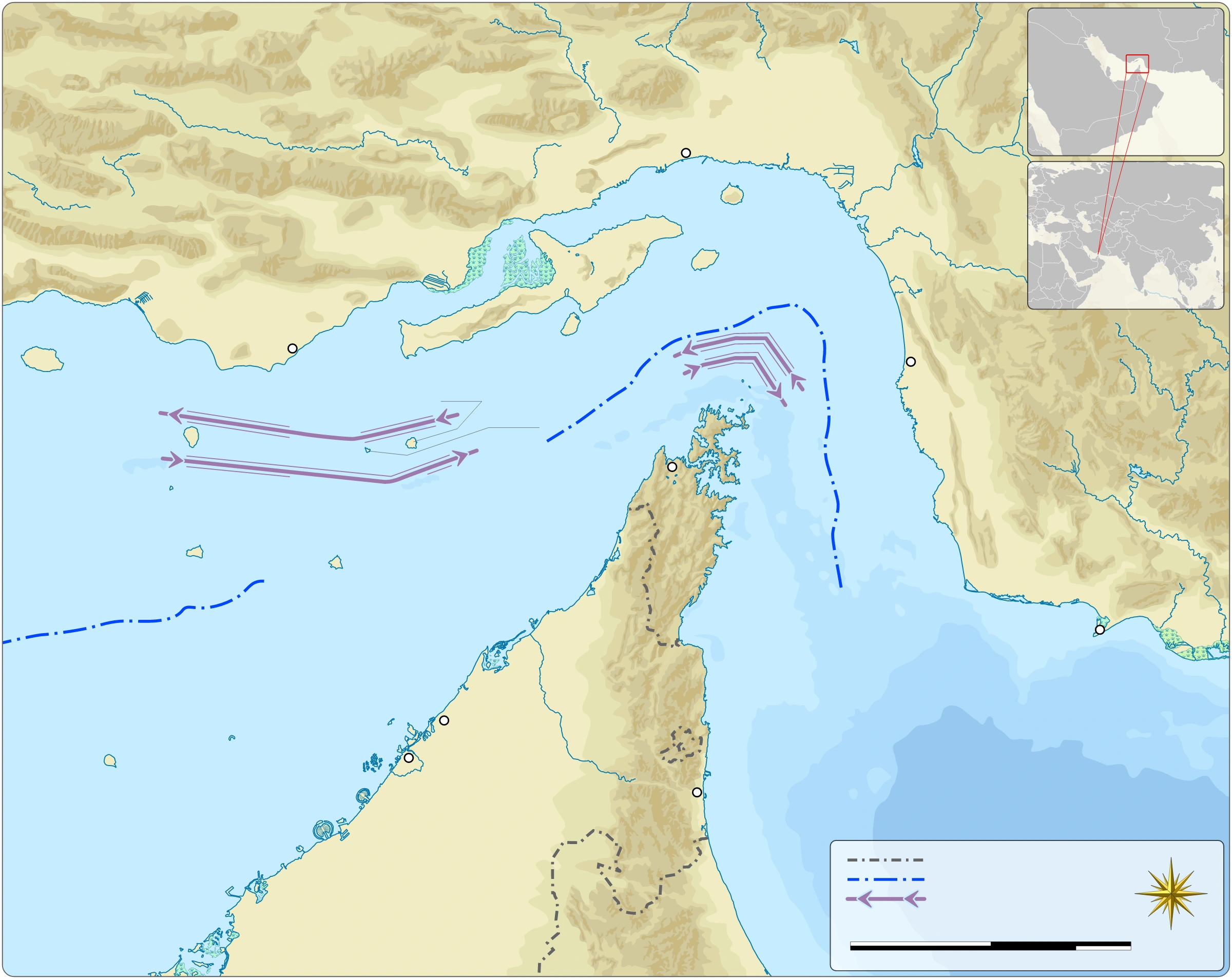
Map study
Strait of Hormuz: locate Iran, Oman and the Persian Gulf–Gulf of Oman connection. Geographic context for energy trade, not a current disruption map.
- Read the source legend and reference date before interpreting the map.
- Use spatial patterns to support topic revision; verify current official boundaries, designations and warnings separately.
Credit: Goran tek-en · CC BY-SA 4.0 · sourceConverted to WebP on an opaque white background; proportionally resized without cropping. Original cartography and legend retained.
1. Origin, occurrence and resource terminology
Natural gas is a combustible mixture dominated by methane, with variable quantities of ethane, propane, butane, carbon dioxide, nitrogen and hydrogen sulphide. Most commercial deposits originate from organic matter buried in sedimentary basins and transformed through heat, pressure and geological time. Gas can also form through microbial activity. Its occurrence therefore reflects sedimentary history, suitable source rocks and subsurface conditions rather than surface relief alone.
In a conventional accumulation, gas migrates into porous and permeable reservoir rocks and is retained beneath an impermeable seal. A structural or stratigraphic trap prevents further escape. Associated gas occurs with crude oil, either dissolved in it or as a gas cap; non-associated gas occurs in reservoirs without significant oil. Offshore location describes geography, not a separate chemical type of gas.
Unconventional resources include coal-bed methane, shale gas and tight gas. Coal-bed methane is mainly adsorbed onto coal surfaces and is commonly released by lowering reservoir pressure through dewatering. Shale gas occurs in very low-permeability shale, while tight gas occupies low-permeability reservoirs. Gas hydrates are ice-like compounds containing gas, found under suitable pressure and temperature conditions in marine sediments and permafrost. Their presence does not imply commercially recoverable reserves.
- Resources describe a broader estimated occurrence; reserves refer to quantities recoverable commercially under specified conditions.
- Raw gas usually needs treatment to remove water, acid gases and other impurities before entering transmission systems.
2. Geographical distribution in India
India’s gas geography is concentrated in selected onshore and offshore sedimentary basins. The western offshore, especially the Mumbai offshore region, has long been important. The Bassein gas field, off Maharashtra, is a major non-associated gas accumulation. Mumbai High is primarily known as an oil field but also produces associated gas. These offshore resources helped support industrial development and gas-based activities in western India.
The Krishna–Godavari basin extends across coastal Andhra Pradesh and the adjoining Bay of Bengal. Its deep-water developments, including fields within the KG-D6 block, have strengthened the significance of the eastern offshore in domestic supply. The Cauvery basin, covering parts of Tamil Nadu and adjoining offshore areas, also contains hydrocarbons. A basin boundary should not be confused with a single field, producing block or administrative state.
Northeastern production is associated with Assam and the Assam–Arakan geological region, while Tripura has important onshore gas fields supplying power generation and local consumption. Gujarat’s Cambay basin is another established producing region. Coal-bed methane development is linked to coal-bearing areas such as Raniganj in West Bengal and Sohagpur in Madhya Pradesh. Thus, conventional gas and coal-bed methane require different geological map associations.
- For map practice, locate Maharashtra’s offshore fields, coastal Andhra Pradesh, Gujarat, Assam, Tripura, Raniganj and Sohagpur.
- India has investigated gas hydrates in the Krishna–Godavari, Mahanadi and Andaman offshore regions; these are not established commercial supply sources.
Imported LNG supply chain
- 1. Gas extraction and treatment
- 2. Liquefaction at the exporting location
- 3. Transport in an LNG carrier
- 4. Unloading, storage and regasification at an Indian terminal
- 5. Pipeline transmission and distribution to consumers
3. LNG, pipelines and the geography of supply
Natural gas is difficult to transport economically over long distances without specialised infrastructure because of its low density at ordinary conditions. Pipelines carry processed gas under pressure. For overseas trade, gas is cooled to approximately −162°C to produce liquefied natural gas, reducing its volume to about one six-hundredth of the gaseous volume. LNG travels in specialised ships and is regasified at receiving terminals before distribution.
India’s LNG infrastructure is coastal. Important terminals include Dahej and Hazira in Gujarat, Dabhol in Maharashtra, Kochi in Kerala, Ennore in Tamil Nadu and Dhamra in Odisha. Gujarat’s concentration of terminals, pipelines and industrial consumers illustrates the cumulative advantages of early infrastructure investment. A terminal’s nameplate capacity does not equal actual throughput: demand, cargo prices and downstream pipeline connectivity affect utilisation.
The Hazira–Vijaipur–Jagdishpur pipeline was a landmark in carrying western gas supplies towards inland markets. The expanding national gas grid seeks to connect producing areas, import terminals and consuming centres. The Pradhan Mantri Urja Ganga project, associated with the Jagdishpur–Haldia–Bokaro–Dhamra pipeline system, extends access in eastern India. Greater connectivity can reduce regional disparities, but construction alone does not guarantee affordable gas or commercially viable demand.
- Qatar is a major LNG supplier to India; diversified suppliers and contracts help manage supply risks.
- City gas distribution networks deliver piped natural gas to consumers and supply compressed natural gas for vehicles.
| Fuel | Composition or form | Typical application |
|---|---|---|
| CNG | Methane-rich gas compressed at high pressure | Vehicle fuel |
| LNG | Methane-rich gas liquefied by deep cooling | Overseas bulk transport and storage |
| PNG | Natural gas supplied through distribution pipelines | Household cooking and industrial use |
| LPG | Mainly propane and butane, stored as pressurised liquid | Cooking and heating |
4. Economic uses, institutions and energy security
Natural gas serves as both an energy source and an industrial feedstock. In fertiliser manufacture, it supplies hydrogen for ammonia production, linking gas availability and prices to urea economics and agricultural input support. Other consumers include refineries, petrochemicals, ceramics, glass and steel industries. Gas-fired power plants can start and adjust output relatively quickly, making them potentially useful alongside variable wind and solar generation.
India’s gas consumption exceeds domestic production, creating substantial LNG import dependence. International gas prices, exchange-rate movements, shipping disruptions and competition for cargoes can influence delivered costs. Long-term contracts improve predictability but do not remove every price or supply risk. High fuel costs have constrained the operation of some gas-based power plants, demonstrating that installed generating capacity is not the same as actual generation.
The Ministry of Petroleum and Natural Gas oversees the sector. The Directorate General of Hydrocarbons has upstream technical and regulatory functions, while the Petroleum and Natural Gas Regulatory Board, established under the 2006 Act, regulates specified downstream activities, including authorisation of pipelines and city gas distribution networks. The Hydrocarbon Exploration and Licensing Policy, introduced in 2016, provides a framework for exploration and production. Gas pricing and allocation vary by category; there is no single uniform price for all domestic and imported gas.
- Do not confuse the upstream role of the Directorate General of Hydrocarbons with the downstream remit of PNGRB.
- Gas availability, pipeline access and delivered prices jointly influence industrial location.
5. Environmental significance and exam distinctions
Natural gas generally emits less carbon dioxide per unit of energy during combustion than coal and produces much less ash and sulphur pollution. Replacing dirtier fuels can therefore improve local air quality. However, natural gas is neither renewable nor carbon-free. Methane leakage during production, processing, transport and distribution can weaken its climate advantage because methane is a powerful greenhouse gas, particularly over shorter time horizons.
Environmental concerns also include offshore ecosystem disturbance, accidental releases, water use and wastewater management in some unconventional extraction methods. Effective policy requires leak detection and repair, reduced venting and flaring, safety standards and lifecycle emissions assessment. Gas may assist selected transition needs, but infrastructure investment must account for the risk of locking consumers into long-lived fossil-fuel assets.
For prelims, distinguish natural gas from LPG, which mainly comprises propane and butane and is readily liquefied under moderate pressure. CNG and PNG describe compression and delivery arrangements rather than distinct geological resources. Biogas is produced through anaerobic decomposition of organic material; after purification and upgrading, compressed biogas can serve uses similar to fossil CNG, but its origin is different.
Real-world case studies
Kochi: connectivity determines utilisation
Kochi’s LNG terminal initially faced low utilisation because downstream connectivity was limited. The Kochi–Mangaluru pipeline, inaugurated in 2021, improved access to consumers in Kerala and Karnataka. The example shows why terminal capacity and an integrated supply network must be assessed together.
Tripura: gas-linked regional development
The approximately 727 MW Palatana combined-cycle power project uses natural gas from Tripura. It illustrates how a local hydrocarbon resource can support electricity supply and regional economic integration in northeastern India.
Previous year questions
No source-linked PYQ is available here yet. Use the practice questions below.
Practice questions
Practice MCQ 1
Consider the following statements: 1. CNG requires cooling natural gas to approximately −162°C. 2. LNG is generally regasified before entering conventional transmission pipelines. 3. LPG consists mainly of propane and butane. Which statements are correct?
- A. 1 and 2 only
- B. 2 and 3 only
- C. 1 and 3 only
- D. 1, 2 and 3
Practice MCQ 2
Which pair is incorrectly matched?
- A. Bassein gas field — Western offshore
- B. Krishna–Godavari basin — Eastern offshore and coastal Andhra Pradesh
- C. Raniganj coal-bed methane — West Bengal
- D. Cambay basin — Assam
Practice MCQ 3
Consider the following statements: 1. Natural gas is used as a feedstock in ammonia production. 2. Methane leakage can reduce the climate advantage of natural gas over coal. 3. Identification of gas hydrates establishes commercially recoverable reserves. Which statements are correct?
- A. 1 only
- B. 1 and 2 only
- C. 2 and 3 only
- D. 1, 2 and 3
Mains practice · Explain the geographical and economic constraints on expanding natural gas use in India. Assess its role as a transition fuel. Answer in 250 words.
- Map concentrated domestic production and coastal LNG entry points.
- Discuss pipeline gaps, regional demand and delivered costs.
- Link import dependence to price and supply vulnerability.
- Explain fertiliser, industrial and flexible power-generation uses.
- Balance cleaner combustion against methane leakage and fossil-fuel lock-in.
Further reading
- NCERT, India: People and Economy, Class XII, Mineral and Energy Resources.
- Ministry of Petroleum and Natural Gas: annual reports and Indian Petroleum and Natural Gas Statistics.
- Petroleum Planning and Analysis Cell: natural gas production, consumption and LNG import statistics.
- Directorate General of Hydrocarbons: India Hydrocarbon Outlook.
- Petroleum and Natural Gas Regulatory Board: pipeline and city gas distribution information.
Preparing for UPSC Civil Services? Get classroom teaching, answer-writing evaluation and mentorship at Pragnya IAS Academy, Ashok Nagar — see why aspirants choose us for IAS coaching in Hyderabad.