
Map study
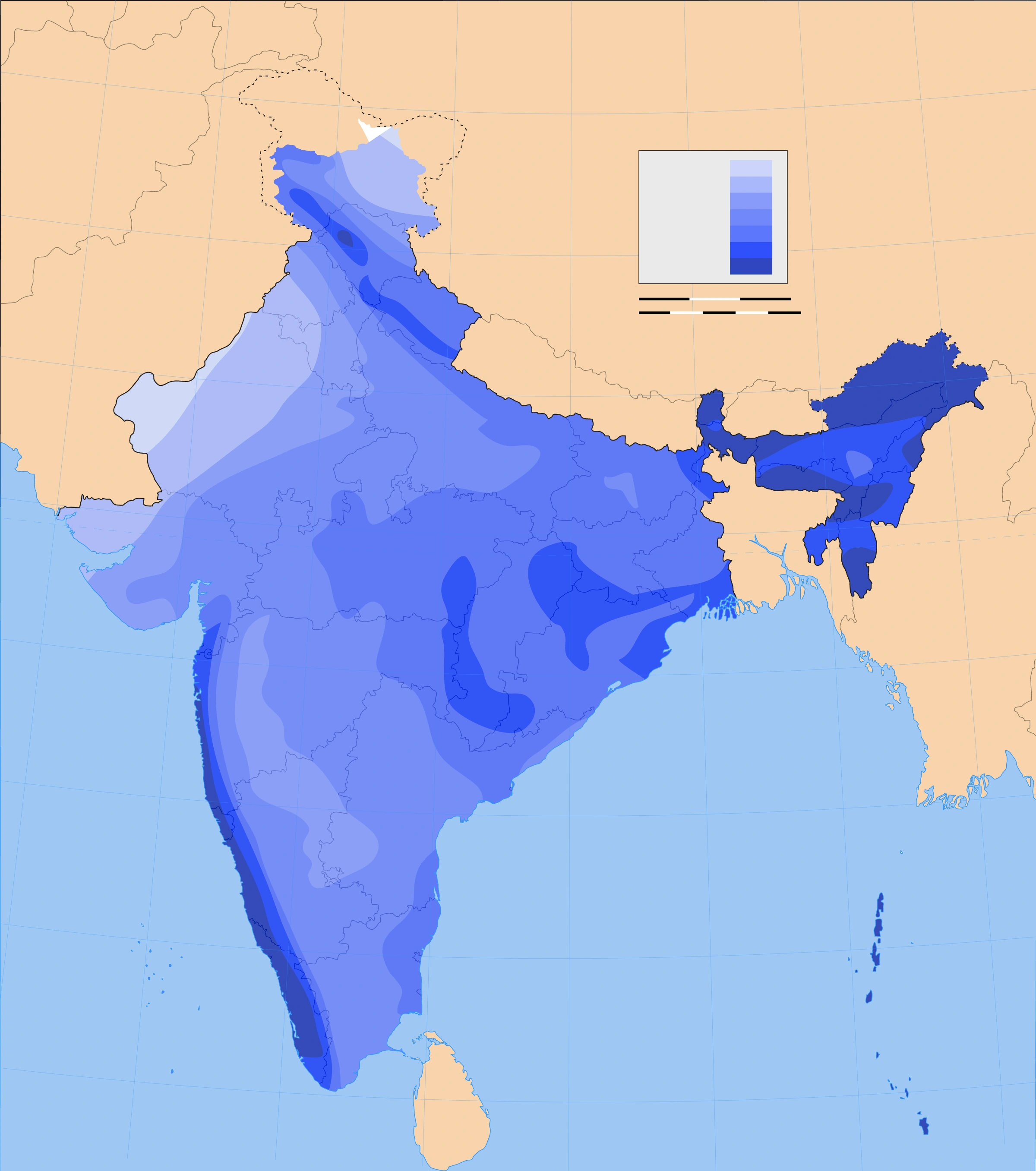
Annual rainfall distribution: compare the western coast and northeast with the dry northwest and rain-shadow interior. Historical climatological reference, not a current-year forecast.
- Read the source legend, scale and reference period before comparing regions.
- Connect spatial patterns to the processes discussed in this topic; this map is a study reference, not live operational data.
Credit: Planemad · CC BY-SA 3.0 · sourceConverted to WebP on an opaque white background; proportionally resized without cropping. Original cartography and legend retained.
Map study
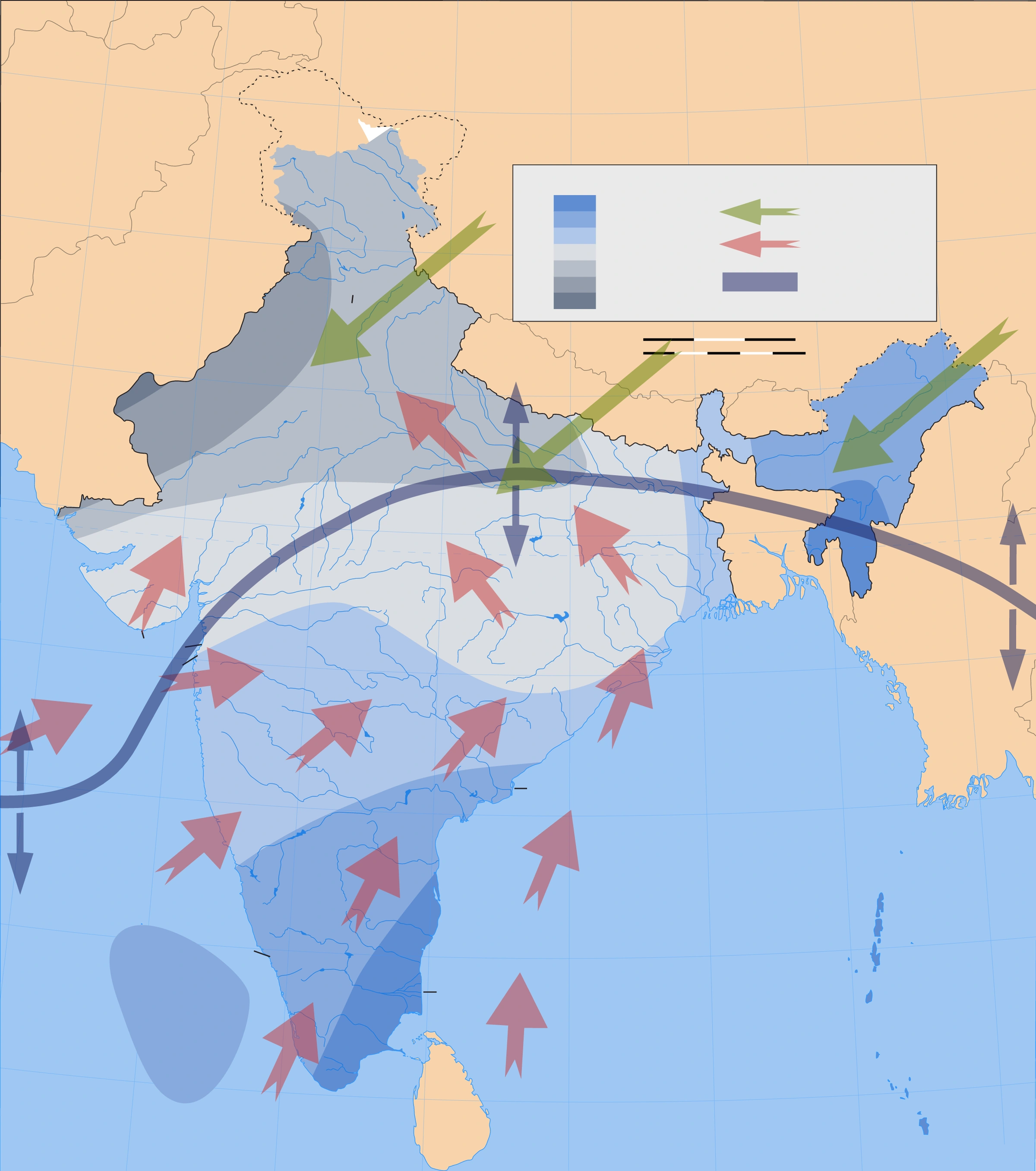
Southwest monsoon onset progression in the source reference map. Actual dates vary each year; consult IMD for current onset information.
- Read the source legend, scale and reference period before comparing regions.
- Connect spatial patterns to the processes discussed in this topic; this map is a study reference, not live operational data.
Credit: Saravask; Planemad; Nichalp · CC BY-SA 3.0 · sourceConverted to WebP on an opaque white background; proportionally resized without cropping. Original cartography and legend retained.
1. Why the monsoon develops
The term monsoon derives from the Arabic word mausim, meaning season. Its defining feature is a marked seasonal reversal of prevailing winds, accompanied in many regions by contrasting wet and dry seasons. The Indian monsoon forms part of the larger Asian monsoon system. The traditional explanation treats it as a giant land–sea breeze, but this is incomplete: the actual mechanism involves tropical circulation, upper-air winds, continental relief and coupled ocean–atmosphere processes.
During northern summer, the Indian landmass and surrounding Asian interior warm strongly. A heat low develops over northwestern India and adjoining Pakistan, while relatively high pressure persists over the southern Indian Ocean. This pressure contrast supports cross-equatorial airflow towards South Asia. However, land heating alone cannot explain the timing of onset, prolonged breaks or differences between individual monsoon seasons.
The Intertropical Convergence Zone, or ITCZ, is a broad zone of low-level convergence and rising air associated with the tropical rain belt. It migrates seasonally towards the warmer hemisphere. Over the Indian region, its northward displacement is associated with the establishment of the monsoon trough across northern India. Moisture convergence, uplift and condensation generate rainfall; the release of latent heat then reinforces the circulation.
- Essential distinction: a pressure gradient drives winds, while moisture availability, convergence and uplift determine where rain occurs.
- The ITCZ is neither a fixed line nor everywhere directly beneath the overhead Sun.
2. Cross-equatorial winds, jets and mountain barriers
The Mascarene High, a subtropical high-pressure region over the southern Indian Ocean, helps sustain the pressure gradient towards South Asia. Southeast trade winds cross the equator and turn to their right in the Northern Hemisphere under the Coriolis effect, becoming southwesterlies. Their acceleration near East Africa produces the Somali low-level jet, which transports substantial moisture across the Arabian Sea towards India.
The upper atmosphere also reorganises. In winter, the subtropical westerly jet commonly flows south of the Himalayas. With summer warming, this jet shifts north of the Himalayan region, while a tropical easterly jet develops over southern Asia. These changes accompany the summer monsoon circulation. They should not be interpreted as independent switches that mechanically produce onset on a particular date.
The Himalayas restrict the penetration of cold, dry extratropical air into South Asia and influence atmospheric circulation. The elevated Tibetan Plateau exchanges heat with the atmosphere and contributes to the Asian summer circulation, although its relative thermal and mechanical roles are more complex than a simple heated-plateau explanation. Near the surface, the Western Ghats and northeastern hills force moist air to rise. Consequently, windward slopes receive heavy orographic rainfall, while leeward areas can remain comparatively dry.
- The Somali jet is a low-level flow; the tropical easterly jet and subtropical westerly jet are upper-tropospheric features.
- Coriolis deflection is to the right in the Northern Hemisphere and to the left in the Southern Hemisphere.
Simplified southwest monsoon mechanism
- 1. Northern summer heating strengthens continental low pressure and shifts the tropical rain belt northward.
- 2. The southern Indian Ocean high supports cross-equatorial airflow.
- 3. Southeast trades cross the equator and become southwesterlies.
- 4. Low-level winds carry oceanic moisture towards India.
- 5. Convergence, mountain uplift and low-pressure systems produce rainfall.
- 6. Latent heat release helps maintain the monsoon circulation.
3. Onset, branches and rainfall distribution
Monsoon onset usually occurs over the Andaman Sea before reaching Kerala around 1 June. The India Meteorological Department identifies Kerala onset using specified rainfall, wind and outgoing longwave radiation criteria. Therefore, one intense pre-monsoon thunderstorm does not establish onset. A rapid increase in sustained rainfall accompanying circulation changes is popularly called the burst of the monsoon.
The southwest monsoon is conventionally described as having Arabian Sea and Bay of Bengal branches, although these are connected parts of one circulation. Arabian Sea winds produce heavy rain along the western coastal belt and windward Western Ghats. Descending air east of the Ghats creates a rain shadow over parts of the interior peninsula. Some Arabian Sea moisture also feeds rainfall farther north and inland.
Bay of Bengal winds bring moisture towards northeastern India and the eastern Himalayan foothills. The regional pressure field and topography help channel moist flow westward along the Gangetic plains. Bay-origin low-pressure systems and depressions frequently move westward or northwestward, distributing rainfall across central India. Rainfall generally decreases westward across the northern plains as moisture supply and rain-producing systems diminish.
Mawsynram and Cherrapunji illustrate the importance of local relief: moisture-rich winds undergo strong uplift against the southern slopes of the Meghalaya Plateau. Conversely, western Rajasthan receives little rain because effective moisture convergence and uplift are limited. The broadly southwest–northeast alignment of the Aravallis offers relatively little obstruction to the prevailing Arabian Sea flow.
| Feature | Nature or location | Typical role |
|---|---|---|
| Mascarene High | Southern Indian Ocean subtropical high | Supports cross-equatorial pressure gradient |
| Somali jet | Low-level flow near East Africa and over the Arabian Sea | Transports moisture towards India |
| Monsoon trough | Seasonal elongated low-pressure zone across northern India | Organises convergence and rain-producing systems |
| El Niño | Equatorial Pacific warming | Often associated with weaker Indian summer rainfall |
| Positive Indian Ocean Dipole | Warmer western relative to southeastern equatorial Indian Ocean | Can favour rainfall; effects depend on other conditions |
4. Active spells, breaks and oceanic controls
Monsoon rainfall fluctuates within a season. During active spells, favourable trough positioning, cyclonic circulations and low-pressure systems support widespread rainfall over the monsoon core zone. During a typical break, the monsoon trough shifts towards the Himalayan foothills and rainfall decreases over much of central India, while increasing near the foothills and in parts of the northeast. A break is therefore not a nationwide cessation of rainfall.
The Madden–Julian Oscillation is an eastward-moving tropical pattern of enhanced and suppressed convection. Its phase and location can favour or inhibit Indian monsoon activity. Boreal summer intraseasonal oscillations, including northward-propagating convection over the Indian Ocean, also influence active–break cycles. These processes help explain why a season with near-normal total rainfall can still contain damaging dry spells.
El Niño, the warm phase of ENSO in the equatorial Pacific, often weakens the Indian summer monsoon through changes in tropical circulation, but the relationship is not deterministic. La Niña often favours stronger rainfall, without guaranteeing it. A positive Indian Ocean Dipole features relatively warmer western equatorial Indian Ocean waters and cooler southeastern equatorial waters near Sumatra–Java. It can favour Indian monsoon rainfall and sometimes moderate an adverse El Niño influence. Eurasian snow conditions and Indian Ocean warming also affect the background circulation.
- Seasonal rainfall totals, spatial distribution and timing are separate measures of monsoon performance.
- Neither ENSO nor the Indian Ocean Dipole alone determines the outcome of a monsoon season.
5. Withdrawal and the northeast monsoon
As the Asian landmass cools after summer and the tropical rain belt shifts southward, the southwest monsoon circulation weakens. Withdrawal normally begins from northwestern India around 17 September and progresses southeastward. It is diagnosed from sustained changes such as reduced rainfall, drying of the lower atmosphere and the establishment of an anticyclonic circulation, rather than from an isolated rainless day.
During October–December, low-level northeasterly winds become established over much of the peninsula. Although these winds originate over land, they acquire moisture while crossing the Bay of Bengal. Tamil Nadu and adjoining southeastern coastal areas consequently receive substantial rainfall from the northeast monsoon. Easterly waves, depressions and tropical cyclones contribute importantly to this rain; it is not simply precipitation from steady northeasterly winds.
The Coromandel Coast is relatively sheltered from the summer southwesterlies but exposed to moisture-bearing systems during the post-monsoon period. Retreating monsoon describes the seasonal withdrawal transition, whereas northeast monsoon refers more specifically to the associated regional circulation and rainfall regime.
Real-world case studies
1997: El Niño did not produce an Indian monsoon drought
Despite a very strong El Niño, all-India summer monsoon rainfall in 1997 remained near normal. A strong positive Indian Ocean Dipole was an important counteracting influence. The episode demonstrates why ENSO-based expectations must be assessed alongside Indian Ocean conditions and atmospheric variability.
Western Ghats rain shadow
Moist Arabian Sea winds rise over the Western Ghats, producing heavy rainfall around the Konkan and windward slopes. Pune, east of the crest, receives much less rainfall than Mumbai. This contrast illustrates how relief redistributes rainfall within the same monsoon circulation.
Previous year questions
UPSC Prelims 2017
With reference to the Indian Ocean Dipole, consider the statements: 1. It is characterised by a sea-surface temperature difference between the tropical western Indian Ocean and the tropical eastern Pacific Ocean. 2. It can influence the impact of El Niño on the monsoon. Which is/are correct?
- A. 1 only
- B. 2 only
- C. Both 1 and 2
- D. Neither 1 nor 2
Practice questions
Practice MCQ 1
Which sequence best explains the formation of cross-equatorial southwesterly monsoon winds?
- A. Northeast trades cross the equator and turn right.
- B. Southeast trades cross the equator and turn right.
- C. Southeast trades cross the equator and turn left.
- D. Southern Hemisphere westerlies cross the equator without deflection.
Practice MCQ 2
Consider the statements: 1. During a typical monsoon break, the trough may shift towards the Himalayan foothills. 2. A monsoon break necessarily reduces rainfall everywhere in India. Which is/are correct?
- A. 1 only
- B. 2 only
- C. Both 1 and 2
- D. Neither 1 nor 2
Practice MCQ 3
Why does the Tamil Nadu coast receive substantial rainfall during October–December?
- A. The subtropical westerly jet directly supplies surface moisture.
- B. Northeasterly flow acquires Bay of Bengal moisture, aided by easterly disturbances and cyclonic systems.
- C. The Western Ghats force dry continental winds to release moisture over Tamil Nadu.
- D. The southwest monsoon permanently reverses the Bay of Bengal’s ocean currents.
Mains practice · The Indian monsoon is more than a seasonal land–sea breeze. Explain its mechanism and the causes of its variability. Answer in 250 words.
- Begin with differential heating, pressure gradients and seasonal wind reversal.
- Explain ITCZ migration, cross-equatorial flow and the Mascarene High.
- Discuss low-level and upper-air jets, Himalayan barriers and orographic rainfall.
- Separate intraseasonal variability from interannual influences such as ENSO and the Indian Ocean Dipole.
- Conclude that timing and distribution matter alongside seasonal totals.
Further reading
- NCERT, India: Physical Environment, Class XI, chapter Climate.
- NCERT, Fundamentals of Physical Geography, Class XI, chapter Atmospheric Circulation and Weather Systems.
- India Meteorological Department: Monsoon FAQs, onset and withdrawal criteria, and seasonal rainfall reports, mausam.imd.gov.in.
- Indian Institute of Tropical Meteorology: Educational and research resources on monsoon variability, tropmet.res.in.
Preparing for UPSC Civil Services? Get classroom teaching, answer-writing evaluation and mentorship at Pragnya IAS Academy, Ashok Nagar — see why aspirants choose us for IAS coaching in Hyderabad.