

ONGC Oil and Gas Processing Platform. Bombay High, South Field. Undersea pipelines carry oil and gas to Uran, near Mumbai, some 120 NM away.
Credit: Nandu Chitnis from Pune, India · CC BY 2.0 · source

This picture was taken when I travelled to Digboi with my friend for visiting the inside campus of the beautiful Digboi Oil Refinery Campus.
Credit: Nilotpal Hazarika123 · CC0 · source
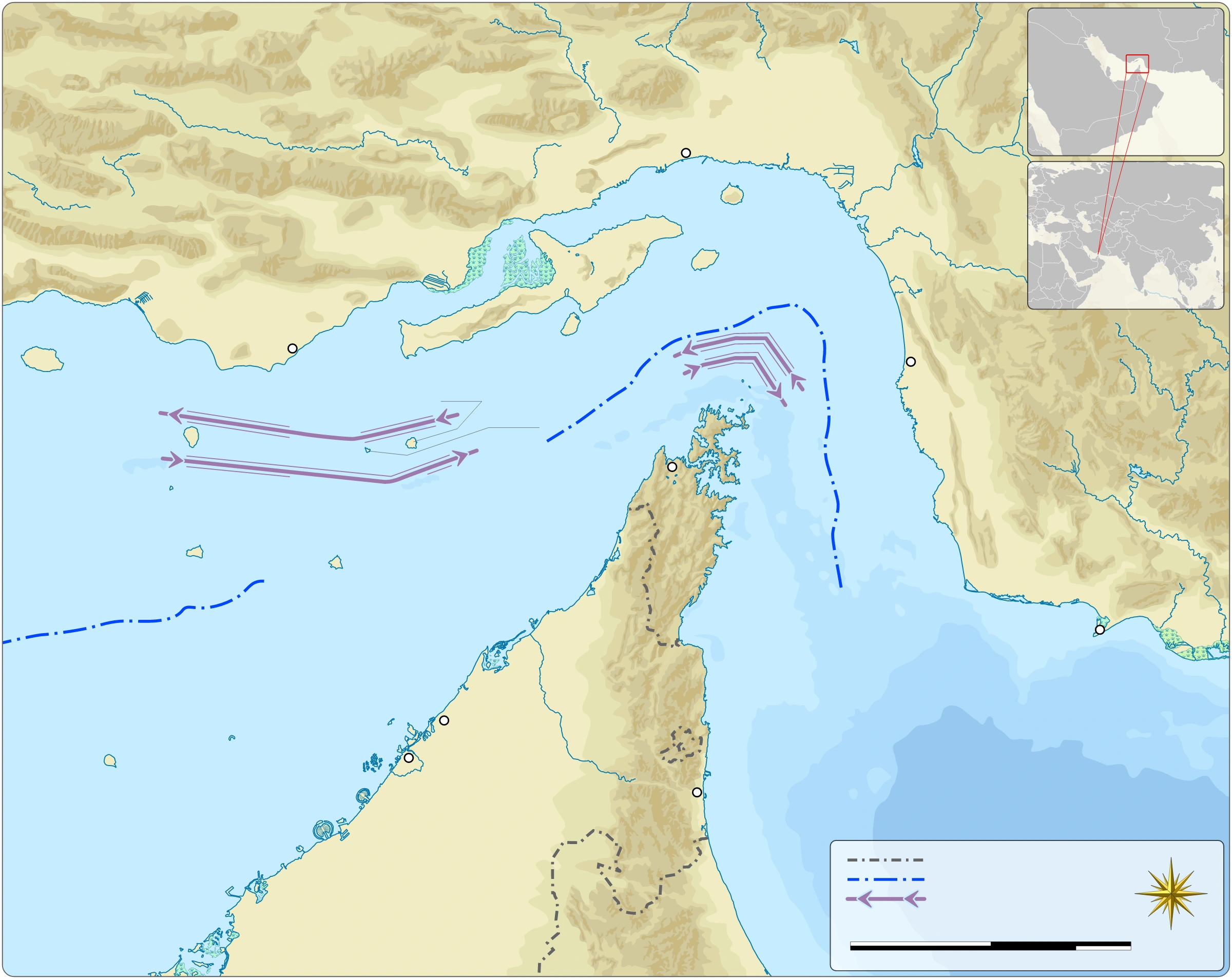
Map study
Strait of Hormuz: locate Iran, Oman and the Persian Gulf–Gulf of Oman connection. Geographic context for energy trade, not a current disruption map.
- Read the source legend and reference date before interpreting the map.
- Use spatial patterns to support topic revision; verify current official boundaries, designations and warnings separately.
Credit: Goran tek-en · CC BY-SA 4.0 · sourceConverted to WebP on an opaque white background; proportionally resized without cropping. Original cartography and legend retained.
1. Formation, occurrence and basic terminology
Petroleum originates predominantly from organic matter deposited in ancient marine and lake environments. Burial under successive sediment layers, restricted oxygen supply and geological heating transform this organic matter into hydrocarbons over millions of years. Temperature and burial history influence whether a source rock generates mainly oil or gas. Petroleum is therefore non-renewable on human timescales, and its distribution reflects the geological evolution of sedimentary basins rather than present-day vegetation or climate.
A conventional petroleum accumulation requires a working petroleum system: an organic-rich source rock, adequate thermal maturation, migration pathways, a porous and permeable reservoir, an impermeable seal and a suitable trap. Sandstone and limestone commonly serve as reservoirs, while shale or evaporites may provide seals. Structural traps include anticlines and fault-related closures; stratigraphic traps result from changes in rock characteristics, such as a sandstone layer pinching out. Petroleum occupies interconnected pore spaces rather than vast underground lakes.
Within a simple reservoir, gas may occur above oil and water below it because of density differences, although actual reservoirs can be more complex. Resources refer broadly to estimated quantities present, whereas reserves are quantities recoverable under specified technical and economic conditions. Conventional petroleum can flow through suitable reservoir rocks; tight oil and shale oil resources generally require more intensive extraction techniques. Natural gas may occur with crude oil as associated gas or independently in gas fields.
- Porosity measures storage space within a rock; permeability measures the ease with which fluids move through it.
- A sedimentary basin is favourable for exploration, but sedimentary rocks alone do not guarantee commercially recoverable petroleum.
- Crude quality varies: light versus heavy reflects density, while sweet versus sour principally reflects sulphur content.
Timeline
1901
Digboi refinery began operations in Assam.
1974–1976
Mumbai High was discovered in 1974; production began in 1976.
2016
The government approved the Hydrocarbon Exploration and Licensing Policy.
April 2020
India implemented nationwide Bharat Stage VI fuel and vehicle emission standards.
2. Petroleum geography of India
The Directorate General of Hydrocarbons identifies 26 sedimentary basins in India, covering about 3.4 million square kilometres across onland, shallow-water and deep-water areas. Exploration success is uneven because basins differ in geological history, data availability, accessibility and commercial viability. India’s principal producing regions are the western offshore, Assam–Arakan, Cambay, Rajasthan, Krishna–Godavari and Cauvery basins. The presence of petroleum potential should be distinguished from an established producing field.
In the northeast, Upper Assam contains historic oilfields such as Digboi, Naharkatiya and Moran. Digboi’s refinery began operations in 1901 and remains an important landmark in India’s petroleum history. Assam’s petroleum industry supported the development of refineries, pipelines and industrial settlements, but flood-prone terrain, ecological sensitivity and transport constraints complicate operations. Oil India Limited has a major operational presence in this region.
Gujarat’s Cambay basin includes Ankleshwar, Kalol and Mehsana. Western offshore production is centred on Mumbai High and adjoining fields such as Heera and Neelam; Mumbai High was discovered in 1974 and began production in 1976. Rajasthan’s Barmer basin contains the Mangala, Bhagyam and Aishwariya fields. On the eastern margin, the Krishna–Godavari and Cauvery basins contain important hydrocarbon accumulations. Offshore extraction becomes more technically demanding and expensive as water depth increases.
- Map sequence, west to east: Rajasthan and Cambay; Mumbai offshore; Cauvery; Krishna–Godavari; Assam–Arakan.
- Do not confuse Mumbai High, an offshore field, with Mumbai’s refinery and port infrastructure.
- Krishna–Godavari and Cauvery are hydrocarbon basins associated with India’s eastern coastal margin and adjoining offshore areas.
From petroleum exploration to consumption
- 1. Geological mapping and seismic surveys identify prospects.
- 2. Exploratory drilling tests for hydrocarbons.
- 3. Appraisal establishes reservoir characteristics and commercial viability.
- 4. Development wells and production facilities extract petroleum.
- 5. Pipelines or tankers move crude to storage and refineries.
- 6. Refining and distribution supply fuels and petrochemical feedstocks.
3. Extraction, refining and industrial location
The petroleum industry is divided into upstream, midstream and downstream activities. Upstream operations cover exploration, drilling and production. Midstream operations include transportation and storage, while downstream activities cover refining, marketing and related processing. Exploration uses geological interpretation, seismic surveys and exploratory wells; a promising seismic structure is not itself proof of an economically viable oilfield.
At refineries, fractional distillation separates crude oil into fractions according to boiling ranges. Further processes such as cracking, reforming and desulphurisation improve product yields and quality. Major outputs include liquefied petroleum gas, petrol, naphtha, aviation turbine fuel, kerosene, diesel, lubricating oils and bitumen. Naphtha and other refinery streams are important petrochemical feedstocks. Natural gas processing also supplies LPG, so LPG should not be treated as exclusively a refinery product.
Refineries need not be located near oilfields because crude oil can be transported economically by large tankers and pipelines. Location depends on port access, markets, water, power, land, transport links and environmental requirements. Jamnagar, Vadinar, Kochi, Mangaluru and Paradip illustrate coastal advantages for imported crude and product exports. Inland refineries such as Mathura, Panipat and Bina demonstrate the importance of pipelines and large consuming hinterlands. Pipelines reduce routine road congestion but require substantial initial investment and careful leak monitoring.
- ONGC and Oil India are major public-sector upstream enterprises.
- Indian Oil, Bharat Petroleum and Hindustan Petroleum are major public-sector refining and marketing companies.
- India can simultaneously be highly dependent on crude imports and a significant exporter of refined petroleum products.
| Region or basin | Location | Representative fields or features |
|---|---|---|
| Assam–Arakan | Northeastern India | Digboi, Naharkatiya and Moran |
| Cambay | Gujarat | Ankleshwar, Kalol and Mehsana |
| Western offshore | Arabian Sea, off Maharashtra | Mumbai High, Heera and Neelam |
| Rajasthan | Western Rajasthan | Barmer basin; Mangala, Bhagyam and Aishwariya |
| Krishna–Godavari | Andhra Pradesh and adjoining Bay of Bengal | Onshore and offshore oil and gas accumulations |
| Cauvery | Tamil Nadu, Puducherry and adjoining offshore areas | Oil and gas occurrences in the southeastern coastal region |
4. Energy security and petroleum governance
Petroleum remains central to transport, aviation, petrochemicals and several industrial activities. India’s crude import dependence exceeds 85%, making the economy vulnerable to international price movements, exchange-rate changes, shipping disruptions and geopolitical conflicts. The Persian Gulf remains important to global oil supply, while India has diversified sourcing across regions. Supplier rankings change over time and should always be read with the relevant financial year.
Maritime chokepoints connect petroleum geography with strategic affairs. The Strait of Hormuz links the Persian Gulf with the Gulf of Oman; Bab el-Mandeb controls the southern entrance to the Red Sea; and the Strait of Malacca connects the Indian Ocean with major East Asian markets. Disruptions may raise freight and insurance costs even when physical supplies continue through alternative routes. Energy security consequently includes affordability and reliable delivery, not merely the existence of global reserves.
The Ministry of Petroleum and Natural Gas oversees sector policy, while the Directorate General of Hydrocarbons provides technical support for upstream management. The Hydrocarbon Exploration and Licensing Policy, approved in 2016, introduced a uniform licence for different hydrocarbons, revenue sharing and marketing and pricing freedom subject to applicable provisions. Open Acreage Licensing allows companies to propose exploration areas rather than depend solely on predefined bidding blocks. Strategic reserves, diversified imports, domestic exploration, efficiency and alternative fuels together form a more resilient policy approach.
- Indian Strategic Petroleum Reserves Limited manages strategic crude storage facilities.
- Strategic reserves are emergency buffers, not a substitute for sustained import arrangements or demand management.
- The Petroleum and Natural Gas Regulatory Board regulates specified downstream activities, including aspects of pipeline infrastructure and city gas distribution.
5. Environmental concerns and the transition challenge
Petroleum creates environmental risks throughout its life cycle. Exploration may disturb habitats; drilling generates waste and contaminated water; spills damage coasts, fisheries and wetlands; and refineries consume water and emit pollutants. Gas flaring releases carbon dioxide, while methane leakage from associated operations increases climate impacts. Combustion of petroleum fuels produces greenhouse gases and, depending on fuel quality and engine technology, local air pollutants.
India adopted nationwide Bharat Stage VI fuel and vehicle emission standards in April 2020. These standards address vehicular pollution but do not eliminate carbon dioxide emissions. The Ethanol Blended Petrol Programme, electric mobility, public transport and improved fuel efficiency can reduce oil demand growth. However, biofuel expansion must consider feedstock availability, water consumption, land use and food security. A balanced transition combines cleaner transport with safer extraction, effective spill response, refinery efficiency and protection of vulnerable communities.
- Oil spills can smother mangrove roots and harm marine birds, fish larvae and coastal livelihoods.
- Environmental appraisal, well-control systems, independent inspections and emergency preparedness are essential safeguards.
- Electrifying transport reduces direct petroleum use, while its full climate benefit depends partly on the electricity mix.
Real-world case studies
Jamnagar: refining without proximity to a major oilfield
Reliance’s Jamnagar refining complex in Gujarat illustrates port-oriented industrial location. Access to maritime crude supplies, large-scale processing, storage and export infrastructure supports production for domestic and overseas markets. The example shows why refinery geography differs from oilfield geography and why imported raw materials can support export-oriented manufacturing.
Baghjan blowout, Assam, 2020
An Oil India gas well at Baghjan suffered a blowout on 27 May 2020 and caught fire on 9 June. Its location near Dibru-Saikhowa National Park and the Maguri-Motapung wetland highlighted the ecological and livelihood risks of hydrocarbon operations in sensitive landscapes. The incident underlines the importance of well integrity, emergency response and environmental restoration.
Previous year questions
UPSC Mains 2017 · GS-I
Petroleum refineries are not necessarily located nearer to crude oil producing areas, particularly in many developing countries. Explain its implications.
- Explain the role of imported crude, ports, tanker transport and pipelines.
- Discuss market access, economies of scale, utilities and industrial linkages.
- Use coastal and inland Indian refinery examples.
- Assess employment, regional development, import vulnerability and coastal environmental pressures.
Practice questions
Practice MCQ 1
With reference to conventional petroleum accumulations, consider the following statements: 1. Reservoir rocks require suitable porosity and permeability. 2. An impermeable seal can prevent further upward migration of hydrocarbons. 3. Petroleum generally occurs in large, empty underground caverns. Which of the statements given above are correct?
- A. 1 and 2 only
- B. 2 and 3 only
- C. 1 and 3 only
- D. 1, 2 and 3
Practice MCQ 2
Which one of the following pairs is incorrectly matched?
- A. Ankleshwar — Gujarat
- B. Mangala — Rajasthan
- C. Moran — Assam
- D. Mumbai High — Bay of Bengal
Practice MCQ 3
Consider the following statements about India’s petroleum economy: 1. High crude import dependence can coexist with exports of refined petroleum products. 2. Strategic petroleum reserves are intended to buffer supply disruptions. 3. Every refinery must be located within an oil-producing basin. Which of the statements given above are correct?
- A. 1 only
- B. 1 and 2 only
- C. 2 and 3 only
- D. 1, 2 and 3
Mains practice · India’s petroleum security depends as much on geography and logistics as on domestic resource availability. Discuss with reference to producing basins, refinery locations and maritime routes. Suggest measures to reduce vulnerability. Answer in 250 words.
- Identify major producing basins and the limitations of domestic supply.
- Explain coastal and market-oriented refinery locations.
- Discuss import dependence, chokepoints and freight risks.
- Assess strategic reserves, supplier diversification and pipeline infrastructure.
- Recommend efficiency, public transport, electrification and environmentally responsible exploration.
Further reading
- NCERT, India: People and Economy, Class XII, chapter on Mineral and Energy Resources.
- NCERT, Contemporary India II, Class X, chapter on Minerals and Energy Resources.
- Ministry of Petroleum and Natural Gas: annual reports and Indian Petroleum and Natural Gas Statistics.
- Petroleum Planning and Analysis Cell: official statistics on production, consumption, imports and refining.
- Directorate General of Hydrocarbons: India Hydrocarbon Outlook and sedimentary basin information.
- Indian Strategic Petroleum Reserves Limited: official information on strategic storage facilities.
Preparing for UPSC Civil Services? Get classroom teaching, answer-writing evaluation and mentorship at Pragnya IAS Academy, Ashok Nagar — see why aspirants choose us for IAS coaching in Hyderabad.