
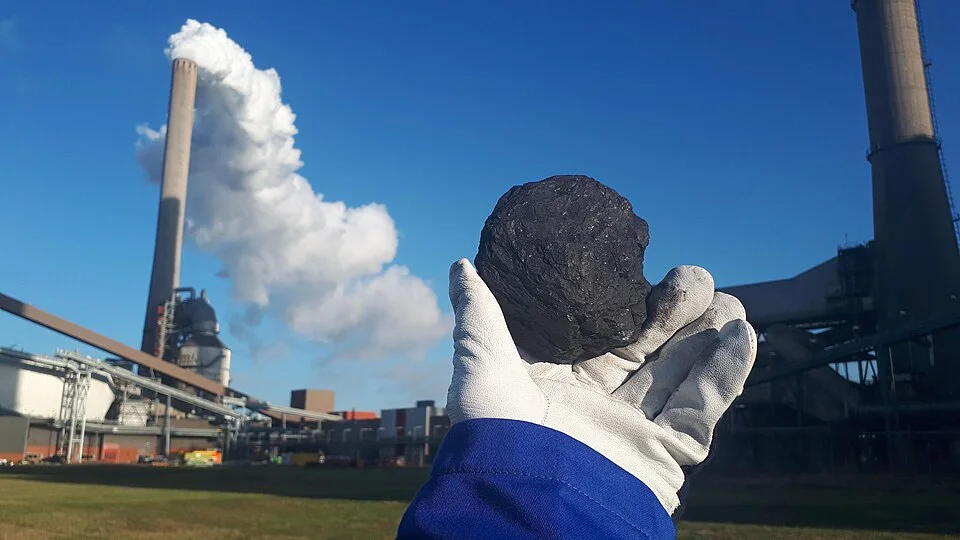
Coal held before a coal-fired power plant in the Netherlands; a comparative illustration of coal-based electricity generation.
Credit: Adrem68 · CC BY-SA 4.0 · sourceResized and converted to WebP; uncropped.
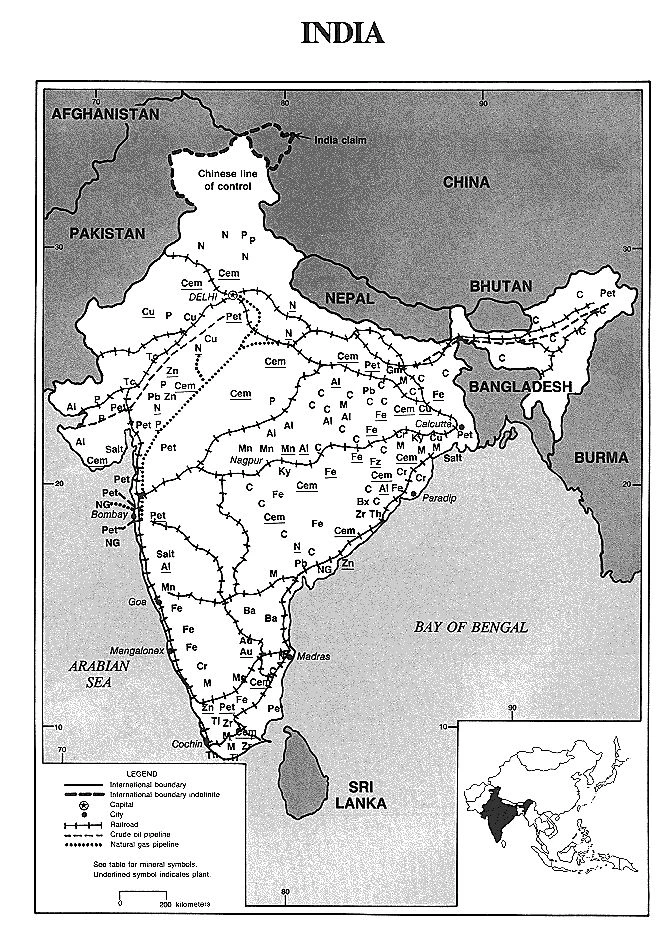
Map study
USGS reference map of mineral deposits and mineral industries in India. Historical place names and boundary depiction are retained from the source; not a current official political map, mine inventory or production dataset.
- Locate Fe (iron), Mn (manganese), Al (aluminium/bauxite-related) and C (coal) symbols; underlined symbols denote industrial plants, not deposits.
- Compare the eastern and peninsular mineral belts. The source legend does not establish present reserves, output or operating status.
- For current official boundary depiction and mineral statistics, consult Survey of India and Indian Bureau of Mines publications.
Credit: United States Geological Survey · Public domain (US federal government work) · sourceConverted to WebP without cropping or changing cartography; original legend retained.
1. Formation, rank and economic classification
Coal is a combustible sedimentary rock formed from accumulated plant matter, commonly deposited in ancient swamp environments. Waterlogging limits decomposition; subsequent burial, compaction and heating progressively increase carbon concentration. This transformation is called coalification. Coal is non-renewable on human timescales because its formation requires geological time. Coal seams occur within sedimentary sequences and may be displaced or disrupted by later faulting and folding.
Coal rank describes the degree of coalification. The broad progression is peat, lignite, sub-bituminous coal, bituminous coal and anthracite. Peat is the precursor rather than a coal rank in many formal classifications. With increasing rank, moisture and volatile matter generally decline, while fixed carbon increases. Anthracite is hard and has high fixed carbon; lignite is brownish, moisture-rich and comparatively low in calorific value. Ash content reflects mineral matter and should not be confused with rank.
Coking quality is a separate technological property. Suitable coking coal softens and resolidifies during heating without air to produce strong, porous coke, used as fuel, reductant and structural support in blast furnaces. Not all bituminous coal is coking coal. Non-coking coal is principally used in electricity generation, cement manufacture and other industrial heating.
- Calorific value measures heat released per unit mass; it is not identical to fixed-carbon percentage.
- India grades non-coking coal mainly by gross calorific value, while coking-coal grading uses ash content.
Timeline
1972–1973
Major coking and non-coking coal nationalisation legislation enacted.
1975
Coal India Limited established.
2014–2015
Supreme Court allocation cancellations followed by the Coal Mines (Special Provisions) Act, 2015.
2020
Participation rules liberalised and commercial coal-mine auctions launched.
2. Geological distribution and major coalfields
Gondwana formations contain the overwhelming majority of India’s coal resources, with the principal productive seams largely dating to the Permian Period. They accumulated in continental sedimentary basins associated with ancient river systems and fault-controlled depressions. The Damodar, Son, Mahanadi, Godavari and Wardha valley regions are therefore central to coal geography. These basin associations explain the strong concentration of coal in eastern and central India rather than its uniform distribution across the peninsula.
The Damodar basin includes Jharia, Bokaro, Giridih and North and South Karanpura in Jharkhand, and Raniganj in West Bengal. Jharia is particularly important for prime coking coal. Odisha contains Talcher and the Ib Valley coalfields; Chhattisgarh contains Korba and major coal-bearing areas of the Mand–Raigarh region. Singrauli extends across Madhya Pradesh and Uttar Pradesh, while Sohagpur lies in Madhya Pradesh. Telangana’s Godavari Valley and Maharashtra’s Wardha Valley are other important belts.
Tertiary coal occurs mainly in northeastern India, including Assam, Meghalaya, Nagaland and Arunachal Pradesh. Some northeastern deposits have relatively high sulphur content, although quality varies between deposits. Important lignite occurrences are found in Tamil Nadu, Rajasthan and Gujarat. Neyveli is the best-known centre, while Rajasthan’s Barmer region and Gujarat’s Kachchh district are also significant. Coal occurrences in the Himalayan region are comparatively limited.
- Map linkage: Raniganj–West Bengal; Jharia–Jharkhand; Talcher–Odisha; Korba–Chhattisgarh.
- Map linkage: Singrauli–Madhya Pradesh and Uttar Pradesh; Godavari Valley–Telangana; Neyveli–Tamil Nadu.
Coal-to-electricity chain
- 1. Exploration and resource assessment
- 2. Mine allocation, approvals and planning
- 3. Extraction and coal preparation
- 4. Rail, road or conveyor transport
- 5. Combustion, steam generation and electricity production
- 6. Emission control, ash management and mine reclamation
3. Production, industrial location and energy security
Coal supports thermal power generation, iron and steel production, cement manufacture and several other industries. Coal-based plants generate roughly three-quarters of India’s electricity in recent years, although the share varies annually. This is a generation share, not an installed-capacity share: renewable installations contribute differently because their utilisation patterns differ. Coal availability consequently affects electricity reliability, industrial costs, railway freight and regional employment.
Coal India Limited, a central public-sector enterprise, is the dominant producer. Singareni Collieries Company Limited is jointly owned by the Telangana and Union governments, with Telangana holding the majority stake. NLC India Limited is a major lignite producer and power generator. Captive and commercial mines supplement public-sector output. Captive production is linked to the producer’s own requirements, whereas commercial mining permits market sale under the applicable regulatory framework.
Bulky coal and high transport costs encourage pithead power plants near mines. By contrast, imported-coal-based plants often occupy coastal locations near ports. Steel plants require connections to coking coal, iron ore, water and transport networks. Domestic production growth does not eliminate imports because coal varieties are not perfectly interchangeable. Limited supplies of suitable domestic coking coal, high ash in much Indian coal, plant specifications and regional logistics sustain import demand.
- A geological resource estimate does not establish that the entire quantity is technically, environmentally or economically mineable.
- Washing can reduce ash and improve feed quality, but creates rejects and requires management of water and fine particles.
| Type | Main characteristic | Indian relevance |
|---|---|---|
| Lignite | Low-rank, moisture-rich brown coal | Neyveli; deposits in Rajasthan and Gujarat |
| Sub-bituminous | Rank between lignite and bituminous | Do not equate every non-coking coal with this rank |
| Bituminous | Includes both coking and non-coking varieties | Characteristic of major Gondwana coalfields |
| Anthracite | High fixed carbon and low volatile matter | Limited occurrences in the Himalayan region |
4. Mining methods, institutions and policy
Opencast mining removes overburden to expose relatively shallow seams. It dominates Indian output because large-scale mechanisation enables high productivity and generally lower extraction costs. Its costs include extensive land disturbance, forest loss, dust and overburden dumps. Underground mining accesses deeper seams through shafts or inclines. It reduces some surface disturbance but can involve roof falls, methane accumulation, ventilation difficulties, water ingress and surface subsidence.
Coking-coal nationalisation took place principally under the Coking Coal Mines (Nationalisation) Act, 1972, followed by wider nationalisation under the Coal Mines (Nationalisation) Act, 1973. Coal India Limited was established in 1975. Following the Supreme Court’s cancellation of numerous coal-block allocations in 2014, the Coal Mines (Special Provisions) Act, 2015 provided a framework for allocating affected mines through auction and government allotment.
The Mineral Laws (Amendment) Act, 2020 widened participation in coal mining, and commercial coal-mine auctions were launched in June 2020. Allocation of a block does not itself authorise immediate extraction: mining plans, environmental clearance, forest approval where applicable, land access and other permissions remain necessary. The Ministry of Coal oversees sectoral policy; the Coal Controller Organisation performs specified regulatory and statistical functions. The Directorate General of Mines Safety, under the Ministry of Labour and Employment, regulates occupational safety.
- District Mineral Foundations are intended to benefit people and areas affected by mining.
- Mine planning should provide for progressive reclamation, final closure and financial arrangements for closure obligations.
5. Environmental impacts and the transition challenge
Coal’s impacts extend across extraction, transport and combustion. Mining can fragment habitats, displace settlements, alter drainage and lower local groundwater levels. Sulphide-bearing material may generate acid mine drainage when exposed to air and water. Coal fires release pollutants and greenhouse gases while destabilising the ground. Railway sidings, haul roads and stockyards also generate fugitive dust, making pollution a supply-chain issue rather than only a power-plant issue.
Combustion releases carbon dioxide, particulate matter, sulphur dioxide, nitrogen oxides and trace contaminants, with quantities depending on fuel quality and controls. High-ash coal increases ash-handling requirements. Fly ash can be used in cement, bricks and other approved applications, but poorly managed ash ponds threaten water quality and public safety. Pollution controls, efficient plants, enclosed handling systems and monitored ash utilisation reduce impacts without making coal carbon-free.
India’s policy challenge is to reconcile affordable, reliable energy with cleaner air and its net-zero target for 2070. Renewable generation, storage, transmission expansion, efficiency and diversified local economies can reduce coal dependence over time. A just transition must address mine workers, informal livelihoods, public revenues and coal-dependent districts. Reclamation should restore ecological functions and secure livelihoods rather than be assessed solely by the area planted with trees.
- Coal gasification converts coal into synthesis gas; it does not automatically deliver low-carbon energy.
- For balanced answers, distinguish immediate energy-security requirements from long-term diversification and decarbonisation.
Coal: From Geological Resource to Thermal Power
The supplied metadata describes a piece of coal held before a coal-fired power plant in the Netherlands. This is a comparative illustration of coal’s energy use, not evidence about an Indian coalfield or power station. In conventional coal-based thermal generation, combustion supplies heat to produce steam, which drives a turbine coupled to a generator. The example connects a geological resource with electricity production, but cannot establish coal rank, calorific value, ash content or suitability for metallurgical use.
In India, coal distribution reflects geological history. Major Gondwana coalfields occur in peninsular sedimentary basins, including the Damodar valley; Tertiary coal deposits occur notably in the northeast. Coal supports electricity generation and industrial activity, while its bulk makes transport costs important for plant location. Pithead stations reduce long-distance coal haulage, but water availability, transmission links, demand and environmental constraints also shape location. Energy security therefore depends not simply on coal underground, but on extractability, fuel quality, logistics and the environmental costs of mining and combustion.
- Coking versus non-coking describes technological suitability, not geological age. Suitable coking coal produces coke for blast-furnace ironmaking; non-coking coal is widely used for power generation.
- Resources are not synonymous with reserves: geological occurrence does not guarantee economic recovery. Mining conditions, technology, costs and regulatory constraints affect what can actually be extracted.
- Separate local pollution from climate impacts: particulate matter, sulphur dioxide and ash require different controls from carbon dioxide. Coal washing can reduce ash but does not make combustion carbon-free.
Real-world case studies
Jharia: valuable coking coal beneath a vulnerable landscape
Jharia in Jharkhand combines strategically important coking-coal deposits with long-running mine fires and subsidence. Rehabilitation involves housing, livelihoods, land rights and access to services, not merely relocation. It illustrates the tension between mineral extraction, public safety and environmental restoration.
Neyveli: lignite and pithead power
Neyveli in Tamil Nadu demonstrates the close location of lignite mines and thermal power stations. Lignite’s high moisture and relatively low energy density favour use near the mine. Large opencast operations also require groundwater management, overburden handling and progressive land reclamation.
Previous year questions
No source-linked PYQ is available here yet. Use the practice questions below.
Practice questions
Practice MCQ 1
Consider the following pairs: 1. Talcher — Odisha; 2. Raniganj — Jharkhand; 3. Singrauli — Madhya Pradesh and Uttar Pradesh. Which pairs are correctly matched?
- A. 1 and 2 only
- B. 1 and 3 only
- C. 2 and 3 only
- D. 1, 2 and 3
Practice MCQ 2
With reference to coal, consider the following statements: 1. All bituminous coal is suitable for producing metallurgical coke. 2. Coal rank and ash content describe different properties. 3. Lignite generally contains more moisture than anthracite. Which statements are correct?
- A. 1 only
- B. 1 and 2 only
- C. 2 and 3 only
- D. 1, 2 and 3
Practice MCQ 3
Which best explains why India can increase domestic coal production while continuing to import coal?
- A. All domestic coal is lignite.
- B. Domestic coal cannot be used in thermal power plants.
- C. Coal qualities, industrial requirements and transport economics differ.
- D. Commercial mining legally requires an equivalent quantity of imports.
Mains practice · Explain the geological and geographical concentration of coal in India. Examine its implications for energy security and a just energy transition. Answer in 250 words.
- Locate Gondwana basin coal, northeastern Tertiary coal and major lignite deposits.
- Connect distribution with industrial belts, pithead power plants and freight corridors.
- Distinguish domestic abundance from coking-coal and quality-related import dependence.
- Discuss land disturbance, emissions, displacement and coal-dependent employment.
- Recommend phased diversification, worker support, reclamation and reliable clean-energy infrastructure.
Further reading
- NCERT, India: People and Economy, Class XII, Mineral and Energy Resources.
- NCERT, Contemporary India–II, Class X, Minerals and Energy Resources.
- Ministry of Coal, Annual Report and coal-sector statistics: coal.gov.in.
- Coal Controller Organisation, Coal Directory of India.
- Geological Survey of India, National Inventory of Coal and Lignite Resources.
- Central Electricity Authority, General Review and electricity-generation reports.
- https://commons.wikimedia.org/wiki/File:Piece_of_coal_in_front_of_a_coal_firing_power_plant.jpg
Preparing for UPSC Civil Services? Get classroom teaching, answer-writing evaluation and mentorship at Pragnya IAS Academy, Ashok Nagar — see why aspirants choose us for IAS coaching in Hyderabad.