
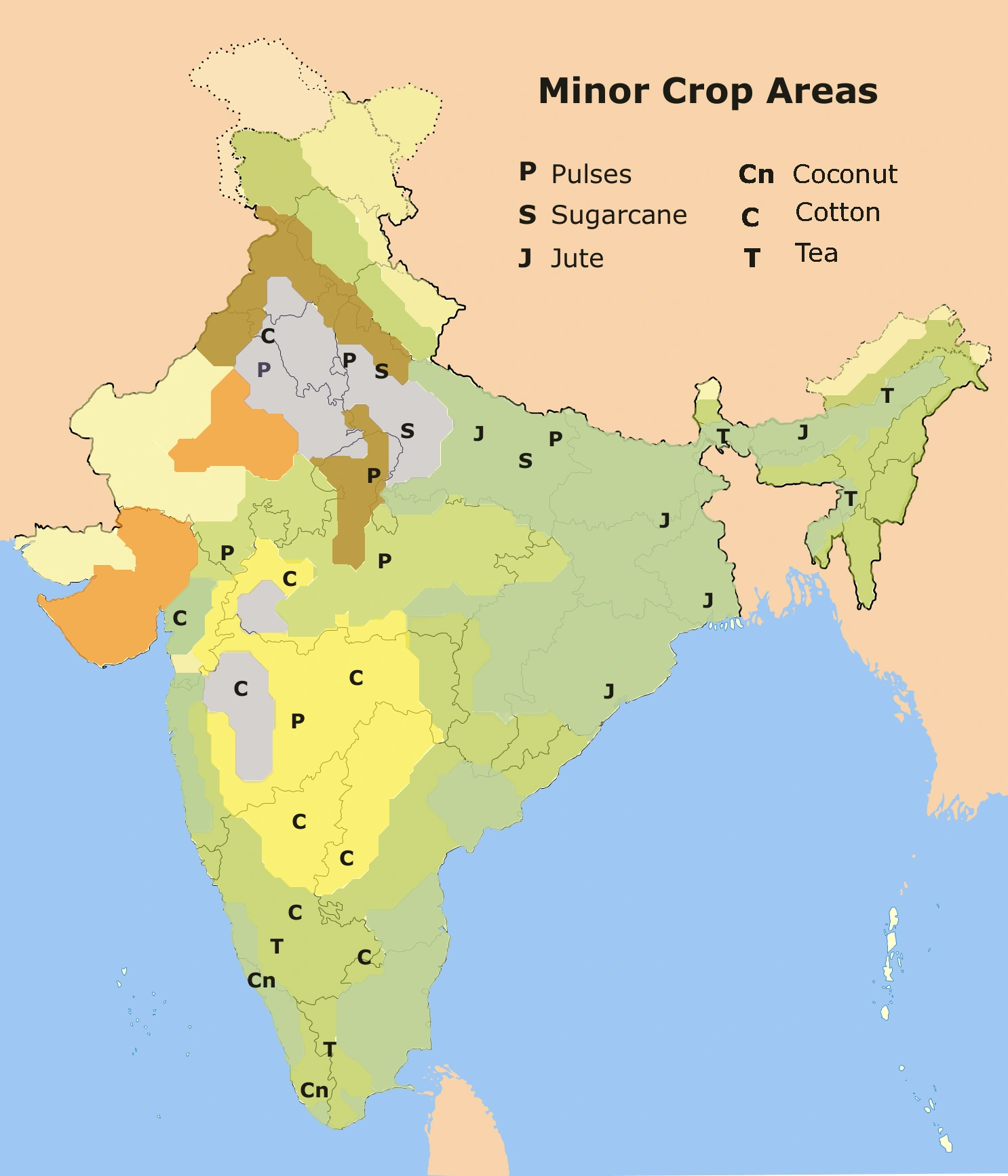
Map study
Selected crop regions of India: identify the legend symbols before comparing patterns. Symbols do not imply exclusive growing areas or current production totals.
- Read the source legend, scale and reference period before comparing regions.
- Connect spatial patterns to the processes discussed in this topic; this map is a study reference, not live operational data.
Credit: Amog · CC BY-SA 2.5 · sourceConverted to WebP on an opaque white background; proportionally resized without cropping. Original cartography and legend retained.
1. Crop requirements and industrial location
Sugar is a major agro-based industry linking farmers, mills, transporters, distilleries and power producers. In India, commercial sugar is manufactured predominantly from sugarcane rather than sugar beet. Cane also supplies gur, or jaggery, and khandsari, an unrefined sugar. Consequently, total cane production cannot be treated as cane available to organised sugar mills: part is retained for seed, consumed directly or processed by alternative sweetener units.
Sugarcane is a tropical and subtropical crop requiring a long, warm growing season, generally around 21–27°C, with adequate moisture. Rainfall of about 75–100 cm can support cultivation, but irrigation is important where rainfall is deficient or seasonally concentrated. Well-drained fertile loams and alluvial soils are suitable; black soils also support cane in peninsular India. Waterlogging, severe frost and prolonged drought adversely affect production. Relatively dry, sunny conditions during maturation favour sucrose accumulation.
Sugar mills are strongly raw-material-oriented. Cane is bulky, costly to transport and loses recoverable sugar when crushing is delayed after harvest. Mills therefore cluster within cane-growing belts rather than near distant consumer markets. All-weather rural roads, harvesting labour and coordinated supply schedules are crucial. Ratoon cropping, in which a new crop grows from the harvested plant’s stubble, reduces establishment costs but requires careful nutrient, irrigation and disease management.
2. Regional distribution and the peninsular shift
Uttar Pradesh has India’s largest sugarcane area and is a leading cane-producing state. Its Upper and Middle Ganga plains combine fertile alluvium, extensive irrigation, dense settlement and a large agricultural workforce. Major belts include western districts such as Meerut, Muzaffarnagar, Saharanpur and Bijnor, along with central and eastern districts. Bihar, Haryana, Punjab and Uttarakhand also participate in the northern sugar economy.
Maharashtra’s principal belt lies in the irrigated western and southern parts of the state, notably around Pune, Ahmednagar, Solapur, Satara, Sangli and Kolhapur. Karnataka’s important districts include Belagavi, Bagalkot, Vijayapura and Mandya. Tamil Nadu, Gujarat, Andhra Pradesh and Telangana also have sugar industries. Water availability and irrigation infrastructure often matter more than annual rainfall alone in explaining local concentrations.
The industry expanded substantially towards western and southern India because tropical conditions generally support higher sucrose recovery, favourable crop growth and a longer potential crushing season. Cooperative investment, irrigation development and links with distilleries reinforced this expansion. Nevertheless, the shift does not imply that northern India has become unimportant: Uttar Pradesh remains central, and state sugar-output rankings fluctuate with weather, cane quality and ethanol diversion.
Distinguish three indicators: cane yield is harvested cane per hectare; sugar recovery is sugar obtained as a percentage of cane crushed; and sugar output depends on both the quantity crushed and recovery. A state with more cane need not always manufacture more sugar.
From sugarcane to sugar and industrial co-products
- 1. Harvest mature cane and transport it rapidly to the mill.
- 2. Crush cane: extract juice and separate bagasse.
- 3. Clarify juice: remove impurities and collect press mud.
- 4. Evaporate clarified juice and crystallise sugar.
- 5. Centrifuge, dry and grade sugar; separate molasses.
- 6. Use bagasse for energy and suitable molasses streams for ethanol.
3. Processing, by-products and ethanol
At the mill, cane is weighed, prepared and crushed to extract juice. Clarification removes impurities; evaporation concentrates the juice; crystallisation and centrifugation separate sugar crystals from mother liquor. Manufacturing is seasonal because it follows cane availability. The capital-intensive factory must therefore coordinate harvesting and transport carefully to maintain crushing efficiency and avoid deterioration of cane.
Bagasse is the fibrous residue left after juice extraction. It fuels boilers and cogeneration plants, providing steam and electricity, with surplus electricity potentially exported to the grid. It is also used in paper and board manufacture. Molasses, a sugar-rich liquid residue, supplies distilleries producing ethanol and other alcohol products. Press mud, or filter cake, is used in organic manure and can support compressed biogas production.
Under the Ethanol Blended Petrol Programme, ethanol provides an additional market linked to sugar-sector economics. Depending on prevailing government permissions, ethanol can be produced from C-heavy molasses, B-heavy molasses and sugarcane juice or syrup; grain-based feedstocks are also used. India advanced its target of 20% ethanol blending in petrol to ethanol supply year 2025–26. Diverting fermentable sugar towards ethanol can moderate sugar surpluses, but policy must balance fuel supply, domestic sugar availability, food security and water demand.
| Feature | Northern belt | Peninsular belt |
|---|---|---|
| Principal states | Uttar Pradesh, Bihar, Haryana, Punjab | Maharashtra, Karnataka, Tamil Nadu |
| Climate | Subtropical; winter cold constrains growth | Tropical; generally longer favourable growing period |
| Sugar recovery | Historically lower; improved varieties can narrow the gap | Generally higher under favourable conditions |
| Institutional pattern | Strong private-mill presence, especially in Uttar Pradesh | Historically important cooperatives, particularly in Maharashtra |
| Major concern | Seasonal constraints, disease and payment arrears | Water stress in drought-prone irrigated districts |
4. Pricing, institutions and trade regulation
The Union government fixes the Fair and Remunerative Price, or FRP, of sugarcane under the Sugarcane (Control) Order, 1966, after considering recommendations of the Commission for Agricultural Costs and Prices. FRP is linked to a specified basic sugar recovery, with prescribed adjustments. Some states announce a State Advised Price, or SAP, generally above the central FRP. These are cane prices payable to growers, not retail prices of sugar.
Sugar’s minimum selling price, introduced in 2018, is a separate ex-mill price floor for sugar sold by mills. Confusing it with cane FRP or the agricultural Minimum Support Price system is a common examination error. The sector contains private, cooperative and public-sector mills. Maharashtra’s cooperative tradition has been particularly influential in mobilising farmers and organising rural investment.
Major partial decontrol measures in 2013 removed the levy-sugar obligation and the then regulated release mechanism. However, the industry did not become entirely deregulated: cane pricing and state-level supply arrangements continued, while subsequent market interventions included mill-wise monthly sale quotas and the minimum selling price. Export restrictions, permissions and duties can change with domestic availability. Cane-price commitments, fluctuating sugar realisations and weak mill finances contribute to payment arrears owed to farmers.
5. Environmental pressures and geographical significance
Sugarcane is a long-duration crop with substantial water requirements. Its expansion in drought-prone, irrigated districts creates tensions between farm incomes, drinking water and competing crops. High economic returns supported by assured purchasing arrangements may encourage cane cultivation even where the agro-climatic water balance is unfavourable. Assess sustainability using basin-level water availability and irrigation efficiency, not simply state production totals.
Distillery spent wash and inadequately treated mill effluents can pollute surface water and groundwater because of their high organic load. Bagasse cogeneration improves resource use but still requires emission control. Climate variability, heat stress, pests and diseases affect both cane availability and recovery. Labour-intensive harvesting also produces seasonal migration, especially in western India.
Priorities include drip irrigation, soil-moisture-based scheduling, suitable varieties, timely crushing, transparent cane payments and effective effluent management. Diversification into ethanol, biogas and electricity can improve revenues, but does not automatically solve water scarcity or farmer arrears. For geographical analysis, connect physical conditions with irrigation policy, factory ownership, road access and market incentives.
Real-world case studies
Pravaranagar: cooperative industrialisation
The Pravara cooperative sugar factory at Pravaranagar in present-day Ahilyanagar district, Maharashtra, began crushing in 1950. Associated with Vitthalrao Vikhe Patil and D. R. Gadgil, it became an influential model of farmer-linked industrialisation. It demonstrates how collective organisation and supporting rural infrastructure can shape industrial location.
Maharashtra’s 2015–16 drought
Severe drought in parts of Maharashtra highlighted the tension between irrigated sugarcane, industrial water use and drinking-water needs. The episode illustrates why profitability and mill proximity cannot alone establish crop suitability: basin water budgets and competing demands must also be considered.
Previous year questions
UPSC Mains 2013 · GS-I
Do you agree that there is a growing trend of opening new sugar mills in the Southern states of India? Discuss with justification.
- Explain tropical climatic advantages and generally higher sugar recovery.
- Discuss longer potential crushing seasons, irrigation and cooperative investment.
- Connect mills with ethanol, cogeneration and transport networks.
- Qualify the trend with water stress and the continuing importance of Uttar Pradesh.
Practice questions
Practice MCQ 1
Consider the following statements: 1. Sugar mills generally locate near cane-growing areas because cane is bulky and deteriorates after harvesting. 2. The state producing the most sugarcane must necessarily produce the most mill-made sugar. Which statements are correct?
- A. 1 only
- B. 2 only
- C. Both 1 and 2
- D. Neither 1 nor 2
Practice MCQ 2
Which pair is incorrectly matched?
- A. Bagasse — Cogeneration
- B. Molasses — Ethanol production
- C. Press mud — Organic manure
- D. Fair and Remunerative Price — Ex-mill sugar price floor
Practice MCQ 3
Consider the following statements: 1. Ratooning involves regrowth from harvested cane stubble. 2. All ethanol used in India’s petrol-blending programme must originate from sugarcane. 3. Higher cane yield necessarily means higher percentage sugar recovery. Which statements are correct?
- A. 1 only
- B. 1 and 2 only
- C. 2 and 3 only
- D. 1, 2 and 3
Mains practice · Explain the geographical distribution of India’s sugar industry. How far can diversification into ethanol and cogeneration resolve its structural problems? Answer in 250 words.
- Locate the Ganga plain and western–southern peninsular belts.
- Link location to climate, irrigation, perishability, roads and institutions.
- Explain additional revenues and the management of sugar surpluses.
- Examine water stress, arrears, seasonal capacity use and policy uncertainty.
- Recommend efficient irrigation, transparent payments and integrated pollution control.
Further reading
- NCERT, Contemporary India–II: Agriculture and Manufacturing Industries.
- NCERT, India: People and Economy.
- Department of Food and Public Distribution: Sugar Division and annual reports.
- Commission for Agricultural Costs and Prices: Price Policy for Sugarcane reports.
- NITI Aayog and Ministry of Petroleum and Natural Gas: Roadmap for Ethanol Blending in India 2020–25.
Preparing for UPSC Civil Services? Get classroom teaching, answer-writing evaluation and mentorship at Pragnya IAS Academy, Ashok Nagar — see why aspirants choose us for IAS coaching in Hyderabad.