
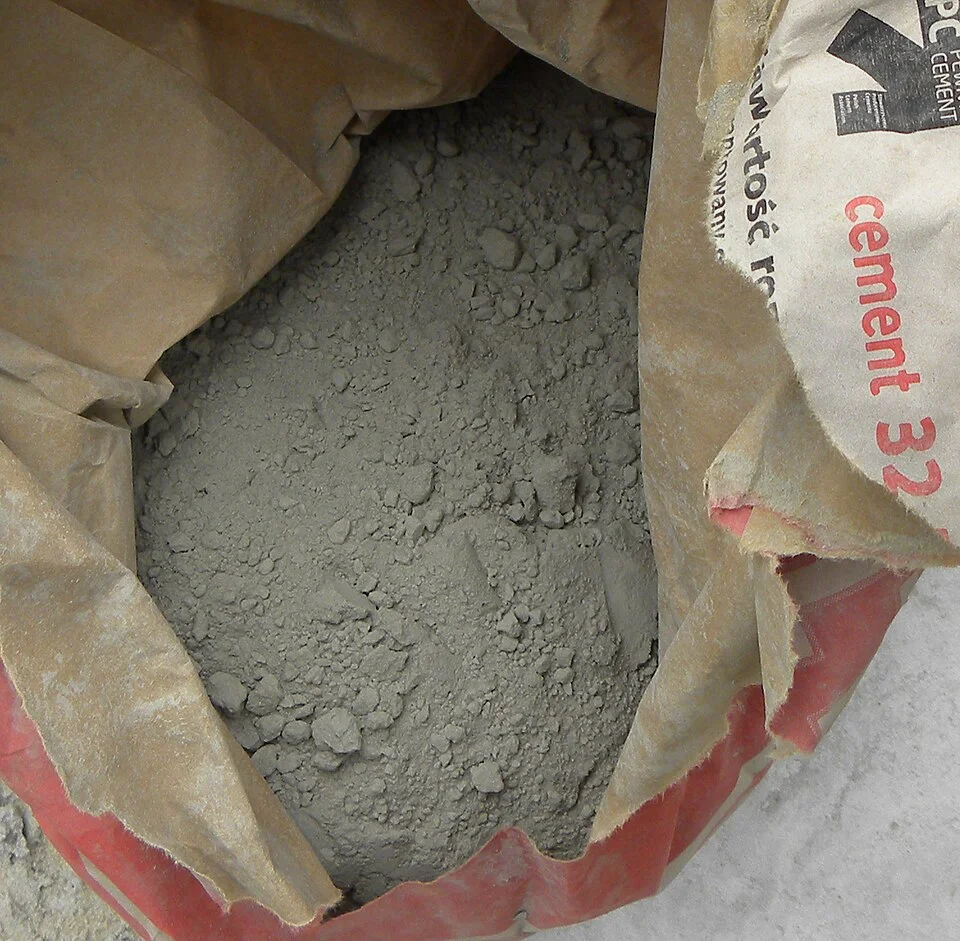
Cement: an illustrative reference for a basic infrastructure industry.
Credit: Szlomo Lejb · CC BY-SA 4.0 · sourceResized and converted to WebP; uncropped.
1. Nature and economic significance
Cement is a finely ground hydraulic binder: when mixed with water, it sets and hardens through hydration and can retain strength under water. It binds sand and coarse aggregates in concrete and is used with sand in mortar. Cement supports housing, roads, bridges, irrigation works, ports and industrial construction. Demand therefore closely follows urbanisation, infrastructure investment and the construction cycle.
India ranks second after China in cement production, but domestic demand remains central to the industry. Housing programmes such as Pradhan Mantri Awas Yojana and investment in highways, railways and urban infrastructure generate demand. Population growth matters mainly through household formation, settlement expansion and infrastructure requirements, rather than as a direct determinant of factory location.
Cement is heavy and relatively low-value per unit of weight, making freight a significant part of its delivered cost. Integrated plants commonly locate near suitable limestone deposits, whereas grinding and distribution facilities can locate nearer markets. This distinction explains why a cement company’s production network may span several states rather than consist of a single factory.
- Backward linkages include limestone mining, power generation, fuels, machinery and transport.
- Forward linkages include ready-mix concrete, construction, prefabricated components and infrastructure.
2. Raw materials and manufacturing
Limestone is the principal raw material and provides calcium carbonate. Clay or shale supplies silica and alumina; iron-bearing materials and other correctives help achieve the required chemical composition. The suitability of limestone depends on quality, impurities, deposit size and mining conditions, not merely its presence. Gypsum is added during final grinding to regulate setting; it is not the principal clinker-making raw material.
In the widely used dry process, crushed raw materials are proportioned, dried and ground into raw meal. Preheaters recover heat from kiln exhaust gases, while a precalciner carries out much of the carbonate decomposition before material enters the rotary kiln. At approximately 1,450°C, the material forms clinker containing compounds responsible for cement’s hydraulic properties. Clinker is cooled and subsequently ground into cement.
Calcination releases carbon dioxide when calcium carbonate becomes calcium oxide. Additional emissions arise from fuel combustion. Consequently, replacing fossil fuels alone cannot eliminate all production emissions. The older wet process prepares a slurry and consumes more thermal energy because water must be evaporated. Modern dry-process plants dominate Indian production.
Ordinary Portland Cement primarily contains clinker and a setting regulator. Portland Pozzolana Cement incorporates pozzolanic material, commonly fly ash; Portland Slag Cement uses granulated blast-furnace slag. Blending can reduce clinker requirements and improve selected durability characteristics, but performance depends on composition, curing and exposure conditions. Fly ash from thermal power plants and slag from steel plants create important industrial linkages.
Typical dry-process cement manufacturing
- 1. Quarry and crush limestone
- 2. Proportion and grind raw materials into raw meal
- 3. Preheat and precalcine
- 4. Burn in a rotary kiln to form clinker
- 5. Cool clinker
- 6. Grind with gypsum and permitted blending materials
- 7. Store, pack and dispatch
3. Location factors and major Indian belts
Limestone exerts a strong pull on integrated cement plants because large quantities are required and part of the raw material’s mass is lost as carbon dioxide during processing. Locating near quarries avoids transporting unnecessary raw-material weight. Nevertheless, fuel availability, electricity, water, land, environmental permissions and connectivity also influence location. Coal and petroleum coke have been important kiln fuels, supplemented increasingly by suitable alternative fuels.
The northwestern belt includes Rajasthan’s Chittorgarh–Nimbahera, Kota and Pali areas, extending towards Gujarat’s limestone-bearing districts. Rajasthan combines substantial limestone resources with access to northern and western markets. Coastal Gujarat offers opportunities for port-based fuel handling and coastal movement of clinker or cement. Limestone availability alone does not guarantee low delivered costs if market access is poor.
Central India contains the Satna–Maihar–Rewa belt of Madhya Pradesh and the Baloda Bazar–Raipur region of Chhattisgarh. These clusters benefit from limestone resources and transport connections to multiple regional markets. Chhattisgarh’s wider coal, power and steel economy also supports industrial inputs and opportunities for blended cement.
Southern clusters include Nalgonda and Suryapet in Telangana; YSR Kadapa and Nandyal in Andhra Pradesh; Kalaburagi in Karnataka; and Ariyalur in Tamil Nadu. The Deccan and adjoining sedimentary basins contain significant limestone deposits. In the northeast, Meghalaya is important because of its limestone resources, although terrain and connectivity influence costs. Producing-state rankings can change with capacity additions and utilisation.
| Material | Composition or origin | Prelims distinction |
|---|---|---|
| Clinker | Kiln-produced nodules | Intermediate product, not finished cement |
| Ordinary Portland Cement | Primarily clinker with gypsum | Gypsum regulates setting |
| Portland Pozzolana Cement | Clinker, gypsum and pozzolana | Commonly incorporates fly ash |
| Portland Slag Cement | Clinker, gypsum and granulated blast-furnace slag | Links cement with iron and steel production |
| Concrete | Cement, water and fine and coarse aggregates | Composite construction material, not a cement variety |
4. Transport, markets and regional organisation
An integrated plant manufactures clinker and cement, whereas a standalone grinding unit receives clinker for processing into cement. Grinding units may locate near large urban markets, ports, thermal power stations or steel plants. This allows companies to combine clinker from limestone-rich regions with fly ash or slag available elsewhere, while reducing the distance over which finished cement must be distributed.
Railways are important for long-distance bulk movement of coal, clinker and cement. Roads provide flexible distribution and last-mile delivery to dealers and construction sites. Coastal shipping can connect suitable port-linked production and consumption centres. The preferred mode depends on distance, shipment size, terminals, handling costs and reliability; no single mode is cheapest everywhere.
Cement must be protected from moisture during storage and transport. It moves in bags as well as in bulk tankers and specialised handling systems. Large construction projects and ready-mix concrete plants favour bulk delivery. PM Gati Shakti and the National Logistics Policy are relevant through their broader aims of multimodal connectivity and logistics efficiency, rather than as cement-production schemes.
5. Environmental issues and resource efficiency
Limestone quarrying changes landforms, removes vegetation and can affect drainage, groundwater and nearby habitats. Mining, crushing and material handling generate dust; kilns can emit particulate matter, nitrogen oxides and sulphur dioxide. Impacts require site-specific assessment, especially around settlements, forests and ecologically sensitive limestone landscapes.
Pollution controls include enclosed conveyors, covered storage, bag filters or electrostatic precipitators, dust suppression and emission monitoring. Mine rehabilitation, progressive reclamation and groundwater management address extraction impacts. Cement projects are subject to applicable environmental-clearance requirements under the EIA Notification, 2006, and pollution-control consents under the Air and Water Acts.
Decarbonisation measures include efficient kilns, waste-heat recovery, renewable electricity, lower clinker content and carefully controlled alternative fuels. Co-processing suitable wastes can substitute fuel or raw materials, but requires characterisation, authorisation and emission safeguards. Energy efficiency is promoted through the Bureau of Energy Efficiency’s Perform, Achieve and Trade scheme. Emerging limestone–calcined clay cement can further reduce clinker demand, while carbon capture may address residual process emissions.
Cement: Location, Transport and Environmental Linkages
Cement manufacturing links mineral extraction to construction demand. Limestone supplies calcium, while clay or other suitable materials provide silica and alumina. Heating the prepared mix in a kiln produces clinker, which is ground with gypsum to regulate setting. Cement is therefore not the same as clinker or concrete: concrete combines cement with water and aggregates such as sand and gravel. The supplied metadata identifies cement but does not establish its composition, manufacturing process or place of production.
In India, integrated cement plants commonly locate near substantial limestone deposits because transporting bulky raw materials is costly. Producing regions include Rajasthan, Madhya Pradesh, Andhra Pradesh, Telangana, Karnataka and Chhattisgarh. Fuel, electricity, water and rail or road connectivity also influence location. Grinding units can operate closer to consuming markets or sources of supplementary materials, rather than beside limestone quarries. This distinction explains why cement production geography cannot be inferred from mineral deposits alone.
- Transport economics: Cement has a relatively low value compared with its bulk; freight costs shape market reach, while rail and coastal shipping can support longer-distance movement.
- Environmental impacts: Carbon dioxide comes from both limestone calcination and fuel combustion. Cleaner energy alone cannot eliminate process emissions; dust control and quarry rehabilitation address additional impacts.
- Prelims/Mains distinction: Blended cements may incorporate fly ash or suitable blast-furnace slag, reducing clinker requirements. Such industrial linkages do not mean every cement plant uses identical raw materials or technology.
Real-world case studies
Ariyalur, Tamil Nadu: raw-material-led clustering
Ariyalur’s limestone-bearing sedimentary formations support several cement plants. The cluster illustrates the pull of mineral resources on integrated manufacturing, alongside access to construction markets in Tamil Nadu. Concentrated quarrying also makes dust control, haul-road management and mine rehabilitation important local concerns.
Limestone Calcined Clay Cement: India–Switzerland research collaboration
Research involving IIT Delhi, IIT Madras, Switzerland’s EPFL and other partners has advanced LC3 technology. It combines clinker with calcined clay, limestone and gypsum. Its significance lies in lowering clinker demand and associated emissions while using suitable clays; material testing and standards remain essential.
Previous year questions
No source-linked PYQ is available here yet. Use the practice questions below.
Practice questions
Practice MCQ 1
Consider the following statements: 1. Calcination of limestone releases carbon dioxide. 2. Gypsum is added mainly to regulate cement setting. 3. Concrete and clinker are the same material. Which statements are correct?
- A. 1 and 2 only
- B. 2 and 3 only
- C. 1 and 3 only
- D. 1, 2 and 3
Practice MCQ 2
A standalone cement grinding unit is most likely to benefit from proximity to which combination?
- A. A limestone quarry alone, without transport links
- B. A construction market, clinker transport facilities and fly ash supplies
- C. A cotton-growing region and humid climate
- D. A petroleum refinery, without access to clinker
Practice MCQ 3
Which pair is incorrectly matched?
- A. Satna–Maihar: Madhya Pradesh
- B. Ariyalur: Tamil Nadu
- C. Kalaburagi: Karnataka
- D. Nalgonda: Andhra Pradesh
Mains practice · Explain the geographical factors shaping India’s cement industry. How are logistics and low-carbon technologies modifying its traditional location pattern? Answer in 250 words.
- Begin with limestone dependence, weight loss and energy intensity.
- Illustrate with Rajasthan, central India and southern clusters.
- Distinguish integrated plants from market-oriented grinding units.
- Explain rail, road, coastal shipping and industrial by-product linkages.
- Discuss blended cement, LC3, waste-heat recovery and alternative fuels.
- Conclude that limestone remains fundamental while production networks become more dispersed.
Further reading
- NCERT, Contemporary India II: Manufacturing Industries.
- Indian Bureau of Mines, Indian Minerals Yearbook: Cement; Limestone and Other Calcareous Materials.
- Bureau of Energy Efficiency: Cement sector and Perform, Achieve and Trade scheme.
- Central Pollution Control Board: Cement industry standards and co-processing guidelines.
- National Council for Cement and Building Materials: Cement technology and sustainability resources.
- https://commons.wikimedia.org/wiki/File:Cement_02_(cropped).jpg
Preparing for UPSC Civil Services? Get classroom teaching, answer-writing evaluation and mentorship at Pragnya IAS Academy, Ashok Nagar — see why aspirants choose us for IAS coaching in Hyderabad.