
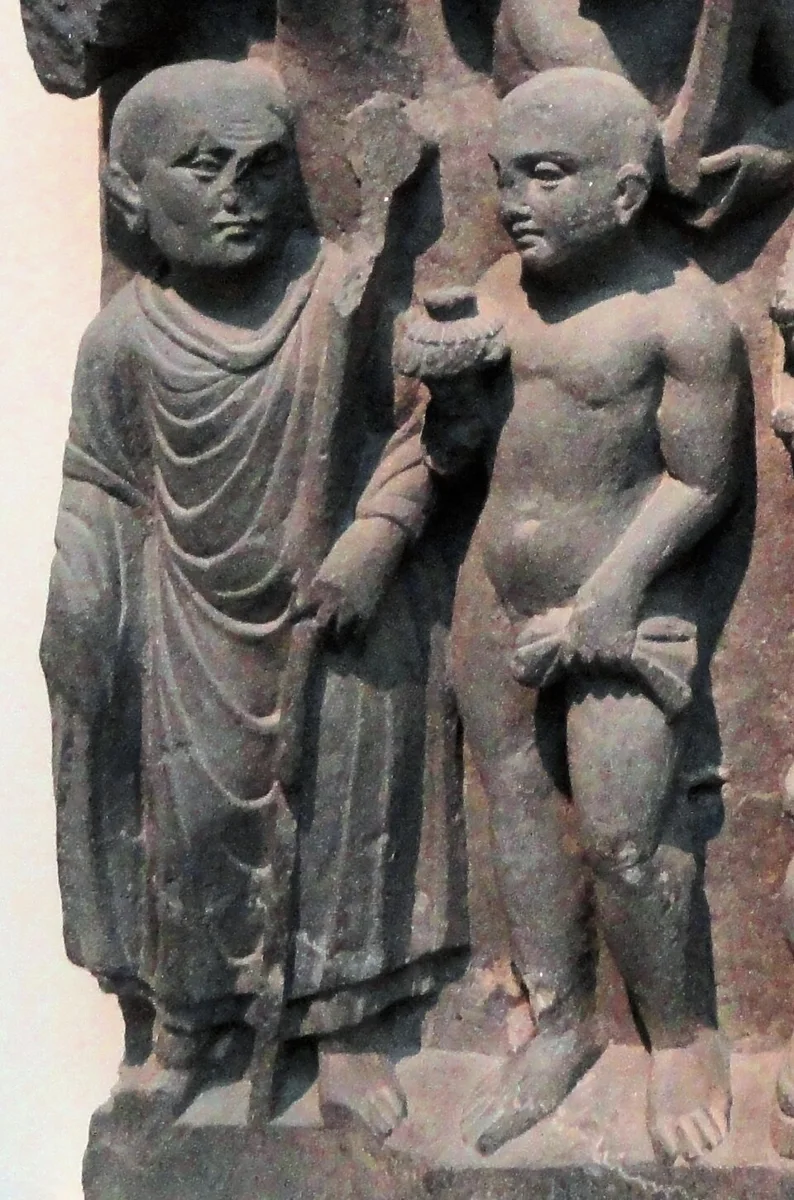
Gandhara sculpture identified as Mahākāśyapa meeting an Ājīvika and learning of the Buddha’s parinirvana.
Credit: Daderot · CC0 · sourceResized and converted to WebP; uncropped.
1. Historical setting and the problem of sources
The Ajivikas emerged within the shramana environment of northern India around the sixth–fifth centuries BCE. Shramanas were renouncers who explored liberation through ascetic discipline, debate and alternatives to household life. Their growth coincided with the second urbanisation, expanding trade, new towns and the consolidation of mahajanapadas, particularly in the middle Gangetic plain. Buddhism, Jainism and Ajivika teaching developed within this diverse intellectual setting rather than as isolated movements.
Ajivikas are conventionally classified as a heterodox or non-Vedic school. In this context, heterodox means outside traditions accepting the Vedas as supreme religious authority; it does not automatically mean materialist or opposed to every supernatural belief. Ajivikas accepted a continuing cycle of existence, unlike the denial of an afterlife commonly associated with materialist traditions.
No securely identifiable Ajivika canonical literature survives. Much of our knowledge comes from Buddhist and Jain authors who debated against them. These texts preserve valuable names and doctrines, but their descriptions may simplify opponents or contain sectarian criticism. Inscriptions recording donations to Ajivikas are more direct evidence of institutional existence and royal patronage, though they reveal little about detailed theology.
- Use literary accounts to reconstruct teachings, while identifying their Buddhist or Jain standpoint.
- Use inscriptions to establish donors, recipients and material support; do not infer a complete philosophy from a cave dedication.
Timeline
Approximately sixth–fifth centuries BCE
Gosala and the early Ajivikas belong to the shramana milieu associated with Mahavira and the Buddha; precise personal dates remain uncertain.
Third century BCE
Ashoka dedicates caves at Barabar to Ajivikas.
Later third century BCE
Dasharatha dedicates caves in the Nagarjuni hills to Ajivikas.
Later ancient and medieval periods
Literary references continue, including in southern India, but institutional continuity and some identifications remain debated.
2. Makkhali Gosala and the ascetic community
Makkhali Gosala is remembered as the leading Ajivika teacher and is commonly described in textbooks as the movement’s founder. Since the early history is fragmentary, principal organiser or prominent exponent is sometimes a more cautious description. Buddhist literature places him among six well-known non-Buddhist teachers associated with the Buddha’s time. Exact dates for his birth and death are uncertain and should not be presented as securely established.
The Buddhist Samannaphala Sutta, in the Digha Nikaya, attributes a strongly deterministic teaching to Gosala. The Jain Bhagavati Sutra presents him as an associate of Mahavira before a separation and doctrinal conflict. This narrative is important for reconstructing interaction between ascetic groups, but its biographical episodes should be read as Jain testimony, not as independently verified events.
Literary descriptions associate Ajivika renouncers with nudity, wandering and severe austerities. Such practices placed them within a shared ascetic culture also inhabited by other groups. Nakedness alone therefore cannot identify an ancient ascetic as Ajivika. The movement included organised communities capable of receiving substantial donations, while evidence of support from rulers and other patrons shows that its history extended beyond Gosala’s personal teaching.
- Gosala, Mahavira and the Buddha belong to a broadly overlapping historical milieu.
- Do not confuse Makkhali Gosala with Ajita Kesakambalin, another teacher whose doctrines are generally described as materialist.
Ajivika determinism as reconstructed from external accounts
- 1. Existence is governed by niyati.
- 2. Beings pass through a predetermined sequence of lives.
- 3. Individual effort cannot independently shorten that sequence.
- 4. Release occurs upon completion of the allotted course.
3. Niyati, rebirth and the meaning of asceticism
The signature Ajivika doctrine was niyati: existence unfolds according to a fixed order that individual effort cannot alter. In the Buddhist presentation of Gosala’s teaching, beings undergo a predetermined course of transmigration before reaching the end of suffering. Deliberate action, vows or austerities cannot independently accelerate that process. This is why Ajivika thought is usually labelled determinist or fatalist.
The important contrast concerns the efficacy of action. Jainism regards karmic bondage as something that can be stopped and eliminated through ethical discipline and austerity. Buddhism assigns a central role to intentional action and teaches a path through which suffering can cease. Ajivika teaching, as represented by its opponents, denies that such effort changes the allotted course of existence. It should not be reduced to the vague statement that all ancient Indian traditions believed in fate.
Their rigorous asceticism may appear inconsistent with determinism, but the two need not be logically incompatible. An ascetic life could itself be understood as part of the predetermined sequence rather than as an instrument that independently produces liberation. However, surviving evidence does not allow every practice to be explained with certainty. Claims that Ajivikas were simply inactive, immoral or identical to Charvakas are misleading extrapolations from hostile accounts.
- Niyati is the safest identifying term in a matching question.
- Ajivika determinism concerns the inability of effort to change destiny, not a simple denial of rebirth.
- Absence of effective free agency in an attributed doctrine does not prove absence of social rules within its community.
| Aspect | Ajivikas | Jainism | Buddhism |
|---|---|---|---|
| Prominent early teacher | Makkhali Gosala | Mahavira, the twenty-fourth Tirthankara | Gautama Buddha |
| Distinctive doctrinal emphasis | Niyati or predetermined cosmic order | Jiva, karmic bondage and liberation | Four Noble Truths and dependent origination |
| Role of deliberate effort | Cannot alter the predetermined course, according to surviving accounts | Essential to stopping and removing karmic bondage | Essential to cultivating the path towards cessation of suffering |
| Textual evidence | Own canon lost; chiefly external accounts | Surviving Jain canonical and later literature | Surviving Buddhist canonical and later literature |
4. Mauryan patronage and the caves of Bihar
The clearest material evidence for Ajivikas comes from the Mauryan period. Ashoka’s inscriptions record cave donations to Ajivikas at Barabar, near Gaya in present-day Bihar. Sudama Cave is a particularly important example, with a dedication dated to his twelfth regnal year. Ashoka’s association with Buddhism therefore did not prevent him from supporting another ascetic community. These donations illuminate the broader religious landscape of his reign.
Dasharatha, Ashoka’s grandson, continued this patronage by dedicating caves in the nearby Nagarjuni hills to Ajivikas. The Barabar–Nagarjuni group contains some of India’s earliest surviving rock-cut architectural monuments. Several interiors display the highly polished stone surfaces conventionally associated with Mauryan workmanship. Excavation into hard granite and carefully finished chambers demonstrate substantial technical skill and organised patronage.
Lomas Rishi Cave at Barabar is especially famous for its arch-shaped entrance and facade imitating timber architectural forms. Nevertheless, an architectural association with the Barabar group must be distinguished from an explicit inscription naming Ajivika recipients: Lomas Rishi itself lacks such a surviving Mauryan dedication. Similarly, the caves should not all be described as Buddhist chaitya halls merely because they influenced the later history of Indian rock-cut architecture.
- Ashoka: inscribed Ajivika donations at Barabar.
- Dasharatha: inscribed Ajivika donations at Nagarjuni.
- Lomas Rishi: important architectural evidence, but not an independently inscribed Ajivika dedication.
5. Later history and significance for ancient Indian religion
Ajivika history did not end with the Mauryas. Later literary references, including those in southern India, indicate the continuing remembrance and possible presence of Ajivika teachers and doctrines. Tamil works such as Manimekalai are relevant to the history of philosophical debate. However, the identification of particular southern inscriptions or ascetic communities as Ajivika is sometimes disputed. A precise, universally accepted date for the movement’s disappearance cannot be supplied.
For historical interpretation, the Ajivikas demonstrate that early Indian religious life was more diverse than a simple contrast between Brahmanism, Buddhism and Jainism. They contributed a distinctive position to debates about causation, action, rebirth and liberation. Their disappearance as an identifiable major community also illustrates how uneven textual survival shapes our picture of the past.
For UPSC, connect the topic to three larger themes: shramana alternatives during the age of the mahajanapadas, plural religious patronage under the Mauryas, and the beginnings of surviving rock-cut architecture. Strong answers separate doctrinal reconstruction from epigraphic fact and avoid assuming that every non-Vedic school shared the same understanding of karma or liberation.
- High-yield associations: Gosala–niyati; Ashoka–Barabar; Dasharatha–Nagarjuni.
- Source criticism is essential because an extinct community is largely described through the writings of its rivals.
Ajivikas in Buddhist Narrative and Historical Evidence
The supplied metadata identifies this Gandhara sculpture with a Buddhist narrative in which Mahākāśyapa encounters an Ājīvika and learns of the Buddha’s parinirvana, or final passing away. Its relevance lies in the presence of an Ajivika within Buddhist narrative tradition, rather than in any direct illustration of Ajivika doctrine. Gandhara belonged to the northwestern cultural world of the ancient subcontinent; this example can therefore contextualise interactions among religious communities, but should not be treated as an Ajivika devotional object or a contemporary portrait of Makkhali Gosala.
Ajivikas formed part of the shramana milieu alongside Buddhists, Jains and other renunciant groups. Their characteristic teaching, niyati, understood existence as governed by an invariable order rather than redirected by individual effort. Yet their association with rigorous asceticism cautions against equating determinism with an absence of religious discipline. Since their own scriptures have not survived, Buddhist and Jain descriptions require critical reading: they preserve important testimony while also reflecting rival traditions’ concerns. Mauryan cave-dedication inscriptions provide a different kind of evidence, securely illuminating patronage without supplying a complete account of Ajivika philosophy.
- Distinguish representation from authorship: an Ajivika appearing in Buddhist art does not make the sculpture an Ajivika religious commission.
- For Indian history, connect Ajivika patronage with Ashoka’s Barabar cave dedications and Dasharatha’s Nagarjuni dedications; avoid assigning every cave indiscriminately.
- For Prelims and Mains, distinguish Ajivika niyati from Buddhist and Jain understandings of karma, and separate narrative testimony from inscriptional evidence.
Real-world case studies
Sudama Cave: evidence of religious patronage beyond Buddhism
Sudama Cave’s Ashokan dedication to Ajivikas provides direct evidence that royal support crossed sectarian boundaries. Its polished granite interior also links religious patronage with Mauryan craftsmanship. The inscription establishes a donation; it does not establish Ashoka’s acceptance of Ajivika determinism.
Lomas Rishi: separating architectural context from inscriptional proof
Lomas Rishi is frequently illustrated alongside Ajivika caves because of its location at Barabar. Its timber-inspired facade is historically significant, but it has no surviving Mauryan dedication explicitly naming Ajivikas. It is a useful example of why proximity and stylistic resemblance should not substitute for direct epigraphic evidence.
Previous year questions
No source-linked PYQ is available here yet. Use the practice questions below.
Practice questions
Practice MCQ 1
With reference to the Ajivikas, consider the following statements: 1. Niyati was central to their attributed doctrine. 2. They rejected rebirth in the same manner as materialist schools. 3. Their original canonical literature survives as the principal source for their history. Which of the statements given above is/are correct?
- A. 1 only
- B. 1 and 2 only
- C. 2 and 3 only
- D. 1, 2 and 3
Practice MCQ 2
Which one of the following pairs is correctly matched?
- A. Makkhali Gosala — Buddhist Middle Way
- B. Dasharatha — Ajivika cave donations at Nagarjuni
- C. Ajita Kesakambalin — Principal exponent of Ajivika niyati
- D. Lomas Rishi — Surviving Ashokan dedication explicitly naming Ajivikas
Practice MCQ 3
Ashoka’s cave donations to Ajivikas most directly establish which of the following?
- A. Ashoka abandoned Buddhism and adopted Ajivika doctrine.
- B. All Mauryan caves were Buddhist monasteries.
- C. Mauryan royal patronage could extend to more than one religious community.
- D. Ajivikas accepted the Buddhist understanding of intentional action.
Mains practice · Explain the distinctive position of the Ajivikas within ancient India’s shramana traditions. What limitations do the available sources impose on reconstructing their history? Answer in 150 words.
- Locate their emergence in the early historic Gangetic region and identify Makkhali Gosala.
- Explain niyati and contrast it with the efficacy of ethical and ascetic effort in Buddhism and Jainism.
- Mention rigorous asceticism without equating determinism with inactivity.
- Use Barabar and Nagarjuni inscriptions as direct evidence of Mauryan patronage.
- Highlight the lost Ajivika canon and the sectarian perspectives of surviving Buddhist and Jain accounts.
Further reading
- NCERT, Themes in Indian History, Part I: Thinkers, Beliefs and Buildings.
- Upinder Singh, A History of Ancient and Early Medieval India: From the Stone Age to the 12th Century.
- A. L. Basham, History and Doctrines of the Ajivikas.
- Archaeological Survey of India: information on Barabar and Nagarjuni caves.
- Digha Nikaya, Samannaphala Sutta, read with attention to its Buddhist perspective.
- https://commons.wikimedia.org/wiki/File:Mah%C4%81k%C4%81%C5%9Byapa_meets_an_%C4%80j%C4%ABvika_and_learns_of_the_parinirvana,_Gandhara_sculpture.jpg
Preparing for UPSC Civil Services? Get classroom teaching, answer-writing evaluation and mentorship at Pragnya IAS Academy, Ashok Nagar — see why aspirants choose us for IAS coaching in Hyderabad.