
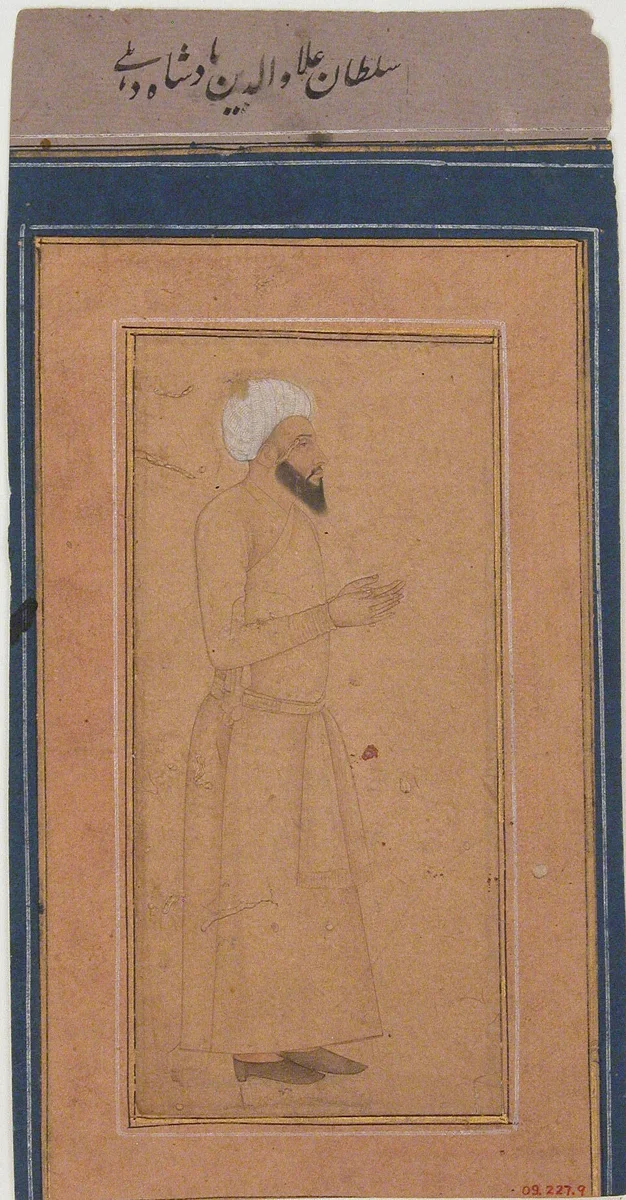
Portrait identified in the file title as Alauddin Khalji; its date and authorship are not supplied.
Credit: Unknown authorUnknown author · Public domain · sourceResized and converted to WebP; uncropped.
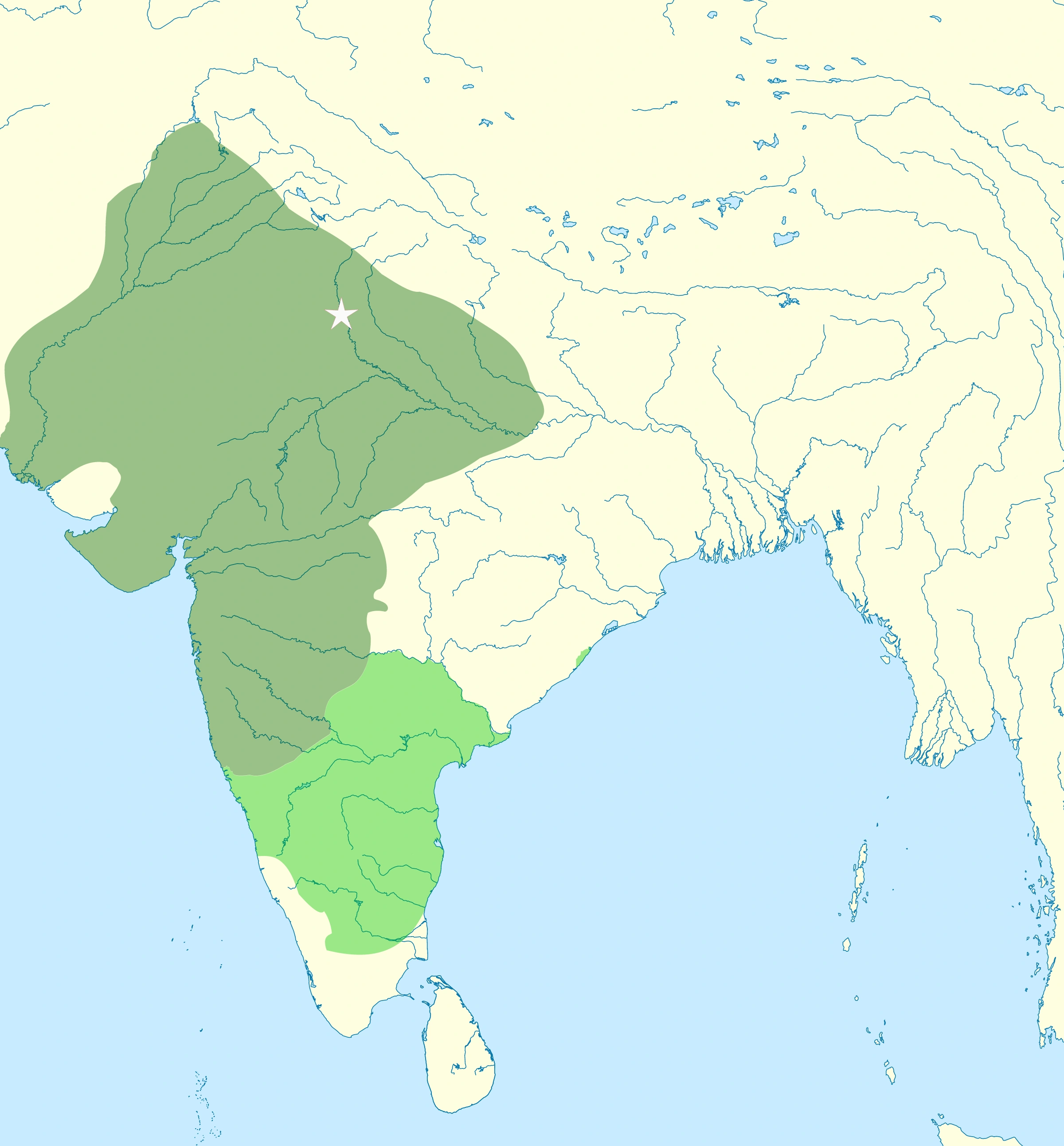
Map study
Delhi Sultanate under the Khaljis: compare the northern core with the Deccan campaign regions.
- Read the source date and legend before interpreting territorial extent.
- Compare core regions, neighbouring powers and geographic barriers; historical borders and influence are approximate and changed over time.
Credit: Utcursch; Uwe Dedering base map · CC BY-SA 4.0 · sourceConverted to WebP on an opaque white background; proportionally resized without cropping. Original cartography and legend retained.
1. Accession, sources and the character of kingship
Alauddin belonged to the Khalji dynasty, which replaced the Mamluk or Slave dynasty in 1290. As governor of Kara, he conducted a profitable raid on Devagiri, the Yadava capital in the Deccan, in 1296. Its wealth strengthened his political position. Later that year, he murdered his uncle and father-in-law, Sultan Jalaluddin Khalji, near Kara and secured the Delhi throne. His accession illustrates the importance of military resources, personal followings and control over accumulated wealth in Sultanate succession.
His main political objective was an authoritative monarchy capable of maintaining a large army and preventing aristocratic rebellion. According to Ziauddin Barani, he identified drinking gatherings, close alliances among nobles, accumulated wealth and inadequate intelligence as conditions encouraging conspiracies. Measures therefore included confiscation of certain grants and properties, restrictions on wine and social gatherings, regulation of matrimonial alliances among nobles, and a stronger intelligence network. Their enforcement and geographical reach should not be assumed to have been uniform.
Amir Khusrau’s Khazain-ul-Futuh is an important contemporary account, although its courtly praise requires critical reading. Barani’s Tarikh-i-Firuz Shahi, written several decades later, provides detailed descriptions of administration and prices. Isami’s Futuh-us-Salatin is another relevant narrative. Barani presents Alauddin as willing to frame state regulations, or zawabit, according to political necessity rather than accept every prescription of the religious scholars. This was pragmatic sovereignty within a medieval Islamic monarchy, not secularism in the modern constitutional sense.
Timeline
1296
Raid on Devagiri; murder of Jalaluddin Khalji; accession to the Delhi throne.
1299
Gujarat campaign and major Mongol confrontation at Kili.
1301–1303
Capture of Ranthambore and Chittor; Mongol attack on Delhi in 1303.
1305–1306
Conquest of Malwa and major victories against Mongol invasions.
1309–1311
Malik Kafur’s campaigns against Warangal and southern kingdoms; Alai Darwaza completed in 1311.
1316
Death of Alauddin Khalji and beginning of an unstable succession.
2. Territorial expansion and defence against the Mongols
Alauddin combined territorial expansion with defence of the north-western frontier. Gujarat was invaded in 1299 by armies led by Ulugh Khan and Nusrat Khan; Malik Kafur entered the Sultan’s service after this campaign. Ranthambore fell in 1301 and Chittor in 1303. Malwa was conquered in 1305, while Siwana and Jalore were subdued in 1308 and 1311 respectively. These victories strengthened Delhi’s position in Rajasthan and central India and opened access to commercial wealth and routes.
Southern expeditions under Malik Kafur brought Devagiri, Warangal, the Hoysala kingdom and the Pandya country within Delhi’s military reach. Campaigns against Warangal in 1309–1310 and into the far south in 1310–1311 yielded tribute, elephants, horses and treasure. Much of the southern strategy involved extracting submission and tribute from existing rulers rather than immediately establishing uniform provincial administration. It is therefore misleading to treat every raided territory as a directly administered part of the Sultanate.
Repeated Mongol attacks made military preparedness essential. Important encounters included Kili in 1299, the attack on Delhi in 1303, Amroha in 1305 and another major invasion in 1306. Alauddin strengthened frontier arrangements and maintained a large centrally controlled army. Siri served as a fortified royal centre associated with this military setting. The Chittor campaign must be distinguished from the story of Padmini: Malik Muhammad Jayasi’s Padmavat was composed around 1540, more than two centuries later, and is not contemporary proof of the events it narrates.
Military needs and administrative intervention
- 1. Mongol threats and territorial expansion increase military requirements.
- 2. A large army creates demand for reliable revenue and affordable supplies.
- 3. Closer revenue assessment and control of intermediaries strengthen resource mobilisation.
- 4. Grain procurement, storage and merchant supervision support regulated markets.
- 5. Controlled prices help sustain soldiers on prescribed cash salaries.
- 6. Horse branding, descriptive rolls and intelligence reinforce supervision.
3. Revenue administration and control over rural intermediaries
A large army required dependable revenue. Alauddin expanded direct royal fiscal control, particularly in the core territories around Delhi and the Ganga–Yamuna Doab. Land revenue assessment was linked to measurement of cultivated land, and the state demand in the closely administered core is described as reaching half the produce. This figure should not be projected mechanically onto every territory acknowledging his supremacy, especially distant tributary kingdoms.
The privileges of rural intermediaries, identified in the sources as khuts, muqaddams and chaudhuris, were curtailed. They were made to bear fiscal obligations rather than shift their burden onto ordinary cultivators. These measures reduced the independent resources of local elites and improved the state’s access to agrarian surplus. Nevertheless, revenue centralisation did not necessarily improve peasant welfare: high assessment, strict collection and additional taxes imposed considerable pressure on the countryside.
Besides land revenue, sources mention ghari, a house tax, and charai, a grazing tax. The Diwan-i-Mustakhraj was concerned with recovering arrears from revenue collectors and officials. Measures against corruption and unauthorised deductions sought to ensure that assessed revenue reached the treasury. Collection of part of the revenue in grain also supported state granaries and the supply arrangements underlying the market system.
For examination purposes, distinguish these measures from the more elaborate revenue arrangements associated with Sher Shah and Akbar. Alauddin used measurement and close supervision, but did not introduce Akbar’s zabt or dahsala system. Similarly, the iqta system predated him: his importance lies in tighter supervision of officials and intermediaries, not in originating that institution.
| Term | Function | Prelims distinction |
|---|---|---|
| Diwan-i-Riyasat | Supervision of market regulation | Not the department for revenue arrears |
| Shahna-i-mandi | Market superintendent | An official, not a tax |
| Diwan-i-Mustakhraj | Recovery of revenue arrears | Associated with fiscal enforcement |
| Dagh | Branding of horses | Checked substitution of inferior mounts |
| Chehra or huliya | Descriptive record of soldiers | Checked fraudulent military musters |
| Ghari and charai | House and grazing taxes | Distinct from land revenue |
4. Market regulation and military organisation
Alauddin’s market regulations are among the most distinctive features of his reign. A principal purpose was to maintain soldiers on controlled cash salaries by keeping essential goods affordable. Price schedules covered grain, cloth and other commodities, as well as horses, cattle and enslaved persons. The best-documented operation of the system concerns Delhi; it should not automatically be described as an identically enforced, empire-wide arrangement.
The Diwan-i-Riyasat supervised market arrangements, while the shahna-i-mandi was an important market superintendent. Merchants were registered, and officials monitored stocks, prices, weights and measures. Separate intelligence channels, including barids and munhiyans, helped the Sultan check official reports. Hoarding, profiteering and concealment of supplies attracted severe punishment. Caravan traders, including banjaras, were important in moving grain from producing regions towards the capital.
Price ceilings were supported by supply management rather than proclamation alone. State granaries stored grain, and regulated distribution helped address scarcity. Restrictions on intermediaries and oversight of merchants were intended to prevent manipulation. The system linked agrarian extraction, transport, storage, surveillance and urban consumption. It was coercive economic regulation driven substantially by military-fiscal needs, not a modern welfare programme or an early version of a contemporary public distribution scheme.
Army supervision complemented market control. Dagh identified approved horses through branding, while descriptive rolls recorded soldiers to prevent substitution and fraudulent musters. These measures checked the presentation of inferior horses and fictitious personnel. They were later employed and developed by other rulers. The strict market regime depended heavily on Alauddin’s personal authority and did not endure in the same form after his death.
5. Architecture, cultural setting and historical significance
Alauddin’s building activity expressed both military power and imperial ambition. Siri was a fortified urban centre north-east of the older Qutb complex. The Hauz-i-Alai, now associated with Hauz Khas, was a major reservoir intended to support the expanding settlement. Firuz Shah Tughlaq later restored the reservoir and developed the adjoining complex; the monuments visible there should therefore not all be attributed to Alauddin.
The Alai Darwaza, dated 1311, forms part of the Qutb complex and is a major early example of mature arcuate construction in Delhi Sultanate architecture. Its red sandstone, white marble, geometric ornament and inscriptions make it important for art-and-culture questions. Alauddin also planned an enlarged mosque complex and the enormous Alai Minar, which remained unfinished. The incomplete tower is physical evidence of ambitions that outlasted neither the ruler nor his building programme.
Amir Khusrau’s association with the court highlights the growth of Indo-Persian literary culture. Nevertheless, popular claims assigning every musical innovation to Khusrau should be treated cautiously. Alauddin died in 1316, after which succession struggles weakened the dynasty; Khalji rule ended in 1320. His lasting significance lies in the relationship between conquest, protection against invasion, agrarian taxation and administrative surveillance. His achievements demonstrate the capabilities of a centralising Sultanate, while the fragility of some arrangements reveals their dependence on personal authority and coercive enforcement.
Alauddin Khalji: Military Power and Administrative Control
The metadata identifies this portrait as Alauddin, Sultan of Delhi, making it relevant as an illustration of the ruler. However, the description provides copyright information rather than historical provenance. It does not establish when the portrait was produced, who made it, or whether it preserves a contemporary likeness. Use it to introduce Alauddin Khalji, not as independent evidence for his appearance, dress or court culture.
Alauddin’s administration illustrates the connection between warfare and resource mobilisation in the Delhi Sultanate. Defending against Mongol attacks and sustaining expansion required a large, reliable army. Market regulations sought to keep essential goods affordable, helping maintain soldiers on controlled cash salaries. Revenue measures, particularly in the central agricultural zone, strengthened the state’s claims on agrarian surplus and curtailed privileges of rural intermediaries. These policies should be studied together as instruments of royal power, while recognising that their geographical reach and practical enforcement were not necessarily uniform.
- Military organisation: Dagh, or horse branding, and descriptive rolls of soldiers helped check fraudulent musters; distinguish these measures from modern recruitment systems.
- Market control: Regulated prices depended on supervision, supply arrangements and penalties. They were not simply welfare measures or evidence of a modern planned economy.
- Evidence and comparison: Read Amir Khusrau’s courtly writings and Barani’s later account critically. Do not attribute Muhammad bin Tughlaq’s token currency or capital transfer to Alauddin.
Real-world case studies
Delhi’s grain market: prices depended on supplies
Barani’s account links controlled grain prices with procurement, granaries, transport arrangements and surveillance. This illustrates why the policy cannot be understood simply as an order fixing prices. Its effectiveness depended on maintaining supplies and compelling merchants and officials to comply. The account remains valuable, but was written after Alauddin’s reign and should be read critically.
Warangal: tribute without immediate annexation
Malik Kafur’s expedition secured the submission of the Kakatiya ruler Prataparudra in 1310 and extracted substantial tribute. Local rule continued, illustrating the distinction between military submission and direct provincial administration. Warangal’s subsequent conquest in 1323 belonged to the Tughlaq period, not Alauddin’s reign.
Previous year questions
No source-linked PYQ is available here yet. Use the practice questions below.
Practice questions
Practice MCQ 1
With reference to Alauddin Khalji’s administration, consider the following pairs: 1. Diwan-i-Riyasat — Market supervision; 2. Diwan-i-Mustakhraj — Recovery of revenue arrears; 3. Dagh — Descriptive rolls of soldiers. How many pairs are correctly matched?
- A. Only one
- B. Only two
- C. All three
- D. None
Practice MCQ 2
Which of the following statements about Alauddin Khalji are correct? 1. His southern expeditions frequently sought tribute while retaining local rulers. 2. Padmavat is a contemporary account of his Chittor campaign. 3. Alai Darwaza was constructed during his reign.
- A. 1 and 2 only
- B. 2 and 3 only
- C. 1 and 3 only
- D. 1, 2 and 3
Practice MCQ 3
Which explanation best connects Alauddin Khalji’s market regulations with his military policy?
- A. They replaced cash salaries with hereditary land grants.
- B. They helped maintain a large army by keeping essential commodities affordable at prescribed salaries.
- C. They abolished agrarian taxation to encourage voluntary grain donations.
- D. They eliminated the need for military inspections.
Mains practice · Alauddin Khalji’s administrative measures formed an interconnected response to military and political pressures. Discuss with reference to revenue, markets and army organisation. Answer in 250 words.
- Introduce Mongol invasions, expansion and aristocratic rebellion as major pressures.
- Explain land measurement, high assessment in core areas and checks on intermediaries.
- Connect grain procurement and storage with market regulation and soldiers’ salaries.
- Discuss dagh, descriptive rolls and intelligence as anti-fraud mechanisms.
- Distinguish directly administered territories from southern tributary kingdoms.
- Conclude with coercive costs, geographical limits and dependence on personal authority.
Further reading
- NCERT, Our Pasts–II, chapter on the Delhi Sultans.
- Satish Chandra, Medieval India: From Sultanat to the Mughals, Part One.
- Peter Jackson, The Delhi Sultanate: A Political and Military History.
- Archaeological Survey of India: Qutb Minar and its Monuments.
- Amir Khusrau, Khazain-ul-Futuh, and Ziauddin Barani, Tarikh-i-Firuz Shahi, in scholarly translations.
- https://commons.wikimedia.org/wiki/File:Portrait_of_Sultan_%27Ala-ud-Din,_Padshah_of_Delhi.jpg
Preparing for UPSC Civil Services? Get classroom teaching, answer-writing evaluation and mentorship at Pragnya IAS Academy, Ashok Nagar — see why aspirants choose us for IAS coaching in Hyderabad.