

This is a photo of ASI monument number
Credit: Yashvi Sahraya · CC BY-SA 4.0 · source

Silver Tanka Coin of Alauddin Khilji circa 1296-1312 CE, Khilji Dynasty, Delhi Sultanate. The obverse reads, "Al-sultan al-a'zam /'ala al-dunya wa'l din / abu'l muzaffar muhammad shah /al-sultan." Tra
Credit: SpeakingArch · CC BY-SA 4.0 · source
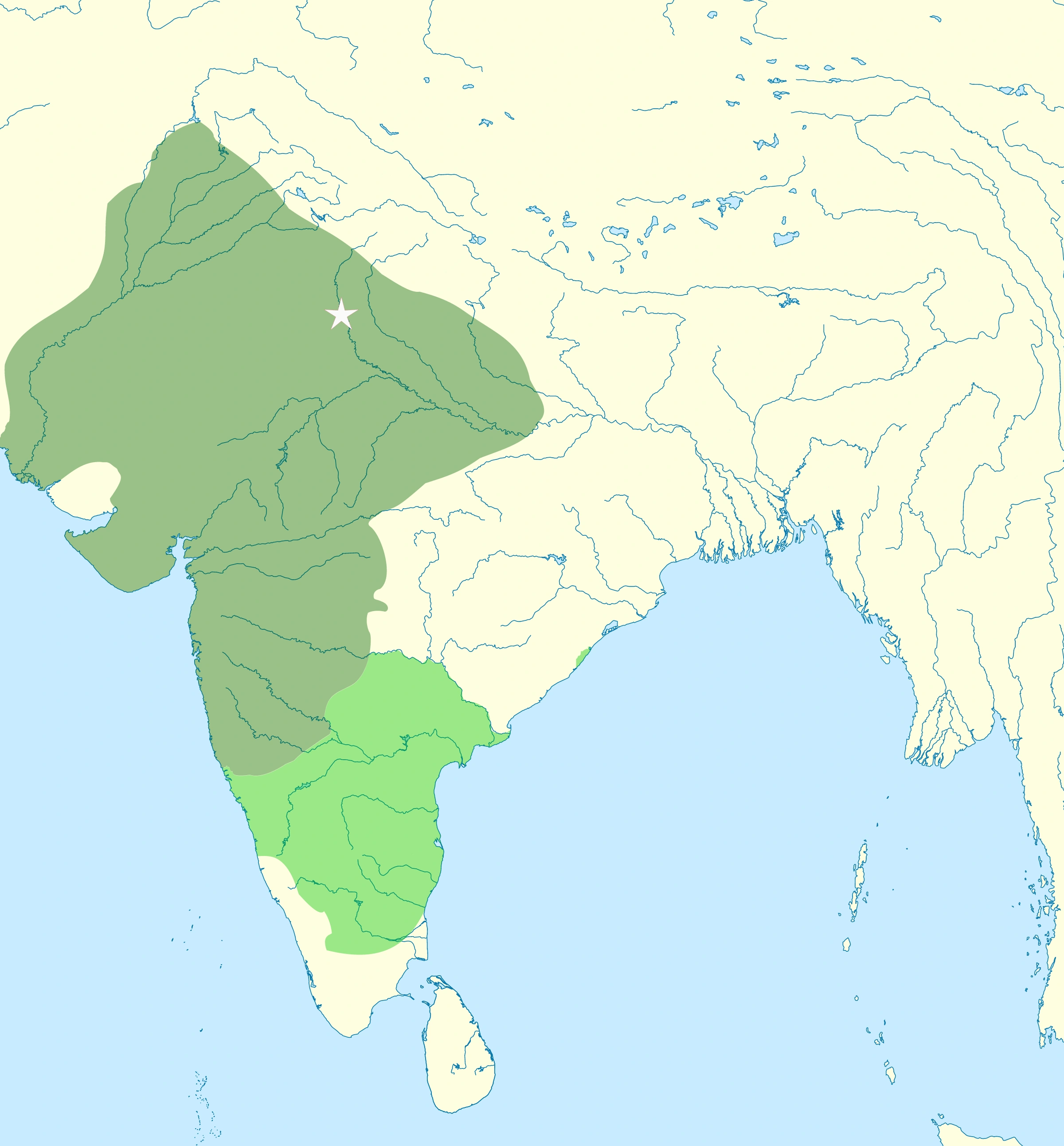
Map study
Delhi Sultanate under the Khaljis: compare the northern core with the Deccan campaign regions.
- Read the source date and legend before interpreting territorial extent.
- Compare core regions, neighbouring powers and geographic barriers; historical borders and influence are approximate and changed over time.
Credit: Utcursch; Uwe Dedering base map · CC BY-SA 4.0 · sourceConverted to WebP on an opaque white background; proportionally resized without cropping. Original cartography and legend retained.
1. Historical setting and objectives
Market regulation under Alauddin Khalji must be understood within the military and fiscal pressures facing the Delhi Sultanate. Repeated Mongol incursions threatened its north-western frontier and, on occasion, Delhi itself. At the same time, campaigns in Gujarat, Rajasthan and the Deccan required substantial military resources. Maintaining a large army therefore became central to the Sultan’s security and expansionist policy.
According to Barani, Alauddin sought to make relatively modest cash salaries sufficient for soldiers by reducing and stabilising the prices of necessities. Cheap grain, clothing, horses and other supplies could lower the cost of maintaining an army without a proportionate increase in the salary bill. Price regulation was thus primarily an instrument of statecraft rather than a modern welfare programme.
The reforms also strengthened royal authority over merchants, rural intermediaries and military elites. Urban consumers could benefit from controlled prices, but these benefits rested on compulsory deliveries, close surveillance and restricted commercial freedom. For examination purposes, distinguish the policy’s military-fiscal objective from its incidental benefits to the wider population.
Timeline
1296 CE
Alauddin Khalji became Sultan of Delhi.
1299–1303 CE
Major Mongol attacks, including the threat to Delhi in 1303, intensified pressure to strengthen the army.
Later part of Alauddin’s reign
An integrated system of price regulation, supply management and market surveillance operated; precise dates for every component are uncertain.
1316 CE and after
Alauddin died; the elaborate market controls were subsequently relaxed under his successors.
2. Regulated markets and administrative machinery
Alauddin established differentiated arrangements for major commodity groups. The grain market was subject to close supervision because food prices directly affected subsistence and soldiers’ purchasing power. Cloth, sugar, edible oils, dry fruits and various manufactured or valuable goods were associated with the Sarai-i-Adl, a regulated trading centre. Horses, cattle and enslaved persons were also brought under price schedules and official inspection.
The Diwan-i-Riyasat was the department associated with supervision of markets and merchants. The Shahna-i-Mandi was a market superintendent, especially prominent in accounts of grain regulation. Merchants had to register and comply with official conditions. The state sought to control not merely the final selling price but also the conduct of dealers, intermediaries and transporters.
Market officials were checked through separate channels of information. Barids, or intelligence-reporting officials, and munhiyans, or secret informants, supplied reports to the Sultan. This overlapping surveillance reduced dependence on a single official’s account. The system illustrates a recurring feature of Sultanate administration: specialised offices operated alongside personal royal supervision and a network of intelligence gathering.
Military-fiscal logic of the reforms
- 1. Mongol threats and expansion increased military requirements.
- 2. A large standing army created pressure on the treasury.
- 3. Controlled prices aimed to make cash salaries adequate.
- 4. Procurement, granaries and regulated transport supported supply.
- 5. Inspection and intelligence enforced compliance.
- 6. The system depended on sustained royal supervision.
3. Grain prices, procurement and supply management
Fixing prices alone could not ensure that goods remained available. Alauddin therefore linked grain regulation with procurement, storage and transport. State granaries were stocked partly through revenue collected in kind from designated areas. Grain stocks could be released when supply was disrupted, helping prevent scarcity from immediately producing a steep rise in the controlled price.
Barani reports a wheat price of 7½ jitals per man, barley at 4 jitals and gram at 5 jitals. These are important illustrative figures, but the medieval man should not be equated automatically with the later standard maund of approximately 37 kilograms. Historical weights varied across periods and regions, making modern conversions uncertain.
Grain carriers and traders, including transport groups commonly described as banjaras, were registered and placed under obligations intended to maintain supplies to Delhi. Hoarding and speculative withholding were restricted. Cultivators were pressed to dispose of saleable surplus through prescribed arrangements rather than retain it in anticipation of higher prices.
During scarcity, regulated distribution and restrictions on purchases helped spread available supplies. Barani celebrates price stability even under adverse conditions, but such claims should be read as those of a chronicler, not as independently verified statistical evidence.
| Term | Function | Exam distinction |
|---|---|---|
| Diwan-i-Riyasat | Supervision of market regulation and merchants | Not the army department |
| Shahna-i-Mandi | Market superintendent | Associated particularly with grain-market supervision |
| Sarai-i-Adl | Regulated trading centre for cloth and other specified goods | A market arrangement, not an intelligence office |
| Barids and munhiyans | Reporting and intelligence gathering | Provided checks on merchants and officials |
| Dagh and chehra | Horse branding and soldiers’ descriptive records | Military controls complementary to market reforms |
4. Non-grain markets and enforcement
The controls extended beyond basic food because the army and the capital required diverse supplies. At the Sarai-i-Adl, merchants sold specified goods at officially determined prices. Registration, guarantees and, in some cases, state advances helped secure the participation of traders and maintain supplies, including commodities brought from outside Delhi.
Horse regulation had particular military significance. The cavalry depended on reliable access to serviceable animals, and the state sought to limit manipulation by dealers and brokers. Horses were differentiated by quality rather than assigned one uniform price. Controls over cattle and enslaved persons similarly reflected the hierarchical social and economic order of the period; they were not measures of universal social protection.
Enforcement targeted overcharging, false weights, hoarding and collusion. Officials inspected transactions, and the Sultan could cross-check reports through independent informants. Barani describes exceptionally harsh punishments, including retaliation for short-weighing. Such accounts demonstrate the coercive reputation of the administration, although vivid anecdotes should not automatically be treated as evidence of routine practice in every market.
A useful analytical distinction is between a price ceiling and a complete regulatory system. Alauddin’s policy combined ceilings with procurement, transport obligations, stock management and punishment; its reported effectiveness depended on their joint operation.
5. Links with agrarian and military reforms
Market regulation formed part of a broader restructuring of state resources. In the core territories, especially the Ganga-Yamuna Doab and adjoining areas, Alauddin strengthened revenue assessment and collection. Land revenue was fixed at half the produce in areas covered by these arrangements. Measures against the privileges of khuts, muqaddams and other rural intermediaries sought to increase direct state control and reduce their capacity to retain surplus.
These agrarian measures supported the market system by bringing grain and revenue under closer official supervision. However, the land-revenue demand and market price schedules were distinct policies: one concerned extraction from agricultural production, while the other governed commercial exchange. Their effects converged in supporting the army and concentrating resources in royal hands.
Military reforms provided another connection. Dagh, the branding of horses, and chehra, the descriptive registration of soldiers, aimed to prevent fraud in recruitment and inspection. These were not market offices or grain-distribution measures. They complemented price regulation by making military expenditure more effective while controlled prices helped sustain the purchasing power of soldiers’ cash pay.
6. Results, limitations and historical interpretation
The reforms demonstrate the Sultanate’s capacity to intervene deeply in urban provisioning. In the principal narrative account, Delhi enjoyed stable prices and dependable supplies under strict supervision. Nevertheless, the surviving evidence is strongest for the capital and its supply zone. Extending these claims to every provincial town or rural market would exaggerate the geographical reach of the system.
The distributional effects were uneven. Soldiers and many urban purchasers benefited from cheaper necessities, whereas traders faced restricted margins and cultivators faced heavy revenue demands and constraints on disposing of surplus. Official price stability therefore cannot, by itself, establish widespread prosperity. The administrative burden and dependence on coercion also raised questions about long-term sustainability.
Barani wrote under later rulers and interpreted earlier events through his own political and moral concerns. His account remains indispensable but requires critical reading. The elaborate controls did not survive long after Alauddin’s death in 1316; under his successors, particularly Qutbuddin Mubarak Shah, many restrictions were relaxed. Their disappearance illustrates the difficulty of institutionalising a system dependent on intensive personal supervision.
Real-world case studies
Delhi under Mongol pressure, 1303
A Mongol force under Targhi threatened Delhi in 1303, compelling Alauddin to adopt a defensive position around Siri. The episode illustrates why the capital’s defence, cavalry strength and provisioning were urgent priorities. It provides context for the military-fiscal interpretation of market regulation, but does not establish an exact starting date for every reform.
Previous year questions
No source-linked PYQ is available here yet. Use the practice questions below.
Practice questions
Practice MCQ 1
With reference to Alauddin Khalji’s market reforms, consider the following statements: 1. They aimed to support a large army at manageable cost. 2. Their uniform enforcement across the entire Sultanate is firmly established. 3. Supply management accompanied price fixation. Which of the statements given above are correct?
- A. 1 and 2 only
- B. 2 and 3 only
- C. 1 and 3 only
- D. 1, 2 and 3
Practice MCQ 2
Which one of the following pairs is incorrectly matched?
- A. Shahna-i-Mandi — Market superintendent
- B. Sarai-i-Adl — Regulated trading centre
- C. Munhiyans — Secret informants
- D. Chehra — State grain granaries
Practice MCQ 3
Which of the following best explains why Alauddin’s grain regulations included state granaries and controls over transporters?
- A. To replace all private trade with state retailing
- B. To support controlled prices by maintaining market supplies
- C. To abolish agricultural revenue collection
- D. To introduce a uniform modern system of weights
Mains practice · Alauddin Khalji’s market reforms were an integrated military-fiscal strategy rather than merely a system of price controls. Discuss their mechanisms and limitations. Answer in 250 words.
- Introduce Mongol pressure, expansion and the cost of maintaining a standing army.
- Explain fixed prices, differentiated markets and registered merchants.
- Connect grain procurement, granaries and transport obligations with supply stability.
- Discuss the Diwan-i-Riyasat, Shahna-i-Mandi and independent intelligence channels.
- Link agrarian extraction and military inspection without conflating these measures.
- Assess uneven social effects, limited geographical evidence, coercion and dependence on the ruler.
- Conclude with their administrative significance and limited institutional durability.
Further reading
- Satish Chandra, Medieval India, NCERT old syllabus textbook: chapters on the Delhi Sultanate.
- Satish Chandra, History of Medieval India: discussion of Alauddin Khalji’s administrative and economic measures.
- Ziyauddin Barani, Tarikh-i-Firuz Shahi: translated passages on Alauddin Khalji, read critically as a later narrative source.
- IGNOU eGyanKosh: history course units on the Khaljis and the economy of the Delhi Sultanate.
Preparing for UPSC Civil Services? Get classroom teaching, answer-writing evaluation and mentorship at Pragnya IAS Academy, Ashok Nagar — see why aspirants choose us for IAS coaching in Hyderabad.