

Qutb Minar hallway in Delhi, India
Credit: Vssun · Public domain · source
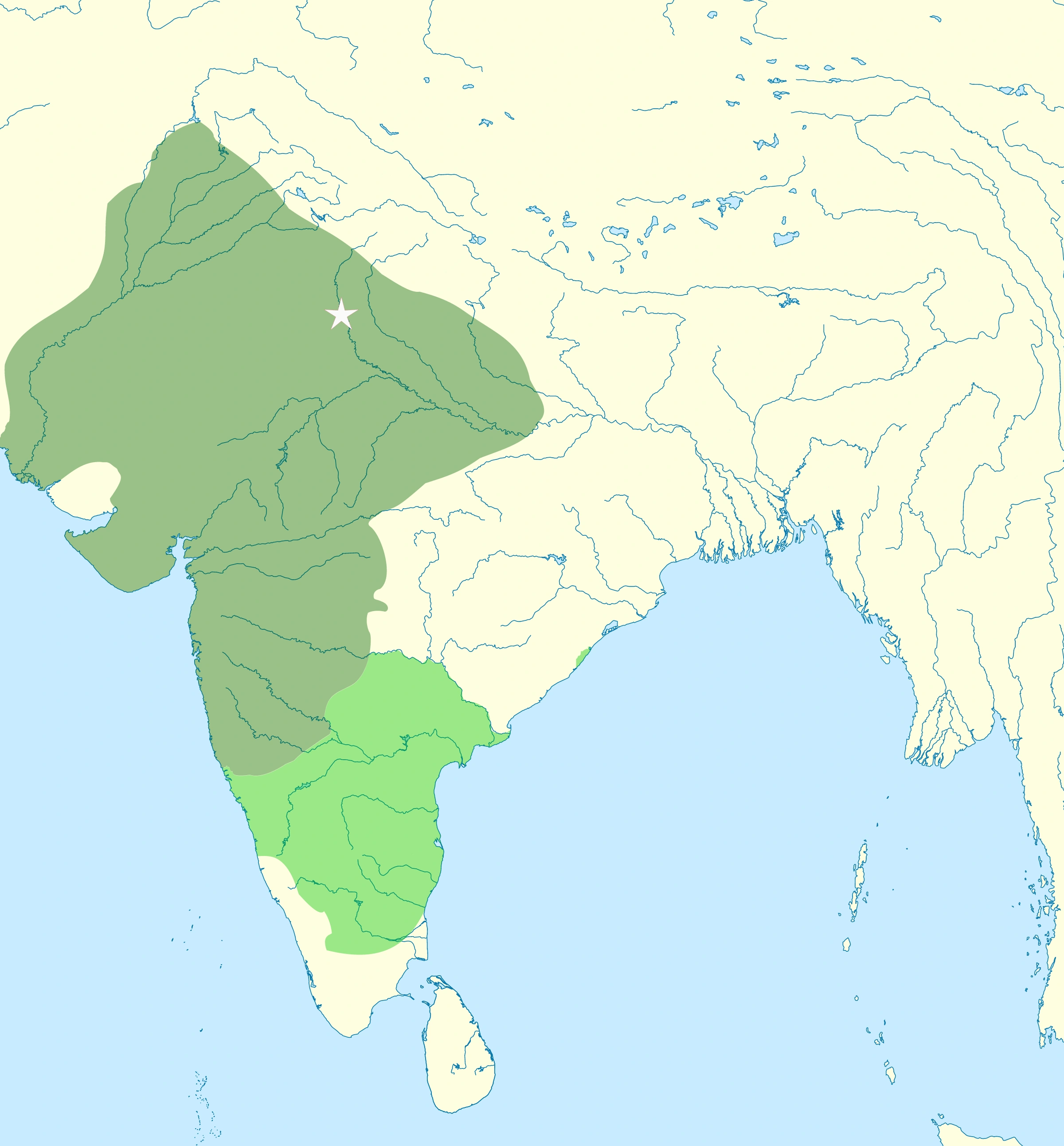
Map study
Delhi Sultanate under the Khaljis: compare the northern core with the Deccan campaign regions.
- Read the source date and legend before interpreting territorial extent.
- Compare core regions, neighbouring powers and geographic barriers; historical borders and influence are approximate and changed over time.
Credit: Utcursch; Uwe Dedering base map · CC BY-SA 4.0 · sourceConverted to WebP on an opaque white background; proportionally resized without cropping. Original cartography and legend retained.
1. Origins, accession and historical sources
The Khalji takeover of 1290 displaced the descendants of Balban and weakened the political monopoly of the established Turkish aristocracy. The Khaljis were of Turkic origin but had long been associated with Afghanistan. Contemporary elite prejudice sometimes treated them as outsiders to the dominant Turkish ruling group. The expression Khalji revolution therefore refers primarily to a change in the composition and accessibility of the ruling elite, not to a popular or democratic revolution.
Jalaluddin Firuz Khalji, who ruled from 1290 to 1296, preferred conciliation towards many opponents. His nephew and son-in-law Ali Gurshasp, the future Alauddin, was governor of Kara. In 1296, Alauddin raided Devagiri, the Yadava capital in the Deccan, before becoming sultan. The wealth obtained strengthened his political position. He subsequently murdered Jalaluddin at Kara and secured the throne of Delhi.
Important sources include Amir Khusrau’s Khazain-ul-Futuh and Ziauddin Barani’s Tarikh-i-Firuz Shahi. Khusrau was a contemporary associated with the court, while Barani wrote later and interpreted events through his own political and moral concerns. Their accounts should be read critically: courtly praise, elite interests and retrospective explanation shape their descriptions of conquest and administration.
- Dynastic sequence: Mamluks, Khaljis, Tughlaqs, Sayyids and Lodis.
- Distinguish contemporary evidence from later literary traditions when studying Khalji campaigns.
Timeline
1290
Jalaluddin Firuz Khalji establishes the Khalji dynasty.
1296
Alauddin raids Devagiri, murders Jalaluddin and becomes sultan.
1299–1305
Major campaigns secure Gujarat, Ranthambore, Chittor and Malwa; Mongol attacks continue.
1307–1311
Malik Kafur leads major campaigns into the Deccan and far south.
1316
Alauddin dies; succession struggles lead to Mubarak Shah’s accession.
1320
Mubarak Shah is overthrown; Khusrau Khan is subsequently defeated and Tughlaq rule begins.
2. Territorial expansion and resistance to the Mongols
Alauddin’s expansion first targeted strategically and economically important regions of northern and western India. Ulugh Khan and Nusrat Khan led the Gujarat campaign in 1299; its commercial wealth and access to maritime trade were important attractions. Malik Kafur entered Alauddin’s service following this campaign. Ranthambore fell in 1301, Chittor in 1303, and Malwa was conquered in 1305. These victories enlarged the Sultanate’s resource base and weakened powerful regional centres.
Southern campaigns must be distinguished from the direct annexation of northern territories. Alauddin’s raid on Devagiri in 1296 preceded his accession. Later, Malik Kafur campaigned against Devagiri in 1307–08, Warangal in 1309–10, Dwarasamudra in 1311 and the Pandya country in 1311. These expeditions generally sought treasure, tribute and acknowledgement of supremacy rather than immediate, uniform provincial administration. Devagiri experienced further intervention and tighter control in Alauddin’s final years.
Repeated Mongol attacks made frontier security and the defence of Delhi central concerns. Major confrontations included Kili in 1299, the attack on Delhi in 1303 and Amroha in 1305. Alauddin strengthened fortifications, developed Siri as a fortified centre and maintained a large army. His forces prevented the Mongols from establishing control over the Sultanate, although the invasions imposed heavy military and fiscal pressures.
- Chittor’s conquest is historical; the Padmini narrative is best known through Malik Muhammad Jayasi’s Padmavat, composed around 1540, long after the event.
- Do not equate Malik Kafur’s southern victories with the permanent annexation of all peninsular India.
Military and fiscal logic of Alauddin’s reforms
- 1. Mongol threats and expansion require a large army
- 2. Closer revenue assessment increases central resources
- 3. Cash salaries support centrally maintained troops
- 4. Price controls seek to preserve salary purchasing power
- 5. Horse branding, soldier records and intelligence reinforce supervision
3. Kingship, nobility and military organisation
Alauddin sought a highly centralised monarchy capable of suppressing rebellion and financing continuous warfare. Barani attributes to him the view that government should be guided by political necessity rather than requiring clerical approval for every measure. This indicates an assertion of royal discretion, not modern secularism or the separation of religion and the state.
To weaken conspiracies, Alauddin resumed numerous grants and revenue assignments, tightened intelligence gathering, and restricted elite drinking parties and social gatherings. Marriage alliances among nobles required royal permission. These measures targeted the wealth, communication and kinship networks through which powerful men could organise opposition. Intelligence officials and secret reporters supplied information to the ruler, while severe punishments reinforced compliance.
A large centrally maintained cavalry was essential against the Mongols and for expansion. Alauddin used dagh, the branding of horses, and chehra, descriptive records of soldiers, to check substitution and false musters. Cash payment made the purchasing power of soldiers’ salaries politically important. Military inspection, market control and revenue collection therefore formed interconnected elements of his state-building programme rather than isolated reforms.
- Dagh concerned horses; chehra concerned the identification of soldiers.
- Alauddin’s military system strengthened central supervision but did not abolish the iqta system.
| Term | Meaning | Examination relevance |
|---|---|---|
| Dagh | Branding of horses | Prevented substitution of inferior horses at inspection |
| Chehra | Descriptive rolls of soldiers | Checked false musters and impersonation |
| Diwan-i-riyasat | Office supervising market regulation | Associated with price and merchant controls |
| Shahna-i-mandi | Market-control official | Associated particularly with supervision of the grain market |
| Ghari and charai | House tax and grazing tax | Distinct from the principal land-revenue demand |
| Khalisa | Land whose revenue went to the central treasury | Not synonymous with all territory acknowledging the sultan’s supremacy |
4. Revenue reforms and market regulation
Alauddin expanded khalisa lands, whose revenues were reserved for the central treasury, and imposed closer assessment in the core territories, especially the Ganga–Yamuna Doab. Land measurement was used in assessment, and the state demand in the closely controlled area was fixed at approximately half the produce. This should not be assumed to have operated uniformly across every province or tributary kingdom. Ghari, a house tax, and charai, a grazing tax, were additional imposts.
The privileges of rural intermediaries such as khuts and muqaddams were curtailed. The regime sought to prevent them from shifting their liabilities onto ordinary cultivators or appropriating excessive resources. Closer control over revenue officials and collection increased the state’s access to agricultural surplus. Nevertheless, high demands and coercive enforcement placed substantial burdens on rural society; these measures should not be described simply as pro-peasant reforms.
Market regulations were concentrated in Delhi. Prices were fixed for grain and numerous other commodities, including cloth, livestock and horses. The diwan-i-riyasat supervised market arrangements, while the shahna-i-mandi was an important market-control official. Merchant registration, intelligence reports, checks on weights, and penalties for overcharging or concealment supported enforcement.
Grain collected as revenue in kind and supplies brought by merchants, including caravan traders, helped provision the capital. State granaries and regulated distribution during scarcity reduced pressure on prices. An important objective was to maintain soldiers at relatively modest cash salaries by controlling living costs. Barani reports considerable price stability, but historians must assess such claims alongside the coercion and administrative concentration required to sustain the system.
- Remember the functional chain: revenue surplus financed the army, while regulated prices supported soldiers’ purchasing power.
- Avoid projecting Delhi’s detailed price controls onto the entire subcontinent.
5. Architecture, succession and historical significance
Alauddin’s reign contributed significantly to Sultanate architecture. The Alai Darwaza, built in 1311 at the Qutb complex in Delhi, displays accomplished use of the true arch and dome, red sandstone, marble and geometric decoration. His proposed Alai Minar remained unfinished. Siri and the reservoir later known as Hauz Khas reflected the defensive and water-supply requirements of an expanding capital.
After Alauddin’s death in 1316, Malik Kafur briefly dominated the court through the child ruler Shihabuddin Umar. Qutbuddin Mubarak Shah subsequently ruled from 1316 to 1320 and relaxed several of Alauddin’s restrictive measures. Khusrau Khan overthrew him in 1320 but was defeated by Ghazi Malik, who assumed the title Ghiyasuddin Tughlaq. The rapid succession struggles exposed the fragility of institutions dependent on a powerful ruler.
The Khaljis substantially expanded the Sultanate’s political reach and demonstrated the potential of centralised fiscal and military organisation. Their legacy should be evaluated through both achievements and limitations: successful Mongol resistance and resource mobilisation coexisted with coercion, uneven territorial integration and unstable succession.
Real-world case studies
Warangal: tribute rather than immediate annexation
Malik Kafur’s expedition of 1309–10 compelled the Kakatiya ruler Prataparudra to submit and provide wealth and tribute. The local dynasty continued to govern. This illustrates the difference between extracting submission under Alauddin and the later Tughlaq conquest of Warangal in 1323.
Alai Darwaza: an architectural marker
The Alai Darwaza at Delhi’s Qutb complex was completed in 1311. Its true arches, dome and contrasting sandstone and marble make it an important example of early Indo-Islamic architectural development. It should not be confused with the nearby unfinished Alai Minar.
Previous year questions
No source-linked PYQ is available here yet. Use the practice questions below.
Practice questions
Practice MCQ 1
With reference to Alauddin Khalji’s administration, consider the following pairs: 1. Dagh: branding of horses; 2. Chehra: descriptive records of soldiers; 3. Charai: house tax. How many pairs are correctly matched?
- A. Only one
- B. Only two
- C. All three
- D. None
Practice MCQ 2
Which statement best describes Malik Kafur’s southern campaigns under Alauddin Khalji?
- A. They immediately replaced every southern dynasty with governors appointed from Delhi.
- B. They began only after the establishment of the Tughlaq dynasty.
- C. They generally secured wealth, tribute and submission without uniform direct annexation.
- D. They were directed exclusively against ports on the western coast.
Practice MCQ 3
Consider the following statements: 1. Alauddin’s detailed market regulations were centred on Delhi. 2. The Alai Darwaza was constructed during his reign. 3. Jayasi’s Padmavat is a contemporary account of the conquest of Chittor in 1303. Which statements are correct?
- A. 1 and 2 only
- B. 2 and 3 only
- C. 1 and 3 only
- D. 1, 2 and 3
Mains practice · Alauddin Khalji’s revenue, market and military reforms constituted an interconnected programme of centralisation. Discuss its objectives and limitations. Answer in 250 words.
- Introduce the pressures of Mongol invasions, expansion and aristocratic rebellion.
- Connect land-revenue assessment and central treasury resources with army expenditure.
- Explain how market regulation supported the purchasing power of cash salaries.
- Discuss dagh, chehra, intelligence and restrictions on noble networks.
- Identify coercion, rural burdens and the limited geographical reach of intensive controls.
- Conclude with the contrast between strong personal rule and fragile institutional continuity.
Further reading
- Satish Chandra, Medieval India, NCERT old syllabus textbook.
- Satish Chandra, History of Medieval India, Orient BlackSwan.
- NCERT, Our Pasts–II, chapter on the Delhi Sultans.
- Archaeological Survey of India: Qutb Minar and its monuments, Delhi.
- UNESCO World Heritage Centre: Qutb Minar and its Monuments, Delhi.
Preparing for UPSC Civil Services? Get classroom teaching, answer-writing evaluation and mentorship at Pragnya IAS Academy, Ashok Nagar — see why aspirants choose us for IAS coaching in Hyderabad.