
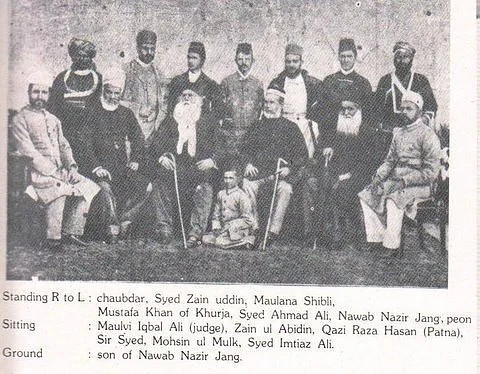
Figures associated with the Aligarh Movement, identified in the metadata as including Sir Syed Ahmad Khan and Zainul Abideen.
Credit: Unknown authorUnknown author · Public domain · sourceResized and converted to WebP; uncropped.
Historical setting and objectives
The Aligarh Movement emerged from the political and social changes accompanying the decline of Mughal authority and the consolidation of British rule. Sections of the Muslim service gentry and landed elite experienced declining influence, while English education increasingly determined access to administration and the professions. These changes affected regions and classes differently; Indian Muslims were not a uniformly disadvantaged or politically homogeneous community.
The Revolt of 1857 was a decisive turning point. Sir Syed, then serving in the East India Company’s judicial establishment, witnessed the violence and the deterioration of relations between British officials and Muslims in north India. He sought both to counter British suspicion and to persuade Muslims that acquiring modern knowledge was essential to their advancement.
His programme linked educational regeneration with social reform and accommodation with colonial authority. Rather than advocating an immediate struggle for political power, he prioritised English, science and institutional education. Aligarh therefore represented a reformist response to colonial modernity, not a movement for restoring Mughal rule.
- Core objectives: modern education, intellectual reform, social improvement and better relations with the colonial government.
- Initial social base: primarily north Indian Muslim ashraf, or socially prominent groups, including landed and service families.
- Historical significance: formation of an educated Muslim public and a durable network of schools, publications and associations.
Timeline
1817
Sir Syed Ahmad Khan was born in Delhi.
1858
Sir Syed wrote Asbab-e-Baghawat-e-Hind.
1864
Scientific Society founded at Ghazipur.
1866
Aligarh Institute Gazette began publication.
1870
Tahzib-ul-Akhlaq launched.
1875–1877
Aligarh school opened and developed into the Muhammadan Anglo-Oriental College.
1886
Muhammadan Educational Conference founded.
1898
Sir Syed died at Aligarh.
1920
Aligarh Muslim University established by legislation.
Sir Syed’s writings and institutional programme
Sir Syed’s Asbab-e-Baghawat-e-Hind, generally translated as The Causes of the Indian Revolt, was written in 1858. It examined administrative failures, exclusion of Indians from meaningful consultation and fears concerning religious interference. Although a loyalist, he did not regard British policy as beyond criticism. His approach combined criticism of governmental errors with advocacy of reconciliation.
The Scientific Society, founded at Ghazipur in 1864 and later moved to Aligarh, translated useful works into accessible languages, especially Urdu, and encouraged discussion of modern knowledge. Its early activities involved both Hindus and Muslims. The Aligarh Institute Gazette, begun in 1866, provided another channel for educational and public debate.
A visit to England in 1869–1870 strengthened Sir Syed’s interest in British collegiate education. He launched Tahzib-ul-Akhlaq in 1870 to encourage ethical improvement, reasoned discussion and criticism of restrictive social habits. The Muhammadan Anglo-Oriental school opened at Aligarh in 1875; the college phase followed in 1877, when Viceroy Lord Lytton laid its foundation stone.
The Muhammadan Educational Conference, founded in 1886, extended the educational campaign beyond Aligarh. Its annual meetings encouraged local initiatives and discussion of schooling. The college later became the institutional nucleus of Aligarh Muslim University, established by legislation in 1920; Sir Syed himself died in 1898.
- Examination distinction: 1875 marks the school’s opening, 1877 the college phase, and 1920 the establishment of AMU.
- The Scientific Society, Tahzib-ul-Akhlaq and the Educational Conference were distinct instruments of the same broad reform programme.
Logic of the Aligarh reform programme
- 1. Post-1857 insecurity and changing employment opportunities
- 2. Diagnosis of educational backwardness
- 3. Translation, journalism and rational discussion
- 4. Residential modern education with religious instruction
- 5. Expansion through educational associations
- 6. Emergence of educated professional and political networks
Religious interpretation, education and social reform
Sir Syed advocated a rational interpretation of Islam and maintained that genuine religious truth could not contradict the laws of nature. He encouraged the reinterpretation of inherited explanations when they conflicted with reason and scientific knowledge. His position challenged uncritical acceptance of customary authority and attracted opposition from sections of the religious establishment.
The educational model was not simply secularisation or imitation of Europe. The Muhammadan Anglo-Oriental College combined English-medium modern learning with Islamic instruction, residential discipline and attention to character formation. It sought to prepare students for university examinations, government employment and the professions while preserving a Muslim cultural identity.
Associates such as Mohsin-ul-Mulk and Viqar-ul-Mulk helped sustain the institutional programme. Writers including Altaf Husain Hali used literature to encourage moral regeneration and reflection on social decline. Shibli Nomani taught at Aligarh but retained an independent intellectual outlook; the movement contained differing views rather than a single fixed doctrine.
Its social reform was gradual and selective. Compared with its campaign for male higher education, early Aligarh gave limited priority to women’s institutional education. Sir Syed’s outlook remained shaped by elite household norms. Later reformers associated with Aligarh, notably Sheikh Abdullah and Waheed Jahan Begum, advanced girls’ education and opened a girls’ school there in 1906.
- Modern subjects included science, English and other branches of Western learning; religious instruction was retained.
- Rationalism did not mean rejection of Islam: the stated aim was reconciliation of faith and modern knowledge.
- Elite priorities and limited early reach among women and poorer communities qualified the movement’s reforming achievements.
| Institution or publication | Date | Primary function |
|---|---|---|
| Scientific Society | 1864 | Translation and dissemination of modern knowledge |
| Aligarh Institute Gazette | 1866 | Educational information and public discussion |
| Tahzib-ul-Akhlaq | 1870 | Social, ethical and intellectual reform |
| Muhammadan Anglo-Oriental College | 1877; school precursor in 1875 | Modern collegiate education with religious instruction |
| Muhammadan Educational Conference | 1886 | Expansion of educational awareness and institutions |
Political outlook and relations with other currents
Sir Syed’s political strategy emphasised loyalty to British rule and educational preparation before organised political agitation. He opposed Muslim participation in the Indian National Congress, founded in 1885. He feared that representative institutions based chiefly on numerical strength, operating amid educational inequalities, could disadvantage Muslims.
The Hindi–Urdu controversy of 1867 in the North-Western Provinces sharpened his concern about competing community interests. He defended Urdu and increasingly stressed safeguards for Muslims. However, his earlier cooperation with Hindus and statements of shared belonging show that his political thought evolved. It is misleading to reduce his entire career to an already completed demand for Pakistan.
Aligarh differed from the Deoband movement, whose seminary was founded in 1866. Aligarh prioritised Western-style education and accommodation with colonial rule, while Deoband concentrated on Islamic scholarship and religious-moral reform. This distinction should not be converted into a claim that all Deoband scholars later followed one political line or that all Aligarh graduates supported communal separatism.
Aligarh’s networks subsequently influenced Muslim political organisation, including the milieu in which the All-India Muslim League emerged in 1906. Nevertheless, the League was founded in Dacca after Sir Syed’s death, not by him. The educational movement, the Educational Conference and the Muslim League must be distinguished institutionally.
- Loyalism was a strategy of accommodation, not evidence that Sir Syed endorsed every colonial policy.
- Educational mobilisation helped create political networks, but later separatist outcomes were neither immediate nor inevitable.
Legacy and examination perspective
The movement’s most enduring achievement was institution-building. It widened access to modern higher education for sections of Indian Muslims, developed Urdu public discussion and encouraged engagement with science. Its residential college model produced teachers, administrators, writers and political figures whose views later ranged from nationalism to Muslim separatism.
Its limitations were equally significant: an initially narrow social base, reliance on elite patronage, caution toward mass politics and an uneven approach to gender reform. An assessment should therefore separate its educational modernism from its political conservatism, while recognising that both formed part of Sir Syed’s response to the insecurity of the post-1857 period.
- For Prelims, link institutions with dates, places and functions rather than treating every Aligarh initiative as a college.
- Do not confuse Sir Syed Ahmad Khan with Syed Ahmad Barelvi, associated with an earlier Islamic revivalist movement.
- For analytical answers, balance educational achievement with social limitations and the changing politics of community representation.
Aligarh: Educational Reform and Its Political Limits
The Aligarh Movement treated modern education as a means of improving the position of Indian Muslims under colonial rule. Sir Syed Ahmad Khan encouraged engagement with Western science, English education and rational inquiry while retaining Islamic religious instruction. The Muhammadan Anglo-Oriental College became its institutional centre. Translation, publication and public discussion complemented classroom teaching, showing that the movement sought intellectual renewal rather than merely the establishment of a college.
Its political orientation must be distinguished from its educational contribution. Sir Syed favoured cooperation with British authority and opposed participation in the early Indian National Congress, reflecting concerns about Muslim representation and the community’s educational position. The movement initially drew strongly on elite male networks, limiting its social reach. Its later significance for Muslim political identity should not be read as an inevitable progression towards Partition. The supplied metadata identifies a group associated with the movement, including Sir Syed and Zainul Abideen; it does not establish each person’s role, the occasion or the image’s date.
- Institutional distinction: the Muhammadan Anglo-Oriental College was the precursor of Aligarh Muslim University; the names are not interchangeable across periods.
- Reform distinction: Aligarh combined modern learning with religious instruction; it was neither simply secular education nor a rejection of Islam.
- Analytical distinction: educational modernisation, colonial loyalism and representative politics were related but separate dimensions; assess each rather than applying a single nationalist or communal label.
Real-world case studies
Scientific Society: knowledge through translation
Founded at Ghazipur in 1864, the Society addressed the language barrier separating many readers from modern scholarship. Translation and public discussion made knowledge dissemination an organised activity. Its early Hindu–Muslim cooperation also demonstrates why the movement’s educational beginnings should not be read solely through later communal politics.
Girls’ education at Aligarh
Sheikh Abdullah and Waheed Jahan Begum opened a girls’ school at Aligarh in 1906 despite social resistance. This initiative, which later developed into the institution now known as AMU’s Women’s College, illustrates both the early movement’s gender limitations and the subsequent expansion of its educational agenda.
Previous year questions
No source-linked PYQ is available here yet. Use the practice questions below.
Practice questions
Practice MCQ 1
Consider the following pairs: 1. Scientific Society — Translation and dissemination of modern knowledge; 2. Tahzib-ul-Akhlaq — Social and ethical reform; 3. Muhammadan Educational Conference — Organisation founded to demand Pakistan. How many pairs are correctly matched?
- A. Only one
- B. Only two
- C. All three
- D. None
Practice MCQ 2
Which of the following is the correct chronological order?
- A. Scientific Society → Tahzib-ul-Akhlaq → Muhammadan Educational Conference → Aligarh Muslim University
- B. Tahzib-ul-Akhlaq → Scientific Society → Aligarh Muslim University → Muhammadan Educational Conference
- C. Scientific Society → Muhammadan Educational Conference → Tahzib-ul-Akhlaq → Aligarh Muslim University
- D. Muhammadan Educational Conference → Scientific Society → Tahzib-ul-Akhlaq → Aligarh Muslim University
Practice MCQ 3
With reference to Sir Syed Ahmad Khan, consider the following statements: 1. He sought to reconcile Islamic belief with reason and modern science. 2. He supported participation in the Indian National Congress from its inception. 3. He founded the All-India Muslim League. Which of the statements given above is/are correct?
- A. 1 only
- B. 1 and 2 only
- C. 2 and 3 only
- D. 1, 2 and 3
Mains practice · The Aligarh Movement combined educational modernism with political conservatism. Discuss its achievements and limitations. Answer in 250 words.
- Introduce the post-1857 context and Sir Syed’s priorities.
- Explain the roles of the Scientific Society, Tahzib-ul-Akhlaq, MAO College and Educational Conference.
- Discuss reconciliation of religious belief with reason and scientific learning.
- Analyse loyalism, opposition to the early Congress and concerns about representation.
- Assess elite orientation and limitations in early women’s education.
- Conclude with its institutional legacy without treating later separatism as inevitable.
Further reading
- NCERT, Our Pasts–III, chapter Women, Caste and Reform.
- Bipan Chandra, History of Modern India, discussion of nineteenth-century social and religious reform.
- Aligarh Muslim University official website: university history and Sir Syed Ahmad Khan.
- India Code: Aligarh Muslim University Act, 1920.
- Sir Syed Ahmad Khan, The Causes of the Indian Revolt.
- https://commons.wikimedia.org/wiki/File:Aligarh_Movement.jpg
Preparing for UPSC Civil Services? Get classroom teaching, answer-writing evaluation and mentorship at Pragnya IAS Academy, Ashok Nagar — see why aspirants choose us for IAS coaching in Hyderabad.