
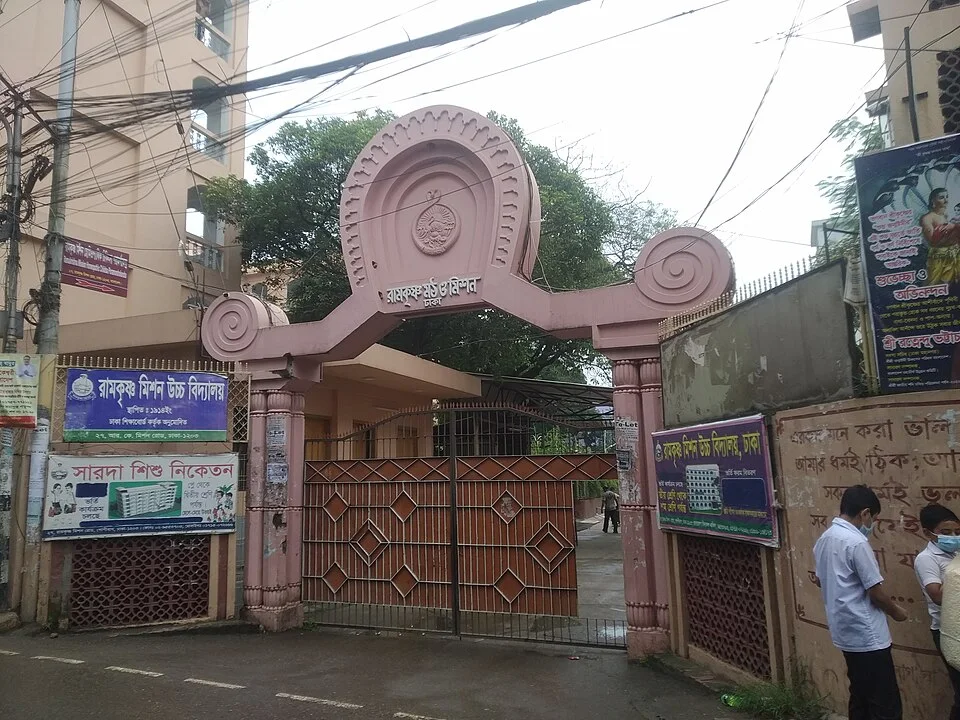
Ramakrishna Math and Ramakrishna Mission, Dhaka, Bangladesh, as identified in the source metadata.
Credit: Ifteebd10 · CC BY-SA 4.0 · sourceResized and converted to WebP; uncropped.
Historical setting and Sri Ramakrishna’s influence
The Ramakrishna movement emerged in nineteenth-century Bengal, where colonial rule, Western education, Christian missionary criticism and Indian intellectual debate encouraged reconsideration of inherited religious practices. Reform did not follow a single pattern. Some organisations challenged image worship and scriptural authority, while others sought renewal within existing traditions. The Ramakrishna movement belonged broadly to the latter tendency, but gave religious renewal a distinctive universalist and service-oriented expression.
Sri Ramakrishna, born Gadadhar Chattopadhyay in 1836 at Kamarpukur in Bengal, became associated with the Kali temple at Dakshineswar near Calcutta. His teaching emphasised direct spiritual experience rather than merely intellectual argument or ritual formalism. Drawing on his practice of different devotional and spiritual disciplines, including engagement with Islamic and Christian paths, he taught that different religions could lead towards the same ultimate reality.
His outlook is commonly expressed through the saying Jato mat, tato path, meaning as many faiths, so many paths. This did not imply that every religion had identical doctrines. It affirmed the possibility of spiritual realisation through diverse paths. Ramakrishna accepted image worship and devotion; therefore, he should not be confused with reformers who rejected these practices. He died at Cossipore in 1886.
Timeline
1836
Birth of Sri Ramakrishna at Kamarpukur in Bengal.
1863
Birth of Narendranath Datta, later Swami Vivekananda, in Calcutta.
1886
Death of Ramakrishna; his young disciples develop their monastic community at Baranagar.
11 September 1893
Vivekananda delivers his opening address at the World’s Parliament of Religions in Chicago.
1 May 1897
Vivekananda establishes the Ramakrishna Mission in Calcutta.
1898
Belur becomes the permanent institutional centre of the movement.
1909
The Ramakrishna Mission receives registration under the Societies Registration Act, 1860.
Vivekananda and the establishment of the Mission
Swami Vivekananda, born Narendranath Datta in Calcutta on 12 January 1863, became Ramakrishna’s leading interpreter before Indian and international audiences. After Ramakrishna’s death, his young disciples formed a monastic brotherhood centred initially at Baranagar. Vivekananda subsequently travelled widely through India. His encounters with poverty, social exclusion and the neglect of ordinary people helped shape his conviction that spiritual regeneration required material assistance and education.
At the World’s Parliament of Religions in Chicago in September 1893, Vivekananda presented Hindu religious thought in terms of tolerance, acceptance and the universality of spiritual aspiration. His addresses attracted international attention and strengthened his position as an interpreter of Vedanta. However, the Mission did not yet exist: the Chicago appearance preceded its foundation by nearly four years.
After returning to India, Vivekananda founded the Ramakrishna Mission on 1 May 1897. It provided an organised framework for spiritual teaching and public service involving monks and lay supporters. Belur became the permanent institutional centre in 1898. Vivekananda died there on 4 July 1902, but the organisation continued to expand under his brother disciples and successors. The Mission was formally registered in 1909 under the Societies Registration Act, 1860.
Practical Vedanta: from principle to service
- 1. Recognise the divinity inherent in human beings.
- 2. Regard service to others as a spiritual responsibility.
- 3. Organise monks and lay supporters for collective action.
- 4. Provide education, healthcare, relief and rehabilitation.
- 5. Pursue individual spiritual growth alongside social welfare.
Practical Vedanta and religious harmony
Vivekananda’s Practical Vedanta translated philosophical ideas into ethical and social duties. If divinity is present in every human being, helping others becomes more than charitable generosity: it becomes a form of spiritual discipline. The movement therefore connected personal liberation with the welfare of society. Its motto, Atmano mokshartham jagat hitaya cha, summarises these complementary objectives rather than treating renunciation and service as opposites.
Service to human beings as manifestations of the divine is central to this outlook. The associated idea of serving the living being as Shiva gives religious significance to caring for the sick, educating children and assisting disaster victims. Vivekananda stressed strength, self-confidence and character-building, while criticising social practices that weakened people or denied them dignity. His educational ideal was not simply the accumulation of information but the development of human capacities.
The movement recognised the disciplines of knowledge, devotion, action and meditation, usually described as jnana, bhakti, karma and raja yoga. It did not make rejection of images or rituals a condition of religious progress. Nor did its universalism require conversion to a new creed. For examination purposes, distinguish this acceptance of multiple spiritual paths from the Arya Samaj’s emphasis on Vedic authority and the Brahmo Samaj’s characteristic opposition to image worship.
| Organisation | Foundation and leading figure | Characteristic emphasis |
|---|---|---|
| Brahmo Sabha, later Brahmo Samaj | 1828; Raja Rammohan Roy | Monotheism, opposition to image worship and social reform. |
| Prarthana Samaj | 1867; Atmaram Pandurang | Theistic worship and social reform in western India; M. G. Ranade was a major leader. |
| Arya Samaj | 1875; Swami Dayanand Saraswati | Authority of the Vedas, rejection of image worship and religious-social reform. |
| Ramakrishna Mission | 1897; Swami Vivekananda | Practical Vedanta, harmony of religions and organised service. |
Organisation and fields of service
The Ramakrishna Math and Ramakrishna Mission are closely connected but legally separate bodies. The Math is a monastic institution, while the Mission is a registered society organised for religious, educational, medical and charitable activities. Their leadership overlaps, and both have their headquarters at Belur Math. Nevertheless, reducing the distinction to religion versus charity is misleading: both participate in spiritual teaching and service.
Education became a major field of activity through schools, colleges, hostels, libraries, vocational training and institutions serving disadvantaged communities. Medical work includes hospitals, dispensaries and outreach services. Relief and rehabilitation address famines, floods, cyclones, earthquakes and other emergencies. Rural and tribal welfare initiatives connect education and healthcare with local needs. These activities express the movement’s view that spiritual life should respond to concrete suffering.
Publishing and public lectures have also spread Vedantic ideas. Prabuddha Bharata, an English-language journal started in 1896 under Vivekananda’s inspiration, and Udbodhan, a Bengali journal begun in 1899, are important associated publications. The network developed branches outside India as well, helping circulate Vedanta internationally. Institutional service is intended to operate without discrimination based on religion or caste, and the organisation maintains a non-political character rather than functioning as a party or nationalist association.
Historical significance and examination distinctions
The Mission broadened the social meaning of organised monasticism by making sustained public service a central institutional responsibility. It combined continuity with Hindu spiritual traditions and adaptation to modern organisational methods, including registered societies, educational institutions, publications and coordinated relief. Its importance therefore lies not only in religious teaching but also in the institutionalisation of humanitarian work.
Vivekananda’s defence of Indian spiritual traditions contributed to cultural self-confidence under colonial rule. His emphasis on strength, national regeneration and the uplift of ordinary people influenced later public figures and nationalist thought. This influence should not be confused with direct political participation by the Mission. Cultural nationalism and organisational involvement in anti-colonial campaigns are separate historical questions.
The movement also illustrates the diversity of nineteenth-century reform. It did not primarily pursue reform through legislation or wholesale rejection of inherited worship. Instead, it emphasised spiritual reinterpretation, education and service. Sarada Devi, Ramakrishna’s wife and a revered spiritual guide, was important to the movement’s early community. The separate women’s monastic institution Sri Sarada Math was established much later, in 1954; it should not be projected backwards as an institution founded by Vivekananda in 1897.
Ramakrishna Mission: Practical Vedanta and Organised Service
The metadata identifies this photograph with the Ramakrishna Math and Ramakrishna Mission in Dhaka, Bangladesh. It is relevant to the movement’s institutional reach beyond present-day India, but it should not be presented as an Indian location or as evidence of the Dhaka centre’s founding date. The image metadata alone cannot establish the building’s age, architectural features or specific charitable activities.
Founded by Swami Vivekananda in 1897, the Ramakrishna Mission translated spiritual ideals into organised humanitarian work. Its understanding of practical Vedanta connected spiritual discipline with service to human beings, treating service as more than secular charity. Education, healthcare and relief became important expressions of this approach. Within modern Indian reform, the movement illustrates renewal through reinterpretation of religious traditions rather than their wholesale rejection. Its affirmation of different religious paths also distinguished religious pluralism from an insistence that all traditions must abandon their distinctive practices.
- Distinguish inspiration from organisation: Sri Ramakrishna supplied the central spiritual inspiration; Vivekananda founded the Mission and developed its programme of organised service.
- Distinguish Math from Mission: the Math is the monastic institution; the Mission organises religious, educational and humanitarian activities. They are closely associated but legally distinct bodies.
- For Mains, separate influence from formal politics: the movement contributed to cultural confidence and social service, but the Mission should not be classified as a political organisation of the nationalist movement.
Real-world case studies
Swami Akhandananda’s famine relief, 1897
During famine in the Mahula area of Murshidabad district, Bengal, Swami Akhandananda organised relief in 1897. Assistance to famine-affected people and subsequent care for orphaned children became an early example of the movement’s organised service. The work helped establish humanitarian activity as an enduring monastic responsibility.
Plague relief in Calcutta, 1899
During the Calcutta plague emergency, workers associated with the Mission, notably Swami Sadananda and Sister Nivedita, undertook sanitation, public-awareness and relief activities. The response illustrates how Vivekananda’s service ideal could support practical urban public-health work rather than remain confined to philosophical instruction.
Previous year questions
No source-linked PYQ is available here yet. Use the practice questions below.
Practice questions
Practice MCQ 1
Consider the following statements: 1. Sri Ramakrishna founded the Ramakrishna Mission in 1897. 2. Vivekananda’s Chicago address preceded the foundation of the Mission. 3. Belur Math is situated in present-day West Bengal. Which of the statements given above are correct?
- A. 1 and 2 only
- B. 2 and 3 only
- C. 1 and 3 only
- D. 1, 2 and 3
Practice MCQ 2
Which of the following best expresses Practical Vedanta as associated with Swami Vivekananda?
- A. Spiritual liberation requires withdrawal from every form of social service.
- B. Acceptance of the Vedas requires rejection of all devotional worship.
- C. Recognition of human divinity makes service to others a spiritual discipline.
- D. Religious harmony requires all communities to adopt identical rituals.
Practice MCQ 3
With reference to the Ramakrishna movement, consider the following statements: 1. The Math and Mission are legally distinct organisations. 2. The Mission was registered under the Societies Registration Act, 1860. 3. Rejection of image worship is a compulsory principle of the movement. Which of the statements given above are correct?
- A. 1 only
- B. 2 and 3 only
- C. 1 and 2 only
- D. 1, 2 and 3
Mains practice · How did the Ramakrishna Mission combine religious renewal with organised social service? Explain its significance in colonial India. Answer in 150 words.
- Introduce Vivekananda’s foundation of the Mission in 1897 and Ramakrishna’s spiritual influence.
- Explain Practical Vedanta, inherent human divinity and service as spiritual discipline.
- Connect religious harmony with acceptance of diverse paths rather than identical doctrines.
- Illustrate service through education, healthcare, famine relief and plague relief.
- Assess cultural self-confidence and social responsibility while distinguishing these from direct political activism.
Further reading
- Ramakrishna Math and Ramakrishna Mission official website, belurmath.org: history, ideology, activities and annual reports.
- The Complete Works of Swami Vivekananda, Advaita Ashrama: Addresses at the Parliament of Religions, Practical Vedanta and Lectures from Colombo to Almora.
- NCERT, Themes in Indian History, Part III: colonial society and historical context.
- Bipan Chandra, History of Modern India: nineteenth-century religious and social reform.
- https://commons.wikimedia.org/wiki/File:Ramakrishna_Math_Dhaka.jpg
Preparing for UPSC Civil Services? Get classroom teaching, answer-writing evaluation and mentorship at Pragnya IAS Academy, Ashok Nagar — see why aspirants choose us for IAS coaching in Hyderabad.