
Map study
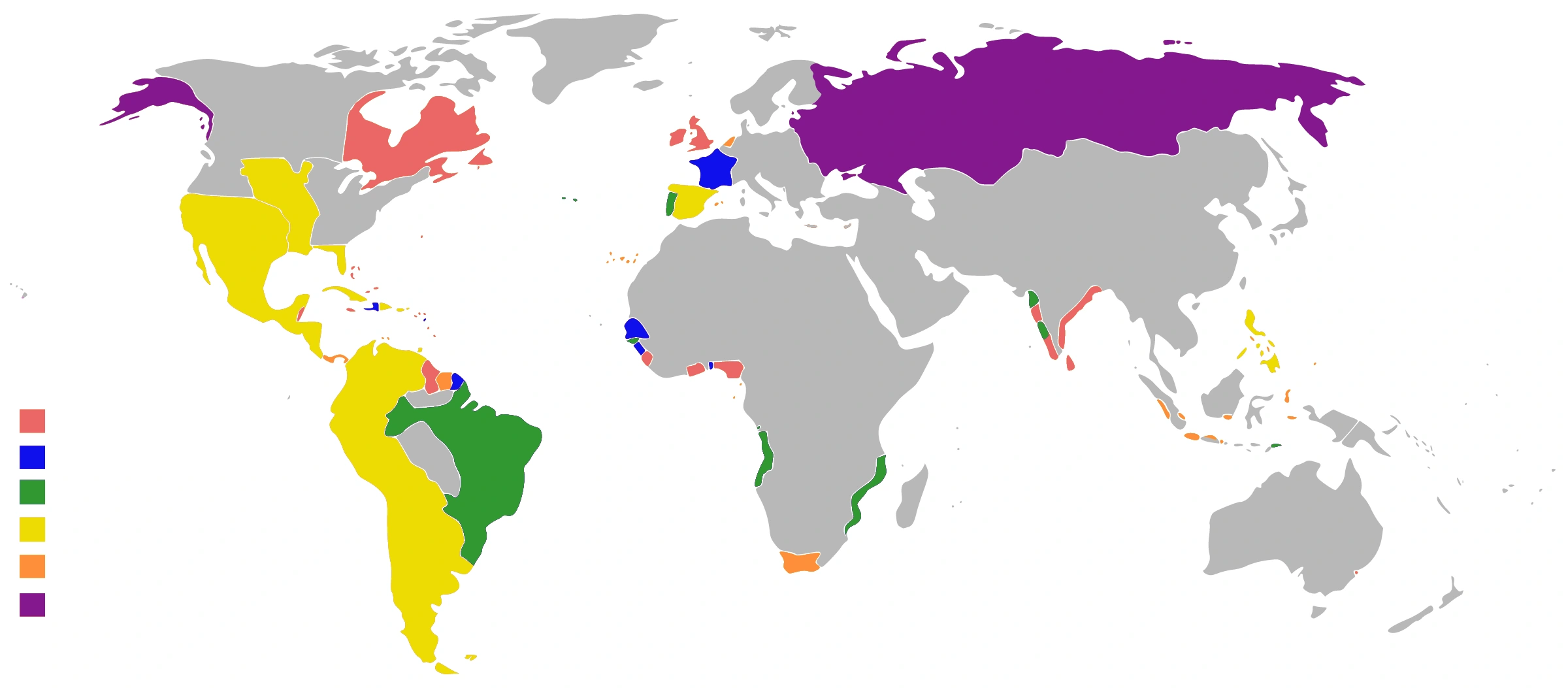
Colonial empires in 1800: global context for European expansion. A date-specific map, not the maximum territorial extent of every colonial power.
- Read the legend and reference date before interpreting regional patterns.
- Relate the map to the article’s topic; verify current administrative boundaries or data separately.
Credit: George Tsiagalakis · CC BY-SA 4.0 · sourceConverted to WebP on an opaque white background; proportionally resized without cropping. Original cartography and legend retained.
Background: commerce, regional politics and European war
English and French companies competed for Indian textiles, overseas markets and access to ports. Madras, Bombay and Calcutta were important English bases, while Pondicherry was the main French headquarters in India. Both companies maintained fortified settlements, armed ships and troops. Consequently, commercial rivalry could become military conflict whenever European relations deteriorated or opportunities emerged within Indian politics.
The weakening of Mughal central authority after Aurangzeb’s death in 1707 created a political setting in which provincial rulers exercised increasing autonomy. Hyderabad emerged under Nizam-ul-Mulk Asaf Jah, while the nawab of the Carnatic, based at Arcot, was formally subordinate to Hyderabad. Neither region was a political vacuum: Indian rulers, bankers, merchants and military groups actively negotiated alliances with European companies.
The Coromandel Coast became the main theatre because Madras and Pondicherry were close to one another and connected to valuable textile-producing hinterlands. European companies initially sought trading advantages, but protecting commerce increasingly involved controlling forts, securing revenue assignments and influencing rulers. The Carnatic Wars therefore combined European conflicts with regional succession struggles rather than constituting a simple, continuous war of conquest.
- Three interacting levels: European interstate rivalry, competition between trading companies, and conflicts among Indian political claimants.
- Geographical distinction: the Carnatic was a southeastern political region; Hyderabad represented the larger Deccan power above it.
Timeline
1746
French capture of Madras and defeat of the nawab’s forces near the Adyar.
1748
Treaty of Aix-la-Chapelle ends the First Carnatic War; Nizam-ul-Mulk dies.
1749
Battle of Ambur strengthens the French-backed claimants.
1751–1754
Clive captures and defends Arcot; Dupleix is recalled in 1754.
1760–1761
French defeat at Wandiwash is followed by Pondicherry’s surrender.
1763
Treaty of Paris confirms the end of the principal Anglo-French territorial contest in India.
First Carnatic War, 1746–1748
The First Carnatic War was an Indian extension of the War of the Austrian Succession in Europe. In 1746, a French expedition commanded by La Bourdonnais captured Madras from the English. His disagreement with Dupleix, governor-general of the French establishments in India, over the settlement of the captured town exposed divisions within French leadership. The English nevertheless retained their nearby base at Fort St David.
Anwar-ud-din, nawab of the Carnatic, opposed French possession of Madras. At the Battle of Adyar, associated with St Thomé, a relatively small French-led force defeated the nawab’s much larger army. The encounter demonstrated the battlefield value of disciplined infantry, coordinated firepower and effective command. Its significance should not be exaggerated into a claim that all Indian armies were inherently inferior; organisation, circumstances and leadership mattered.
The Treaty of Aix-la-Chapelle ended the European war in 1748, and Madras was restored to the English. Thus, the first war produced no lasting territorial victory in India. Its deeper consequence was political: European companies recognised that their military forces could influence regional affairs, while Indian contenders increasingly saw company troops as useful allies.
- Immediate trigger: Anglo-French hostilities arising from a European war.
- Exam distinction: La Bourdonnais captured Madras; Dupleix directed the wider French political strategy.
From commercial competition to political intervention
- 1. Competition for ports and textile trade
- 2. Fortification and recruitment of troops
- 3. Alliance with rival Indian claimants
- 4. Military assistance exchanged for revenue and influence
- 5. Sustained warfare tests finance and maritime support
- 6. English predominance over the French
Second Carnatic War, 1749–1754
The Second Carnatic War arose chiefly from succession disputes in Hyderabad and the Carnatic. After Nizam-ul-Mulk’s death in 1748, Nasir Jang and Muzaffar Jang contested Hyderabad. In the Carnatic, Chanda Sahib challenged Anwar-ud-din. Dupleix supported Muzaffar Jang and Chanda Sahib, while the English supported Nasir Jang and subsequently Muhammad Ali, Anwar-ud-din’s son.
At Ambur in 1749, the French-backed coalition defeated and killed Anwar-ud-din. Muhammad Ali withdrew to Trichinopoly, now Tiruchirappalli. After successive changes in Hyderabad, French influence strengthened under Salabat Jang, supported by the French commander Bussy. Bussy secured revenue assignments in the Northern Circars to sustain French troops. These arrangements illustrated how military assistance could be exchanged for income and political leverage.
In 1751, Robert Clive captured Arcot, diverting attention from the struggle around Trichinopoly. His defence of Arcot enhanced English prestige and weakened the French-backed coalition. Chanda Sahib was captured and killed in 1752, while Muhammad Ali’s position improved. The French government and company authorities, concerned about expenditure and uncertain commercial returns, recalled Dupleix in 1754. His successor, Godeheu, negotiated a settlement with the English.
The settlement attempted to restrain intervention in Indian political disputes. It did not immediately eliminate French influence, particularly in Hyderabad, but Dupleix’s ambitious strategy suffered a decisive setback. The episode established intervention in succession disputes, deployment of sepoys and acquisition of revenue rights as important instruments of company expansion.
- French alignment: Muzaffar Jang and Chanda Sahib; later, Bussy sustained Salabat Jang.
- English alignment: Nasir Jang and Muhammad Ali; Clive’s Arcot operation was the major turning point.
| War | Main context | Key development | Settlement |
|---|---|---|---|
| First, 1746–1748 | War of the Austrian Succession | French capture of Madras | Aix-la-Chapelle; Madras restored |
| Second, 1749–1754 | Hyderabad and Carnatic succession disputes | Ambur and Clive’s Arcot campaign | Godeheu’s settlement with the English |
| Third, 1756–1763 | Seven Years’ War | Wandiwash and fall of Pondicherry | Paris; French commercial presence survives |
Third Carnatic War, 1756–1763
The Third Carnatic War formed part of the global Seven Years’ War. Fighting was not confined to the Carnatic: the English captured the French settlement of Chandernagore in Bengal in 1757. In southern India, Count de Lally arrived in 1758 and captured Fort St David. However, his campaign suffered from financial shortages, strained relations with other French officials and unreliable naval support.
Lally recalled Bussy from Hyderabad to strengthen operations in the Carnatic. This weakened the French position in the Deccan. His siege of Madras in 1758–1759 failed, while English operations also undermined French influence along the eastern coast. British maritime strength helped protect communications and supplies; French fleets could not provide equally sustained support.
The decisive land battle occurred at Wandiwash, now Vandavasi in Tamil Nadu, on 22 January 1760. Sir Eyre Coote defeated Lally’s army, and Bussy was captured. Pondicherry surrendered to the English in January 1761. The Treaty of Paris in 1763 restored French trading establishments under restrictions on their military and political role. France remained commercially present, but its attempt to rival the English as a major territorial power in India had failed.
- Wandiwash was the decisive battlefield defeat; Pondicherry’s fall dismantled the principal French base.
- The 1763 settlement did not expel every French settlement from India.
Why the English prevailed and why the rivalry mattered
English success resulted from interacting advantages rather than one battle alone. British naval power supported troop movements, supplies and communication across widely separated settlements. The English company’s broader commercial resources and access to credit helped sustain campaigns. Its position improved further after Plassey in 1757, when influence in Bengal opened access to substantial wealth. However, the formal grant of Bengal’s diwani came only in 1765, after the Carnatic Wars.
Both companies possessed monopolies, depended on governments and used Indian soldiers and finance. Nevertheless, the French company was more vulnerable to metropolitan financial difficulties and inconsistent state support. Disagreements among Dupleix, La Bourdonnais, Lally and naval commanders weakened coordination at critical moments. English leaders also proved effective at exploiting regional alliances and French strategic mistakes.
The rivalry accelerated the transition from coastal trade to territorial politics. It demonstrated the usefulness of sepoy armies trained in European drill and the importance of revenues for maintaining them. Yet British dominance over India was not completed in 1763: Mysore, the Marathas and other Indian powers continued to resist expansion. The correct conclusion is narrower: the French ceased to be the leading European obstacle to English ascendancy.
- Avoid monocausal explanations: sea power, finance, alliances, leadership and global priorities worked together.
- Distinguish outcomes: French political defeat did not mean immediate British conquest of the entire subcontinent.
Real-world case studies
Arcot, 1751: an indirect military strategy
Clive attacked the Carnatic capital instead of concentrating solely on relieving Trichinopoly. Holding Arcot forced his opponents to redirect military effort and strengthened English prestige among potential allies. The episode shows how a limited operation could reshape a wider succession struggle.
Bussy in Hyderabad: troops supported by assigned revenues
Bussy maintained French influence at Salabat Jang’s court and obtained Northern Circars revenue assignments for troop maintenance. His recall in 1758 exposed the tension between preserving political influence in the Deccan and concentrating forces against Madras.
Previous year questions
No source-linked PYQ is available here yet. Use the practice questions below.
Practice questions
Practice MCQ 1
Which treaty provided for the restoration of Madras to the English after the First Carnatic War?
- A. Treaty of Paris
- B. Treaty of Aix-la-Chapelle
- C. Treaty of Allahabad
- D. Treaty of Salbai
Practice MCQ 2
Consider these statements: 1. Dupleix supported Chanda Sahib in the Carnatic succession struggle. 2. Bussy strengthened French influence in Hyderabad. 3. Bengal’s diwani financed the English victory at Wandiwash. Which statements are correct?
- A. 1 and 2 only
- B. 2 and 3 only
- C. 1 and 3 only
- D. 1, 2 and 3
Practice MCQ 3
Which sequence is chronologically correct?
- A. Ambur → Arcot campaign → Wandiwash → Fall of Pondicherry
- B. Arcot campaign → Ambur → Fall of Pondicherry → Wandiwash
- C. Ambur → Wandiwash → Arcot campaign → Fall of Pondicherry
- D. Wandiwash → Ambur → Arcot campaign → Fall of Pondicherry
Mains practice · Anglo-French rivalry in India was shaped as much by Indian regional politics as by European conflicts. Discuss with reference to the Carnatic Wars. Answer in 250 words.
- Connect the First and Third Wars to European and global conflicts.
- Explain the Hyderabad and Carnatic succession disputes underlying the Second War.
- Assess Indian agency through alliances, revenue assignments and military cooperation.
- Examine naval power, finance and strategic coordination.
- Conclude by distinguishing French political defeat from complete British conquest.
Further reading
- Bipan Chandra, History of Modern India, discussion of European penetration and British conquest.
- NCERT, Our Pasts–III, chapter From Trade to Territory.
- A History of Modern India, edited by Ishita Banerjee-Dube, discussion of eighteenth-century company expansion.
- Government of Puducherry official portal: history of Puducherry.
Preparing for UPSC Civil Services? Get classroom teaching, answer-writing evaluation and mentorship at Pragnya IAS Academy, Ashok Nagar — see why aspirants choose us for IAS coaching in Hyderabad.