
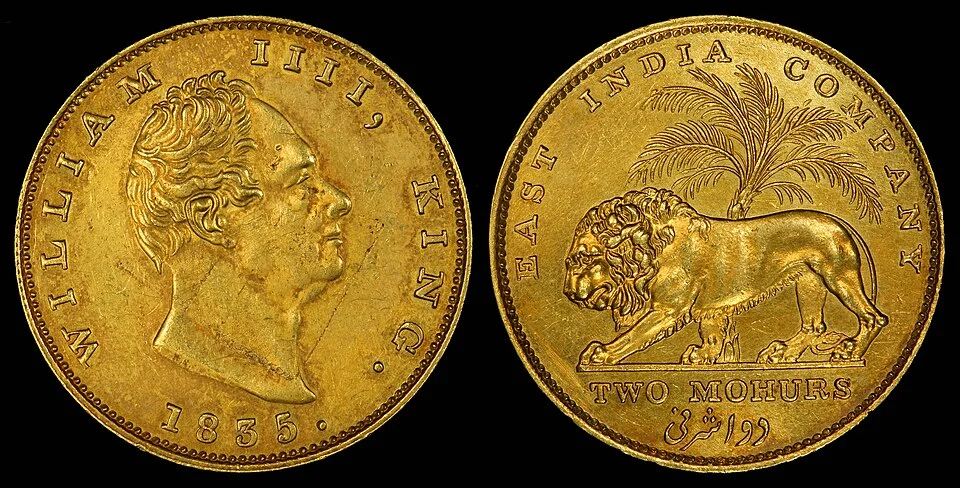
British India two-mohur gold coin, 1835, described as depicting William IV; an illustration of Company-era coinage.
Credit: National Museum of American History · Public domain · sourceResized and converted to WebP; uncropped.
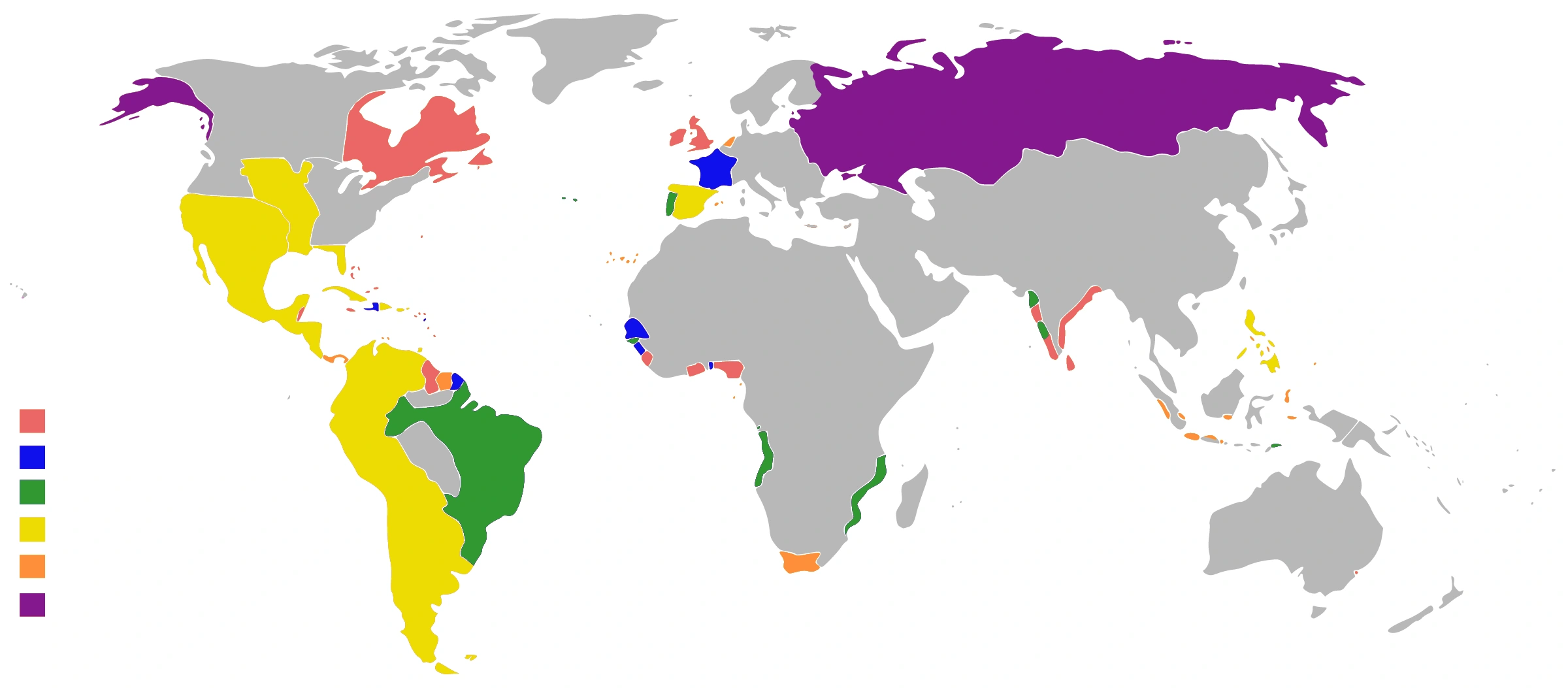
Map study
Colonial empires in 1800: global context for European expansion. A date-specific map, not the maximum territorial extent of every colonial power.
- Read the legend and reference date before interpreting regional patterns.
- Relate the map to the article’s topic; verify current administrative boundaries or data separately.
Credit: George Tsiagalakis · CC BY-SA 4.0 · sourceConverted to WebP on an opaque white background; proportionally resized without cropping. Original cartography and legend retained.
1. Foundation, corporate character and early trade
The East India Company was founded during European competition for Asian spices, textiles and other valuable commodities. Elizabeth I’s charter of 31 December 1600 granted English merchants an exclusive English trading privilege in a vast eastern trading zone. This was not a grant of sovereignty over Indian territory. The enterprise initially financed individual voyages and subsequently developed a more durable joint-stock structure, pooling capital and distributing commercial risks among investors.
In London, shareholders participated through the Court of Proprietors, while the Court of Directors managed Company affairs. Overseas, a factory meant a trading establishment containing warehouses, offices and residences, not an industrial manufacturing unit. Company servants called factors purchased goods, negotiated with merchants and maintained accounts. Indian brokers, bankers, artisans and shipowners were indispensable to these operations.
The Company initially pursued the spice trade but increasingly concentrated on Indian cotton textiles, silk, indigo and saltpetre. It paid substantially in imported bullion before territorial revenues altered this pattern. England’s financial and political rivalries also affected the corporation: a competing English company received a charter in 1698, and the two enterprises were united in 1709 as the United Company of Merchants of England Trading to the East Indies.
- A royal charter authorised English commerce; Indian rulers’ permissions enabled local trading privileges.
- Do not confuse the English East India Company with the Dutch VOC, founded in 1602, or the French East India Company, founded in 1664.
Timeline
1600
Elizabeth I grants the Company its founding charter.
1612–1613
Victory near Swally is followed by the establishment of the Surat factory.
1717
Farrukhsiyar issues a farman expanding Company privileges.
1757–1765
Plassey, Buxar and the Diwani grant establish the foundations of Company power in Bengal.
1773–1784
The Regulating Act and Pitt’s India Act establish parliamentary supervision.
1813–1833
Successive Charter Acts remove commercial monopolies and end Company trading.
1858–1874
Government passes to the Crown in 1858; the Company is dissolved in 1874.
2. Trading settlements and European rivalry
William Hawkins reached Jahangir’s court in 1609 but failed to secure a lasting commercial settlement. The English naval victory over the Portuguese near Swally, or Suvali, in 1612 helped strengthen their position, and a factory was established at Surat in 1613. Sir Thomas Roe’s embassy to Jahangir, from 1615 to 1619, improved commercial relations. These developments occurred within Mughal sovereignty, not through an English conquest of the empire.
The Company gradually built three principal coastal centres. Madras developed after the acquisition of local rights in 1639, followed by Fort St George. Bombay passed to the English Crown as part of Catherine of Braganza’s marriage dowry in 1661 and was leased to the Company in 1668. In Bengal, Job Charnock established a Company settlement at Sutanuti in 1690; rights over Sutanuti, Kalikata and Govindpur were acquired in 1698. Calling him the sole founder of Kolkata overlooks earlier settlements.
Farrukhsiyar’s farman of 1717 expanded important Company privileges, notably facilitating its Bengal trade against a fixed annual payment. Disputes over duty-free passes, or dastaks, later became central to conflict with Bengal’s nawabs. The Carnatic Wars of 1746–1763 linked European warfare with Indian succession disputes. The English victory at Wandiwash in 1760 and the Treaty of Paris in 1763 curtailed French political ambitions without eliminating French trading settlements.
From trading corporation to territorial state
- 1. Royal charter and pooled merchant capital
- 2. Indian trading permissions and coastal factories
- 3. Fortifications, armed forces and political alliances
- 4. Military victories and installation of dependent rulers
- 5. Acquisition of revenue rights and territorial resources
- 6. Revenue-financed expansion and administrative consolidation
- 7. Parliamentary supervision followed by Crown takeover
3. Bengal and the transition to territorial power
Bengal offered productive agriculture, major textile industries and substantial revenue resources. Siraj-ud-Daulah opposed unauthorised Company fortification and abuses of commercial privileges. At Plassey on 23 June 1757, Robert Clive defeated him through a combination of military action and conspiracy involving Mir Jafar and other influential interests. Plassey was decisive politically, but it was not a straightforward conquest of all Bengal.
Mir Jafar’s dependence and the Company’s financial demands destabilised the nawabi. Mir Qasim, installed in 1760, attempted administrative and military reforms and challenged unequal trading privileges. At Buxar on 22 October 1764, Company forces under Hector Munro defeated the combined forces of Mir Qasim, Shuja-ud-Daulah of Awadh and Mughal emperor Shah Alam II. Buxar demonstrated military superiority more directly than Plassey and strengthened the Company’s bargaining position.
Under the 1765 Allahabad settlement, Shah Alam II granted the Company the Diwani of Bengal, Bihar and Orissa. The historical designation Orissa here should not be equated mechanically with all of present-day Odisha. In the resulting dual government, the Company controlled revenue while the nawab nominally retained the Nizamat, including policing and criminal justice. Power became detached from clear administrative responsibility. Warren Hastings ended this arrangement in 1772.
- Plassey: political intervention and installation of a dependent nawab.
- Buxar: decisive defeat of a broader regional coalition.
- Diwani: a legal-fiscal foundation for territorial government.
| Measure | Principal change | Common examination trap |
|---|---|---|
| Regulating Act, 1773 | Governor-General of Bengal and provision for a Supreme Court at Calcutta | Did not create the Governor-General of India |
| Pitt’s India Act, 1784 | Board of Control supervises political affairs | Dual control was not Bengal’s dual government |
| Charter Act, 1813 | Most Indian trade opened to other British merchants | Tea and China trade monopolies remained |
| Charter Act, 1833 | Company commerce ended; Governor-General of India created | Company territorial government continued |
| Government of India Act, 1858 | Indian government transferred to the Crown | Corporate dissolution occurred only in 1874 |
4. Expansion and the revenue–military system
Access to Bengal’s revenues transformed the Company’s finances. It could purchase Indian exports and maintain armies using resources raised within India, reducing dependence on imported bullion. Its forces combined European officers and soldiers with much larger numbers of Indian sepoys. Military organisation, credit networks, diplomacy and divisions among Indian powers together explain expansion; European weapons alone do not.
Expansion involved both warfare and indirect control. Four Anglo-Mysore Wars culminated in Tipu Sultan’s death at Seringapatam in 1799. Three Anglo-Maratha Wars ended in 1818 with the defeat of the Peshwa and extensive Company predominance. Sind was annexed in 1843 and Punjab in 1849. These campaigns were neither inevitable nor uniformly successful: Indian states repeatedly resisted and sometimes defeated Company armies.
Lord Wellesley systematically extended subsidiary alliances: rulers accepted Company troops, paid for their maintenance or ceded territory, and surrendered substantial freedom in external affairs. Hyderabad entered such an arrangement in 1798. Under Dalhousie, the Doctrine of Lapse denied recognition to certain adopted heirs for succession to dependent states, facilitating annexations such as Satara, Jhansi and Nagpur. Awadh, however, was annexed in 1856 on the stated ground of misgovernment, not lapse. Revenue settlements, courts and a growing bureaucracy consolidated control after conquest.
5. Parliamentary regulation and the end of Company rule
Company financial difficulties, accusations of corruption and the consequences of territorial government prompted parliamentary intervention. The Regulating Act of 1773 created the Governor-General of Bengal with a council and provided for a Supreme Court at Calcutta, established in 1774. Warren Hastings became the first Governor-General of Bengal. The Act represented an initial supervisory framework, not a complete transfer to Crown government.
Pitt’s India Act of 1784 created a Board of Control to supervise political affairs while retaining the Court of Directors. This arrangement is often called dual control; it must be distinguished from Bengal’s dual government of 1765–1772. The Charter Act of 1813 ended the Company’s monopoly over most Indian trade but retained its tea trade and trade with China. The Charter Act of 1833 ended its remaining commercial functions and made the Governor-General of Bengal the Governor-General of India, first held by William Bentinck.
The Charter Act of 1853 separated legislative and executive functions of the Governor-General’s council and opened the way for competitive civil-service recruitment. Following the Revolt of 1857, the Government of India Act of 1858 transferred Indian government to the Crown. A Secretary of State for India, assisted by a council, replaced the Company’s governing machinery. Queen Victoria’s proclamation followed on 1 November 1858. The corporation survived formally until its dissolution in 1874.
- Distinguish commercial monopoly, territorial administration and corporate existence: they ended at different dates.
Company Coinage and Territorial Authority
The metadata identifies this object as a British India two-mohur coin dated 1835 and depicting William IV. It is directly relevant to the East India Company because it belongs to the period when the Company governed extensive Indian territories, before the transfer of government to the Crown in 1858. Coinage connects the Company's commercial origins with its exercise of territorial authority: governing involved not only armies and revenue collection but also regulating the monetary framework through which taxes, salaries and trade were settled.
The coin belongs to the context of the 1835 coinage reforms, which advanced a uniform monetary system across Company territories. A British monarch's portrait on Company-era currency should not be mistaken for evidence that direct Crown government had already begun. The Company operated under growing parliamentary supervision while retaining its Indian administrative role. This is an Indian monetary example, not a foreign comparative artefact. However, the supplied metadata alone cannot establish the coin's mint, circulation history, production volume or everyday purchasing power. Nor does a gold denomination demonstrate that gold was the principal medium used in ordinary transactions.
- Mohur denotes a gold denomination; distinguish it from the silver rupee when studying Company monetary policy.
- For Prelims, separate royal representation on currency from constitutional control: Company government preceded direct Crown rule.
- For Mains, link monetary standardisation with fiscal administration and market integration, without assuming that legislation immediately eliminated regional monetary diversity.
Real-world case studies
Bengal famine of 1770: responsibility under dual government
The famine devastated Bengal during the Company’s dual-government period. Crop failures interacted with poverty, disrupted markets and an extractive revenue system. Its enormous mortality exposed the weaknesses of a structure in which the Company commanded fiscal resources without accepting clear responsibility for welfare. Precise death estimates remain uncertain. The crisis is important for understanding the move towards direct revenue administration in 1772.
Hyderabad: subsidiary alliance and indirect rule
In 1798, under Wellesley, the Nizam accepted a subsidiary arrangement and dismissed his French-trained corps. A further treaty in 1800 involved territorial cessions to support the subsidiary force. Hyderabad retained its ruler but lost substantial strategic autonomy. The example shows that Company expansion included subordinating states without formally annexing them.
Previous year questions
No source-linked PYQ is available here yet. Use the practice questions below.
Practice questions
Practice MCQ 1
Consider the following statements: 1. The Charter Act of 1813 ended the Company’s monopoly over trade with China. 2. The Charter Act of 1833 ended the Company’s commercial activities. 3. The Government of India Act of 1858 immediately dissolved the Company as a corporation. Which of the statements given above is/are correct?
- A. 1 and 2 only
- B. 2 only
- C. 2 and 3 only
- D. 1, 2 and 3
Practice MCQ 2
Which one of the following correctly distinguishes Plassey from Buxar?
- A. Plassey defeated a coalition led by Shah Alam II, while Buxar defeated Siraj-ud-Daulah.
- B. Plassey established Company political influence in Bengal, while Buxar strengthened the military position preceding the Diwani grant.
- C. Plassey immediately transferred Indian government to the Crown, while Buxar restored Company rule.
- D. Plassey ended French power in the Carnatic, while Buxar ended Portuguese power at Surat.
Practice MCQ 3
Consider the following pairs: 1. Bombay — Leased to the Company by the English Crown in 1668 2. Awadh — Annexed through the Doctrine of Lapse in 1856 3. Hyderabad — Subsidiary alliance under Wellesley in 1798. How many pairs are correctly matched?
- A. Only one
- B. Only two
- C. All three
- D. None
Mains practice · The East India Company’s transformation from merchant corporation to territorial power rested on the interaction of commerce, revenue and military force. Examine. Answer in 250 words.
- Introduce the contrast between the 1600 trading charter and the 1765 Diwani grant.
- Explain factories, Indian commercial intermediaries and imperial trading privileges.
- Assess European rivalry, Indian succession politics and Company alliances.
- Distinguish the contributions of Plassey, Buxar and Diwani.
- Show how Indian revenue financed export purchases, armies and further expansion.
- Discuss subsidiary alliances, annexations and administrative consolidation.
- Conclude with the contradiction between private corporate interests and public government, leading to parliamentary control and the 1858 transfer.
Further reading
- NCERT, Our Pasts–III: From Trade to Territory and Ruling the Countryside.
- NCERT, Themes in Indian History, Part III: Colonialism and the Countryside; Rebels and the Raj.
- Bipan Chandra, History of Modern India.
- UK Parliament website: historical resources on the East India Company and parliamentary regulation.
- British Library, India Office Records: sources on Company administration and commerce.
- https://commons.wikimedia.org/wiki/File:India_1835_2_Mohurs.jpg
Preparing for UPSC Civil Services? Get classroom teaching, answer-writing evaluation and mentorship at Pragnya IAS Academy, Ashok Nagar — see why aspirants choose us for IAS coaching in Hyderabad.