
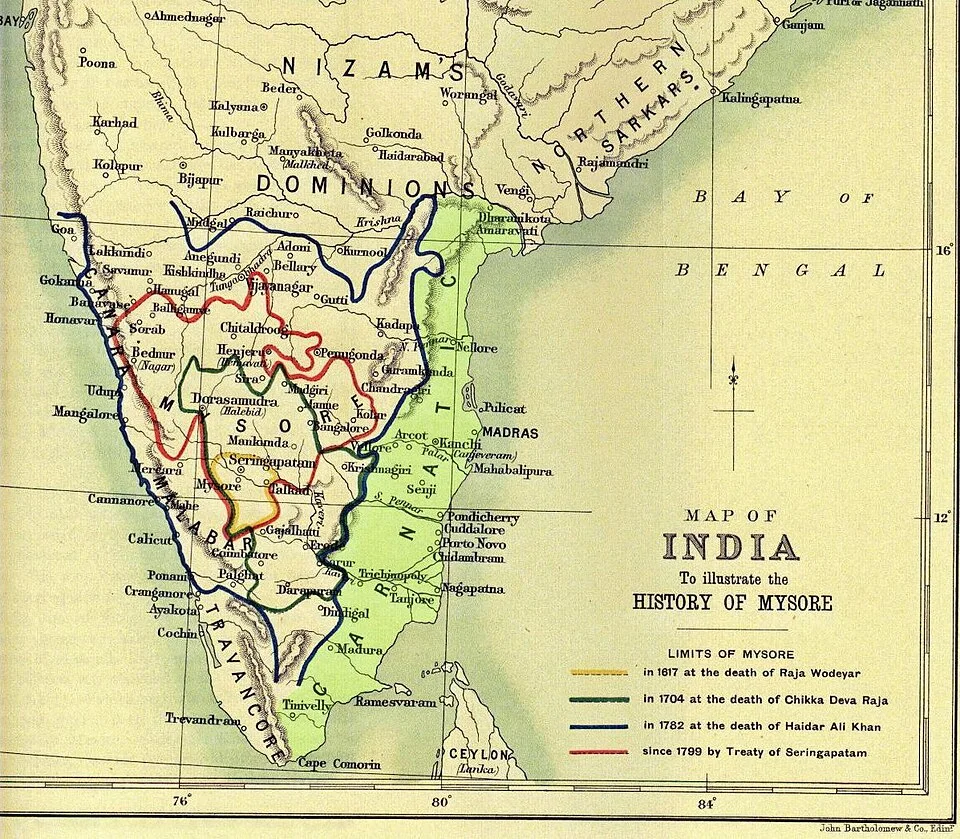
Map of the Carnatic region in present-day India, providing geographical context for the Carnatic Wars.
Credit: Nwbeeson · CC BY-SA 4.0 · sourceResized and converted to WebP; uncropped.
Regional setting and origins
In eighteenth-century political usage, the Carnatic referred broadly to the southeastern coastal region associated with the Coromandel Coast, not to the modern state of Karnataka. Arcot was the seat of its nawab, while Madras and Pondicherry were the principal English and French coastal bases. Hyderabad, ruled by the Nizam, exercised a nominal superior authority over the Carnatic, although regional rulers increasingly acted independently as Mughal power weakened.
The English East India Company, established in 1600, and the French East India Company, founded in 1664, initially sought commercial advantage. Competition over textiles, ports and shipping gradually became linked to fortification and military mobilisation. European wars brought their settlements into conflict, while disputed Indian successions offered opportunities to obtain revenues, territory and influence by supporting rival claimants.
Indian rulers were active participants rather than merely spectators. They sought European troops and artillery to strengthen their own positions. The resulting alliances were contingent: company officers, regional nobles and succession claimants pursued overlapping but distinct objectives. The Carnatic Wars therefore cannot be understood as either purely European conflicts or a simple contest between Europeans and Indians.
- Map focus: locate Arcot, Madras or Chennai, Pondicherry or Puducherry, Trichinopoly or Tiruchirappalli, Wandiwash or Vandavasi, and Hyderabad.
- Political distinction: the Nizam of Hyderabad and the Nawab of the Carnatic were separate authorities, although their succession struggles became interconnected.
Timeline
1746
French capture of Madras; defeat of the nawab’s forces at Adyar.
1748
Treaty of Aix-la-Chapelle; death of Nizam-ul-Mulk.
1749
Battle of Ambur; Anwar-ud-din killed.
1751
Clive captures and defends Arcot; Salabat Jang established in Hyderabad with French support.
1754
Dupleix recalled; Pondicherry settlement.
1760–1761
British victory at Wandiwash followed by the fall of Pondicherry.
1763
Treaty of Paris ends the Seven Years’ War.
First Carnatic War, 1746–1748
The First Carnatic War arose from the War of the Austrian Succession in Europe. In 1746, a French fleet commanded by La Bourdonnais captured Madras from the English. Differences then emerged between La Bourdonnais and Joseph François Dupleix, the French governor at Pondicherry, over the settlement and disposal of the captured town.
Anwar-ud-din, the Nawab of the Carnatic, attempted to assert his authority over the European settlements. At the Battle of Adyar, associated with St Thomé, a relatively small French force defeated his much larger army. The encounter demonstrated the local effectiveness of coordinated infantry fire and disciplined formations. Its significance should not be exaggerated into a claim that all Indian armies were inherently inferior: leadership, organisation, terrain and deployment mattered.
The French failed to capture Fort St David, while an English attempt against Pondicherry in 1748 was also unsuccessful. The Treaty of Aix-la-Chapelle ended the European war and its Indian extension. Madras was restored to the English, while Louisbourg in North America was returned to France as part of the wider settlement. Neither company obtained a decisive territorial advantage, but European officers recognised the political possibilities of military intervention.
From commercial rivalry to political intervention
- 1. Competition over coastal trade and fortified settlements
- 2. European wars and Indian succession disputes
- 3. Company alliances with competing Indian claimants
- 4. Military assistance exchanged for revenue and political concessions
- 5. British victories weaken French-backed alternatives
- 6. English influence expands through dependent regional rulers
Second Carnatic War, 1749–1754
The second war emerged primarily from Indian succession disputes. The death of Nizam-ul-Mulk Asaf Jah I in 1748 generated rivalry in Hyderabad between his son Nasir Jang and grandson Muzaffar Jang. In the Carnatic, Chanda Sahib challenged Anwar-ud-din. Dupleix supported Muzaffar Jang and Chanda Sahib; the English supported Nasir Jang and, after Anwar-ud-din’s death, his son Muhammad Ali.
At Ambur in 1749, forces supporting Chanda Sahib and Muzaffar Jang, assisted by the French, defeated and killed Anwar-ud-din. Muhammad Ali took refuge at Trichinopoly. Nasir Jang was killed in 1750, and Muzaffar Jang briefly became Nizam before being killed in 1751. Bussy then helped establish Salabat Jang in Hyderabad. The French gained substantial influence at his court and secured assignments of revenue from parts of the Northern Circars to maintain their troops.
The English response included Robert Clive’s seizure of Arcot in 1751. By attacking the Carnatic capital, Clive sought to divert pressure from Muhammad Ali at Trichinopoly. His defence of Arcot enhanced English prestige and helped alter the course of the struggle. Subsequent operations involving Stringer Lawrence strengthened the English position; Chanda Sahib was captured and killed in 1752.
Dupleix’s ambitious policy required expenditure that the French authorities were increasingly unwilling to sustain. He was recalled in 1754 and replaced by Charles Godeheu. The Pondicherry settlement sought to restrain intervention in Indian political disputes. Muhammad Ali emerged as the recognised Nawab of the Carnatic, although French influence under Bussy at Hyderabad did not immediately disappear.
| War | Main context | Key episode | Settlement |
|---|---|---|---|
| First, 1746–1748 | War of the Austrian Succession | Capture of Madras and Battle of Adyar | Aix-la-Chapelle; Madras restored |
| Second, 1749–1754 | Hyderabad and Carnatic successions | Ambur and defence of Arcot | Pondicherry settlement; English position strengthened |
| Third, 1756–1763 | Seven Years’ War | Wandiwash and fall of Pondicherry | Paris; French settlements restored without comparable political power |
Third Carnatic War, 1756–1763
The Third Carnatic War formed part of the Seven Years’ War, a global conflict involving European powers and their overseas possessions. Count de Lally arrived in India in 1758 and captured Fort St David. However, his attempt to take Madras in 1758–1759 failed. Financial shortages, difficulties in obtaining supplies and tensions within the French command weakened his campaign.
Lally recalled Bussy from Hyderabad to reinforce operations in the Carnatic. This reduced French influence in the Deccan at a critical moment. English forces under Francis Forde captured Masulipatam in 1759, further undermining the French position on the eastern coast.
The decisive land battle occurred at Wandiwash on 22 January 1760. Eyre Coote defeated the French army commanded by Lally, and Bussy was taken prisoner. The English subsequently reduced French strongholds, and Pondicherry surrendered in January 1761. The Treaty of Paris in 1763 restored French trading settlements, including Pondicherry, but France no longer possessed a comparable capacity to contest British political expansion in India.
- Exam distinction: Wandiwash was fought in 1760; Pondicherry fell in 1761; the Treaty of Paris followed in 1763.
- French commercial presence survived; French prospects of establishing a rival territorial empire were decisively weakened.
British advantages and historical significance
British success resulted from several interacting advantages rather than one battle alone. Naval strength helped maintain communications, move reinforcements and interrupt French supplies. The English Company possessed a broader network of bases, notably Bombay, Madras and Calcutta. Its growing position in Bengal after Plassey in 1757 widened access to money and supplies. This should not be confused with the grant of Bengal’s Diwani, which came only in 1765.
French efforts suffered from financial weakness, inadequate and irregular support from Europe, and disputes among commanders. The French Company’s dependence on royal backing could become a vulnerability when metropolitan priorities lay elsewhere. English commanders also faced setbacks, but more dependable logistical support and effective coordination increasingly favoured them.
The wars established a pattern of company intervention in succession disputes, support for dependent rulers, and the maintenance of European-trained sepoy forces through Indian revenues. They did not create British supremacy over the entire subcontinent overnight: Mysore, the Marathas and other powers remained formidable. Their immediate significance was the removal of France as the leading European competitor for territorial power and the consolidation of English influence in the Carnatic.
- Do not confuse the Carnatic Wars with the later Anglo-Mysore Wars.
- Remember the changing drivers: European war in the first conflict, Indian succession politics in the second, and global Anglo-French war in the third.
The Carnatic: Geography of Anglo-French Competition
The Carnatic region provides the geographical setting for the three Carnatic Wars (1746–1763). In eighteenth-century political usage, the name referred broadly to southeastern India, rather than simply to modern Karnataka. The Coromandel Coast connected company settlements such as Madras and Pondicherry with maritime supply routes, while inland centres such as Arcot linked coastal commerce to revenue and regional politics. This relationship between ports and the hinterland helps explain why commercial competition developed into struggles over political authority.
The conflicts were not merely European wars transferred to India. Although the First and Third Carnatic Wars were linked to wider Anglo-French hostilities, the Second centred on succession contests in the Carnatic and Hyderabad. Indian claimants sought company troops and resources, while the companies sought influence, commercial advantages and revenue. British victory at Wandiwash and the subsequent fall of Pondicherry weakened French military ambitions. The 1763 peace allowed France to recover trading establishments, but did not restore its earlier political position. The supplied metadata identifies a regional map; it does not establish that particular battlefields, eighteenth-century boundaries or campaign routes are marked.
- Geographical distinction: the historical Carnatic is not interchangeable with present-day Karnataka; regional names and political boundaries changed over time.
- Causal distinction: European rivalry and Indian succession politics interacted; neither alone adequately explains all three wars.
- Outcome distinction: French political-military defeat did not mean the disappearance of French trading settlements or immediate British control over all southern India.
Real-world case studies
Arcot, 1751: a diversion with political effects
Clive attacked Arcot while Muhammad Ali faced pressure at Trichinopoly. The capture and defence of the capital drew hostile forces away and strengthened confidence in English support. The episode illustrates how a limited military operation could affect a wider succession struggle.
Bussy in Hyderabad: financing military influence
Bussy’s troops helped sustain Salabat Jang’s position, while revenue assignments in the Northern Circars financed the French force. This linked military assistance with fiscal concessions. Bussy’s recall in 1758 exposed the fragility of influence dependent on a resident military presence.
Previous year questions
No source-linked PYQ is available here yet. Use the practice questions below.
Practice questions
Practice MCQ 1
Which treaty ended the First Carnatic War and provided for the restoration of Madras to the English?
- A. Treaty of Paris
- B. Treaty of Aix-la-Chapelle
- C. Treaty of Allahabad
- D. Treaty of Seringapatam
Practice MCQ 2
Consider the following statements about the Second Carnatic War: 1. Dupleix supported Muzaffar Jang and Chanda Sahib. 2. Clive captured Arcot to divert pressure from Trichinopoly. 3. Bussy helped establish Nasir Jang after Muzaffar Jang’s death. Which statements are correct?
- A. 1 and 2 only
- B. 2 and 3 only
- C. 1 and 3 only
- D. 1, 2 and 3
Practice MCQ 3
Arrange the following events chronologically: 1. Battle of Wandiwash 2. Battle of Ambur 3. Capture of Madras by La Bourdonnais 4. Recall of Dupleix.
- A. 2–3–4–1
- B. 3–4–2–1
- C. 3–2–4–1
- D. 2–4–1–3
Mains practice · The Carnatic Wars transformed European commercial competition into a struggle for political influence in India. Discuss, explaining the reasons for British success. Answer in 250 words.
- Introduce the interaction between European rivalry and weakening Mughal authority.
- Explain the Hyderabad and Carnatic succession disputes and competing alliances.
- Connect trained troops with revenue assignments and dependence on company support.
- Assess naval power, financial resources, Bengal and command coordination.
- Conclude with French political decline, while distinguishing it from the continuation of French trade.
Further reading
- NCERT, Our Pasts III, chapter From Trade to Territory.
- Bipan Chandra, History of Modern India, discussion of European penetration and British conquest.
- Sekhar Bandyopadhyay, From Plassey to Partition and After, discussion of early colonial expansion.
- Puducherry district official website, historical background: puducherry.dcourts.gov.in and py.gov.in.
- https://commons.wikimedia.org/wiki/File:CarnaticRegion.jpg
Preparing for UPSC Civil Services? Get classroom teaching, answer-writing evaluation and mentorship at Pragnya IAS Academy, Ashok Nagar — see why aspirants choose us for IAS coaching in Hyderabad.