
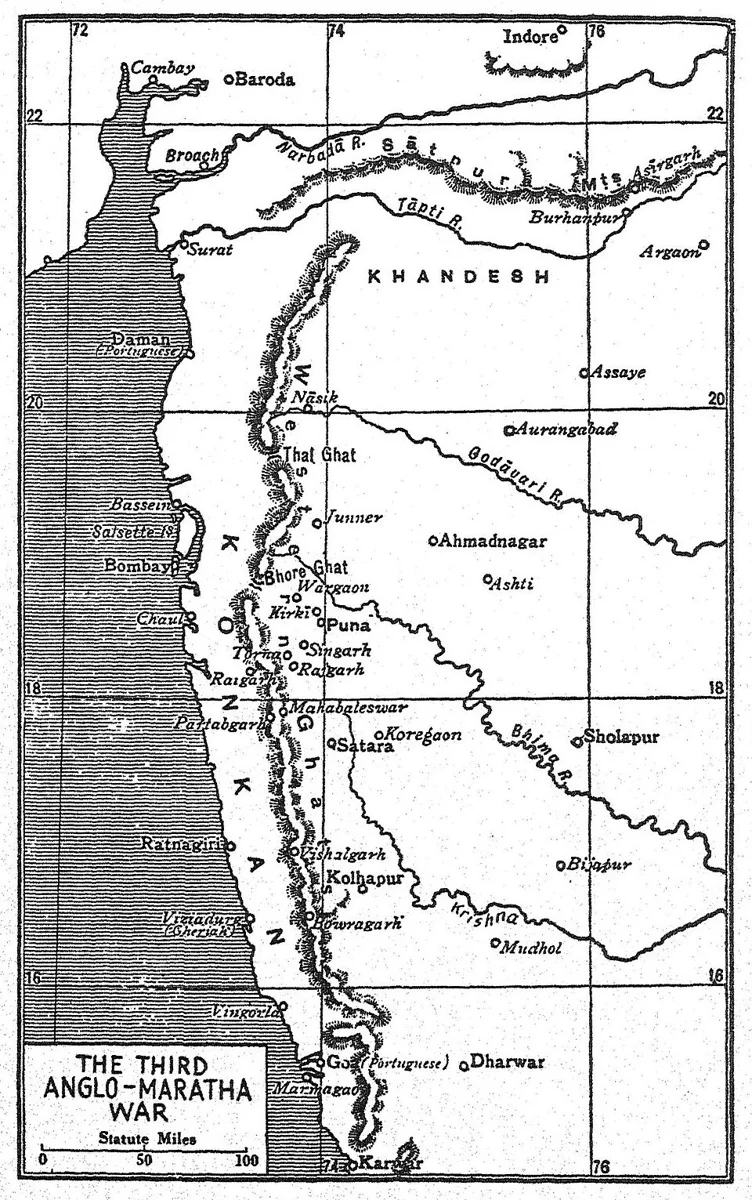
Map of the Third Anglo-Maratha War, illustrating the final phase of British expansion against Maratha powers.
Credit: AnonymousUnknown author · Public domain · sourceResized and converted to WebP; uncropped.
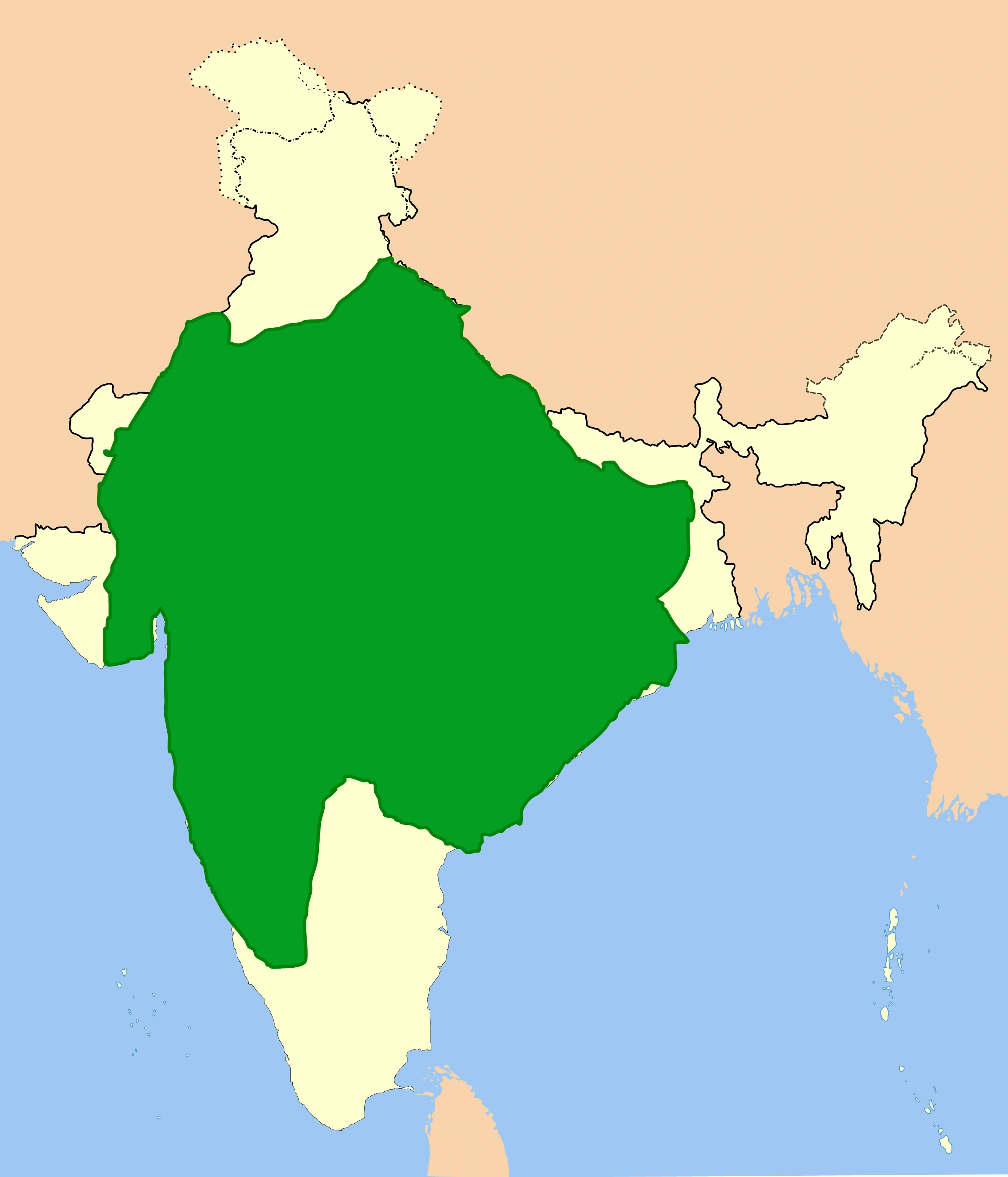
Map study
Maratha power around 1760: confederate influence was not identical to uniform central administration.
- Read the source date and legend before interpreting territorial extent.
- Compare core regions, neighbouring powers and geographic barriers; historical borders and influence are approximate and changed over time.
Credit: Ayunipear · CC0 · sourceConverted to WebP on an opaque white background; proportionally resized without cropping. Original cartography and legend retained.
1. The Maratha confederacy and the background to conflict
The Marathas remained a major force after their defeat at the Third Battle of Panipat in 1761. Under Peshwa Madhavrao I, they recovered considerable territory and influence. However, Madhavrao’s death in 1772 reopened succession disputes. These disputes gave the East India Company opportunities to intervene through rival claimants, treaties and military assistance rather than through immediate conquest of the entire Maratha dominion.
The Maratha polity was a confederacy rather than a uniformly administered state. Its leading centres were the Peshwa at Poona, the Scindia or Shinde house in the Gwalior region, the Holkars at Indore, the Bhonsles at Nagpur and the Gaekwads at Baroda. The Peshwa exercised a leading position, but powerful chiefs maintained their own armies, revenues and diplomatic interests. Their rivalries repeatedly prevented coordinated resistance to Company expansion.
British interests included securing Bombay, gaining strategic coastal possessions, protecting trade and excluding European rivals from Indian courts. Nevertheless, neither British policy nor Maratha responses were entirely uniform. The Bombay government and the Governor-General’s government in Bengal differed over the initial intervention. Maratha chiefs likewise alternated between cooperation, resistance and accommodation according to changing political circumstances.
- Distinguish the Maratha Chhatrapati’s royal authority from the Peshwa’s executive leadership.
- Do not treat the five principal Maratha houses as a permanently united military alliance.
Timeline
1775
Treaty of Surat and beginning of the First Anglo-Maratha War.
1779
British defeat culminates in the Convention of Wadgaon.
1782
Treaty of Salbai concludes the First War.
31 December 1802
Baji Rao II signs the Treaty of Bassein.
1803–1805
Second War; settlements with Bhonsle, Scindia and Holkar.
1817–1818
Third War; Peshwaship abolished after Baji Rao II’s surrender.
2. First Anglo-Maratha War, 1775–1782
The immediate cause was the struggle following the murder of Peshwa Narayanrao in 1773. His uncle Raghunathrao claimed the Peshwaship, but a group of Maratha ministers, prominently Nana Phadnavis, supported Narayanrao’s posthumous son, Madhavrao II. Raghunathrao sought British assistance. By the Treaty of Surat in March 1775, the Bombay government agreed to support him in return for territorial and revenue concessions, including Salsette and Bassein.
The Bengal government opposed Bombay’s arrangement. Its envoy negotiated the Treaty of Purandar in 1776, abandoning British support for Raghunathrao in return for a settlement that allowed the Company to retain Salsette. The compromise did not endure. Renewed intervention led to a British reverse near Poona and the Convention of Wadgaon in January 1779, under which the Bombay force accepted humiliating terms.
Warren Hastings rejected the Wadgaon settlement and continued the war. British forces subsequently captured Ahmedabad, Bassein and Gwalior in separate operations. The Treaty of Salbai, concluded in 1782 through Mahadji Scindia’s mediation, recognised Madhavrao II as Peshwa and provided a pension for Raghunathrao. The British retained Salsette, while most other wartime acquisitions were restored. Salbai established roughly two decades of peace between the Company and the Peshwa.
- Treaty sequence: Surat, Purandar, Wadgaon, Salbai.
- Wadgaon was a Maratha success, not the final settlement of the war.
- Salbai belongs to Warren Hastings’s period, not Lord Hastings’s.
How Bassein accelerated British expansion
- 1. Holkar defeats the Peshwa’s coalition near Poona
- 2. Baji Rao II seeks British protection
- 3. Bassein places the Peshwa under subsidiary alliance
- 4. Scindia and Bhonsle resist British ascendancy
- 5. British victories bring territorial cessions and strategic control
3. Bassein and the Second Anglo-Maratha War, 1803–1805
A renewed struggle between the Peshwa, Scindia and Holkar precipitated the Second War. In October 1802, Yashwantrao Holkar defeated the forces of Peshwa Baji Rao II and Scindia near Poona. The Peshwa fled and accepted British protection through the Treaty of Bassein on 31 December 1802. This placed the head of the confederacy within Lord Wellesley’s subsidiary alliance system.
The Peshwa accepted a subsidiary force of about 6,000 infantry with artillery, assigned territory yielding approximately Rs 26 lakh annually for its maintenance and accepted restrictions on independent diplomacy and the employment of Europeans hostile to the British. The treaty was not an annexation of all Maratha territory. Its importance lay in subordinating the Peshwa’s external relations and enabling a permanent British military presence close to the confederacy’s political centre.
Daulat Rao Scindia and Raghuji II Bhonsle resisted the resulting British ascendancy. In 1803, Arthur Wellesley defeated their forces at Assaye and Argaon, while General Lake won victories in northern India, including Delhi and Laswari. British occupation of Delhi brought the Mughal emperor Shah Alam II under Company protection. The Treaty of Deogaon with the Bhonsle and Surji-Anjangaon with Scindia imposed extensive territorial and diplomatic concessions.
Holkar fought separately from 1804. His resistance, Colonel Monson’s disastrous retreat and unsuccessful British assaults on Bharatpur demonstrated that Company victory was not effortless. A less expansionist policy followed Wellesley’s departure. Peace with Holkar at Rajghat in December 1805 concluded this phase of conflict.
- Deogaon: Raghuji II Bhonsle; major losses included Cuttack and Balasore.
- Surji-Anjangaon: Daulat Rao Scindia; major losses included territories in the Ganga–Yamuna Doab.
- Bassein was the political trigger; Assaye and Laswari were battles of the ensuing war.
| Treaty | Year | Maratha party | Significance |
|---|---|---|---|
| Surat | 1775 | Raghunathrao | British support for his claim to the Peshwaship |
| Salbai | 1782 | Peshwa’s government; Scindia mediated | Ended the First War |
| Bassein | 1802 | Baji Rao II | Subsidiary alliance |
| Deogaon | 1803 | Raghuji II Bhonsle | Territorial concessions, including Cuttack |
| Surji-Anjangaon | 1803 | Daulat Rao Scindia | Extensive territorial losses |
| Mandsaur | 1818 | Holkar state | Settlement following Mahidpur |
4. Third Anglo-Maratha War, 1817–1818
The Third War developed alongside Lord Hastings’s campaign against the Pindaris, mobile plundering bands operating mainly in central India. Some Pindari groups had connections with Maratha chiefs, but they were not simply a regular army of the confederacy. British military mobilisation against them also enabled Hastings to isolate potential Maratha opponents and impose tighter political controls.
Peshwa Baji Rao II, resentful of British restrictions and the humiliating Treaty of Poona of June 1817, attacked the British Residency in November. His forces were defeated at Khadki near Poona. Fighting also broke out with Appa Sahib of Nagpur and the Holkar forces. The British prevailed at Sitabuldi near Nagpur in November 1817 and Mahidpur in December. The Treaty of Mandsaur in January 1818 subordinated the Holkar state to British power.
The Peshwa’s campaign continued through engagements including Koregaon and Ashti. He surrendered in June 1818, received a pension and was sent to Bithur near Kanpur. The Peshwaship was abolished and much of his territory entered the Bombay Presidency. A smaller kingdom of Satara was established under Pratap Singh, a descendant of Shivaji. Scindia remained outside the main fighting after the Treaty of Gwalior of November 1817.
- Satara was not annexed in 1818; its annexation came in 1848 under the Doctrine of Lapse.
- Nagpur was subordinated after the war but was annexed only in 1853.
- Third War identification: Lord Hastings, Pindaris, Khadki, Sitabuldi and Mahidpur.
5. Causes of British success and historical significance
British success resulted from the interaction of diplomatic isolation, military organisation and access to substantial revenues and credit. The Company could sustain campaigns across distant theatres and use treaties to detach one chief while fighting another. Maratha rivalry was therefore a strategic disadvantage. However, explanations based only on supposedly backward Maratha armies are misleading: Scindia maintained European-trained infantry and powerful artillery.
The wars produced a differentiated political order. Some territories were directly annexed, while several Maratha dynasties survived as subordinate princely states. Residents, subsidiary forces and restrictions on diplomacy reduced their practical sovereignty. By 1818, the Company had eliminated the Maratha confederacy as the principal large-scale challenger to its supremacy in much of India, although other independent powers, notably the Sikh kingdom, remained.
For examination purposes, distinguish three outcomes: Salbai restored a balance after an inconclusive struggle; the Second War dismantled much of Maratha strategic independence; and the Third established decisive British paramountcy. British expansion here preceded Dalhousie’s Doctrine of Lapse and cannot be explained through that later annexation policy.
Third Anglo-Maratha War: From Confederacy to Company Paramountcy
The supplied metadata identifies this as a map of the Third Anglo-Maratha War, making it directly relevant to the final Anglo-Maratha conflict. The war of 1817–1818 developed amid Company operations against the Pindaris and growing resistance to British constraints on Maratha autonomy. The Maratha confederacy was not a unified territorial state: the Peshwa and leading houses pursued distinct interests. Consequently, the conflict should not be understood as a single coordinated national campaign against the Company.
The defeat of Peshwa Baji Rao II ended the Peshwaship, and much of his territory passed under Company control. Yet British victory did not mean uniform annexation of every Maratha state. Satara was constituted under a ruler of Shivaji’s lineage, while other Maratha dynasties continued within increasingly subordinate political arrangements. This distinction explains how Company paramountcy combined direct territorial rule with indirect control. For Indian history, a campaign map can help connect military geography with this political restructuring; however, the metadata alone cannot establish its routes, boundaries, battle labels or cartographic accuracy.
- Distinguish the Treaty of Bassein, concluded with Baji Rao II in 1802 before the Second War, from the settlements following the Third War.
- Associate Khadki with the Peshwa’s forces, Sitabuldi with the Nagpur Bhonsles, and Mahidpur with the Holkars; these were distinct military theatres.
- For Mains, explain expansion through diplomacy, military pressure and confederacy rivalries. Paramountcy meant overarching British supremacy, not identical administrative status for every defeated power.
Real-world case studies
Delhi, 1803: military victory and imperial legitimacy
Lake’s capture of Delhi displaced Scindia’s influence over the Mughal court. Shah Alam II came under British protection. This illustrates how Company expansion involved control over symbolic centres of authority as well as revenue-producing territories.
Satara, 1818: selective preservation of indigenous royalty
The British abolished the Peshwaship but installed Pratap Singh at Satara. Preserving a restricted kingdom associated with Shivaji’s lineage helped separate Maratha royal legitimacy from the defeated Peshwa’s authority. Its later annexation in 1848 belongs to a different phase of expansion.
Previous year questions
No source-linked PYQ is available here yet. Use the practice questions below.
Practice questions
Practice MCQ 1
Consider the following treaty–party pairs: 1. Bassein — Baji Rao II; 2. Deogaon — Daulat Rao Scindia; 3. Mandsaur — Holkar state. Which pairs are correctly matched?
- A. 1 and 2 only
- B. 1 and 3 only
- C. 2 and 3 only
- D. 1, 2 and 3
Practice MCQ 2
Which sequence is chronologically correct?
- A. Wadgaon → Purandar → Salbai → Bassein
- B. Purandar → Salbai → Wadgaon → Bassein
- C. Purandar → Wadgaon → Salbai → Bassein
- D. Bassein → Purandar → Wadgaon → Salbai
Practice MCQ 3
Regarding the settlement of 1818, consider the following statements: 1. The Peshwaship was abolished. 2. Every major Maratha state was immediately annexed. 3. A kingdom under Pratap Singh was established at Satara. Which statements are correct?
- A. 1 only
- B. 2 and 3 only
- C. 1 and 2 only
- D. 1 and 3 only
Mains practice · The Anglo-Maratha Wars demonstrate that British expansion depended as much on diplomacy as on battlefield victories. Discuss. (250 words)
- Explain the confederacy’s structure and succession disputes.
- Use Surat and Salbai to show intervention followed by negotiated compromise.
- Analyse Bassein as a strategic subsidiary alliance.
- Connect Assaye, Laswari and Mahidpur with treaty settlements.
- Discuss the isolation of Scindia during the Pindari campaign.
- Conclude with the combination of annexation, Residents and subordinate princely states.
Further reading
- NCERT, Our Pasts–III, chapter From Trade to Territory.
- Bipan Chandra, History of Modern India.
- Sekhar Bandyopadhyay, From Plassey to Partition and After.
- Maharashtra State Gazetteers, historical sections on Pune and the Peshwas, gazetteers.maharashtra.gov.in.
- https://commons.wikimedia.org/wiki/File:The_Third_Anglo-Maratha_War_Map.jpg
Preparing for UPSC Civil Services? Get classroom teaching, answer-writing evaluation and mentorship at Pragnya IAS Academy, Ashok Nagar — see why aspirants choose us for IAS coaching in Hyderabad.