
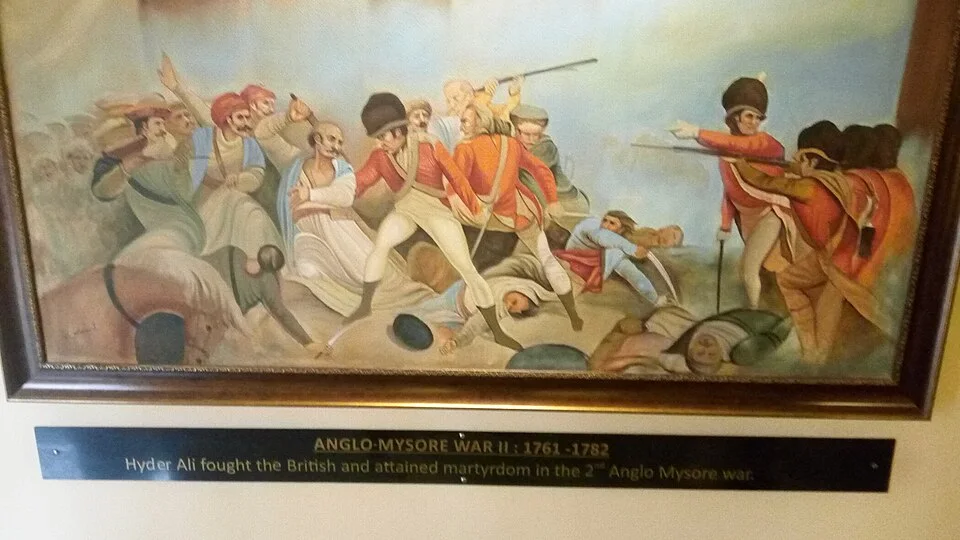
Painting identified as depicting the Second Anglo-Mysore War; metadata associates it with the National War Museum, Pune.
Credit: Amit20081980 · CC BY-SA 4.0 · sourceResized and converted to WebP; uncropped.
1. Mysore’s rise and the struggle for southern India
Mysore emerged as a major regional power during the eighteenth-century weakening of Mughal authority and the fragmentation of politics in the Deccan and Carnatic. Haidar Ali, a military commander who rose through the Mysore army, became the kingdom’s effective ruler in 1761. He retained the nominal authority of the Wodeyar dynasty while concentrating military and administrative power in his own hands. Expansion into Bednur and the Malabar region increased Mysore’s resources and access to western coastal trade.
Mysore’s growth threatened several neighbours, not merely the British. The Marathas sought tribute and territorial influence; the Nizam of Hyderabad feared an expanding southern rival; and the East India Company wished to secure Madras, its commercial interests and its position in the Carnatic. Alliances were therefore unstable. Indian powers sometimes cooperated with the Company against Mysore, but at other moments resisted British expansion themselves.
Haidar and his son Tipu combined mobile cavalry with infantry, artillery and European military expertise. Their coastal interests and contacts with the French gave the conflict a wider imperial dimension. Nevertheless, the wars should not be reduced to an Anglo-French contest: they were fundamentally struggles over territory, revenue and regional predominance. Mysore represented a powerful indigenous obstacle to the Company’s expansion beyond its coastal settlements.
- Strategic geography: the Mysore plateau, Carnatic plains, Western Ghats passes and Malabar ports connected inland power with coastal commerce.
- Srirangapatna, an island fortress on the Kaveri, was the political and military centre of Haidar and Tipu’s state.
Timeline
1761
Haidar Ali becomes Mysore’s effective ruler.
1767–1769
First Anglo-Mysore War; Treaty of Madras concludes the conflict.
1780–1784
Second war; Haidar dies in 1782 and Tipu concludes the Treaty of Mangalore.
1790–1792
Third war; Treaty of Seringapatam strips Mysore of approximately half its territory.
1799
Fourth war; Tipu dies on 4 May, followed by partition and a subordinate Wodeyar restoration.
2. First Anglo-Mysore War, 1767–1769
The first war grew out of British efforts to contain Mysore through arrangements with the Nizam and the Marathas. These alignments did not remain intact. Haidar used negotiation, payments and military pressure to prevent a durable coalition from operating against him. The Nizam’s shifting position illustrates the fluidity of eighteenth-century diplomacy: hostility to Mysore did not automatically produce lasting loyalty to the Company.
Fighting spread across the Carnatic, where Haidar’s mobility challenged the Company’s armies. In 1769, he advanced rapidly towards Madras, exposing the vulnerability of the British presidency’s headquarters and compelling a negotiated settlement. The Treaty of Madras, signed on 4 April 1769, provided broadly for mutual restitution of conquests and assistance if either party was attacked.
The mutual-defence undertaking became a major source of later distrust. When the Marathas attacked Mysore, the Company failed to provide the assistance Haidar expected under the treaty. Thus, the first war did not establish British supremacy or settle the underlying rivalry. Instead, it demonstrated Mysore’s capacity to threaten Madras and left Haidar convinced that British treaty commitments could not be relied upon.
- Exam association: First war — Haidar Ali — Treaty of Madras — mutual assistance.
- The treaty was not a subsidiary alliance, and Mysore did not become a British dependent in 1769.
From regional rivalry to British predominance
- 1. Mysore’s expansion threatens neighbouring powers and Company interests
- 2. Haidar compels the Treaty of Madras
- 3. Renewed conflict ends without British supremacy at Mangalore
- 4. British alliance with the Nizam and Marathas isolates Tipu
- 5. The 1792 settlement reduces Mysore’s territory and resources
- 6. The 1799 conquest replaces independent Mysore with a dependent kingdom
3. Second Anglo-Mysore War, 1780–1784
The immediate background included British action against French settlements after the Anglo-French conflict widened during the American War of Independence. In 1779, the Company captured Mahé on the Malabar coast, a French settlement under Haidar’s protection and an important connection for supplies. Combined with the earlier breach of trust, this helped bring Mysore into renewed war. Haidar sought cooperation with the Marathas and the Nizam, although a coordinated anti-British coalition did not endure.
Haidar invaded the Carnatic in 1780. At Pollilur in September, Mysorean forces inflicted a devastating defeat on a British detachment commanded by Hector Munro’s subordinate, Colonel William Baillie. British fortunes subsequently improved under Sir Eyre Coote, who defeated Haidar at Porto Novo in 1781. The campaign nevertheless remained difficult, with neither side securing a decisive settlement through military operations alone.
Haidar died in December 1782, and Tipu Sultan continued the war. Fighting included operations around Mangalore and the western coast. The Treaty of Mangalore, signed on 11 March 1784, provided for reciprocal restoration of captured territories and the release of prisoners. It is commonly described as a settlement on terms of equality rather than a British victory. For examination purposes, distinguish the founder of Mysore’s military ascendancy, Haidar, from Tipu, who concluded this treaty.
- Exam association: Second war — Mahé and Pollilur — Haidar’s death — Treaty of Mangalore.
- The war occurred during Warren Hastings’s governor-generalship; Cornwallis belongs to the third war.
| War | Principal Mysore ruler | Settlement | Defining outcome |
|---|---|---|---|
| First, 1767–1769 | Haidar Ali | Treaty of Madras | Restitution and mutual assistance |
| Second, 1780–1784 | Haidar Ali, then Tipu Sultan | Treaty of Mangalore | Reciprocal restoration and release of prisoners |
| Third, 1790–1792 | Tipu Sultan | Treaty of Seringapatam | Half the territory surrendered; indemnity and hostages |
| Fourth, 1799 | Tipu Sultan | Partition and subsidiary settlement | Tipu’s death; reduced Wodeyar kingdom |
4. Third Anglo-Mysore War, 1790–1792
The immediate trigger was Tipu’s attack on Travancore’s defensive lines in December 1789. Travancore enjoyed British protection, while its disputes with Mysore involved frontier security and dealings with Cochin and the Dutch. Governor-General Lord Cornwallis treated the attack as grounds for war. Unlike earlier unstable alignments, the British now secured effective cooperation from the Nizam and the Marathas, placing Mysore under pressure from several directions.
The initial British campaign was conducted by General William Medows. Cornwallis subsequently assumed direct command, captured Bangalore in 1791 and advanced towards Seringapatam. Supply difficulties disrupted an early advance, but renewed campaigning and allied pressure forced Tipu to negotiate in 1792. This sequence demonstrates the importance of logistics, siege warfare and diplomatic isolation alongside battlefield performance.
Under the Treaty of Seringapatam in March 1792, Tipu surrendered approximately half his dominions, which were divided among the Company, the Nizam and the Marathas. The Company acquired important territories including Malabar, Dindigul and the Baramahal. Tipu also agreed to pay an indemnity of about three crore rupees. Two of his sons were delivered as hostages to guarantee fulfilment of the settlement and were later returned. The treaty substantially weakened Mysore’s territorial and fiscal base, but did not extinguish its independence.
- Exam association: Third war — Travancore — Cornwallis — loss of half the kingdom.
- Do not confuse the two princes’ temporary hostage status in 1792 with the removal of Tipu’s dynasty after 1799.
5. Fourth war and the consequences of conquest
Lord Wellesley, Governor-General from 1798, pursued a more aggressive policy of British predominance. Tipu’s attempts to obtain French support, including contacts with the French administration in Mauritius, heightened British suspicions. Napoleon’s expedition to Egypt in 1798 sharpened these anxieties, although no substantial French army reached Mysore. Meanwhile, the Nizam entered a subsidiary alliance with the British in 1798, further narrowing Tipu’s diplomatic options.
In 1799, Company armies advanced into Mysore with Hyderabad’s support. General George Harris commanded the principal invading army; Arthur Wellesley was a subordinate commander, not the Governor-General. British troops stormed Seringapatam on 4 May 1799, and Tipu died defending the fortress. Unlike the earlier wars, this conflict ended with the destruction of the existing regime rather than a negotiated treaty with Tipu.
Mysore was partitioned. The Company and the Nizam received territories, while a reduced kingdom was placed under the young Krishnaraja Wodeyar III and bound by a subsidiary alliance. Mysore therefore was not wholly annexed in 1799. Its subordination removed a major obstacle to British power in southern India. Tipu’s resistance, revenue reforms, commercial initiatives and military technology remain significant, but his policies must be studied within the coercive and competitive setting of eighteenth-century state-building rather than through anachronistic national categories.
- Structural explanation for defeat: diplomatic isolation, territorial losses after 1792, the Company’s expanding resources and coordinated military pressure.
- Long-term consequence: British strategic predominance in the south strengthened the Company’s position in subsequent struggles with the Marathas.
Second Anglo-Mysore War: Resistance without a Decisive Settlement
The Second Anglo-Mysore War (1780–1784) illustrates why British expansion in southern India was neither inevitable nor uninterrupted. Haidar Ali challenged Company power in the Carnatic, while the wider Anglo-French rivalry affected regional calculations. The British capture of Mahé, a French settlement linked to Mysore’s interests, was an important immediate provocation, not a complete explanation of the conflict. Mysore’s resistance also reflected disputes over alliances, territorial security and the Company’s growing influence.
After Haidar Ali’s death in 1782, Tipu Sultan continued the war. The Treaty of Mangalore in 1784 provided for mutual restoration of conquests and release of prisoners, rather than establishing Company supremacy over Mysore. This distinguishes the second war from the territorial losses imposed on Tipu after the third war and the destruction of his rule in the fourth. The supplied metadata identifies this painting with the second war, making it relevant as an illustration. However, it does not establish the artist, date of execution or particular episode represented; the painting cannot independently verify battlefield formations, uniforms or participants.
- Prelims distinction: associate Mangalore with the second war; do not confuse it with the Treaty of Seringapatam ending the third.
- Mains linkage: explain expansion through shifting Indian alliances, European rivalry and negotiated settlements, not simply superior British military strength.
- Evidence caution: museum association does not establish contemporaneity; use the painting illustratively and corroborate specific historical claims through other sources.
Real-world case studies
Mysorean rockets and technological transfer
Haidar and Tipu deployed iron-cased rockets, including in the campaigns associated with Pollilur. Their casing allowed greater pressure than many earlier rocket designs, although accuracy remained limited. British examination of Mysorean rockets contributed to William Congreve’s development of military rockets in the early nineteenth century. The example challenges the assumption that military innovation travelled only from Europe to India.
The restoration of the Wodeyars in 1799
Restoring Krishnaraja Wodeyar III gave the post-conquest settlement an appearance of dynastic legitimacy while a subsidiary alliance secured British control. The arrangement illustrates how the Company combined direct territorial acquisition with indirect rule instead of annexing every defeated state outright.
Previous year questions
No source-linked PYQ is available here yet. Use the practice questions below.
Practice questions
Practice MCQ 1
Consider the following pairs: 1. Treaty of Madras — Mutual assistance against attack. 2. Treaty of Mangalore — Surrender of half of Mysore’s territory. 3. Treaty of Seringapatam — Delivery of two of Tipu’s sons as hostages. Which pairs are correctly matched?
- A. 1 and 2 only
- B. 1 and 3 only
- C. 2 and 3 only
- D. 1, 2 and 3
Practice MCQ 2
Which of the following is the correct chronological sequence?
- A. Capture of Mahé by the British → Battle of Pollilur → Death of Haidar Ali → Treaty of Mangalore
- B. Battle of Pollilur → Capture of Mahé by the British → Treaty of Mangalore → Death of Haidar Ali
- C. Capture of Mahé by the British → Death of Haidar Ali → Battle of Pollilur → Treaty of Mangalore
- D. Death of Haidar Ali → Battle of Pollilur → Capture of Mahé by the British → Treaty of Mangalore
Practice MCQ 3
With reference to the settlement following the Fourth Anglo-Mysore War, consider the following statements: 1. The entire Mysore kingdom was directly annexed by the Company. 2. A reduced Mysore kingdom was entrusted to a Wodeyar ruler. 3. The restored kingdom entered a subsidiary alliance. Which statements are correct?
- A. 1 only
- B. 1 and 2 only
- C. 2 and 3 only
- D. 1, 2 and 3
Mains practice · Mysore’s defeat resulted as much from diplomatic isolation as from military reverses. Examine with reference to the Anglo-Mysore Wars. Answer in 250 words.
- Introduce Mysore as a major regional competitor of the Company.
- Contrast Haidar’s successful disruption of hostile alliances in the first war with Tipu’s later isolation.
- Explain the significance of the British-Nizam-Maratha coalition in the third war.
- Connect the territorial and financial losses of 1792 with Mysore’s weakened capacity.
- Discuss the Nizam’s subsidiary alliance and the limited practical value of French support.
- Balance diplomacy against British resources, logistics, siege capabilities and battlefield outcomes.
Further reading
- NCERT, Our Pasts–III, chapter From Trade to Territory: The Company Establishes Power.
- Bipan Chandra, History of Modern India, sections on British conquest and consolidation.
- Sekhar Bandyopadhyay, From Plassey to Partition and After, discussion of British expansion.
- Archaeological Survey of India: information on Daria Daulat Bagh and monuments at Srirangapatna.
- https://commons.wikimedia.org/wiki/File:Painting_of_Second_Anglo-Mysore_War.jpg
Preparing for UPSC Civil Services? Get classroom teaching, answer-writing evaluation and mentorship at Pragnya IAS Academy, Ashok Nagar — see why aspirants choose us for IAS coaching in Hyderabad.