
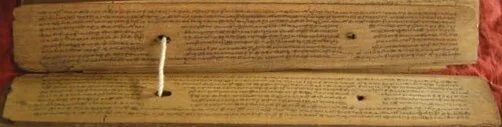
Arthashastra manuscript in Grantha script, identified in the metadata as a circa sixteenth-century copy held at ORI, Mysuru.
Credit: Unknown scribe · Public domain · sourceResized and converted to WebP; uncropped.
1. Authorship, chronology and historical significance
Arthashastra literally denotes a science or systematic treatment of artha. In this context, artha includes material well-being, livelihood, resources and the territory that sustains political power. The work therefore extends well beyond economics in the modern sense. It examines how a ruler acquires a kingdom, maintains order, organises production, collects revenue, protects subjects and deals with rival powers. Its 15 books combine detailed administrative prescriptions with discussions of legal procedure, military operations and the methods of constructing an argument.
Indian tradition attributes the work to Kautilya, commonly identified with Chanakya or Vishnugupta, who assisted Chandragupta Maurya in establishing Mauryan power in the late fourth century BCE. This association explains its importance in accounts of the Mauryan Empire. However, the date and unity of the surviving text remain debated. Many modern scholars identify different compositional layers and place its compilation or final redaction in the early centuries CE, while allowing for older traditions and material.
For historical reconstruction, the distinction between prescription and description is essential. The Arthashastra describes how government ought to function according to its authorial tradition; it does not establish that every office, tax or policy operated uniformly throughout the Mauryan Empire. Its evidence should be compared with Ashokan inscriptions, archaeological remains and Greek accounts associated with Megasthenes. R. Shamasastry's work at Mysore brought a manuscript into modern scholarly discussion in 1905, transforming the study of ancient Indian statecraft.
Timeline
Late fourth century BCE
Traditional setting of Kautilya's association with Chandragupta Maurya.
Early centuries CE
Period within which many modern scholars place compilation or final redaction of the surviving work; precise dating remains debated.
1905
R. Shamasastry brings the Arthashastra manuscript to modern scholarly attention.
1909
Shamasastry publishes a Sanskrit edition.
1915
Shamasastry publishes an English translation.
2. Kingship, the seven constituents and administrative organisation
The ruler occupies a central position but is expected to act through trained ministers, officials and information networks. The text emphasises education, self-control, consultation and a disciplined daily schedule. A frequently cited principle connects the king's happiness with the happiness of his subjects. This concern is practical as well as ethical: prosperous and protected subjects support the treasury, army and stability of the kingdom. Danda, or coercive authority, must uphold order, although the work also authorises severe punishments and covert action.
The saptanga theory presents the state as seven interdependent constituents: svamin, the ruler; amatya, ministers and officials; janapada, territory and population; durga, the fortified centre; kosa, the treasury; danda, coercive or military power; and mitra, the ally. Political strength thus depends on more than the personality of a monarch. Productive territory, capable administration, adequate resources, defence and external support all matter. Weakness in one constituent can undermine the others.
Administrative prescriptions include the samaharta, associated with revenue collection, and the sannidhata, responsible for the treasury and stores. Numerous adhyakshas or superintendents supervise specialised activities such as agriculture, commerce, mines, forests and weights and measures. Record-keeping, inspection and scrutiny of officials receive considerable attention. The text recognises the difficulty of detecting embezzlement and recommends checks on official conduct. These features support an image of elaborate administrative ambition, not proof that a uniform modern-style bureaucracy existed across ancient India.
Interdependence of resources and political power
- 1. Productive territory and population sustain livelihoods.
- 2. Administration mobilises and records revenue.
- 3. The treasury supports officials, forts and armed forces.
- 4. Intelligence and diplomacy identify threats and opportunities.
- 5. Security and protection help sustain production and state stability.
3. Political economy, revenue, law and society
Agriculture is a major foundation of state resources. The text discusses settlement, cultivation, irrigation and the use of uncultivated land, alongside cattle-rearing and trade. Varta denotes productive activities, especially agriculture, animal husbandry and commerce. Revenue could arise from the king's share of agricultural produce, crown lands, customs, tolls, fines and other receipts. A one-sixth share of produce is a familiar norm, but assessments varied with circumstances; it should not be presented as an invariant tax rate for every place and period.
The Arthashastra envisages extensive state supervision of economic life. It discusses mines, metals, forest products, salt, liquor and other strategically or fiscally important sectors. Rules concerning weights, measures, prices, adulteration and traders seek to secure revenue and restrain malpractice. State activity coexists with private cultivators, merchants, artisans and occupational organisations. Consequently, describing this system simply as either socialism or laissez-faire capitalism imposes modern categories on a very different historical setting.
Legal discussions cover debt, deposits, sale, inheritance, marriage, property, labour and offences against persons and the state. Dharmasthiya broadly concerns judicial adjudication, while kantakashodhana, or removal of thorns, addresses threats to social and economic order through policing and punishment. The legal framework is hierarchical: status, gender and dependency shape rights and penalties. It therefore cannot be equated with modern equality before law. Provisions concerning famine, disasters, vulnerable people and productive infrastructure nevertheless demonstrate that governance included protection and relief, not merely extraction.
| Concept | Meaning | Examination distinction |
|---|---|---|
| Saptanga | Seven constituents of the state | Includes territory and population, treasury and ally, not merely king and army. |
| Mandala | Circle of rulers | A model of interstate strategy, not an administrative division. |
| Shadgunya | Six foreign-policy measures | Different from the four expedients of persuasion and coercion. |
| Varta | Agriculture, cattle-rearing and commerce | Concerns productive livelihood and the material basis of power. |
| Dandaniti | Science of government and coercive authority | Broader than punishment alone. |
4. Diplomacy, intelligence and warfare
The mandala theory examines a circle of rulers from the perspective of the vijigishu, the king seeking expansion. An immediately neighbouring ruler is treated as a likely adversary, while a ruler beyond that neighbour may become a potential ally. This is a strategic model grounded in competing interests, not a universal law that all neighbours must always fight. The relative strength of rulers, their geographical position and changing circumstances influence policy.
The six measures of foreign policy, collectively called shadgunya, are sandhi, making peace or a treaty; vigraha, hostility or war; asana, remaining quiet; yana, marching or undertaking an expedition; samsraya, seeking protection; and dvaidhibhava, adopting a dual policy. These should be distinguished from the four commonly cited expedients: sama, conciliation; dana, gifts or inducements; bheda, creating dissension; and danda, force. The six measures describe strategic positions, whereas the four expedients are means of influencing an opponent.
Intelligence gathering is integral to both internal administration and external affairs. Agents operating under varied disguises obtain information, test loyalty and influence hostile forces. The text considers open fighting, deceptive warfare and covert methods, including actions incompatible with contemporary law and ethics. Its reputation for realism arises from this willingness to subordinate methods to security and political advantage. Yet it also recommends negotiation, preparation and restraint when war would weaken the ruler's resources.
5. Reading the Arthashastra for UPSC
The most useful approach combines factual identification with source criticism. Remember the traditional author, language, modern rediscovery, seven state constituents and principal diplomatic concepts. Keep the text distinct from Ashoka's edicts, which are royal inscriptions communicating policies and moral exhortations. Ashokan dhamma emphasised ethical conduct and social concord; the Arthashastra systematised government and political advantage. Nevertheless, a simple contrast between an entirely peaceful Ashoka and an exclusively violent Kautilya is misleading: both traditions recognise governmental responsibility, and Ashoka retained coercive authority.
Avoid three common errors: treating the entire surviving work as securely dated to Chandragupta's reign, assuming that every recommendation was implemented, and reducing the work to a manual of intrigue. It is better understood as a major intellectual tradition linking political power to resources, institutions, information and social order. For Prelims, carefully identify whether a statement concerns a textual prescription, a traditional attribution or independently established historical evidence.
Reading the Arthashastra through its manuscript tradition
This manuscript is directly relevant to the Arthashastra, but its significance lies in textual transmission rather than direct survival from Mauryan times. The supplied metadata identifies it as a circa sixteenth-century copy in Grantha script, held at the Oriental Research Institute in Mysuru, and associates its rediscovery with R. Shamasastry in 1905. Sanskrit is the language of the treatise; Grantha is the script used for this copy. A manuscript’s copying date must not be confused with the composition dates of the material it preserves.
For ancient Indian history, the Arthashastra illuminates systematic thinking about royal authority, revenue, officials, intelligence, law and interstate relations. Its saptanga framework treats the state as seven interdependent constituents, while its mandala reasoning examines foreign policy through relative position and interests. These are analytical and prescriptive formulations, not proof that every ruler implemented a uniform administrative blueprint. Traditional attribution to Kautilya connects the work with Chandragupta Maurya, but its layered composition requires comparison with inscriptions, archaeology and other texts before drawing conclusions about Mauryan practice.
- Prelims distinction: Sanskrit denotes language, Grantha denotes script, and a later manuscript can preserve substantially older textual material.
- Saptanga comprises ruler, minister, territory and population, fort, treasury, armed force and ally; it extends beyond the king alone.
- Mains caution: compare the treatise with Ashokan inscriptions without treating either source as a complete administrative record or assuming their political emphases are identical.
Real-world case studies
Sudarshana Lake: comparing prescriptions with inscriptions
Rudradaman's Junagadh inscription of about 150 CE records that Sudarshana Lake originated under Pushyagupta, a governor of Chandragupta Maurya, and received further works under the Yavana Tushaspha during Ashoka's reign. It also describes repairs under Rudradaman. This provides inscriptional evidence for state involvement in water infrastructure across dynasties, comparable to Arthashastra concerns with irrigation. It does not prove that the work was executed according to the treatise.
Shamasastry and the recovery of a political classic
Working at the Oriental Library in Mysore, R. Shamasastry examined a palm-leaf manuscript and introduced the Arthashastra to modern scholarship. His editions and translation expanded the evidence available for studying ancient administration and political thought. The episode illustrates how manuscript recovery can reshape historical understanding while leaving questions of authorship, dating and actual implementation open.
Previous year questions
No source-linked PYQ is available here yet. Use the practice questions below.
Practice questions
Practice MCQ 1
Which of the following belong to the seven constituents of the state in the Arthashastra? 1. Kosa 2. Mitra 3. Janapada 4. Sandhi
- A. 1 and 2 only
- B. 1, 2 and 3 only
- C. 3 and 4 only
- D. 1, 2, 3 and 4
Practice MCQ 2
Consider the following statements: 1. The Arthashastra is principally a prescriptive treatise. 2. Every institution mentioned in it is independently confirmed for the Mauryan period. 3. The chronology of its surviving form is debated. Which statements are correct?
- A. 1 and 2 only
- B. 2 and 3 only
- C. 1 and 3 only
- D. 1, 2 and 3
Practice MCQ 3
Which pair is correctly matched in the context of the Arthashastra?
- A. Sannidhata — Treasury and stores
- B. Samaharta — Six measures of foreign policy
- C. Varta — Circle of neighbouring rulers
- D. Bheda — Seeking protection from a stronger ruler
Mains practice · The Arthashastra is both a major source of ancient Indian political thought and a problematic guide to Mauryan administrative practice. Discuss. Answer in 250 words.
- Introduce traditional attribution and the debated chronology of the surviving text.
- Explain saptanga, administrative specialisation and the relationship between production, revenue and power.
- Discuss diplomacy, intelligence, coercion and the ruler's protective obligations.
- Distinguish normative prescriptions from demonstrated historical practice.
- Use Ashokan inscriptions, the Junagadh inscription and archaeology as comparative evidence.
- Conclude that its intellectual importance does not require treating it as a literal Mauryan administrative handbook.
Further reading
- NCERT, Themes in Indian History, Part I, Chapter 2: Kings, Farmers and Towns.
- R. S. Sharma, India's Ancient Past, chapters on the Mauryan Empire.
- Upinder Singh, A History of Ancient and Early Medieval India, discussions of the Mauryas and historical sources.
- R. P. Kangle, The Kautiliya Arthasastra, Parts I–III.
- Patrick Olivelle, King, Governance, and Law in Ancient India: Kautilya's Arthasastra.
- https://commons.wikimedia.org/wiki/File:Rediscovered_circa_16th_century_Arthashastra_manuscript_in_Grantha_script_from_the_Oriental_Research_Institute_(ORI)_which_was_found_in_1905_04.jpg
Preparing for UPSC Civil Services? Get classroom teaching, answer-writing evaluation and mentorship at Pragnya IAS Academy, Ashok Nagar — see why aspirants choose us for IAS coaching in Hyderabad.