

Rediscovered circa 16th century Arthashastra manuscript. The Arthashastra is a Sanskrit treatise on statecraft, political science, economic policy and military strategy whose author is traditionally a
Credit: Unknown scribe · Public domain · source

Junagadh inscription of Rudradaman (complete)
Credit: JF. Fleet · Public domain · source
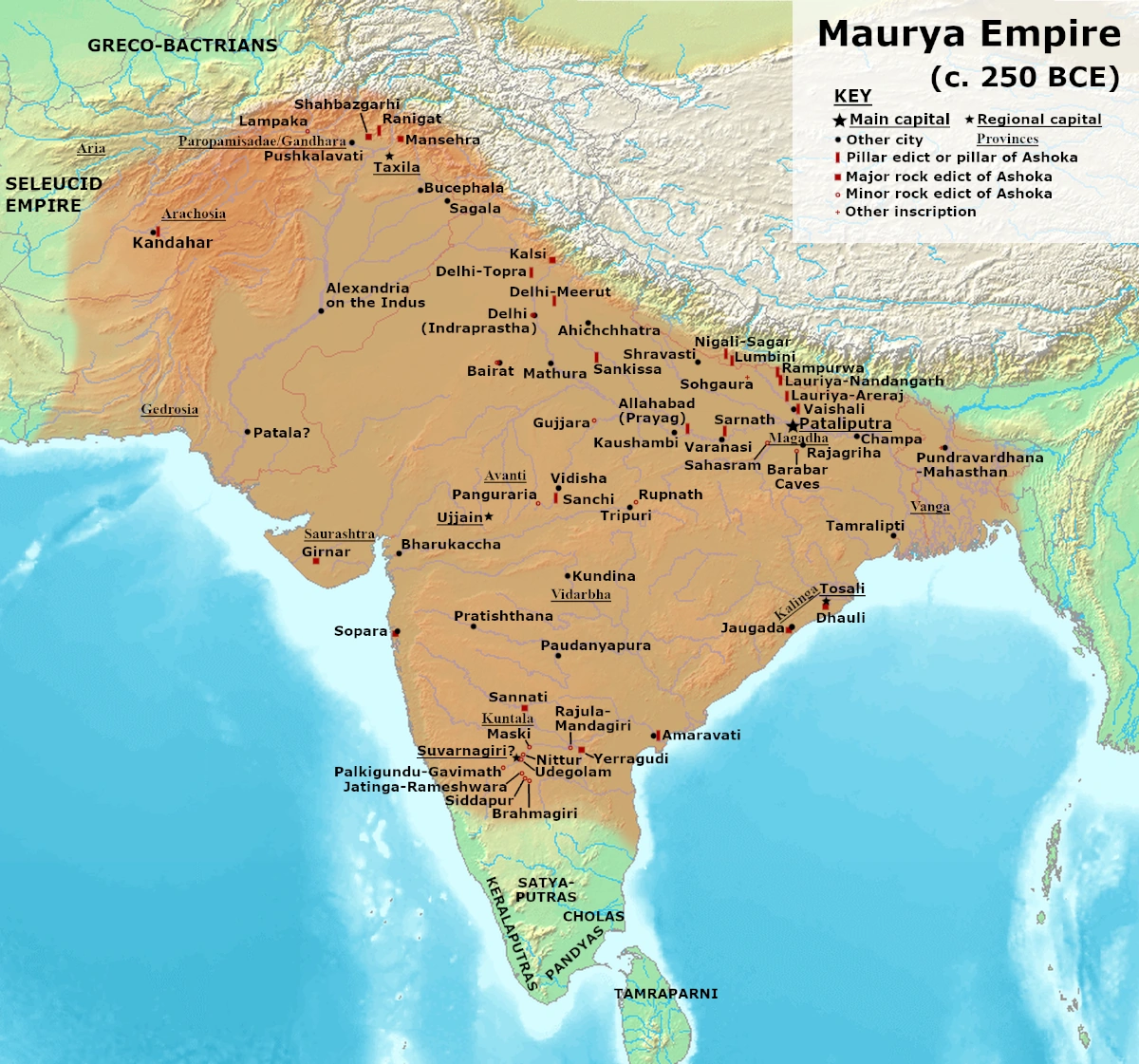
Map study
Mauryan Empire around 250 BCE during Ashoka’s reign: a date-specific historical reconstruction.
- Read the source date and legend before interpreting territorial extent.
- Compare core regions, neighbouring powers and geographic barriers; historical borders and influence are approximate and changed over time.
Credit: Avantiputra7 · CC BY-SA 3.0 · sourceConverted to WebP on an opaque white background; proportionally resized without cropping. Original cartography and legend retained.
1. Identity, historical setting and textual tradition
Kautilya occupies a central place in the Indian tradition of statecraft. Literary traditions identify him with Chanakya, a Brahmana strategist associated with the overthrow of the Nandas and the rise of Chandragupta Maurya around 321 BCE. Vishnugupta is another name connected with the authorial tradition of the Arthashastra. These identifications are conventional, but details of his life cannot be independently established with the certainty available for some later historical figures.
Accounts of Chanakya occur in Buddhist, Jain and Sanskrit literary traditions. Vishakhadatta’s Mudrarakshasa dramatises the political manoeuvres surrounding Chandragupta’s accession and the recruitment of Rakshasa, a former Nanda minister. It is a later literary work, not an eyewitness biography. Stories about Chanakya’s humiliation at the Nanda court or his personal vows should therefore be treated as traditions rather than securely verified events.
The Arthashastra is traditionally attributed to Kautilya, but modern scholarship debates its chronology and authorship. Many scholars regard the surviving work as composite, containing older material and later compilation or redaction extending into the early centuries CE. It remains valuable for understanding ancient political thought, but every prescription should not automatically be labelled a Mauryan practice.
- Exam distinction: Arthashastra concerns statecraft and political economy; it is not merely a book on wealth.
- Chanakya Niti and the Arthashastra are distinct works within the broader textual tradition.
Timeline
Late fourth century BCE
Traditional setting of Kautilya’s association with Chandragupta Maurya.
Early centuries CE
Many modern reconstructions place later compilation or redaction of the surviving Arthashastra in this broad period.
1905
R. Shamasastry brings the manuscript tradition to modern scholarly attention.
1909 and 1915
Shamasastry’s Sanskrit edition and English translation appear respectively.
2. Kingship, order and the seven constituents
The Arthashastra presents government as essential to preventing matsyanyaya, literally the condition in which larger fish devour smaller ones. The expression describes the domination of the weak by the strong when effective authority is absent. Danda, meaning coercive authority or punishment, maintains order when used appropriately. Excessive punishment generates resentment, while inadequate punishment weakens authority; disciplined and proportionate enforcement is therefore important.
Its saptanga theory describes the state through seven constituent elements or prakritis: svamin, the ruler; amatya, the ministers and officials; janapada, the territory and its population; durga, the fortified centre; kosha, the treasury; danda, the coercive or military force; and mitra, the ally. These elements are interdependent. A capable ruler cannot compensate indefinitely for an impoverished population, an empty treasury or unreliable allies.
Kingship demands training, self-control, consultation and sustained attention to public business. The ruler should resist personal vices and appoint competent advisers. The well-known principle that the king’s happiness lies in the happiness of his subjects expresses an instrumental as well as ethical commitment to welfare: productive and secure subjects strengthen the state. Nevertheless, this is monarchical governance, not modern democracy or a theory of equal citizenship.
- The text discusses four branches of learning: anvikshiki, trayi, varta and dandaniti.
- Varta concerns agriculture, cattle-rearing and trade; dandaniti concerns government and coercive authority.
Analytical sequence in Kautilyan strategy
- 1. Assess the seven constituents of one’s own state
- 2. Gather intelligence about other rulers
- 3. Compare strengths, vulnerabilities and alliances
- 4. Choose among the six foreign-policy measures
- 5. Apply suitable diplomatic or coercive methods and reassess
3. Administration, economy and law
The administrative model is detailed and specialised. The samaharta is associated with revenue collection, while the sannidhata manages the treasury and stores. Adhyakshas supervise activities such as agriculture, commerce, mines, forests, weights and measures. Appointment, inspection, accounts and investigation are intended to reduce official misconduct. The text recognises the difficulty of detecting embezzlement, making administrative accountability a recurring concern.
Agriculture is fundamental to fiscal strength. The text discusses settlement, cultivation, irrigation and the management of crown lands. A share of agricultural produce, commonly one-sixth in normative descriptions, is an important revenue source, but taxation varies with circumstances and should not be reduced to a universal fixed rate. Customs duties, commercial levies, fines and income from state-controlled resources also contribute to the treasury.
Economic policy combines private production and exchange with extensive supervision and direct state activity. Regulation of weights, measures, prices and commercial conduct seeks to secure revenue and prevent malpractice. Mines and other strategic resources receive special attention. Calling this system either modern capitalism or socialism is misleading because those categories belong to very different historical settings.
The legal discussions cover debts, deposits, contracts, property, inheritance, marriage, assault and theft. Judicial procedure considers evidence and witnesses, while policing addresses threats to public order. Penalties and rights are not uniformly equal across social categories. The text also recommends measures against calamities and assistance to vulnerable people, showing that coercion, revenue extraction and welfare belong to the same governing framework.
| Concept | Meaning | Focus |
|---|---|---|
| Saptanga | Seven constituents of the state | State capacity |
| Mandala | Circle of rulers | Strategic relationships |
| Shadgunya | Six foreign-policy measures | External policy choices |
| Matsyanyaya | The strong consuming the weak | Need for effective authority |
| Sama, dana, bheda, danda | Persuasion, inducement, division, force | Methods of securing objectives |
4. Diplomacy, intelligence and warfare
The mandala theory analyses a circle of rulers from the standpoint of the vijigishu, the ruler seeking conquest. A neighbouring ruler is treated as a likely enemy, while the enemy’s neighbour may become an ally. This is a strategic model shaped by territorial rivalry, not an immutable rule that all neighbours must always be hostile. Relative strength, geography and political circumstances determine practical choices.
The six measures of foreign policy, or shadgunya, are sandhi, peace or treaty; vigraha, hostility or war; asana, remaining quiet; yana, marching or expedition; samshraya, seeking protection; and dvaidhibhava, a dual policy involving peace with one ruler and hostility towards another. Their application depends on comparative capabilities rather than on a permanent preference for either peace or war.
Diplomacy is supplemented by sama, persuasion; dana, gifts or inducements; bheda, creating divisions; and danda, force. Intelligence networks, secret agents and covert operations support both internal security and external policy. The work considers open fighting, deceptive methods and clandestine action. Its realism is therefore wider than battlefield tactics: alliances, finances, information and the adversary’s internal weaknesses are central to success.
- Do not confuse the four diplomatic expedients with the six foreign-policy measures.
- An ally is one of the seven constituents of the state, underlining the importance of external relationships.
5. Historical significance and source criticism
The Arthashastra provides an unusually systematic account of ancient governance, but it describes what a ruler should do rather than documenting what every ruler actually did. Historians compare it with Ashokan inscriptions, archaeology and the surviving fragments of Megasthenes’ Indica. Differences may reflect chronology, regional variation, literary purpose or the gap between prescriptions and practice.
Its rediscovery transformed the study of Indian political thought. Comparisons with Machiavelli highlight political realism, but the label ‘Indian Machiavelli’ is inadequate: Kautilya’s work also devotes extensive attention to production, taxation, judicial administration and public protection. For Prelims, focus on technical terms, official functions and source distinctions rather than colourful legends.
- Ashoka’s dhamma inscriptions and the Arthashastra have different purposes; neither alone represents the entire Mauryan state.
- Avoid treating modern strategic analogies as proof of direct continuity from ancient institutions.
Real-world case studies
Sudarshana Lake: corroboration with limits
Rudradaman’s Junagadh inscription of 150 CE attributes the original Sudarshana reservoir to Pushyagupta, a governor under Chandragupta Maurya, and mentions works under Ashoka. It independently illustrates state-supported irrigation, a concern of the Arthashastra. It does not prove that the project followed Kautilya’s instructions.
Mysore and the modern recovery of the text
While working at the Oriental Library in Mysore, R. Shamasastry examined a manuscript supplied by a scholar from the Tanjore region. His publications made the Arthashastra widely accessible and substantially expanded the evidence available for studying ancient Indian administration.
Previous year questions
No source-linked PYQ is available here yet. Use the practice questions below.
Practice questions
Practice MCQ 1
Which of the following is not one of the seven constituents in Kautilya’s saptanga theory?
- A. Kosha
- B. Mitra
- C. Durga
- D. Sabha
Practice MCQ 2
Consider these statements: 1. The samaharta is associated with revenue collection. 2. Varta includes agriculture, cattle-rearing and trade. 3. Dvaidhibhava means permanent neutrality towards every ruler. Which statements are correct?
- A. 1 and 2 only
- B. 2 and 3 only
- C. 1 and 3 only
- D. 1, 2 and 3
Practice MCQ 3
Which statement best describes the Arthashastra as a historical source?
- A. It is an Ashokan inscription explaining dhamma.
- B. It is a prescriptive treatise whose surviving form has a debated textual history.
- C. It is an eyewitness Greek account of Pataliputra.
- D. It deals exclusively with religious ritual.
Mains practice · Kautilya’s conception of statecraft combines political realism with administrative and economic responsibility. Discuss, noting the limitations of the Arthashastra as a source for Mauryan history. Answer in 250 words.
- Introduce the traditional attribution and debated composition.
- Explain matsyanyaya, danda and the interdependence of the seven constituents.
- Discuss taxation, production, accountability and protection of subjects.
- Examine mandala, shadgunya and intelligence as instruments of realism.
- Distinguish normative prescriptions from documented practice.
- Conclude with the need for inscriptions, archaeology and comparative textual evidence.
Further reading
- R. S. Sharma, Ancient India, old NCERT.
- Upinder Singh, A History of Ancient and Early Medieval India.
- R. P. Kangle, The Kautiliya Arthasastra.
- Patrick Olivelle, King, Governance, and Law in Ancient India: Kautilya’s Arthasastra.
Preparing for UPSC Civil Services? Get classroom teaching, answer-writing evaluation and mentorship at Pragnya IAS Academy, Ashok Nagar — see why aspirants choose us for IAS coaching in Hyderabad.