
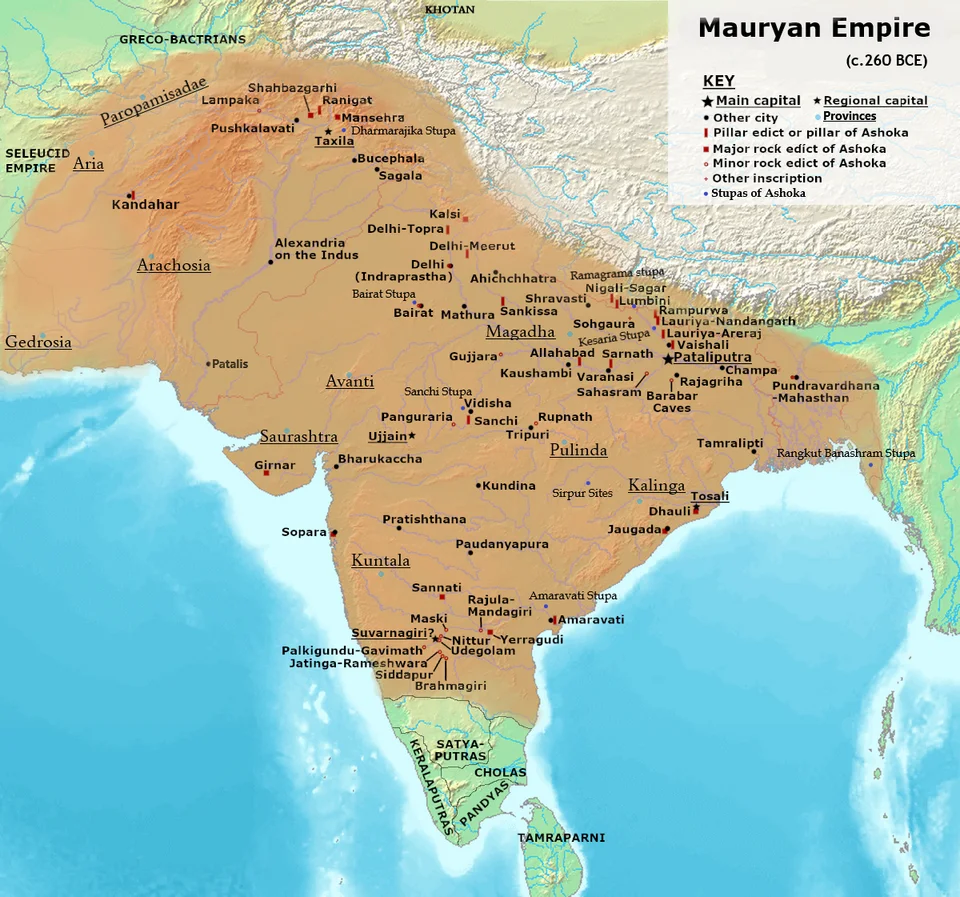
Illustrative reconstruction of Mauryan imperial extent under Ashoka, based on inscriptions and historical sources.
Credit: Levakpitam · CC BY-SA 3.0 · sourceResized and converted to WebP; uncropped.
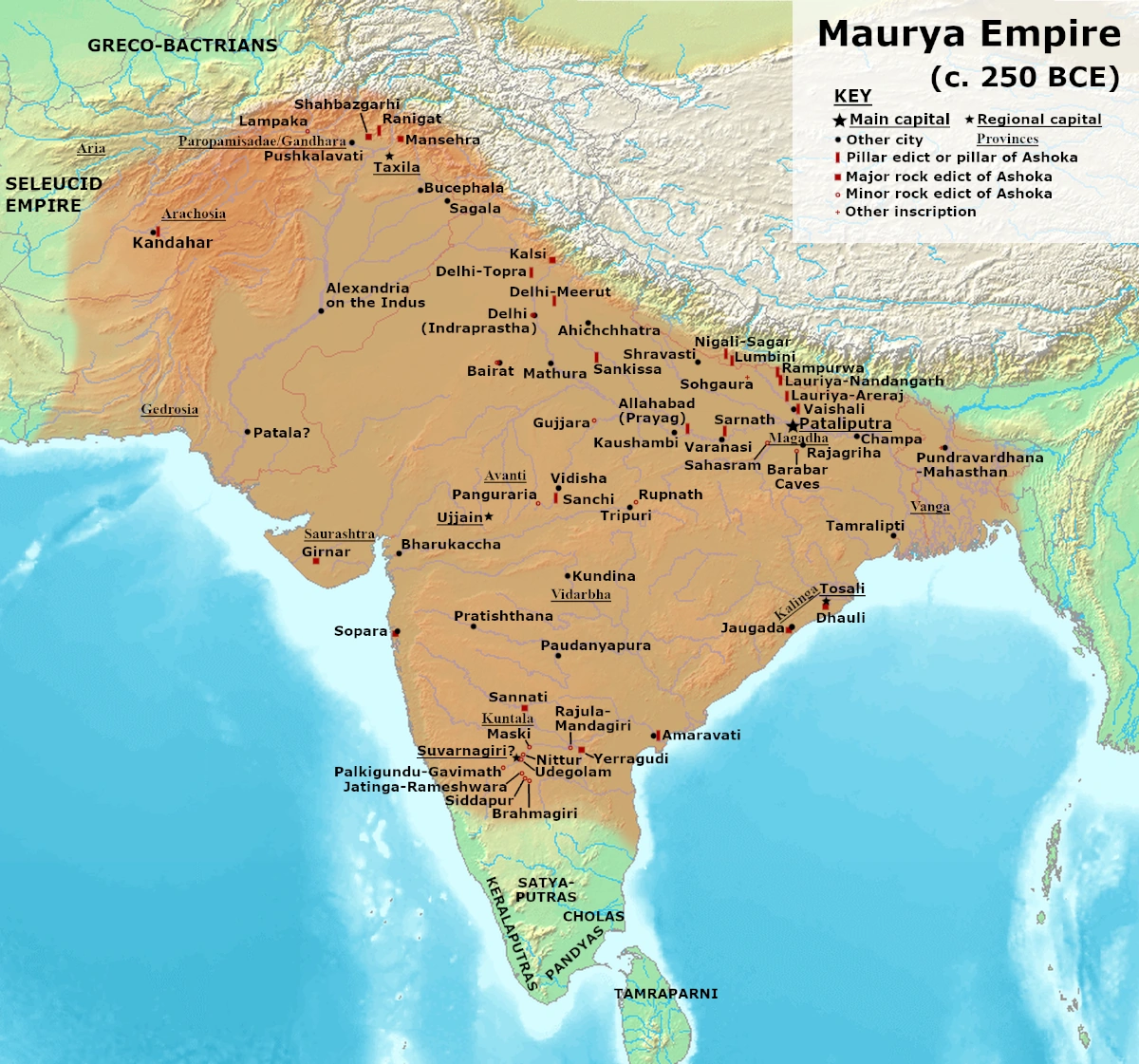
Map study
Mauryan Empire around 250 BCE during Ashoka’s reign: a date-specific historical reconstruction.
- Read the source date and legend before interpreting territorial extent.
- Compare core regions, neighbouring powers and geographic barriers; historical borders and influence are approximate and changed over time.
Credit: Avantiputra7 · CC BY-SA 3.0 · sourceConverted to WebP on an opaque white background; proportionally resized without cropping. Original cartography and legend retained.
1. Sources and the character of the Mauryan state
The Mauryan Empire, conventionally dated c. 321–185 BCE, was the first empire to bring much of the Indian subcontinent under one ruling dynasty. Chandragupta established its foundations, Bindusara continued its expansion, and Ashoka ruled its most extensively documented phase. The state controlled a substantial agricultural revenue base, important urban centres and strategic routes. However, imperial claims should not be confused with equally intensive administration throughout every region.
Ashoka’s rock and pillar inscriptions are the strongest contemporary evidence for official responsibilities, royal communication, provincial centres and public policy. Most are in Prakrit written in Brahmi, while northwestern inscriptions also use Kharosthi; Greek and Aramaic versions occur in the northwest. Their geographical and linguistic variation reveals an effort to communicate with different populations.
The Arthashastra, traditionally attributed to Kautilya or Chanakya, describes kingship, revenue, espionage, law and departmental supervision. Its composition and redaction extended across time, so its institutions must be compared with inscriptions rather than automatically assigned to Chandragupta. Megasthenes, a Seleucid envoy associated with Chandragupta’s court, wrote the Indica, now surviving through quotations in later classical authors. These fragments offer valuable but sometimes schematic descriptions.
The older interpretation of a uniformly centralised bureaucratic empire is therefore qualified by modern scholarship. The Gangetic core probably experienced stronger direct control, while frontier, forest and peripheral regions could be governed through different combinations of officials, military pressure, negotiation and local intermediaries.
Timeline
c. 321 BCE
Chandragupta Maurya establishes the dynasty and consolidates power in the Gangetic region.
c. 305–303 BCE
Conflict and settlement with Seleucus I strengthen Mauryan control in the northwest and establish diplomatic relations.
c. 268 BCE
Ashoka’s coronation, according to a widely used chronology.
c. 261 BCE
Kalinga war, fought in Ashoka’s eighth regnal year.
Ashoka’s thirteenth regnal year
Appointment of dhamma-mahamatras, recorded in Major Rock Edict V.
c. 185 BCE
The Mauryan dynasty ends with the overthrow of Brihadratha by Pushyamitra Shunga.
2. King, central government and provincial administration
The king stood at the centre of policy, appointments, warfare and justice. Ministers and advisers assisted him, while senior officials supervised specialised functions. The Arthashastra stresses consultation, disciplined royal routines and the testing of officials. Ashoka’s Major Rock Edict VI presents a king who expected reports concerning public affairs at all times, illustrating the importance attached to communication and personal supervision.
The Arthashastra distinguishes the samaharta, concerned principally with revenue collection and its organisation, from the sannidhata, responsible for treasury and stores. Adhyakshas were superintendents overseeing activities such as trade, agriculture, mines, weights and measures. These designations are useful for understanding the text’s administrative model, but their precise empire-wide operation under the Mauryas is not independently established.
Provincial administration linked Pataliputra with major regional centres. Taxila connected the empire to northwestern routes, Ujjayini to western and central India, Tosali to Kalinga, and Suvarnagiri to the southern territories. Princes designated kumaras or aryaputras exercised authority at some centres, assisted by mahamatras. It is safer to recognise these centres than to assume a fixed, uniform provincial map for every Mauryan reign.
Ashokan inscriptions mention yuktas, rajukas and pradesikas. Yuktas are generally understood as subordinate executive or accounting officials; pradesikas had regional supervisory responsibilities; rajukas exercised authority over large populations and received important judicial powers. Their exact hierarchy remains debated. Major Rock Edict III ordered these officials to undertake five-yearly tours for administrative duties and instruction in dhamma.
Illustrative cycle of imperial administration, not a fixed official hierarchy
- 1. King formulates orders with advisers
- 2. Provincial authorities and senior officials receive instructions
- 3. Regional and local personnel implement duties
- 4. Tours, inspections and reports communicate conditions
- 5. Royal or delegated authorities issue corrective directions
3. Revenue, economy and local administration
Agriculture sustained the imperial fiscal system. The Arthashastra distinguishes produce from crown lands from the king’s share of privately cultivated land. Bhaga, commonly represented as one-sixth of produce in textual discussions, was an important revenue concept, but actual liabilities could vary by circumstances and locality. Customs, trade-related dues, fines and income from state-controlled resources supplemented agricultural receipts.
Ashoka’s Rummindei inscription provides unusually specific fiscal evidence. Commemorating his visit to the Buddha’s birthplace at Lumbini, it records relief from bali and a reduction of the produce share to one-eighth. The inscription is important because it demonstrates a local concession rather than proving one standard rate throughout the empire.
The Arthashastra envisages close supervision of mines, forests, salt, commerce, weights and measures, and irrigation. Such regulation served revenue collection, resource mobilisation and the prevention of fraud. Nevertheless, extensive private cultivation, production and exchange continued; state regulation did not mean that the whole economy was directly operated by the government.
Villages were basic units of production and assessment. Village headmen and local record-keeping arrangements helped connect cultivators to higher authorities. The Arthashastra discusses officials such as gopas and sthanikas in territorial administration, although their functions depended on context. Local knowledge and established social institutions remained important even within a strong imperial framework.
Megasthenes’ account describes Pataliputra’s civic administration through six committees of five members, dealing with crafts, foreigners, births and deaths, trade, manufactured goods and sales taxation. For examination purposes, this should be identified specifically as a Greek account of urban administration, not an inscriptionally verified system operating in every Mauryan city.
| Office | Principal association | Main source |
|---|---|---|
| Samaharta | Organisation and collection of revenue | Arthashastra |
| Sannidhata | Treasury and stores | Arthashastra |
| Adhyaksha | Supervision of a specialised department or activity | Arthashastra |
| Rajuka | Authority over large populations; judicial responsibilities | Ashokan edicts |
| Pradesika | Regional supervision and periodic tours | Major Rock Edict III |
| Dhamma-mahamatra | Promotion of dhamma and welfare responsibilities | Major Rock Edict V |
4. Military organisation, intelligence and justice
A substantial military establishment supported conquest, internal order and frontier security. Infantry, cavalry, chariots and elephants were major components. Greek accounts describe six military boards concerned with these four arms, naval matters, and transport and provisioning. Their numerical descriptions should be treated cautiously, but the emphasis on logistical organisation is significant.
The Arthashastra assigns a central role to intelligence gathering. Agents operating under different disguises were intended to detect disloyalty, corruption and threats. Alongside this, the text recommends inspection, accounts and penalties for official misconduct. These are prescriptions for maintaining royal control, not evidence that every suggested technique was implemented throughout the empire.
Justice was part of royal authority, exercised through officials and institutions below the king. The Arthashastra addresses contracts, property, inheritance, assault, theft and public order. Its punishments could be severe and socially differentiated. Mauryan governance should therefore not be described as equality before law in the modern constitutional sense.
Ashoka sought greater consistency and restraint in punishment. Pillar Edict IV granted rajukas discretion in rewards and penalties and called for uniformity in judicial procedure and punishment. It also provided a three-day respite for condemned prisoners, allowing relatives to appeal or enabling religious preparation. This moderated penal practice without abolishing capital punishment.
5. Ashoka’s dhamma and administrative adaptation
Following the Kalinga war, conventionally dated c. 261 BCE, Ashoka increasingly presented kingship as a moral responsibility. His dhamma emphasised respect for parents and elders, generosity, restraint in killing, proper treatment of servants and tolerance between religious communities. Although Ashoka personally supported Buddhism, imperial dhamma was not simply the imposition of Buddhist doctrine.
Dhamma-mahamatras, appointed in the thirteenth regnal year according to Major Rock Edict V, worked for moral welfare and among different social and religious groups. Their responsibilities included attention to prisoners and vulnerable persons. They supplemented existing administrative structures rather than replacing revenue, military or judicial officials.
Major Rock Edict II refers to medical treatment for humans and animals, medicinal plants, wells and tree planting. Pillar Edict VII also describes roadside amenities. These measures linked royal legitimacy with public welfare and communication along routes. Separate Kalinga Edicts addressed officials at Tosali and Samapa, emphasising impartiality, avoidance of harsh treatment and the king’s paternal concern for his subjects.
The Mauryan achievement lay in combining resource extraction, political integration and communication over a vast territory. Its limitations included uneven penetration, dependence on officials and the difficulty of supervising distant regions. Ashoka did not abandon coercive authority after Kalinga, and the empire’s eventual decline cannot be explained simply as the consequence of his non-violence.
Imperial Geography and Mauryan Administration
The supplied metadata describes a reconstruction of Mauryan imperial extent using Ashokan inscriptions and historical sources. Such a map provides geographical context for administration: governing a large, environmentally varied empire required provincial centres, communication routes, revenue arrangements and officials connecting the monarchy with local society. It should not, however, be read as a chart of administrative divisions or proof that every region experienced equally intensive state control.
Ashokan inscriptions offer direct evidence of royal instructions and named categories of officials. Major Rock Edict III directs yuktas, rajukas and pradesikas to undertake periodic tours that included instruction in dhamma. Other edicts illuminate the responsibilities of dhamma-mahamatras and the judicial role of rajukas. These references reveal mechanisms of supervision and engagement with subjects, but they do not supply a complete organisational chart of the empire.
For ancient Indian history, the key distinction is between imperial reach and administrative uniformity. Inscription locations establish where particular royal messages were recorded; they do not independently fix every frontier. References to neighbouring peoples or kingdoms must also be distinguished from claims of sovereignty. The Arthashastra and Greek accounts broaden the reconstruction, but their prescriptions, transmission and historical contexts require scrutiny rather than automatic equation with Ashoka’s administration.
- Prelims: distinguish officials attested in Ashokan edicts from offices reconstructed chiefly through textual sources.
- Mains: explain how central authority could coexist with provincial delegation and local diversity.
- Evidence limit: a reconstructed imperial boundary is not a verified provincial boundary or measure of bureaucratic penetration.
Real-world case studies
Sudarshana lake: infrastructure and provincial initiative
Rudradaman’s Junagadh inscription of c. 150 CE retrospectively attributes the Sudarshana reservoir’s construction to Pushyagupta, Chandragupta’s provincial governor, and channels to Tushaspha under Ashoka. It illustrates the remembered connection between Mauryan provincial government and irrigation. Since the inscription is much later, it must be identified as retrospective evidence.
Kalinga: governance after conquest
The Separate Kalinga Edicts at Dhauli and Jaugada instructed officials to avoid unjust imprisonment and harsh treatment. Ashoka’s declaration that all people were his children expressed paternal kingship. These instructions show an attempt to manage a conquered region through supervision and conciliation alongside continuing imperial authority.
Previous year questions
No source-linked PYQ is available here yet. Use the practice questions below.
Practice questions
Practice MCQ 1
Consider the following statements: 1. Ashokan inscriptions are contemporary sources for Mauryan administration. 2. The surviving Arthashastra can be treated as an exact record of all institutions functioning under Chandragupta. 3. Megasthenes’ Indica survives mainly through quotations in later works. Which statements are correct?
- A. 1 and 2 only
- B. 1 and 3 only
- C. 2 and 3 only
- D. 1, 2 and 3
Practice MCQ 2
Which pair is incorrectly matched?
- A. Samaharta — Revenue collection
- B. Sannidhata — Treasury and stores
- C. Rajuka — Judicial responsibilities under Ashoka
- D. Dhamma-mahamatra — Exclusive supervision of the cavalry
Practice MCQ 3
With reference to Ashoka’s administration, consider the following statements: 1. Major Rock Edict III prescribed five-yearly tours by certain officials. 2. Pillar Edict IV abolished capital punishment. 3. The Rummindei inscription records a fiscal concession to Lumbini. Which statements are correct?
- A. 1 only
- B. 2 and 3 only
- C. 1 and 3 only
- D. 1, 2 and 3
Mains practice · The Mauryan Empire combined centralised authority with administrative diversity. Discuss with reference to the available sources and Ashoka’s innovations. Answer in 250 words.
- Introduce the empire’s geographical scale and distinguish central authority from uniform administrative penetration.
- Explain monarchy, advisers, revenue institutions and provincial centres.
- Use inscriptions for rajukas, official tours, royal reporting and dhamma-mahamatras.
- Qualify the evidence of the Arthashastra and Greek accounts.
- Discuss welfare, judicial restraint and Kalinga-specific instructions.
- Conclude that imperial integration coexisted with regional variation and local intermediaries.
Further reading
- NCERT, Themes in Indian History, Part I: Kings, Farmers and Towns.
- R. S. Sharma, India’s Ancient Past, chapters on the Mauryan Empire.
- Upinder Singh, A History of Ancient and Early Medieval India, chapter on the Mauryan Empire.
- Romila Thapar, Asoka and the Decline of the Mauryas.
- Archaeological Survey of India: information on Mauryan sites and Ashokan inscriptions, asi.nic.in.
- https://commons.wikimedia.org/wiki/File:Ashoka_Maurya_Empire.png
Preparing for UPSC Civil Services? Get classroom teaching, answer-writing evaluation and mentorship at Pragnya IAS Academy, Ashok Nagar — see why aspirants choose us for IAS coaching in Hyderabad.