
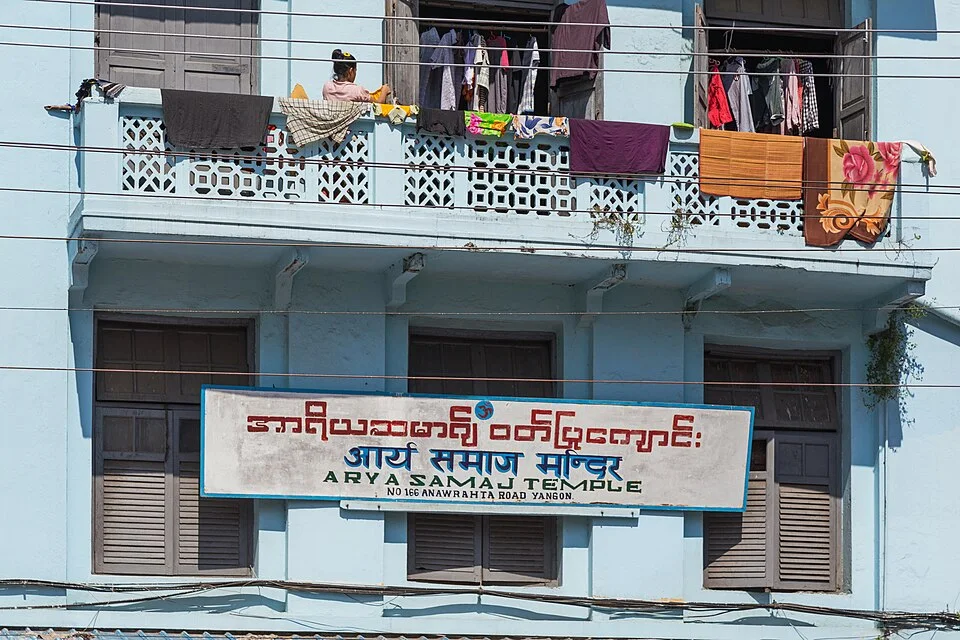
Arya Samaj temple in Yangon, Myanmar: an overseas institutional example.
Credit: Marcin Konsek · CC BY-SA 4.0 · sourceResized and converted to WebP; uncropped.
1. Historical setting, founder and geographical expansion
Arya Samaj emerged within the nineteenth-century debate over religious authority and social regeneration under colonial rule. Christian missionary criticism, Western education, print culture and the public reform activities of organisations such as the Brahmo Samaj encouraged Indians to reassess inherited practices. Dayanand’s response was neither simple acceptance of Western modernity nor defence of every existing Hindu custom. He argued that authentic religion lay in the Vedas and that many contemporary practices were later corruptions. This combination gave Arya Samaj its distinctive character as both a reformist and a Vedic revivalist movement.
Born Mool Shankar in 1824, Dayanand left household life and travelled in search of religious knowledge. His studies under Swami Virajanand at Mathura strengthened his commitment to Sanskrit learning and the recovery of what he regarded as original Vedic truth. He used public debates, lectures and writing to challenge priestly authority and popular religious practices. His major work, Satyarth Prakash, presented his interpretation of Vedic religion while critically examining other religious traditions.
Dayanand founded Arya Samaj in Bombay on 10 April 1875. Its institutional base subsequently became particularly strong in Punjab, the North-Western Provinces, including areas of present-day Uttar Pradesh, and parts of Rajasthan. Lahore became an important organisational and educational centre. After Dayanand’s death in 1883 at Ajmer, followers expanded the movement through schools, associations, publications and social service. Its influence was therefore shaped as much by institution-building as by the founder’s teachings.
- Examination distinction: Dayanand founded Arya Samaj; Raja Rammohan Roy founded the Brahmo Sabha, the precursor of the Brahmo Samaj.
- Arya Samaj’s strongest organisational expansion occurred in northern India, although it originated in Bombay.
Timeline
1824
Mool Shankar, later Swami Dayanand Saraswati, was born at Tankara.
1875
Arya Samaj was founded in Bombay; Satyarth Prakash was first published.
1877
The Lahore organisation was established and became important in consolidating the movement’s principles.
1883
Dayanand died at Ajmer.
1886–1889
DAV School and subsequently DAV College were established at Lahore.
1893
Institutional differences produced the College and Gurukul tendencies.
1902
Munshi Ram established Gurukul Kangri near Haridwar.
2. Religious ideas and the ten principles
Arya Samaj upheld belief in one formless, omniscient and just God. Dayanand treated the Vedas as the highest revealed authority and maintained that their true meaning was compatible with reason and valid knowledge. He rejected idol worship, divine incarnations and the idea that elaborate priest-mediated observances were essential to salvation. He also challenged the religious authority accorded to later texts when their teachings conflicted with his interpretation of the Vedas. The movement’s appeal to reason thus operated within a firm commitment to Vedic authority rather than unrestricted religious scepticism.
The ten principles combine theology with ethical and social obligations. They call for studying and teaching the Vedas, accepting truth and rejecting falsehood, acting according to dharma, spreading knowledge and working for the physical, spiritual and social welfare of humanity. They also stress justice and affection in dealings with others and link individual welfare to the welfare of society. These principles provided a common framework for a movement that developed different institutional approaches after its founder’s death.
Arya worship commonly included havan or yajna, Vedic recitation and collective instruction. Its opposition to rituals should therefore not be understood as rejection of every ceremonial practice: it opposed practices considered non-Vedic while retaining those interpreted as authentically Vedic. Similarly, 'Back to the Vedas' was a programme for religious purification and social reconstruction, not a straightforward demand to reproduce every feature of ancient society.
- Core combination: monotheism, Vedic authority, ethical conduct and organised social service.
- Do not confuse Arya Samaj’s rejection of idol worship with rejection of Hindu religious identity.
Arya Samaj’s programme of regeneration
- 1. Identify the Vedas as the source of authentic religion
- 2. Challenge practices considered non-Vedic
- 3. Promote learning, ethical conduct and social reform
- 4. Build schools, associations and service institutions
- 5. Strengthen collective self-respect and public participation
3. Social reform, women and caste
Arya Samaj opposed child marriage, supported widow remarriage and promoted education for women. Its schools and public campaigns challenged the view that women should remain excluded from formal learning or sacred knowledge. Dayanand advocated access to Vedic study beyond the hereditary groups that had traditionally claimed it. Arya institutions also undertook charitable work, including assistance during famine and the establishment of orphanages, linking religious regeneration with practical social responsibility.
On caste, Dayanand rejected the proposition that birth alone should determine social rank. He defended an idealised varna system based on qualities, conduct and occupation rather than hereditary entitlement. Arya reformers consequently criticised untouchability and restrictions that denied large sections of society access to education and religious participation. However, describing Dayanand as rejecting every form of varna would be inaccurate. His position differed from later movements seeking the complete annihilation of caste, and institutional ideals did not automatically remove caste distinctions among followers.
Shuddhi, meaning purification, became an important means of admitting or readmitting individuals and communities into the Hindu fold. It acquired greater organisational prominence under later leaders, particularly Swami Shraddhanand. Supporters saw it as a challenge to exclusion and a response to conversion. Critics and rival religious organisations often perceived it as competitive religious mobilisation. Its significance must therefore be assessed both as an effort to widen religious membership and as a development that sometimes intensified inter-community tensions.
- Women’s education, widow remarriage and opposition to child marriage are central social-reform themes.
- Rejection of caste by birth should be distinguished from rejection of the concept of varna itself.
| Dimension | Arya Samaj | Brahmo Samaj |
|---|---|---|
| Origin | Dayanand Saraswati; Bombay, 1875 | Rammohan Roy’s Brahmo Sabha; Calcutta, 1828 |
| Religious authority | Supreme authority of the Vedas | Initially drew strongly on the Upanishads; later branches developed differing theological positions |
| Shared reform concerns | Monotheism, opposition to idol worship and support for social reform | Monotheism, opposition to idol worship and support for social reform |
| Distinctive activities | DAV institutions, Gurukul education and shuddhi | Congregational worship and reformist religious and social associations |
| Major regional strength | Punjab and northern India | Bengal, with influence beyond the region |
4. Education: DAV and Gurukul traditions
Education became Arya Samaj’s most durable institutional contribution. The Dayanand Anglo-Vedic School opened at Lahore in 1886, followed by a college in 1889. Lala Hans Raj played a leading role, with support from figures such as Lala Lajpat Rai and Pandit Guru Dutt Vidyarthi. The DAV approach sought to combine modern subjects and English education with Indian cultural values and Vedic instruction. It offered an alternative to missionary education without discarding the knowledge and qualifications needed in contemporary society.
Differences over educational priorities contributed to a division in the movement in 1893. The DAV or College tendency favoured greater accommodation with modern education, while the Gurukul tendency emphasised residential discipline, Sanskrit learning and a more explicitly Vedic environment. Munshi Ram, later known as Swami Shraddhanand, founded Gurukul Kangri near Haridwar in 1902. It sought to organise education around the teacher-pupil relationship and a disciplined residential life, while also including modern subjects. Neither branch should be reduced to a simple contrast between progressive and reactionary education.
- DAV: synthesis of modern education and Vedic cultural instruction.
- Gurukul Kangri: residential Vedic educational ideal associated with Munshi Ram, later Swami Shraddhanand.
5. Nationalism, achievements and limitations
Arya Samaj helped cultivate confidence in Indian civilisation and encouraged collective organisation under colonial rule. Its schools, debating culture and service associations developed networks useful for public life. Several members participated actively in nationalism; Lala Lajpat Rai is the most prominent example. The movement also encouraged the spread of Hindi in the Devanagari script, although its regional activities operated in multilingual settings. Arya Samaj was a religious-social organisation, however, not a political party with a single uniform position.
Its achievements included educational expansion, challenges to hereditary religious privilege and the creation of durable voluntary institutions. Yet its uncompromising claims about Vedic truth and sharp criticism of other religions could limit interfaith accommodation. Shuddhi, cow-protection campaigns and language controversies sometimes became entangled with competitive communal politics. A balanced historical assessment therefore recognises both reform and religious boundary-making. Arya Samaj illustrates how nineteenth-century reform could use an idealised ancient past to pursue modern social change, rather than treating revivalism and reform as mutually exclusive categories.
- UPSC analytical frame: religious doctrine, social reform, education, nationalism and limitations.
- Avoid assuming that all Arya Samaj members shared identical political views or social practices.
Arya Samaj: Vedic Reform and Overseas Reach
The supplied metadata identifies an Arya Samaj temple on Anawratha Road in Yangon, Myanmar. It provides an overseas example of an institution associated with the movement, rather than evidence from India itself. Its identification illustrates Arya Samaj’s presence beyond India, but does not establish when this institution began, who supported it or how its practices developed. The label ‘temple’ should not be taken as proof of image worship: Arya Samaj rejected idol worship while supporting congregational prayer, Vedic instruction and havan.
Founded by Swami Dayanand Saraswati in Bombay in 1875, Arya Samaj joined Vedic authority to programmes of social reform. Its opposition to caste determined solely by birth should not be confused with rejection of every conception of varna; Dayanand interpreted social classification through qualities and conduct. Education became a major institutional expression of reform. The Dayanand Anglo-Vedic network combined modern learning with Vedic commitments, whereas the Gurukul stream placed greater emphasis on residential education and Vedic discipline. These approaches demonstrate that revivalist religious language could coexist with differing responses to colonial modernity.
- Theology: Distinguish Arya Samaj’s Vedic monotheism and rejection of idol worship from a general defence of all inherited Hindu practices.
- Social reform: Women’s education, widow remarriage and opposition to child marriage were important concerns; shuddhi sought admission or readmission to the Hindu fold.
- Nationalism and evidence: Arya Samaj encouraged self-respect and public mobilisation, but was not a political party. The Yangon institution alone cannot demonstrate its Indian political influence.
Real-world case studies
DAV Lahore: reform through modern institutions
The establishment of DAV School in 1886 demonstrated how a Vedic reform movement could adopt modern institutional education. Under Lala Hans Raj’s leadership, the initiative combined contemporary learning with cultural instruction. The expanding DAV network made educational institution-building a lasting vehicle of Arya Samaj influence.
Gurukul Kangri: an alternative educational model
Founded in 1902 near Haridwar by Munshi Ram, Gurukul Kangri emphasised residential learning, discipline and Vedic culture. Its inclusion of modern subjects shows that cultural revival did not necessarily imply wholesale rejection of contemporary knowledge. It represented an alternative balance between cultural autonomy and modern education.
Previous year questions
No source-linked PYQ is available here yet. Use the practice questions below.
Practice questions
Practice MCQ 1
With reference to Arya Samaj, consider the following statements: 1. It regarded the Vedas as the highest revealed authority. 2. Dayanand upheld birth as the sole basis of varna. 3. It supported women’s education. Which of the statements given above are correct?
- A. 1 and 2 only
- B. 1 and 3 only
- C. 2 and 3 only
- D. 1, 2 and 3
Practice MCQ 2
Which one of the following pairs is correctly matched?
- A. Arya Samaj foundation — Calcutta, 1828
- B. DAV School, Lahore — 1886
- C. Gurukul Kangri — Founded by Dayanand in 1875
- D. Satyarth Prakash — Written by Swami Vivekananda
Practice MCQ 3
Which one of the following best describes shuddhi as associated with Arya Samaj?
- A. A programme confined to teaching English
- B. A movement for worship of divine incarnations
- C. A process of admitting or readmitting people into the Hindu fold
- D. A campaign to recognise hereditary priestly monopoly
Mains practice · Arya Samaj combined religious revival with social reform and modern institution-building. Discuss with reference to its educational and social programmes. Answer in 250 words.
- Introduce Dayanand and the foundation of Arya Samaj in 1875.
- Explain Vedic authority, monotheism and opposition to idol worship.
- Discuss women’s education, widow remarriage and opposition to hereditary caste privileges.
- Distinguish reform of varna from complete rejection of varna.
- Compare DAV’s educational synthesis with Gurukul Kangri’s residential model.
- Assess nationalism and social service alongside tensions arising from religious polemics and shuddhi.
- Conclude that appeals to antiquity could support modern institutional and social change.
Further reading
- NCERT, Our Pasts III, chapter Women, Caste and Reform.
- NCERT, History of Modern India by Bipan Chandra, sections on religious and social reform.
- Swami Dayanand Saraswati, Satyarth Prakash, for the movement’s primary doctrinal exposition.
- DAV College Managing Committee official website, institutional history.
- Gurukula Kangri official website, history of the institution.
- https://commons.wikimedia.org/wiki/File:2016_Rangun,_Ulica_Anawratha,_%C5%9Awi%C4%85tynia_Arya_Samaj_(02).jpg
Preparing for UPSC Civil Services? Get classroom teaching, answer-writing evaluation and mentorship at Pragnya IAS Academy, Ashok Nagar — see why aspirants choose us for IAS coaching in Hyderabad.