
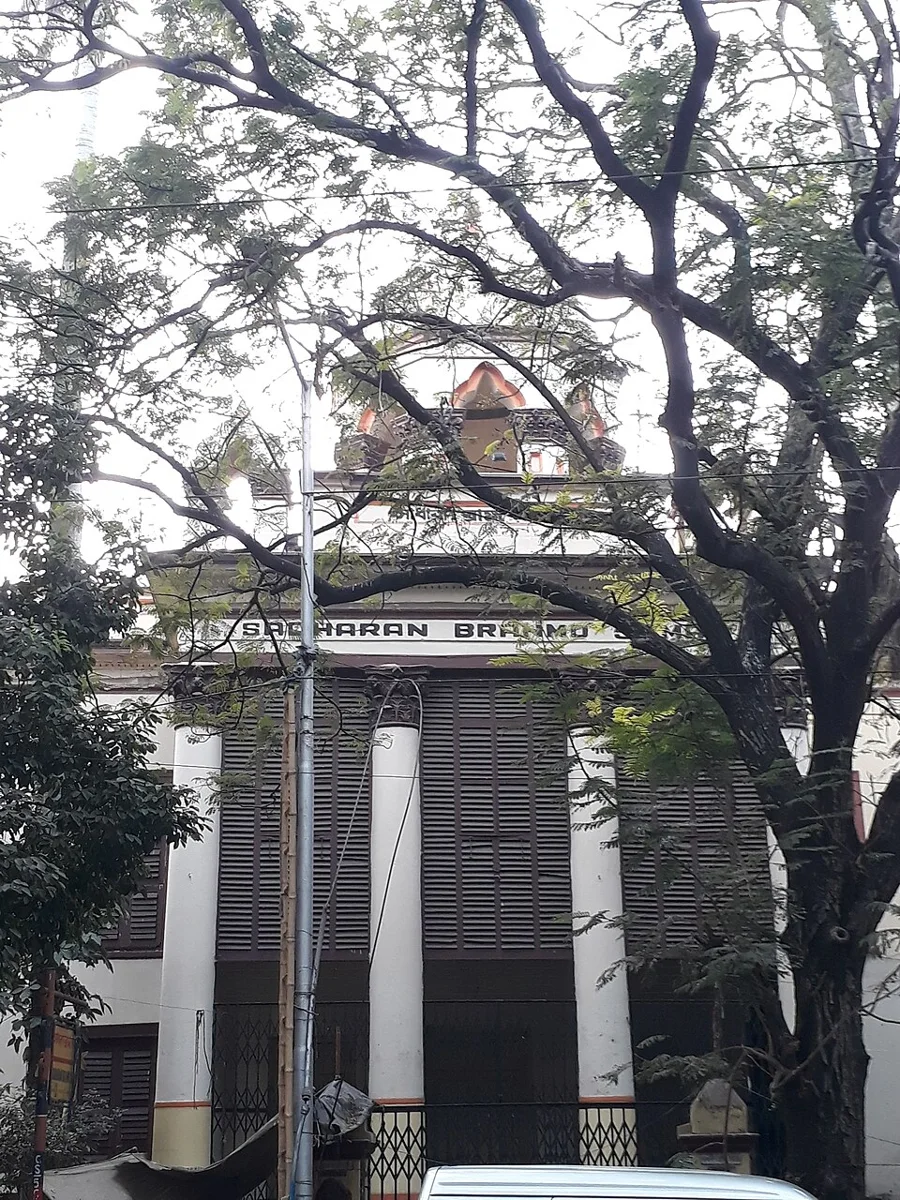
Sadharan Brahmo Samaj building on Bidhan Sarani, Kolkata, associated with a distinct branch of the Brahmo movement.
Credit: Pinakpani · CC BY-SA 4.0 · sourceResized and converted to WebP; uncropped.
1. Origins and the historical setting
The Brahmo Samaj emerged in early nineteenth-century Bengal, where colonial rule, expanding print culture, missionary criticism and new educational institutions stimulated debate about religion and society. Educated Indians confronted questions concerning scriptural authority, social hierarchy and the position of women. The movement formed part of the broader intellectual transformation commonly called the Bengal Renaissance. This term describes a significant cultural awakening, but should not suggest that change reached every social group equally.
Raja Rammohan Roy drew upon several intellectual traditions: the Upanishads and Vedanta, Islamic monotheism, Persian-Arabic learning, and Christian ethical thought. His reformism was therefore neither a simple imitation of Europe nor an uncritical return to the past. He argued that reason and a critical reading of religious texts could recover ethical religion from practices he regarded as corruptions.
Roy established the Atmiya Sabha in Calcutta in 1815 as a forum for religious and philosophical discussion. On 20 August 1828, he founded the Brahmo Sabha, which developed into the Brahmo Samaj. The opening of its worship building in January 1830 and the accompanying trust deed gave the movement an enduring institutional foundation. Roy’s death at Bristol in 1833 deprived it of its founder, but did not end its influence.
- Historical setting: colonial Bengal, print-based public debate and interaction between Indian and European intellectual traditions.
- Exam distinction: Atmiya Sabha preceded Brahmo Sabha; they were not founded in the same year.
Timeline
1815
Rammohan Roy established the Atmiya Sabha in Calcutta.
1828
Brahmo Sabha was founded on 20 August.
1829–1830
Sati was prohibited in the Bengal Presidency in 1829; the Brahmo worship building and trust deed followed in January 1830.
1839–1843
Debendranath founded Tattwabodhini Sabha in 1839, joined the Brahmo movement in 1843, and supported the launch of Tattwabodhini Patrika.
1858–1866
Keshab Chandra Sen joined in 1858 and established Brahmo Samaj of India after the 1866 division.
1878
Sadharan Brahmo Samaj emerged after the Cooch Behar marriage controversy.
1880
Sen announced the New Dispensation or Nava Vidhan.
2. Religious principles and methods
The movement’s central principle was belief in one supreme God. It rejected the necessity of image worship, elaborate ritual and sacrificial practices. The 1830 trust deed envisaged worship of the Eternal, Unsearchable and Immutable Being and prohibited images and sacrifices within the premises. It also discouraged the disparagement of objects of worship respected by others, combining religious criticism with an institutional commitment to tolerance.
Brahmo worship generally emphasised prayer, readings, sermons and devotional singing rather than ritual mediation by a hereditary priesthood. Ethical conduct mattered more than ceremonial observance. The movement challenged the claim that inherited custom alone could justify a practice, and encouraged reason, conscience and moral scrutiny. Its universalistic outlook treated religious truth as potentially accessible across sectarian boundaries.
Its relationship with scripture evolved. Rammohan Roy used the Upanishads to support monotheism, while later Brahmo thinkers moved away from treating the Vedas as infallible. Consequently, the Samaj should not be described as advocating an unchanged return to Vedic authority. Unlike Arya Samaj, it did not make the supreme authority of the Vedas its defining principle. Nor was it simply a Christian organisation: engagement with Christian ethics coexisted with criticism of doctrines such as the Trinity.
- Core ideas: monotheism, opposition to image worship, ethical religion and freedom of rational inquiry.
- Brahmo doctrines changed over time; avoid presenting every branch as doctrinally identical.
Characteristic Brahmo approach to reform
- 1. Identify an inherited practice requiring scrutiny
- 2. Examine it through reason, ethics and religious texts
- 3. Build public debate through associations and print
- 4. Promote education and voluntary changes in conduct
- 5. Seek legal change where considered necessary
3. Leadership, expansion and divisions
Debendranath Tagore gave the movement renewed organisational strength. He founded the Tattwabodhini Sabha in 1839 and formally joined the Brahmo movement in 1843. The Tattwabodhini Patrika, also launched in 1843, became an important vehicle for religious, educational and intellectual discussion. Under his leadership, the movement retained a strong connection with the Upanishadic tradition while developing its own religious identity.
Keshab Chandra Sen joined in 1858 and brought an energetic missionary style and a stronger emphasis on immediate social reform. He advocated measures such as inter-caste marriage and a more universalistic religious outlook. Differences with Debendranath concerned both the pace of reform and religious orientation. In 1866, Sen and his followers established the Brahmo Samaj of India, while Debendranath’s organisation became known as the Adi Brahmo Samaj.
A further division followed the 1878 marriage of Sen’s minor daughter, Suniti Devi, to the Maharaja of Cooch Behar. Critics saw the marriage arrangements as inconsistent with the reform standards Sen had publicly advocated. Disputes over his increasingly personalised leadership also contributed to the break. Anandamohan Bose, Shib Chandra Shastri, Umesh Chandra Dutta and others formed the Sadharan Brahmo Samaj in 1878, stressing democratic organisation and reformist consistency. Sen subsequently developed the New Dispensation, or Nava Vidhan, announced in 1880.
- 1866 split: Adi Brahmo Samaj and Brahmo Samaj of India.
- 1878 split: formation of Sadharan Brahmo Samaj.
| Organisation | Date | Principal association | Distinguishing feature |
|---|---|---|---|
| Atmiya Sabha | 1815 | Rammohan Roy | Early discussion forum preceding the Brahmo Sabha |
| Tattwabodhini Sabha | 1839 | Debendranath Tagore | Intellectual association that helped revitalise Brahmo activity |
| Adi Brahmo Samaj | Name used after the 1866 split | Debendranath Tagore | Continuation of the older organisation |
| Brahmo Samaj of India | 1866 | Keshab Chandra Sen | Greater emphasis on missionary activity and universal religion |
| Sadharan Brahmo Samaj | 1878 | Anandamohan Bose and associates | Democratic organisation and consistent social reform |
4. Social reform, education and legislation
The Brahmo tradition linked religious reform with criticism of social practices. Roy’s campaign against sati combined scriptural argument, petitions and public persuasion. Governor-General Lord William Bentinck’s Bengal Regulation XVII of 1829 declared sati illegal and punishable in the Bengal Presidency. Roy’s contribution was important, but the prohibition was a colonial legislative decision shaped by several influences; it should not be attributed to the Brahmo Samaj alone.
Women’s education, criticism of polygamy and child marriage, and support for widow remarriage became prominent concerns among Brahmo reformers. Roy also criticised restrictions on women’s inheritance rights. Later activists promoted inter-caste marriage and questioned caste exclusiveness. Nevertheless, individual members and branches varied considerably in how far they translated these principles into domestic and social practice.
The movement favoured the spread of modern knowledge. Roy’s 1823 letter to Lord Amherst argued for instruction in mathematics, natural philosophy, chemistry and other useful sciences rather than exclusive public support for traditional Sanskrit learning. Sen’s Indian Reform Association, founded in 1870, pursued activities including female education, temperance and inexpensive publications.
Act III of 1872, commonly discussed as the Native Marriage Act or the early Special Marriage Act, was associated with Brahmo marriage reform. It established a civil marriage route with conditions including monogamy and minimum ages of eighteen for men and fourteen for women. Its original religious declaration requirements restricted its scope. It must not be confused with the much broader Special Marriage Act, 1954.
- Do not credit the Hindu Widows’ Remarriage Act, 1856 solely to Brahmo activism; Ishwar Chandra Vidyasagar was its leading campaigner.
- Distinguish the founder’s individual initiatives from activities undertaken by later Brahmo organisations.
5. Significance, influence and limitations
The Brahmo Samaj helped establish an influential model of reform through voluntary associations, journals, lectures, petitions and schools. It made inherited religious and social practices subjects of public criticism rather than matters beyond discussion. Its emphasis on dignity, education and ethical responsibility contributed to the growth of a modern Indian public sphere.
Its influence extended beyond Bengal. Keshab Chandra Sen’s visits helped stimulate reform discussions in western and southern India. The Prarthana Samaj, founded in Bombay in 1867 by Atmaram Pandurang, shared important concerns with the Brahmo movement but developed as a distinct organisation shaped by local devotional and social traditions. It should not simply be treated as another name for the Brahmo Samaj.
The movement remained concentrated largely among educated urban groups and did not become a mass rural organisation. Internal disagreements, dependence on prominent leaders and gaps between declared ideals and actual conduct limited its reach. Nevertheless, its historical importance exceeded its membership: it influenced later reform associations, women’s education and the intellectual environment in which Indian nationalism developed.
- UPSC focus: match leaders, organisations, split dates and legislative measures accurately.
- Analytical theme: religious reinterpretation and social modernisation could reinforce each other without producing uniform reform.
Sadharan Brahmo Samaj: Reform and Internal Debate
The supplied metadata identifies this building with the Sadharan Brahmo Samaj in Kolkata, making it directly relevant to the institutional history of the Brahmo movement. It should not, however, be presented as the original meeting place of Raja Rammohan Roy’s Brahmo Sabha. The Sadharan Brahmo Samaj emerged in 1878 after a split in Keshab Chandra Sen’s Brahmo Samaj of India. Opposition to Sen’s leadership and controversy over his daughter’s marriage into the Cooch Behar ruling family helped precipitate the separation, exposing tensions between proclaimed reform principles and social practice.
The new organisation upheld monotheistic worship while stressing representative management and a sustained commitment to social reform. Its history demonstrates that the Brahmo movement was not a single, unchanging institution: disagreements concerned religious authority, leadership and the practical meaning of reform. For Modern Indian history, such institutions illustrate how religious reinterpretation intersected with associational life, education and debates about women’s status. The building’s identification establishes an institutional connection, but metadata alone cannot establish its construction date, architectural features or the activities conducted there at any particular time.
- Distinguish the original Brahmo organisation founded in 1828 from the Brahmo Samaj of India and the later Sadharan Brahmo Samaj.
- Monotheism and opposition to image worship did not imply atheism; Brahmo reform retained a religious and ethical foundation.
- For Mains, distinguish intellectual influence from social reach: significant reform debates did not necessarily indicate mass participation.
Real-world case studies
Campaign against sati
Rammohan Roy challenged sati through publications and public intervention, arguing that it was not an obligatory religious duty. Its prohibition through Bengal Regulation XVII of 1829 illustrates the interaction of Indian reform advocacy and colonial legislation, rather than the action of a single organisation.
Cooch Behar marriage controversy, 1878
The marriage of Keshab Chandra Sen’s minor daughter to the Maharaja of Cooch Behar exposed tensions between reformist principles and elite family decisions. Alongside objections to Sen’s leadership, it precipitated the formation of Sadharan Brahmo Samaj, illustrating demands for accountability within reform movements.
Previous year questions
No source-linked PYQ is available here yet. Use the practice questions below.
Practice questions
Practice MCQ 1
Consider the following statements about the Brahmo movement: 1. The Atmiya Sabha preceded the Brahmo Sabha. 2. Debendranath Tagore founded the Tattwabodhini Sabha. 3. Keshab Chandra Sen founded the Sadharan Brahmo Samaj. Which statements are correct?
- A. 1 and 2 only
- B. 2 and 3 only
- C. 1 and 3 only
- D. 1, 2 and 3
Practice MCQ 2
Which of the following most accurately distinguishes the Brahmo Samaj from the Arya Samaj?
- A. The Brahmo Samaj made Vedic infallibility its permanent central doctrine.
- B. The Brahmo Samaj developed a rational monotheistic outlook without maintaining Vedic infallibility as its defining doctrine.
- C. The Brahmo Samaj upheld image worship while Arya Samaj rejected it.
- D. The Brahmo Samaj opposed modern scientific education.
Practice MCQ 3
Arrange the following in chronological order: 1. Formation of Sadharan Brahmo Samaj 2. Enactment of Act III concerning civil marriage 3. Formation of Brahmo Samaj of India 4. Foundation of Tattwabodhini Sabha.
- A. 4–3–2–1
- B. 3–4–1–2
- C. 4–2–3–1
- D. 2–4–3–1
Mains practice · The Brahmo Samaj combined religious reinterpretation with social reform, but its influence exceeded its direct social reach. Discuss. Answer in 250 words.
- Explain its emergence in colonial Bengal and its rational, monotheistic foundations.
- Discuss opposition to image worship and the evolving approach to scriptural authority.
- Examine contributions to women’s rights, education and marriage reform.
- Trace organisational divisions under Debendranath Tagore and Keshab Chandra Sen.
- Assess urban-elite concentration and inconsistencies between ideals and practice.
- Conclude with its wider influence on associational life, public debate and later reform movements.
Further reading
- NCERT, Our Pasts–III, chapter Women, Caste and Reform.
- Bipan Chandra, History of Modern India, discussion of nineteenth-century religious and social reform.
- Sumit Sarkar, Modern India 1885–1947, introductory discussion of social and intellectual change.
- Brahmo Samaj Trust Deed, 1830, for the institution’s original worship provisions.
- India Code, Special Marriage Act, 1954, for comparison with the earlier civil marriage framework.
- https://commons.wikimedia.org/wiki/File:Sadharan_Brahmo_Samaj_building_in_Kolkata_01.jpg
Preparing for UPSC Civil Services? Get classroom teaching, answer-writing evaluation and mentorship at Pragnya IAS Academy, Ashok Nagar — see why aspirants choose us for IAS coaching in Hyderabad.