
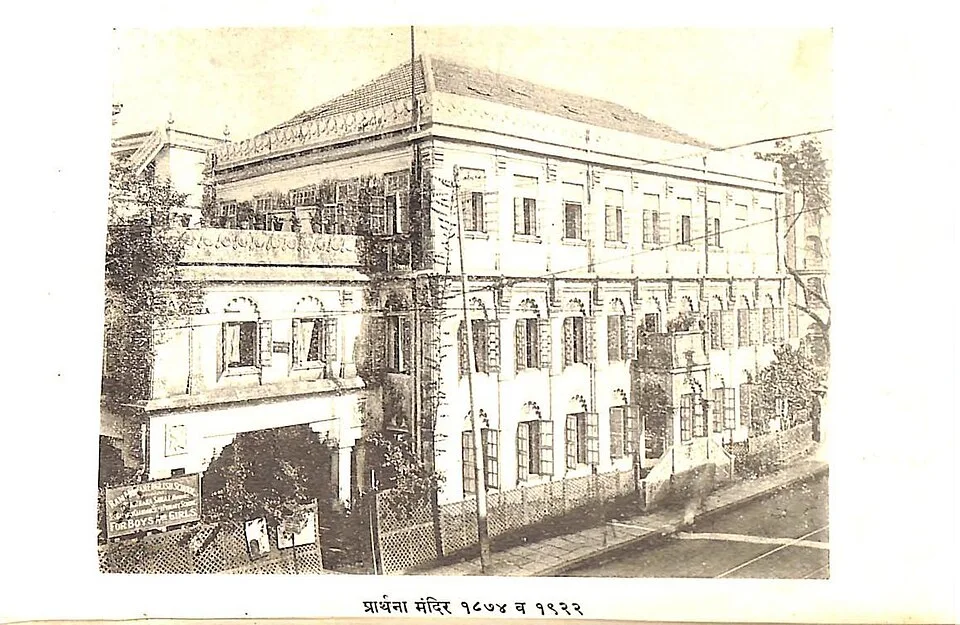
Prarthana Samaj Mandir, identified in the source metadata with the dates 1874 and 1922.
Credit: AnonymousUnknown author · Public domain · sourceResized and converted to WebP; uncropped.
1. Historical setting and foundation
Prarthana Samaj emerged within the changing social environment of nineteenth-century western India. Bombay’s growth as a commercial and administrative centre, English education, print culture and contact with Christian missionary criticism encouraged educated Indians to reconsider inherited religious and social practices. Reformers nevertheless drew upon Indian ethical and devotional traditions rather than simply adopting European models. The result was a movement that sought religious purification alongside improvements in everyday social life.
An important precursor was the Paramahansa Mandali, established in Bombay in 1849 and associated with Dadoba Pandurang. It challenged caste restrictions and religious orthodoxy, but operated largely in secrecy because members feared social exclusion. Prarthana Samaj developed in this earlier reform environment, although the two organisations should not be treated as identical. Atmaram Pandurang, Dadoba’s brother and a physician, became the central figure in the new organisation.
Founded on 31 March 1867, Prarthana Samaj, meaning Prayer Society, drew substantial inspiration from Keshab Chandra Sen’s preaching and the Brahmo movement. It nevertheless developed a regional character shaped by Maharashtra’s society and religious inheritance. Its growth in Bombay and other western Indian centres illustrates how reform ideas circulated across regions but were adapted to local circumstances.
- Do not confuse Atmaram Pandurang, the principal founder, with Ranade, its best-known reformist leader.
- Prarthana Samaj belonged to the Bombay Presidency reform environment, not to the Bengal-centred institutional history of Brahmo Samaj.
Timeline
1849
Paramahansa Mandali emerged in Bombay as an earlier organisation questioning caste restrictions and religious orthodoxy.
1867
Atmaram Pandurang and associates founded Prarthana Samaj in Bombay.
1873
Subodh Patrika began publication.
1887
The Indian National Social Conference was established through the efforts of Ranade, Raghunath Rao and others.
1906
V.R. Shinde founded the Depressed Classes Mission in Bombay.
2. Religious ideas and methods
The Samaj affirmed belief in one God and emphasised prayer, devotion and righteous conduct. It rejected image worship as a necessary means of approaching God and questioned the authority of elaborate ritual and hereditary priestly mediation. Religious worth lay in ethical living rather than observance of ceremonial distinctions. Congregational worship, hymns and discourses provided a practical means of communicating these principles.
Its outlook combined the universalist monotheism of the Brahmo movement with Maharashtra’s bhakti inheritance. The devotional compositions and teachings of saints such as Tukaram and Namdev offered familiar expressions of personal devotion and spiritual equality. This connection helped reformers present their ideas as a renewal of resources within Indian religion, rather than as an entirely foreign intervention.
Unlike movements that demanded a sharp institutional separation from inherited religious life, Prarthana Samaj generally sought reform from within the wider Hindu social setting. Members were not required to abandon every customary association or publicly establish a wholly separate communal identity. This gradualist approach reduced the distance between reformers and the society they hoped to change, but also produced tensions between professed principles and actual domestic practices. The movement’s critique of ritual should therefore not be confused with rejection of religion itself.
- Religious reform: monotheism, prayer and ethical conduct.
- Social implication: caste status and gender restrictions could be subjected to moral scrutiny rather than accepted as unquestionable religious duties.
The Samaj’s approach to reform
- 1. Reinterpret religion through monotheism and ethical principles
- 2. Communicate ideas through prayer meetings, hymns and publications
- 3. Question caste restrictions and oppressive gender customs
- 4. Build support through education, persuasion and voluntary associations
- 5. Pursue gradual institutional and social change
3. Social programme and leading reformers
The Samaj’s social programme concentrated on weakening caste barriers, encouraging widow remarriage, spreading female education and raising the age of marriage. These concerns were interconnected: early marriage restricted education, while enforced widowhood and caste sanctions limited individual choice. Reformers used lectures, publications, voluntary associations and educational work to influence public opinion. Subodh Patrika, begun in 1873, became an important vehicle for disseminating the movement’s ideas.
Mahadev Govind Ranade, a judge and public intellectual, supplied a systematic justification for gradual reform. He regarded social, religious, economic and political improvement as mutually connected. Political progress could not remain secure if society continued to deny education and dignity to large sections of its population. His approach combined historical interpretation, persuasion, institution-building and support for appropriate legislation rather than reliance on abrupt confrontation alone.
Ramakrishna Gopal Bhandarkar, a distinguished scholar of Sanskrit and Indian religious history, brought critical scholarship to religious reform. Narayan Ganesh Chandavarkar, a jurist and public figure, contributed to the movement’s later leadership. Their participation illustrates the importance of the educated professional classes. However, the Samaj’s collective programme must be distinguished from the wider activities of its members: not every institution founded by an associated reformer was formally a branch of Prarthana Samaj.
- The Hindu Widows’ Remarriage Act, 1856, preceded the Samaj; legal permission did not automatically remove social opposition.
- The Age of Consent Act, 1891, concerned consent within and outside marriage; it did not establish a general statutory minimum marriage age.
| Organisation | Foundation | Principal figure | Distinctive emphasis |
|---|---|---|---|
| Brahmo Samaj | 1828, Calcutta | Rammohan Roy | Monotheism and criticism of image worship and social abuses |
| Prarthana Samaj | 1867, Bombay | Atmaram Pandurang | Prayer-based monotheism, bhakti influences and gradual social reform |
| Satyashodhak Samaj | 1873, Poona | Jyotirao Phule | Challenge to caste oppression and Brahmanical domination |
| Arya Samaj | 1875, Bombay | Dayanand Saraswati | Vedic authority and religious-social reform |
4. Institutional connections and comparison with other movements
Prarthana Samaj belonged to a wider network of western Indian reform associations. Ranade and Raghunath Rao helped establish the Indian National Social Conference in 1887. Meeting alongside sessions of the Indian National Congress, the Conference provided a platform for discussing social questions such as early marriage and restrictions on widows. It was a distinct organisation, not simply another name for Prarthana Samaj.
Vitthal Ramji Shinde, who worked as a Prarthana Samaj missionary, founded the Depressed Classes Mission in Bombay in 1906. Its educational and welfare activities addressed the exclusion of communities subjected to untouchability. This connection demonstrates how religious universalism could develop into organised social service. However, later anti-caste movements often went beyond upper-caste reformism by demanding representation, rights and autonomous leadership for oppressed communities.
For comparison, Brahmo Samaj, founded in Calcutta in 1828, supplied a major intellectual influence, while Prarthana Samaj developed a distinct western Indian devotional and social orientation. Arya Samaj, founded by Dayanand Saraswati in 1875, grounded reform in the authority of the Vedas. Prarthana Samaj did not make a return to exclusively Vedic authority its organising principle. Satyashodhak Samaj, founded by Jyotirao Phule in 1873, placed a more direct challenge to Brahmanical domination and caste hierarchy at the centre of its programme.
5. Significance, limitations and examination perspective
Prarthana Samaj’s significance lay in linking religious conscience to social responsibility. Its members helped normalise public discussion of women’s education, widow remarriage and caste restrictions. By building associations and promoting debate through the press, the movement contributed to an emerging public sphere in which inherited authority could be questioned. Its use of bhakti traditions also shows that nineteenth-century reform was neither purely Western imitation nor simply an unchanged continuation of tradition.
Its limitations were substantial. Membership and influence were concentrated among urban, educated groups, and its reach into rural society remained limited. Gradualism could accommodate social hesitation, while caste prejudice and patriarchal norms proved more resilient than changes in religious doctrine. Advocacy also did not ensure that all members consistently implemented reform within their own families. These tensions should be evaluated without dismissing the movement’s contribution.
For Prelims, prioritise the founder, date, Bombay location, Brahmo influence and leading personalities. For analytical answers, distinguish reform of belief from reform of social institutions. Avoid describing the Samaj as a revolutionary mass movement or attributing every western Indian reform initiative to it. Its most defensible historical characterisation is a moderate, associational movement combining monotheistic religion, regional devotional resources and sustained social reform.
Prarthana Samaj: Congregational Worship and Social Reform
The Prarthana Samaj Mandir is directly associated with the organisation and provides an institutional reference for studying reform in western India. Founded in Bombay in 1867 by Atmaram Pandurang and his associates, the Samaj linked prayer to ethical conduct and social improvement. Its monotheism drew inspiration from the Brahmo movement while remaining receptive to Maharashtra’s bhakti tradition. A shared place of worship helped give organised expression to religious fellowship beyond inherited social distinctions; however, this ideal should not be mistaken for proof that caste barriers disappeared in practice.
Leaders such as M.G. Ranade and R.G. Bhandarkar supported women’s education, widow remarriage and opposition to caste exclusiveness and child marriage. Their approach generally favoured persuasion, education and gradual change within Hindu society rather than demanding a complete rupture with it. For Mains, this illustrates how religious reinterpretation could support social reform through associations and public engagement. The supplied metadata identifies a Prarthana Samaj Mandir and associates it with 1874 and 1922, but does not explain those dates. Neither should therefore be treated as the organisation’s founding year or assigned a construction history without corroboration.
- Prelims distinction: Prarthana Samaj was founded in Bombay in 1867; Brahmo influence does not make the two organisations identical.
- Conceptual distinction: Monotheistic prayer and practical social reform were complementary, not competing, elements of the Samaj’s programme.
- Evidence limit: Building metadata establishes institutional relevance, not membership composition, reform outcomes or the chronology of architectural alterations.
Real-world case studies
V.R. Shinde and the Depressed Classes Mission
Shinde’s establishment of the Depressed Classes Mission in 1906 demonstrates the connection between Prarthana Samaj’s ethical outlook and work against untouchability. Educational and welfare initiatives sought to counter social exclusion. The Mission was a distinct institution, and its association with Shinde should not be used to erase the independent role of oppressed communities in anti-caste struggles.
Previous year questions
No source-linked PYQ is available here yet. Use the practice questions below.
Practice questions
Practice MCQ 1
With reference to Prarthana Samaj, consider the following statements: 1. It was founded in Bombay in 1867. 2. Atmaram Pandurang was its principal founder. 3. It regarded exclusive acceptance of Vedic authority as its central organising principle. Which statements are correct?
- A. 1 and 2 only
- B. 2 and 3 only
- C. 1 and 3 only
- D. 1, 2 and 3
Practice MCQ 2
Which of the following pairs is incorrectly matched?
- A. M.G. Ranade — Prarthana Samaj
- B. V.R. Shinde — Depressed Classes Mission
- C. Jyotirao Phule — Satyashodhak Samaj
- D. Dayanand Saraswati — Paramahansa Mandali
Practice MCQ 3
Which statement best describes Prarthana Samaj’s reform strategy?
- A. It rejected religious devotion as incompatible with social progress.
- B. It combined monotheistic worship with gradual reform within the wider Hindu social setting.
- C. It required every member to abandon all customary social associations.
- D. It confined its programme to political independence.
Mains practice · Examine how Prarthana Samaj combined religious reform with social change in nineteenth-century western India. What limited its impact? Answer in 250 words.
- Introduce its foundation in Bombay in 1867 under Atmaram Pandurang.
- Explain Brahmo influence, monotheism and the use of Maharashtra’s bhakti traditions.
- Discuss widow remarriage, female education, marriage-age reform and caste barriers.
- Assess Ranade’s gradualism and the role of voluntary associations and publications.
- Distinguish the Samaj from related institutions such as the Social Conference and Depressed Classes Mission.
- Evaluate its educated urban base, limited mass reach and the gap between advocacy and practice.
Further reading
- NCERT, Our Pasts III, Women, Caste and Reform.
- Bipan Chandra, History of Modern India, chapters on religious and social reform.
- Sumit Sarkar, Modern India 1885–1947, discussion of social reform and caste movements.
- Maharashtra State Gazetteers, official volumes on Bombay and its religious and social institutions.
- https://commons.wikimedia.org/wiki/File:Prarthana_Samaj_Mandir,_1874_%26_1922.jpg
Preparing for UPSC Civil Services? Get classroom teaching, answer-writing evaluation and mentorship at Pragnya IAS Academy, Ashok Nagar — see why aspirants choose us for IAS coaching in Hyderabad.