
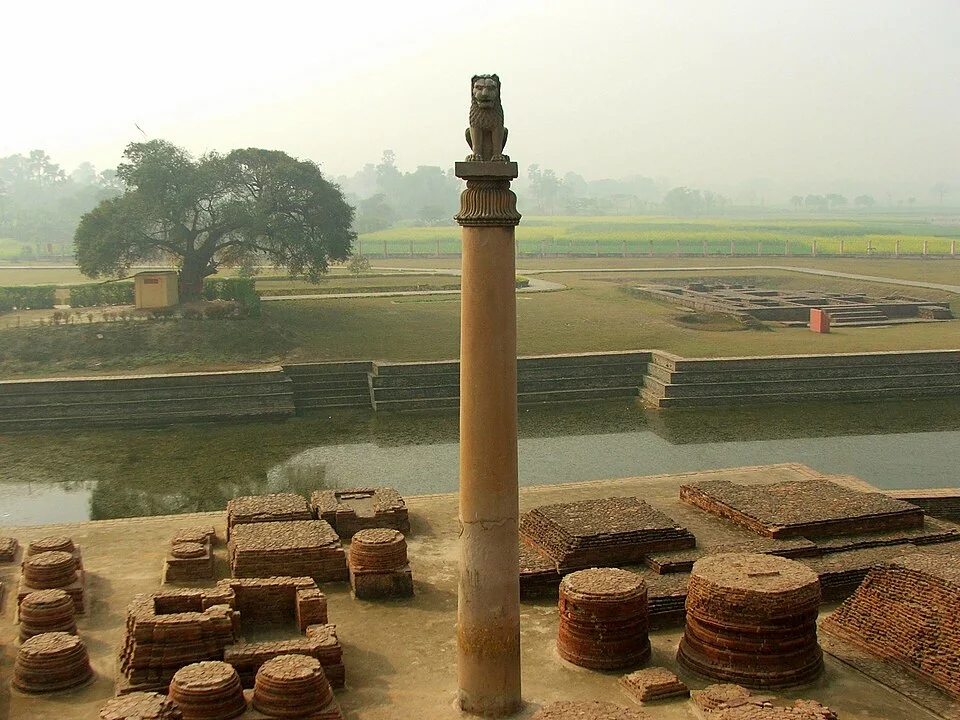
Ashokan pillar at Vaishali, Bihar, illustrating Mauryan monumental culture.
Credit: Bpilgrim (talk · contribs) · CC BY-SA 2.5 · sourceResized and converted to WebP; uncropped.
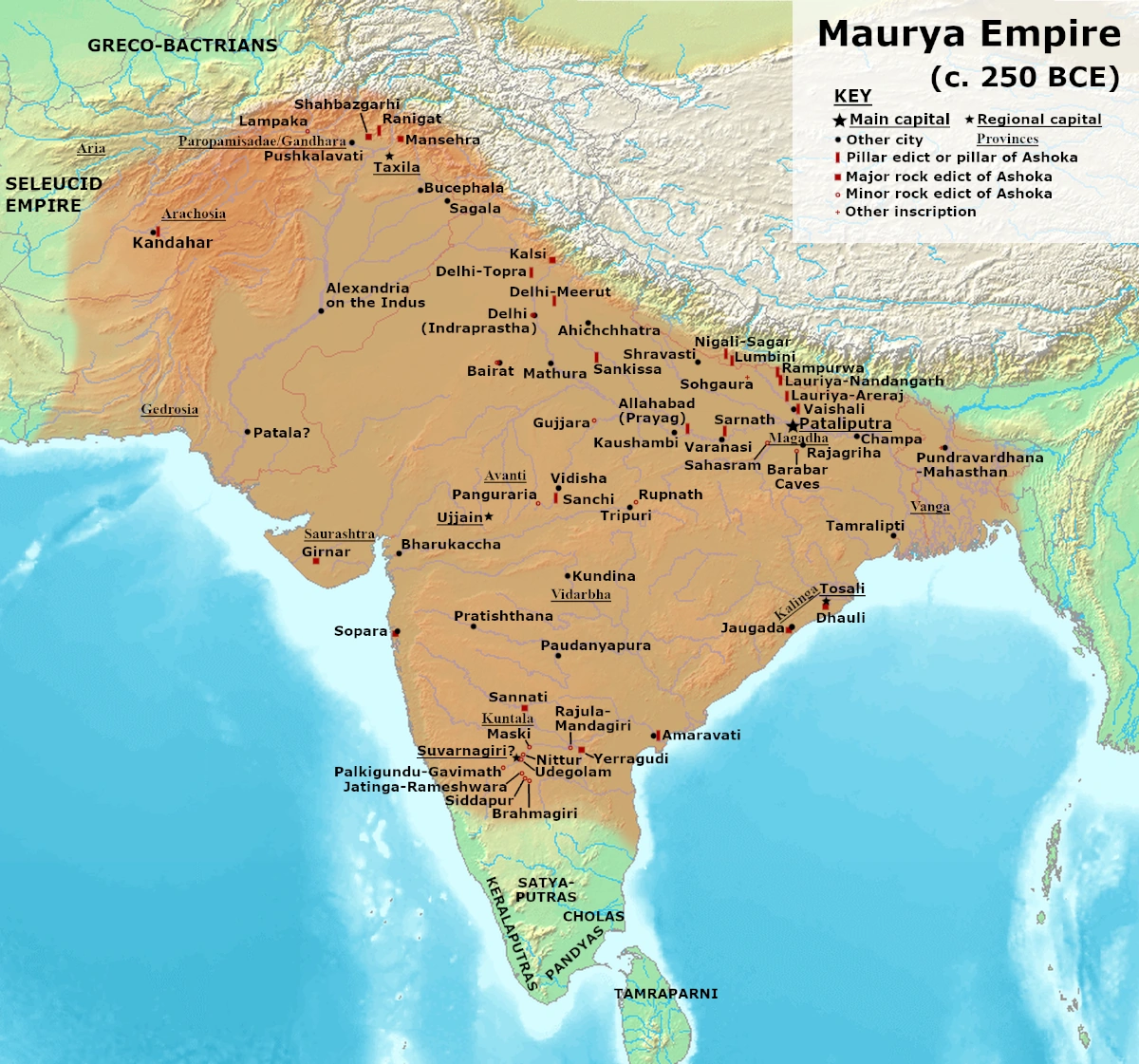
Map study
Mauryan Empire around 250 BCE during Ashoka’s reign: a date-specific historical reconstruction.
- Read the source date and legend before interpreting territorial extent.
- Compare core regions, neighbouring powers and geographic barriers; historical borders and influence are approximate and changed over time.
Credit: Avantiputra7 · CC BY-SA 3.0 · sourceConverted to WebP on an opaque white background; proportionally resized without cropping. Original cartography and legend retained.
1. Sources, chronology and imperial setting
Ashoka inherited a large empire created by Chandragupta Maurya and consolidated under Bindusara. His reign is usually placed around 268–232 BCE, although accession and coronation dates differ among scholarly reconstructions. Buddhist traditions associate his earlier career with Taxila and Ujjain. Their dramatic accounts of succession struggles, however, cannot be treated as securely established facts without corroboration.
The strongest contemporary evidence consists of inscriptions on natural rocks, polished stone pillars and cave walls. These communicate royal instructions, ethical principles, administrative concerns and selected events rather than a continuous biography. Later Buddhist works, including the Sri Lankan Dipavamsa and Mahavamsa and the Sanskrit Ashokavadana, preserve important traditions but were composed long after his lifetime and have religious purposes.
Pataliputra, near modern Patna, was the imperial capital. Inscriptions occur across much of the subcontinent, from the north-west to Karnataka and from Gujarat to Odisha. Their distribution helps reconstruct imperial communications, but it is not an exact boundary map. Cholas, Pandyas, Satiyaputras and Keralaputras appear as southern neighbours, not provinces whose conquest Ashoka records. Tamraparni, generally identified with Sri Lanka, also appears in his geographical horizon.
- Separate contemporary epigraphic evidence from later literary tradition.
- Distinguish accession, coronation and regnal-year references when working with dates.
Timeline
Around 268 BCE
Conventional beginning of Ashoka’s reign; precise accession and coronation dates remain debated.
Around 261 BCE
Kalinga conquered in the eighth regnal year.
Thirteenth year after coronation
Appointment of dhamma-mahamattas, according to Major Rock Edict V.
Twentieth year after coronation
Royal visit to Lumbini recorded in the Rummindei inscription.
Around 232 BCE
Conventional date of Ashoka’s death.
1837 CE
James Prinsep’s work enabled the decipherment of Ashokan Brahmi.
2. Kalinga and the meaning of dhamma
Kalinga occupied a strategically important coastal region broadly corresponding to present-day Odisha and adjoining areas. Major Rock Edict XIII states that Ashoka conquered it in his eighth regnal year. The inscription reports 150,000 people deported, 100,000 killed and many more dying subsequently. These are royal claims, not independently verified demographic statistics, but they reveal the scale of suffering the ruler wished to acknowledge.
Ashoka expresses remorse not merely for battlefield deaths but also for the disruption suffered by Brahmanas, shramanas, householders and people separated from relatives. He presents conquest through dhamma, or dhamma-vijaya, as superior to military conquest. Nevertheless, this did not mean dismantling the army or renouncing all coercion: the same edict warns forest peoples that the king retains the capacity to punish.
Dhamma was an ethical programme addressed to a diverse population. It emphasised obedience to parents, respect for elders and teachers, generosity towards Brahmanas and shramanas, proper treatment of servants, restraint in killing, truthfulness and moderation. It was not identical to Buddhist teachings such as the Four Noble Truths or the Eightfold Path, which the major public edicts do not systematically expound.
Major Rock Edict XII urges restraint in praising one’s own sect and condemning others, promoting respect and learning across religious communities. This was accommodation within an ancient monarchy, not modern constitutional secularism. Likewise, Ashoka’s restrictions on animal slaughter should not be converted into a claim that he prohibited every form of meat consumption.
- Major Rock Edict VIII contrasts earlier royal pleasure tours with dhamma tours.
- Major Rock Edict IX questions the value of many customary ceremonies and favours ethical conduct.
How Ashoka sought to promote dhamma
- 1. Formulate ethical instructions for a diverse population
- 2. Communicate through rock and pillar inscriptions
- 3. Use officials, tours and public instruction
- 4. Support ethical appeals with welfare and judicial measures
- 5. Encourage respect across communities
3. Reading the inscriptions: language, script and content
Most Ashokan inscriptions use forms of Prakrit written in Brahmi. The north-western Major Rock Edicts at Shahbazgarhi and Mansehra use Kharosthi, written from right to left. Greek and Aramaic inscriptions in the Afghan region demonstrate communication with culturally diverse populations. Language and script must be distinguished: Prakrit is a language category, whereas Brahmi and Kharosthi are scripts.
The fourteen Major Rock Edicts cover ethical conduct, welfare, officials and relations with neighbouring peoples. The seven Major Pillar Edicts address related themes, including justice and dhamma administration. Not every site contains the complete standard series, and wording varies regionally. Minor Rock Edicts contain more personal declarations of religious commitment; the Bhabru or Bairat Edict recommends particular Buddhist teachings to monks and nuns.
The Maski inscription is especially important because it explicitly names Ashoka, helping connect that personal name with the royal titles familiar from other records. The Rummindei inscription at Lumbini records a royal visit to the Buddha’s birthplace and fiscal concessions. At Nigali Sagar, an inscription records the enlargement of the stupa of the past Buddha Konakamana and a subsequent royal visit.
At Dhauli and Jaugada in Odisha, Separate Kalinga Edicts occur alongside a modified Major Rock Edict series in which Edicts XI–XIII are absent. They emphasise humane administration, official responsibility and reassurance to frontier populations. Inscription findspots are also not always original locations: some pillars were transported in medieval times.
- Major Rock Edict I: restrictions on animal slaughter and certain festivities.
- Major Rock Edict II: medical treatment for humans and animals, medicinal plants and water facilities.
- Major Rock Edict V: appointment of dhamma-mahamattas.
- Major Pillar Edict VII: an extensive review of measures for promoting dhamma.
| Inscription or site | Principal association | Prelims distinction |
|---|---|---|
| Major Rock Edict XIII | Kalinga, remorse and dhamma-vijaya | Not a declaration abolishing all punishment |
| Major Rock Edict XII | Respect among religious sects | Dhamma is broader than Buddhist doctrine |
| Shahbazgarhi and Mansehra | Prakrit Major Rock Edicts in Kharosthi | Kharosthi runs right to left |
| Maski | Explicit use of Ashoka’s personal name | Important for identifying the ruler |
| Rummindei, Lumbini | Buddha’s birthplace and fiscal concessions | Distinct from Nigali Sagar |
| Barabar caves | Dedications to Ajivikas | Evidence of non-Buddhist patronage |
4. Administration, welfare and religious patronage
Ashoka used existing administrative structures while adding officers concerned with dhamma. Major Rock Edict III instructs yuktas, rajukas and pradesikas to undertake periodic tours for official business and ethical instruction. Major Rock Edict V records the appointment of dhamma-mahamattas thirteen years after coronation. Their concerns included different religious communities and disadvantaged groups; they were not simply Buddhist missionaries.
The edicts portray an accessible king who expected reports even while occupied with personal activities. Rajukas received significant judicial responsibilities. Major Pillar Edict IV provides a three-day respite for persons sentenced to death, illustrating an attempt to moderate punishment rather than abolish capital punishment. Welfare measures included wells, roadside trees, rest facilities and provisions for human and animal health.
Ashoka’s personal Buddhist commitment is clearer in the Minor Rock Edicts and Buddhist-specific records than in his general dhamma proclamations. Sri Lankan chronicles associate his reign with the Third Buddhist Council at Pataliputra under Moggaliputta Tissa and missions involving Mahinda and Sanghamitta. These traditions must be distinguished from the contemporary inscriptions, which do not narrate the council. Patronage was not exclusively Buddhist: Ashoka dedicated caves at Barabar to the Ajivikas.
- Dhamma combined royal communication, moral persuasion, welfare and administrative supervision.
- Claims of ethical influence abroad do not establish Mauryan political control over those territories.
5. Art, historical significance and examination approach
Ashokan pillars are associated with finely polished sandstone shafts and animal capitals. The Sarnath Lion Capital displays four back-to-back lions above an abacus bearing animals and wheels. Adapted as India’s State Emblem on 26 January 1950, it connects Mauryan visual culture with the modern republic. The national flag carries a navy-blue, twenty-four-spoked Ashoka Chakra.
Ashoka’s distinctive importance lies in the surviving public record of a ruler discussing remorse, ethical government and religious coexistence. Yet inscriptions are also instruments of royal self-presentation, not neutral reports proving universal compliance. Similarly, attributing Mauryan decline solely to his non-violence is unsupported. Succession problems, regional pressures and the difficulties of sustaining a large empire require consideration alongside the limited surviving evidence.
- For Prelims, revise edict number, subject, site, language and script as separate categories.
- Avoid assuming that all Mauryan art, every polished pillar or every Buddhist stupa was personally commissioned by Ashoka.
Ashoka’s Pillars: Monuments and Inscriptional Evidence
The supplied metadata identifies this monument as the Ashokan pillar at Vaishali in Bihar, making it directly relevant to Ashoka and Mauryan monumental culture. Ashokan pillars help explain how royal authority was expressed through durable monuments associated with important places and routes. They should not, however, be treated as interchangeable historical documents: attribution to Ashoka does not automatically mean that a pillar bears an Ashokan edict. The Vaishali pillar is not a source for the Major Pillar Edicts, so their contents should not be assigned to it.
For reconstructing Ashoka’s policies, distinguish architectural evidence from inscriptions whose texts and locations are established. His edicts address ethical conduct, administrative responsibility, welfare and respect among religious communities, while particular inscriptions illuminate his Buddhist commitments. Dhamma was therefore neither simply a synonym for Buddhist doctrine nor proof of a modern secular state. Likewise, the connection between the Kalinga War, remorse and dhamma rests especially on Major Rock Edict XIII, not on pillar monuments generally. In an Indian historical context, this example supports discussion of Mauryan patronage and the geography of royal commemoration, but the supplied metadata alone cannot establish a monument’s original setting or a specific political message.
- Separate monument type from text category: an Ashokan pillar is not necessarily an inscribed pillar or a bearer of the Major Pillar Edicts.
- For Prelims, identify inscriptions through their location, language, script and royal titles; most Ashokan inscriptions use Prakrit in Brahmi, but exceptions matter.
- For Mains, combine monuments and inscriptions with other evidence; official ethical prescriptions do not by themselves demonstrate uniform implementation across the empire.
Real-world case studies
Dhauli and Jaugada: governing conquered Kalinga
The Separate Kalinga Edicts address officials associated with Tosali and Samapa. Their emphasis on avoiding unjust imprisonment and harsh treatment shows how imperial messages could be adapted to a recently conquered region. The declaration that all people are the king’s children expresses paternal kingship, not democratic citizenship.
Kandahar: communication across cultural boundaries
Greek and Aramaic Ashokan inscriptions at Kandahar reflect the multilingual north-western environment. They show that imperial communication was adapted to local audiences rather than confined everywhere to Brahmi and Prakrit.
Previous year questions
No source-linked PYQ is available here yet. Use the practice questions below.
Practice questions
Practice MCQ 1
Consider the following pairs: 1. Major Rock Edict V — Dhamma-mahamattas; 2. Major Rock Edict XII — Respect among religious sects; 3. Major Rock Edict XIII — Abolition of capital punishment. Which pairs are correctly matched?
- A. 1 and 2 only
- B. 2 and 3 only
- C. 1 and 3 only
- D. 1, 2 and 3
Practice MCQ 2
Which Ashokan inscription sites are associated with Kharosthi script?
- A. Dhauli and Jaugada
- B. Shahbazgarhi and Mansehra
- C. Maski and Brahmagiri
- D. Sarnath and Lumbini
Practice MCQ 3
Which statement best characterises Ashoka’s dhamma?
- A. It required every subject to join the Buddhist Sangha.
- B. It replaced all judicial punishment with moral instruction.
- C. It promoted shared ethical conduct without requiring a single sectarian identity.
- D. It was restricted to regulating Buddhist monasteries.
Mains practice · Ashoka’s dhamma was both an ethical ideal and a programme of imperial governance. Discuss with reference to his inscriptions. Answer in 250 words.
- Introduce dhamma and distinguish it from specifically Buddhist doctrine.
- Use Edicts XII and XIII for religious accommodation, remorse and dhamma-vijaya.
- Explain officers, administrative tours and public inscriptions.
- Discuss welfare, judicial restraint and continued coercive authority.
- Conclude with the value and limitations of royal inscriptions as evidence.
Further reading
- NCERT, Themes in Indian History, Part I: Kings, Farmers and Towns.
- Upinder Singh, A History of Ancient and Early Medieval India.
- Romila Thapar, Ashoka and the Decline of the Mauryas.
- Archaeological Survey of India: information on Sarnath, Dhauli and Mauryan monuments.
- D. C. Sircar, Inscriptions of Asoka.
- https://commons.wikimedia.org/wiki/File:Ashoka_pillar_at_Vaishali,_Bihar,_India.jpg
Preparing for UPSC Civil Services? Get classroom teaching, answer-writing evaluation and mentorship at Pragnya IAS Academy, Ashok Nagar — see why aspirants choose us for IAS coaching in Hyderabad.