
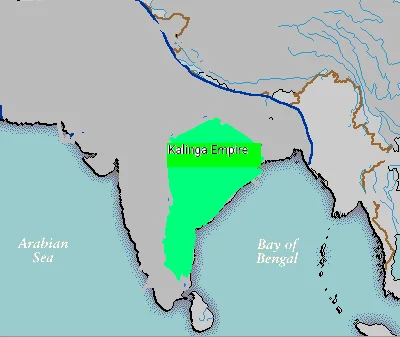
Illustrative map of Kalinga’s extent under Kharavela, as described in the supplied metadata.
Credit: Edasf · CC BY 4.0 · sourceResized and converted to WebP; uncropped.
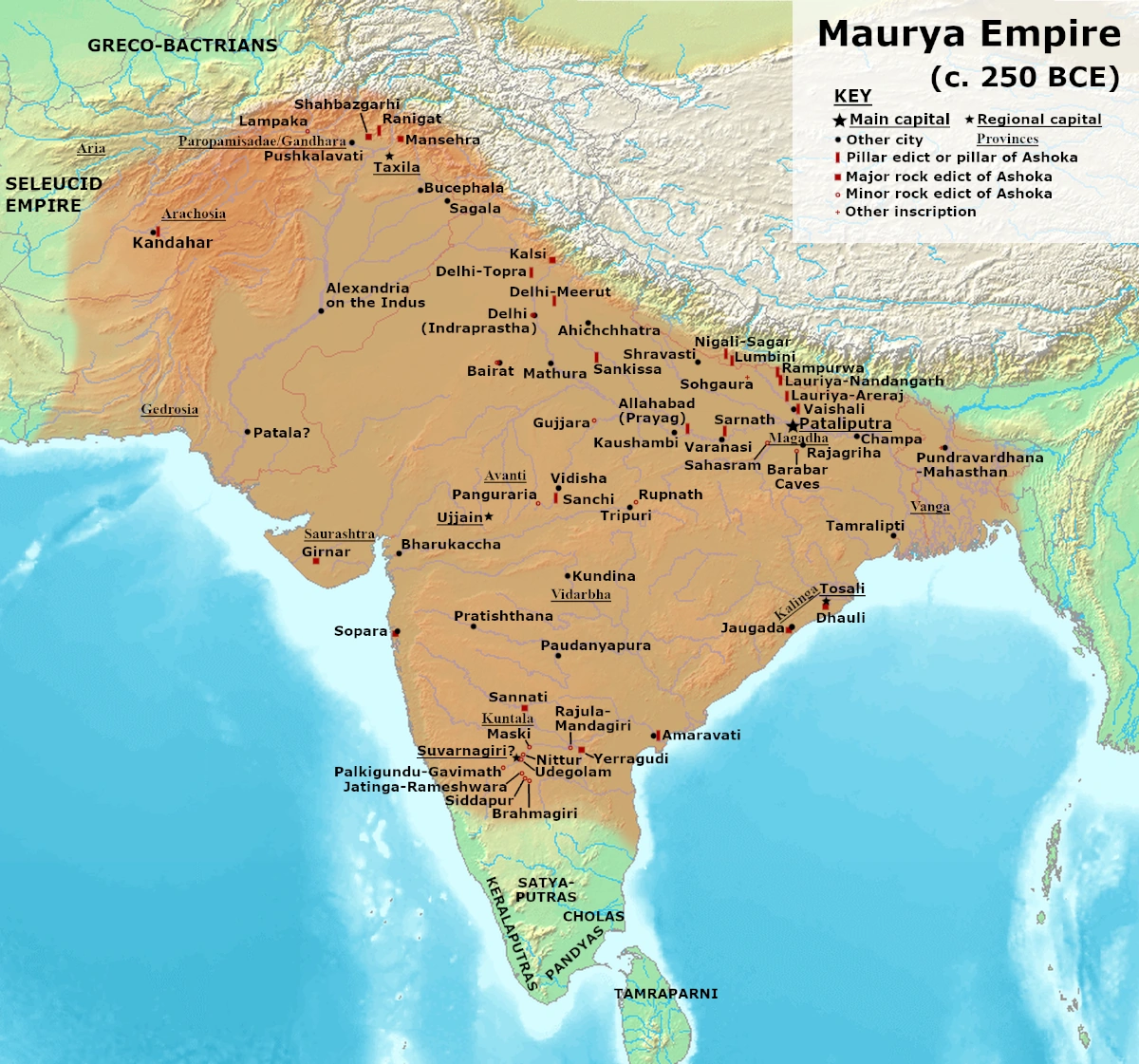
Map study
Mauryan Empire around 250 BCE during Ashoka’s reign: a date-specific historical reconstruction.
- Read the source date and legend before interpreting territorial extent.
- Compare core regions, neighbouring powers and geographic barriers; historical borders and influence are approximate and changed over time.
Credit: Avantiputra7 · CC BY-SA 3.0 · sourceConverted to WebP on an opaque white background; proportionally resized without cropping. Original cartography and legend retained.
1. Historical geography and early importance
Kalinga occupied a strategically important part of the eastern seaboard. Its core lay in coastal Odisha, with influence extending at different times into adjoining northern Andhra Pradesh. Historical descriptions of its northern and southern limits vary; the Mahanadi and Godavari are often used as broad geographical reference points, not as permanent political boundaries. Ancient Kalinga, Utkala and Odra should therefore not be treated as interchangeable territorial labels in every period.
The region combined fertile coastal plains, river valleys, forest resources and access to the Bay of Bengal. Agricultural production supported settlements and political authority, while forests supplied elephants and other valuable resources. Routes across the Eastern Ghats connected the coast with inland central India and the Deccan. This combination made Kalinga important for both overland movement and coastal exchange.
Its pre-Mauryan political history is imperfectly documented. The later Hathigumpha inscription refers to a Nanda king in connection with a canal and the removal of a Jina image or sacred object. These passages are commonly interpreted as evidence of earlier Nanda intervention, although readings and historical implications remain debated. Kalinga was outside Ashoka’s control immediately before his conquest. Tosali and Samapa appear as important administrative locations in the Mauryan inscriptions.
- Map focus: locate the Mahanadi delta, Dhauli, Jaugada, Bhubaneswar and the northern Andhra coast.
- Do not confuse Kalinga with the entire eastern coast or assume that its boundaries remained unchanged.
Timeline
Before the Mauryan conquest
Kalinga develops as an important eastern coastal region; later epigraphic references suggest earlier Nanda intervention.
About 261 BCE
Ashoka conquers Kalinga in the eighth year after his consecration.
Third century BCE, after the conquest
Ashokan inscriptions communicate remorse over warfare and instructions for governing Kalinga.
After about 185 BCE
The end of the Mauryan dynasty forms the wider context for the rise of post-Mauryan regional powers.
Conventionally first century BCE
Kharavela rules Kalinga; the Hathigumpha inscription records his claimed achievements.
2. The Kalinga War and Ashoka’s political transformation
Ashoka conquered Kalinga in the eighth year after his consecration, conventionally placed around 261 BCE. The principal contemporary source is Major Rock Edict XIII. It states that 150,000 people were deported, 100,000 were killed and many times that number subsequently died. These are figures claimed by the inscription, not independently verified demographic totals. The text does not identify the defeated Kalinga ruler.
Control of a powerful coastal region and routes linking the Gangetic heartland with peninsular India provides a plausible strategic context for the war. However, the edict does not supply a detailed account of its causes, military operations or battlefield. Dhauli’s association with the conflict is important in regional memory, but the presence of an Ashokan inscription there does not by itself establish the precise battlefield.
The edict’s distinctive feature is Ashoka’s remorse over the suffering caused by conquest. It discusses not only deaths but also the separation of families, friends, Brahmanas and shramanas. Ashoka presents dhamma-vijaya, conquest through dhamma, as preferable to military conquest. This gives the inscription unusual significance as a royal reflection on the human costs of imperial expansion.
Nevertheless, Kalinga was retained within the Mauryan Empire. Ashoka did not abolish coercive authority, and the same edict warns forest peoples that he retained the power to punish. Nor should the war be presented as the securely established moment of his conversion to Buddhism. His Buddhist commitment and the development of his public dhamma policy require a more nuanced chronology.
- Prelims distinction: Major Rock Edict XIII records the war and remorse; Major Rock Edict XII emphasises respect among religious sects.
- Dhamma was a broad ethical and administrative programme, not simply another name for Buddhist doctrine.
Kalinga’s annexation and the Mauryan response
- 1. Independent Kalinga lies outside Ashoka’s empire
- 2. Mauryan conquest causes deaths, deportation and social disruption
- 3. Major Rock Edict XIII expresses royal remorse
- 4. Ashoka advocates conquest through dhamma
- 5. Separate Kalinga Edicts instruct officials on justice and reassurance
- 6. Kalinga remains under Mauryan imperial authority
3. Mauryan administration: Dhauli and Jaugada
Dhauli, near Bhubaneswar, and Jaugada, in Odisha’s Ganjam district, preserve Ashokan inscriptions in Prakrit using Brahmi script. Their versions of the Major Rock Edict series omit Edicts XI, XII and XIII and include two Separate Kalinga Edicts. Consequently, the famous account of the Kalinga War is known from Major Rock Edict XIII at other sites, not from the surviving Dhauli and Jaugada versions.
The separate edicts address officials associated with Tosali and Samapa. They emphasise fair treatment, restraint in punishment and avoidance of unjust imprisonment. Officials are urged to overcome anger, cruelty, impatience and negligence. Ashoka’s declaration that all people are his children expresses a paternal ideal of kingship: the ruler claims responsibility for their welfare in this world and the next.
Another concern is reassuring unconquered frontier peoples that they need not fear the king and should expect benevolent treatment. Together, these instructions reveal the administrative challenges following annexation: managing officials, moderating judicial conduct and building trust. They are valuable evidence for imperial intentions, although royal commands alone cannot demonstrate how consistently such policies were implemented.
- Dhauli is also known for its rock-cut elephant sculpture.
- The Separate Kalinga Edicts should not be confused with Ashoka’s Minor Rock Edicts or Pillar Edicts.
| Source or site | Association | Exam significance |
|---|---|---|
| Major Rock Edict XIII | Ashoka | Kalinga War, casualties, remorse and dhamma-vijaya |
| Dhauli and Jaugada | Mauryan administration | Separate Kalinga Edicts; local versions omit Major Rock Edicts XI–XIII |
| Hathigumpha inscription | Kharavela | Prakrit-Brahmi record of regnal-year achievements |
| Udayagiri–Khandagiri | Early Jain patronage | Rock-cut caves near Bhubaneswar |
| Sisupalgarh | Early historic urbanisation | Fortified settlement; identification with named ancient capitals remains debated |
4. Post-Mauryan Kalinga and Kharavela
After Mauryan authority weakened, Kalinga re-emerged as a regional political power. Its best-known post-Mauryan ruler was Kharavela, associated with the Mahameghavahana line and commonly linked with the Chedi or Cheti tradition. He is conventionally placed in the first century BCE, but his exact dates remain disputed. The principal source is the Hathigumpha inscription at Udayagiri near Bhubaneswar.
Written in Prakrit and Brahmi script, the inscription presents achievements arranged by regnal years. It records repairs to urban structures, irrigation works, public entertainments, religious benefactions and military expeditions. References to a western campaign involving a Satakarni and to movements towards northern India suggest ambitions beyond Kalinga. However, the damaged condition of the inscription makes several names, geographical identifications and chronological deductions uncertain.
Kharavela is closely associated with Jain patronage. The inscription invokes the arhats and siddhas, and its account of recovering a Kalinga Jina taken away by a Nanda ruler is important for discussions of Jain tradition and royal legitimacy. Udayagiri and Khandagiri preserve rock-cut spaces associated with Jain ascetics and elite patronage. Not every cave can be assigned directly to Kharavela; Ranigumpha and Ganeshagumpha are particularly noted for their sculptural decoration.
- Hathigumpha is a royal eulogy, not a neutral chronicle.
- Distinguish Kharavela’s Jain associations from Ashoka’s Buddhist affiliation and wider dhamma policy.
5. Trade, archaeology and historical interpretation
Kalinga’s coastal location facilitated participation in Bay of Bengal exchange networks. Literary traditions refer to ports such as Dantapura, although their precise identification remains debated. Archaeological sites including Sisupalgarh, near Bhubaneswar, demonstrate substantial early historic urban development through fortifications, gateways and settlement remains. Identifying Sisupalgarh definitively with Tosali or Kalinganagara, however, goes beyond settled evidence.
Odisha’s later maritime traditions and cultural links with Southeast Asia are historically important, but evidence from different centuries must be separated. Modern Bali Jatra commemorates maritime heritage; it is not direct proof of a particular Mauryan-period voyage or colony. Kalinga is best studied by comparing inscriptions, archaeological contexts and literary traditions while recognising their different dates and purposes.
- UPSC themes: imperial expansion, ethical kingship, regional state formation, Jain patronage and maritime exchange.
- Source criticism: distinguish an inscription’s claims from independently established historical conclusions.
Kalinga under Kharavela: Regional Power and Epigraphic Evidence
The supplied metadata identifies this map as a representation of Kalinga under Kharavela, making it directly relevant to Kalinga’s post-Mauryan history. Kalinga’s core lay along India’s eastern coast, broadly corresponding to present-day Odisha and adjoining northern Andhra Pradesh. Its renewed prominence under Kharavela illustrates the emergence of regional political centres after Mauryan authority weakened. However, a modern map’s territorial outline should be treated as a historical reconstruction, not as proof of uniformly administered borders.
The principal source for Kharavela’s reign is the Hathigumpha inscription at Udayagiri near Bhubaneswar. Written in Prakrit using Brahmi script, it records royal achievements, including campaigns, public works and religious patronage. It is especially important for understanding Kharavela’s association with Jainism, but it is also a royal eulogy: damaged passages and disputed readings complicate interpretations of chronology, opponents and geographical reach. Claims about military expeditions must therefore be distinguished from evidence of lasting territorial control. For UPSC, this source should be contrasted with Ashoka’s inscriptions: both express kingship, but their historical settings and rhetorical purposes differ.
- Chronology: Ashoka’s conquest of Kalinga belongs to the Mauryan phase; Kharavela represents its later regional resurgence, not Mauryan rule.
- Source distinction: Hathigumpha concerns Kharavela; the Separate Kalinga Edicts at Dhauli and Jaugada concern Ashoka’s governance.
- Map caution: Distinguish Kalinga’s core territory, claimed campaign routes and reconstructed political influence; these are not interchangeable categories.
Real-world case studies
Dhauli and Jaugada: adapting imperial communication
The omission of Major Rock Edicts XI–XIII and inclusion of separate administrative instructions distinguish these sites from several other Ashokan inscriptional locations. They demonstrate that imperial messages were not reproduced identically everywhere. In recently conquered Kalinga, communication particularly stressed official conduct and public reassurance.
Hathigumpha: using a difficult historical source
The inscription supplies rare information about Kharavela’s public works, campaigns and religious patronage. Yet damaged letters and disputed readings prevent a fully secure reconstruction of his chronology. It illustrates why epigraphy must be assessed through script, language, archaeological setting and comparison with other evidence.
Previous year questions
No source-linked PYQ is available here yet. Use the practice questions below.
Practice questions
Practice MCQ 1
With reference to Ashoka’s inscriptions associated with Kalinga, consider the following statements: 1. Major Rock Edict XIII describes the suffering caused by the Kalinga War. 2. The Dhauli and Jaugada versions preserve Major Rock Edict XIII in full. 3. The Separate Kalinga Edicts emphasise fair administration. Which of the statements given above are correct?
- A. 1 and 2 only
- B. 1 and 3 only
- C. 2 and 3 only
- D. 1, 2 and 3
Practice MCQ 2
Which one of the following combinations is correctly matched?
- A. Hathigumpha inscription — Kharavela — Prakrit and Brahmi
- B. Jaugada edicts — Samudragupta — Sanskrit and Brahmi
- C. Udayagiri–Khandagiri caves — Exclusively Buddhist patronage
- D. Major Rock Edict XIII — Ashoka — Grant of independence to Kalinga
Practice MCQ 3
Which of the following conclusions is best supported by the evidence concerning Ashoka after the Kalinga War?
- A. He dissolved the Mauryan army.
- B. He abandoned all forms of punishment.
- C. He advocated dhamma-vijaya while retaining imperial authority.
- D. He replaced all existing religious traditions with Buddhism.
Mains practice · Kalinga’s inscriptions illuminate both the exercise of political power and its moral justification in ancient India. Discuss with reference to Ashoka and Kharavela. Answer in 250 words.
- Introduce Kalinga’s strategic coastal location and changing imperial and regional contexts.
- Explain conquest, suffering and remorse in Major Rock Edict XIII.
- Discuss dhamma-vijaya alongside the retention of coercive authority.
- Use the Separate Kalinga Edicts to examine justice, welfare and paternal kingship.
- Contrast Kharavela’s celebration of campaigns, public works and Jain patronage.
- Conclude with source limitations: royal self-presentation, damaged readings and uncertain chronology.
Further reading
- NCERT, Themes in Indian History, Part I: Bricks, Beads and Bones; Kings, Farmers and Towns; Thinkers, Beliefs and Buildings.
- Archaeological Survey of India: official information on Dhauli and Udayagiri–Khandagiri caves.
- E. Hultzsch, Inscriptions of Asoka, Corpus Inscriptionum Indicarum, Volume I.
- Upinder Singh, A History of Ancient and Early Medieval India.
- Romila Thapar, Asoka and the Decline of the Mauryas.
- D. C. Sircar, Select Inscriptions Bearing on Indian History and Civilization, Volume I.
- https://commons.wikimedia.org/wiki/File:Kalinga_under_Kharavela.png
Preparing for UPSC Civil Services? Get classroom teaching, answer-writing evaluation and mentorship at Pragnya IAS Academy, Ashok Nagar — see why aspirants choose us for IAS coaching in Hyderabad.