
Map study
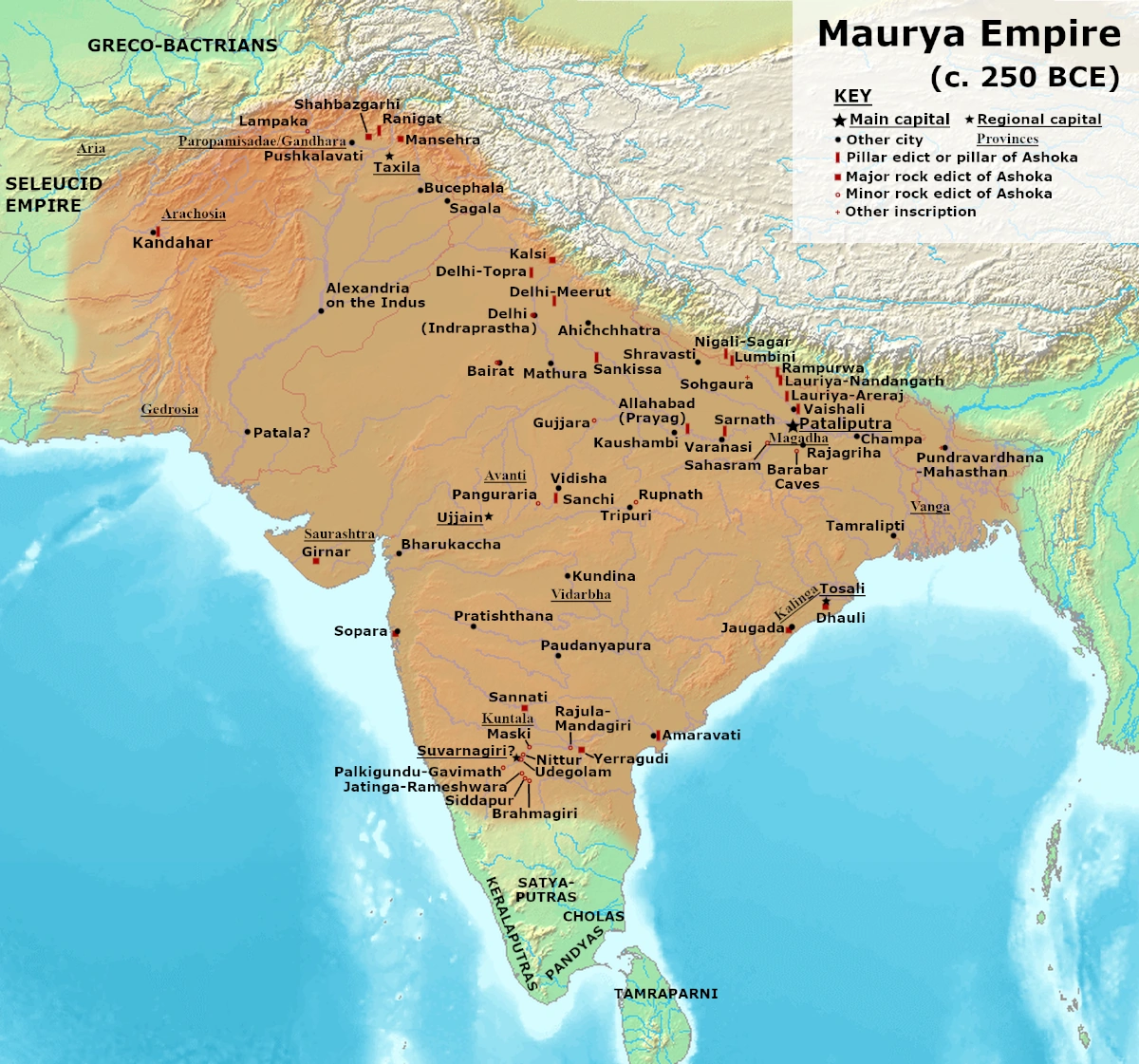
Mauryan Empire around 250 BCE during Ashoka’s reign: a date-specific historical reconstruction.
- Read the source date and legend before interpreting territorial extent.
- Compare core regions, neighbouring powers and geographic barriers; historical borders and influence are approximate and changed over time.
Credit: Avantiputra7 · CC BY-SA 3.0 · sourceConverted to WebP on an opaque white background; proportionally resized without cropping. Original cartography and legend retained.
1. Sources and the character of the economy
The Mauryan Empire emerged during the second urbanisation of the subcontinent. Agricultural expansion, towns, specialised crafts and coinage had already developed in the middle Gangetic valley before Chandragupta Maurya established his dynasty around 322 BCE. Mauryan political integration enlarged the geographical setting within which surplus could be collected and goods circulated. Pataliputra, near major river routes, served as the political centre of this extensive but regionally differentiated economy.
The Arthashastra describes revenue collection, crown lands, mines, workshops, markets and commercial officials. Traditionally attributed to Kautilya or Chanakya, it contains material from different periods, and its surviving compilation is generally placed later than the Mauryas. It is therefore most useful as a source for traditions of statecraft and economic regulation, rather than proof that every prescribed institution operated throughout the empire.
Megasthenes, a Greek envoy at Chandragupta’s court, described farmers, artisans and urban administration. His Indica survives only through quotations and summaries by later writers, whose accounts require caution. Ashokan inscriptions provide contemporary evidence for specific measures, while settlements, pottery and coins reveal material patterns. These sources together suggest substantial state intervention alongside cultivators, merchants, artisans and local institutions, not a completely state-controlled economy.
2. Agriculture, land and irrigation
Agriculture supplied the principal livelihood and the surplus sustaining the army, court and officials. Fertile alluvial soils, monsoon rainfall, river systems and the use of iron implements supported cultivation, although their importance varied between regions. Rice was important in the Gangetic basin, while wheat, barley, pulses, oilseeds and other crops reflected different ecological conditions. Cattle supplied draught power, manure and other valuable products.
The Arthashastra distinguishes crown cultivation from land worked by other cultivators. The sitadhyaksha supervised crown agriculture and activities connected with sowing, labour and cultivation. References to transactions, inheritance and different categories of land rights warn against assuming that the king personally owned every field. Political sovereignty, the right to collect revenue and ownership of particular plots were related but distinct claims.
Irrigation could reduce dependence on rainfall and improve yields. Tanks, wells, channels and reservoirs involved state, local or private initiative. The best-known Mauryan-associated example is Sudarshana lake near Girnar. Rudradaman’s inscription of 150 CE attributes its original construction to Pushyagupta under Chandragupta and the provision of conduits to Tushaspha under Ashoka. This is important retrospective testimony, not a surviving Mauryan construction inscription.
- The Arthashastra also recommends settlement and cultivation of uncultivated land; such prescriptions indicate fiscal priorities rather than the measurable extent of implementation.
- Pastoral communities and forest populations contributed livestock, timber, elephants and other resources, but their relationship with imperial authority was not identical to that of settled cultivators.
Simplified relationship between production and imperial finance
- 1. Cultivation, pastoral activity and crafts generate output.
- 2. Households retain part of production for consumption and future production.
- 3. Revenue officials collect assessed dues in produce or money.
- 4. Treasury and storehouses receive fiscal resources.
- 5. Resources support the army, administration and public works.
3. Revenue, taxation and economic administration
Land revenue formed the fiscal foundation, supplemented by trade duties, fines and income from state-controlled resources and enterprises. Bhaga meant the ruler’s share of produce, with one-sixth frequently presented as a normal assessment. Actual burdens could vary by land category, irrigation arrangements, local circumstances and additional obligations. Bali and kara were other fiscal terms, but their meanings should not be reduced to rigid definitions valid across all early texts.
In the Arthashastra’s administrative scheme, the samaharta organised revenue collection and accounts, while the sannidhata supervised the treasury and stores. Collection in kind remained important because grain could maintain establishments or enter storage. Coin payments also occurred, particularly within monetised sectors. Vishthi, or compulsory labour, represented another possible burden and should be distinguished from cash or produce taxes.
Ashoka’s Lumbini pillar inscription supplies unusually direct evidence of a local fiscal concession. After visiting the Buddha’s birthplace in his twentieth regnal year, the emperor granted the village relief conventionally understood as exemption from bali and liability for only one-eighth of produce. The precise interpretation of some fiscal wording is debated, but the inscription clearly demonstrates that obligations could be modified.
- Shulka referred broadly to tolls or customs duties; frontier crossings, routes and markets offered points for collection.
- Prescriptive discussions of emergency levies must not be treated as evidence that exceptional taxes were routinely imposed throughout the empire.
| Term | Meaning or function | Important qualification |
|---|---|---|
| Bhaga | Ruler’s share of agricultural produce | One-sixth was a common norm, not a proven universal rate. |
| Samaharta | Organisation of revenue collection and accounts | Described in the Arthashastra’s administrative scheme. |
| Sannidhata | Supervision of treasury and stores | Reflects the importance of both money and stored goods. |
| Sitadhyaksha | Supervision of crown agriculture | Does not imply universal state ownership of land. |
| Panyadhyaksha | Supervision of commerce | Evidence of prescribed regulation, not complete state ownership of trade. |
| Shulka | Toll or customs duty | A revenue source distinct from the agricultural produce share. |
4. Crafts, trade, transport and money
Urban demand encouraged textiles, metalworking, pottery, jewellery, ivory work and other specialised production. Pataliputra, Taxila, Kaushambi and Ujjain were important centres within wider networks, although their development was not confined to Mauryan rule. Northern Black Polished Ware is associated with early historic settlements and elite consumption, but its presence alone cannot establish Mauryan political control.
The Arthashastra describes officers supervising commerce, weights and measures, mines, metals and other activities. The panyadhyaksha dealt with trade and market-related administration, while the akaradhyaksha supervised mines. Regulations concerning adulteration, fraudulent measurement and commercial dealings show concern for revenue and orderly exchange. State workshops coexisted with non-state production. Occupational associations, often discussed under the term shreni, formed part of the broader early historic economy; their best-documented later functions should not automatically be projected backwards.
The Uttarapatha linked the Gangetic region with the north-west, while routes conventionally grouped under Dakshinapatha connected northern India with the Deccan. Rivers offered another major transport system. Political contacts with Hellenistic kingdoms created opportunities for exchange, but diplomatic contact alone does not establish trade volumes. Likewise, the flourishing Indo-Roman maritime commerce of later centuries should not be attributed wholesale to the Mauryas.
Silver punch-marked coins facilitated payments and exchange, while copper issues also circulated. Such coins generally carried punched symbols rather than royal portraits or extended legends. They originated before the Mauryas and continued beyond them, making precise attribution difficult. Their circulation indicates monetisation, not the disappearance of barter or payment in kind.
5. State intervention, welfare and historical assessment
Mauryan fiscal capacity supported a large army and administrative apparatus. Strategic resources such as mines, forests and elephants attracted particular state attention. Yet intensive intervention described in the Arthashastra cannot establish a uniform monopoly over all production. Distance, ecology, local authorities and differences in settlement shaped the practical reach of imperial administration.
Ashoka’s Major Rock Edict II mentions medical arrangements for humans and animals, medicinal plants, wells and trees. Pillar Edict VII also records roadside amenities. These measures had welfare and mobility implications, although the inscriptions present them within the emperor’s dhamma policy rather than as a modern economic development programme.
Historians have debated whether military expenditure, administrative costs and fiscal pressure contributed to Mauryan decline. No surviving empire-wide budget or reliable time series establishes a single economic explanation. For examination purposes, distinguish contemporary inscriptions from later testimony, prescriptions from demonstrated practice, and Mauryan developments from the more extensively documented commercial institutions of post-Mauryan India.
Real-world case studies
Lumbini: a contemporary record of fiscal differentiation
The Rummindei pillar inscription in present-day Nepal records Ashoka’s visit to Lumbini, conventionally dated around 249 BCE. Its fiscal concession connects the emperor’s religious patronage with village-level revenue policy. The case is especially valuable because it provides contemporary epigraphic evidence rather than a general prescription in a statecraft text.
Sudarshana lake: irrigation across successive regimes
Rudradaman’s Junagadh inscription, dated 150 CE, recounts the reservoir’s Mauryan origins and records its repair after storm damage. Later, an inscription of Skandagupta’s reign records another restoration. The site demonstrates the long-term value of hydraulic infrastructure and the importance rulers attached to maintaining it, while requiring careful separation of construction dates from the dates of surviving records.
Previous year questions
No source-linked PYQ is available here yet. Use the practice questions below.
Practice questions
Practice MCQ 1
With reference to evidence for the Mauryan economy, consider the following statements: 1. The surviving Arthashastra can be treated as a verbatim administrative record of Chandragupta Maurya’s reign. 2. Ashoka’s Lumbini inscription records a fiscal concession. 3. Northern Black Polished Ware is exclusively associated with Mauryan rule. Which of the statements given above is/are correct?
- A. 1 and 2 only
- B. 2 only
- C. 2 and 3 only
- D. 1 and 3 only
Practice MCQ 2
Which one of the following pairs is correctly matched in the administrative scheme described in the Arthashastra?
- A. Sitadhyaksha — Supervision of crown agriculture
- B. Sannidhata — Command of elephant troops
- C. Akaradhyaksha — Supervision of foreign envoys
- D. Samaharta — Supervision of religious donations alone
Practice MCQ 3
Consider the following statements about the Sudarshana lake: 1. It was situated near Girnar in present-day Gujarat. 2. Its association with Chandragupta Maurya is recorded in Rudradaman’s inscription. 3. Its early history is known solely from a surviving inscription issued by Chandragupta Maurya. Which of the statements given above are correct?
- A. 1 and 2 only
- B. 2 and 3 only
- C. 1 and 3 only
- D. 1, 2 and 3
Mains practice · The Mauryan economy combined an agrarian fiscal foundation with extensive, but uneven, state intervention. Discuss with reference to the strengths and limitations of the available sources. Answer in 250 words.
- Begin with agriculture and surplus extraction as the fiscal base.
- Explain crown cultivation, bhaga, irrigation and payment in kind or money.
- Discuss regulation of trade, crafts, mining and strategic resources.
- Use Lumbini as contemporary fiscal evidence and Sudarshana lake as retrospective testimony.
- Assess the composite Arthashastra, fragmentary Megasthenes and limits of coin and pottery evidence.
- Conclude by rejecting both universal state ownership and uniform administrative control.
Further reading
- NCERT, Themes in Indian History, Part I, Chapter 2: Kings, Farmers and Towns.
- R. S. Sharma, India’s Ancient Past.
- Upinder Singh, A History of Ancient and Early Medieval India.
- Romila Thapar, Asoka and the Decline of the Mauryas.
- R. P. Kangle, The Kautiliya Arthasastra, translation and study.
- Archaeological Survey of India, Corpus Inscriptionum Indicarum, Volume I: Inscriptions of Asoka.
Preparing for UPSC Civil Services? Get classroom teaching, answer-writing evaluation and mentorship at Pragnya IAS Academy, Ashok Nagar — see why aspirants choose us for IAS coaching in Hyderabad.