
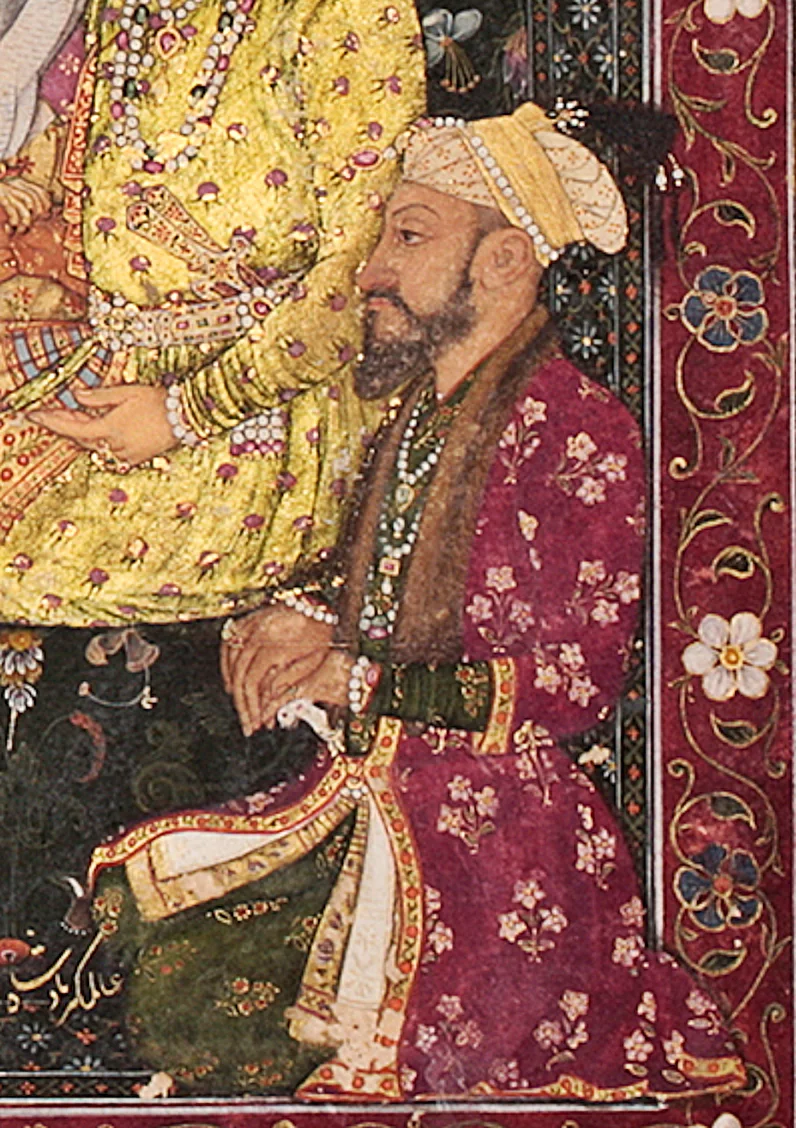
Aurangzeb in a Mughal dynastic manuscript, India, circa 1707–12, Khalili Collection.
Credit: 1707-12 artist · Public domain · sourceResized and converted to WebP; uncropped.
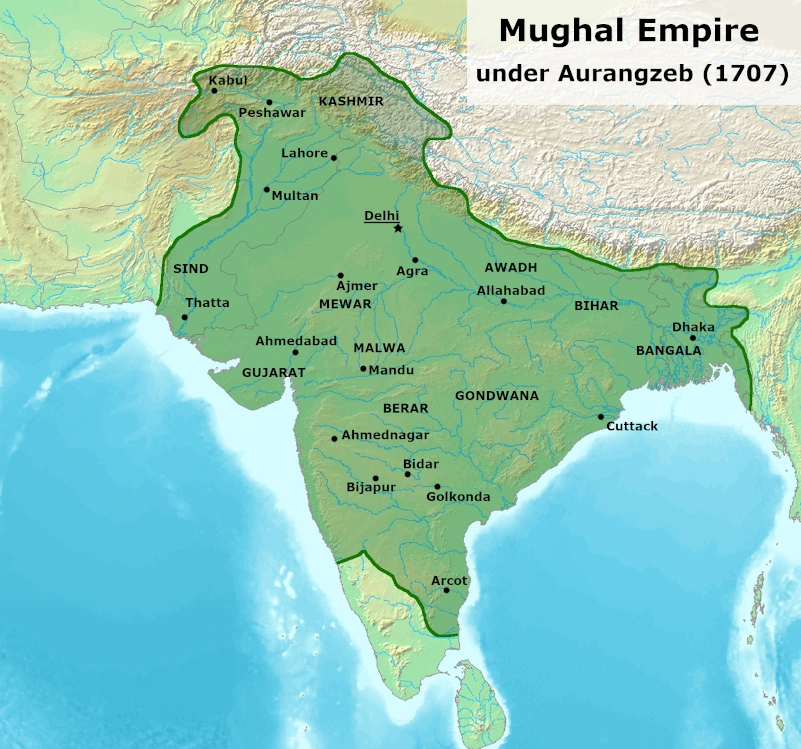
Map study
Mughal Empire in 1707 near the end of Aurangzeb’s reign; this is not Babur’s or Akbar’s territorial extent.
- Read the source date and legend before interpreting territorial extent.
- Compare core regions, neighbouring powers and geographic barriers; historical borders and influence are approximate and changed over time.
Credit: Avantiputra7 · CC BY-SA 4.0 · sourceConverted to WebP on an opaque white background; proportionally resized without cropping. Original cartography and legend retained.
1. Accession and the character of Mughal sovereignty
Aurangzeb gained administrative and military experience as a prince through provincial appointments, including service in the Deccan and Gujarat. Shah Jahan’s illness in 1657 triggered a succession struggle among Dara Shikoh, Shah Shuja, Aurangzeb and Murad Bakhsh. Mughal succession had no binding rule of primogeniture: princes competed through military strength, noble support and control of imperial resources.
Aurangzeb allied with Murad and defeated the imperial army led by Raja Jaswant Singh at Dharmat in April 1658. Their victory over Dara Shikoh at Samugarh, near Agra, in May proved decisive. Aurangzeb confined Shah Jahan in Agra Fort, where the former emperor died in 1666. Dara was defeated again, captured and executed in 1659; Murad was eventually executed, while Shuja fled towards Arakan.
Aurangzeb adopted the title Alamgir, meaning world-seizer. His authority rested on familiar Mughal institutions: the emperor, mansabdari hierarchy, provincial administration and revenue assignments. His reign was therefore not an institutional break with earlier Mughal rule, even though his personal religiosity and public policies differed substantially from Akbar’s.
- Prelims distinction: Dharmat preceded Samugarh; the two battles had different principal opponents.
- Shah Jahan’s confinement began in 1658, but his death occurred only in 1666.
Timeline
1658–1659
Victories in the succession war; accession followed by a formal second coronation.
1665–1666
Treaty of Purandar; Shivaji’s Agra visit and escape.
1675–1679
Execution of Guru Tegh Bahadur, Marwar succession crisis and reimposition of jizya.
1681–1689
Aurangzeb moves to the Deccan; annexes Bijapur and Golconda; Sambhaji is executed.
1707
Aurangzeb dies; another Mughal succession struggle follows.
2. Religious policy, law and cultural patronage
Aurangzeb publicly emphasised Sunni Islamic orthodoxy. He discontinued practices such as jharokha darshan, the emperor’s ceremonial appearance before subjects, and appointed muhtasibs to supervise public morality and observance of prescribed norms. Scholars working under imperial patronage compiled the Fatawa-i-Alamgiri, a major digest of Hanafi jurisprudence. It was not a modern, uniformly enforced statutory code replacing all customary and administrative law.
The reimposition of jizya on non-Muslims in 1679 marked a departure from Akbar’s policy. It was a poll tax with recognised exemptions, not a land-revenue assessment. Aurangzeb also issued orders against certain temples and religious institutions. The destruction of the Vishvanath temple at Banaras and the Keshava Deva temple at Mathura are prominent examples. Religious ideology, punishment of political opposition and assertions of sovereignty could overlap in such actions.
Policy was nevertheless neither uniform nor reducible to a single formula. Documentary evidence also records protection or grants to some Hindu religious establishments, and Hindu officers continued to serve in the imperial elite. Religious discrimination should therefore be recognised without assuming the complete exclusion of non-Muslims from administration.
Courtly cultural patronage changed but did not disappear. Aurangzeb withdrew patronage from court singing, yet music continued among nobles and members of the royal household, while musical scholarship flourished. Major architectural works associated with his reign include Delhi’s Moti Masjid and Lahore’s Badshahi Mosque. Bibi ka Maqbara at Aurangabad was commissioned by his son Azam Shah.
How prolonged warfare could weaken imperial control
- 1. Territorial conquest expands military commitments
- 2. Garrisons and campaigns raise expenditure
- 3. Contested revenue collection strains jagir assignments
- 4. Local resistance disrupts communications and supplies
- 5. Administrative control becomes harder to sustain
3. Regional resistance and imperial negotiations
Several conflicts during the reign involved agrarian grievances, local authority and imperial intervention as well as religion. Jat resistance around Mathura under Gokula erupted in 1669; later leaders such as Raja Ram strengthened regional organisation. The Satnami uprising near Narnaul in 1672 grew from a local confrontation into an armed challenge that imperial forces suppressed.
Rajput relations deteriorated sharply after the death of Jaswant Singh of Marwar in 1678. Imperial intervention in the succession threatened Rathor autonomy and the claims of his infant son Ajit Singh. Durgadas Rathor led resistance, while Mewar also entered the conflict. However, Rajputs were not a single anti-Mughal bloc: several Rajput houses continued imperial service.
Guru Tegh Bahadur was executed at Delhi in 1675 on Aurangzeb’s orders. Sikh tradition remembers his defence of religious freedom, particularly in connection with Kashmiri Pandits. Under Guru Gobind Singh, the founding of the Khalsa in 1699 strengthened Sikh collective identity and military organisation. These developments should not be collapsed into one event or attributed to only one immediate cause.
In the northeast, Mughal expansion faced the Ahom kingdom. At Saraighat in 1671, Ahom forces led by Lachit Borphukan defeated a Mughal force commanded by Raja Ram Singh. The battle demonstrates the limits of imperial power and the importance of riverine warfare and local geography.
| Region or power | Associated leader | Key feature |
|---|---|---|
| Marwar | Durgadas Rathor | Resistance defending Ajit Singh’s succession claim |
| Ahom kingdom | Lachit Borphukan | Mughal defeat at Saraighat, 1671 |
| Marathas | Tarabai | Leadership of resistance after Rajaram’s death |
| Jats | Gokula | Uprising around Mathura, 1669 |
4. The Deccan and the Maratha challenge
The Deccan became the principal theatre of Aurangzeb’s later reign. In 1665, the Treaty of Purandar, negotiated by the Mughal commander Jai Singh, required Shivaji to surrender several forts and accept specified obligations. Shivaji visited Aurangzeb’s court at Agra in 1666, was placed under restraint and escaped. His coronation at Raigad in 1674 asserted an independent kingship.
Aurangzeb moved to the Deccan in 1681, partly in the context of the rebellion of his son Akbar, who sought Maratha support. Bijapur’s Adil Shahi kingdom fell in 1686 and Golconda’s Qutb Shahi kingdom in 1687. These conquests removed major successor states of the Bahmani kingdom and brought the empire close to its maximum territorial extent.
The capture and execution of Sambhaji in 1689 did not end Maratha resistance. Rajaram continued the struggle, including from Jinji in present-day Tamil Nadu. After his death in 1700, Tarabai provided leadership. Mobile Maratha forces, dispersed forts and attacks on supply lines prevented the Mughals from translating repeated battlefield successes into durable control.
Long campaigns stretched communications, increased military expenditure and drew imperial attention away from northern India. Annexation thus produced a paradox: more territory did not necessarily yield proportionately more secure revenue or effective administration.
5. Administration, economy and the decline debate
Mansabdars received ranks and usually drew their remuneration through jagirs, assignments of revenue rather than ownership of land. Expansion increased the number of claimants to these assignments. Differences between assessed revenue, jama, and actual collections, hasil, weakened the capacity of some jagirs to support military obligations. Warfare and contested authority intensified these difficulties.
Historians have explained Mughal weakening through several connected factors: jagirdari pressures, agrarian exploitation, competition among nobles, regional state formation and the costs of Deccan warfare. Aurangzeb’s religious choices and strained political alliances mattered, but a purely personality-based explanation overlooks these structural conditions.
The empire did not collapse immediately upon his death near Ahmadnagar in 1707. Bahadur Shah I succeeded after another succession struggle, and Mughal institutions retained influence even as regional powers expanded. For examination answers, distinguish territorial overstretch, fiscal strain and declining political legitimacy rather than treating them as interchangeable explanations.
Aurangzeb: Dynastic Legitimacy and Imperial Strain
The metadata identifies this image as a representation of Aurangzeb in a manuscript bringing together Mughal rulers from Babur to Aurangzeb and their ancestor Timur. This dynastic context offers a useful entry into Mughal claims to sovereignty: descent, inherited prestige and military achievement helped legitimise imperial rule. However, the manuscript’s approximate dating spans the period around and after Aurangzeb’s death. Its identification alone cannot establish that the portrait was made from life or reveal his personal appearance, beliefs or governing practices.
Aurangzeb’s reign illustrates the distinction between territorial expansion and effective political consolidation. The annexation of Bijapur and Golconda enlarged Mughal possessions, but prolonged Deccan warfare intensified demands on revenue, military resources and administrative coordination. Maratha resistance and contested relations with other regional powers limited the benefits of conquest. His religious policies, including the reimposition of jizya and actions against particular temples, must be examined alongside political circumstances and the continued participation of Hindu elites in imperial service. Neither a portrait nor a single policy adequately explains the complex trajectory of Mughal power.
- Prelims distinction: mansab denoted an official’s rank and service obligations; a jagir was a revenue assignment, not ownership of land.
- Mains approach: connect Deccan campaigning with fiscal pressures and regional resistance, rather than treating territorial size as proof of administrative strength.
- Evidence limit: dynastic portraiture informs the study of imperial representation; claims about policy require corroboration from chronicles, orders and administrative records.
Real-world case studies
Golconda: conquest without assured consolidation
Golconda’s annexation in 1687 eliminated the Qutb Shahi dynasty and opened access to a commercially important region. Yet continuing warfare prevented territorial acquisition from automatically becoming stable fiscal strength.
Saraighat: geography as a strategic advantage
Ahom success on the Brahmaputra in 1671 illustrates how river knowledge, naval tactics and coordinated local resistance could offset Mughal resources. It is a useful example against assuming uninterrupted imperial expansion.
Previous year questions
No source-linked PYQ is available here yet. Use the practice questions below.
Practice questions
Practice MCQ 1
Which sequence is chronologically correct?
- A. Samugarh → Purandar → reimposition of jizya → annexation of Golconda
- B. Purandar → Samugarh → annexation of Golconda → reimposition of jizya
- C. Samugarh → reimposition of jizya → Purandar → annexation of Golconda
- D. Samugarh → Purandar → annexation of Golconda → reimposition of jizya
Practice MCQ 2
Consider these statements: 1. Fatawa-i-Alamgiri was a digest of Hanafi jurisprudence. 2. Jizya was a tax on agricultural land. 3. Hindu nobles continued serving under Aurangzeb. Which are correct?
- A. 1 and 2 only
- B. 2 and 3 only
- C. 1 and 3 only
- D. 1, 2 and 3
Practice MCQ 3
Which pair is incorrectly matched?
- A. Durgadas Rathor — Marwar resistance
- B. Lachit Borphukan — Battle of Saraighat
- C. Tarabai — Maratha resistance
- D. Sambhaji — Qutb Shahi dynasty
Mains practice · Aurangzeb’s reign illustrates the distinction between territorial expansion and effective imperial consolidation. Discuss. Answer in 250 words.
- Introduce the empire’s territorial extent and the prolonged Deccan commitment.
- Explain the annexations of Bijapur and Golconda and continuing Maratha resistance.
- Connect military expenditure with revenue collection and jagirdari pressures.
- Discuss religious policies and regional alliances without adopting a single-cause explanation.
- Conclude by distinguishing imperial weakening from immediate collapse.
Further reading
- NCERT, Themes in Indian History, Part II: Kings and Chronicles.
- Satish Chandra, Medieval India: From Sultanat to the Mughals, Part II.
- John F. Richards, The Mughal Empire, The New Cambridge History of India.
- Athar Ali, The Mughal Nobility Under Aurangzeb.
- https://commons.wikimedia.org/wiki/File:Aurangzeb,_in_The_Rulers_of_the_Mughal_Dynasty_from_Babur_to_Awrangzeb,_with_their_Ancestor_Timur_MSS_874,_India,_circa_1707%E2%80%9312._Khalili_Collection.jpg
Preparing for UPSC Civil Services? Get classroom teaching, answer-writing evaluation and mentorship at Pragnya IAS Academy, Ashok Nagar — see why aspirants choose us for IAS coaching in Hyderabad.