

Great Mosque in Gulbarga Fort.
Credit: Dayal, Deen · Public domain · source
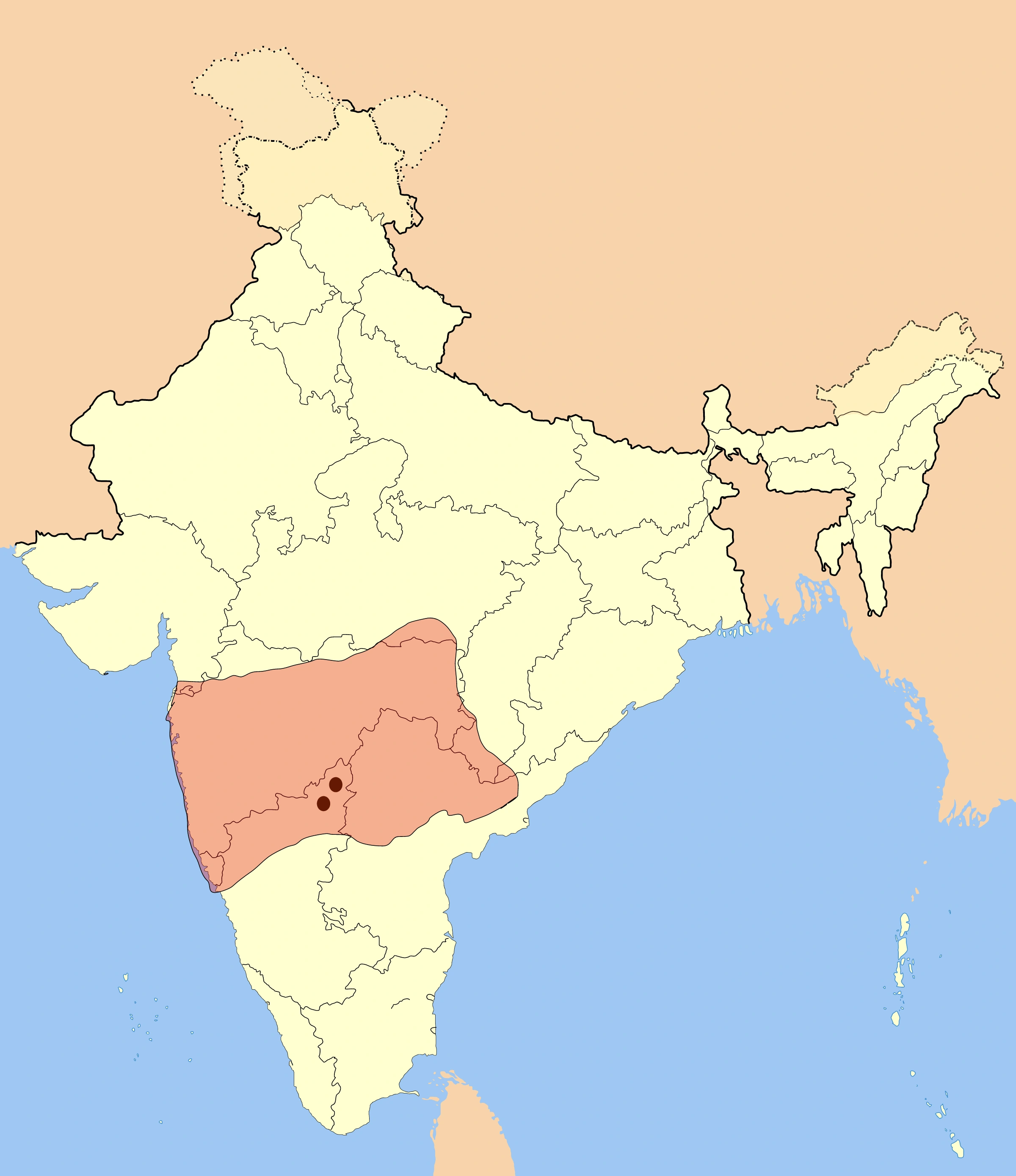
Map study
Bahmani Sultanate: regional background to the later Deccan successor states; this is not a map of their separate later territories.
- Read the source date and legend; distinguish territory, influence and geographic location.
- Historical boundaries and reference memberships are not live political or operational data.
Credit: Mlpkr · CC BY-SA 3.0 · sourceConverted to WebP on an opaque white background; proportionally resized without cropping. Original cartography and legend retained.
Foundation and regional setting
The Bahmani Kingdom arose during the weakening of Muhammad bin Tughlaq’s authority in the Deccan. Military rebellions, problems of controlling distant provinces and resentment among provincial elites enabled local commanders to break away. In 1347, Hasan, commonly known in historical accounts as Hasan Gangu, assumed the title Ala-ud-Din Hasan Bahman Shah. He established his capital at Gulbarga in present-day Karnataka. Stories connecting him with a Brahman patron named Gangu should be treated as traditions rather than securely established explanations of the dynasty’s origin.
The kingdom occupied a strategically important part of the northern Deccan, with boundaries that fluctuated through warfare and alliances. Its territories extended across areas of present-day Karnataka, Maharashtra and Telangana. It did not control the entire Deccan: Vijayanagara dominated much of the south, while other regional rulers remained important in Telangana and the eastern coastal region.
The emergence of Vijayanagara in 1336 and the Bahmani state in 1347 created two major centres of power outside Delhi. Their rivalry was territorial and fiscal as well as political. Fertile agricultural tracts, forts, routes connecting the plateau with ports, and access to imported warhorses were valuable prizes. Religious identities mattered, but reducing Deccan politics to an uninterrupted Hindu–Muslim confrontation obscures changing alliances and the participation of diverse groups in both states.
- Map focus: locate Gulbarga, Bidar, the Krishna and Tungabhadra rivers, the Raichur Doab and Goa.
- The Raichur Doab lies between the Krishna and Tungabhadra rivers, not between the Krishna and Godavari.
Timeline
1347
Hasan Bahman Shah establishes the Bahmani Kingdom with Gulbarga as its capital.
1367
Gulbarga’s Jama Masjid is constructed under Muhammad Shah I.
1429
Conventional date for Ahmad Shah I’s transfer of the capital to Bidar.
Around 1469–1470
Bahmani forces capture Goa from Vijayanagara during Mahmud Gawan’s ascendancy.
1481
Mahmud Gawan is executed.
Around 1490–1518
Provincial powers establish the five successor sultanates.
1527
The nominal Bahmani dynasty comes to an end.
Expansion, rulers and interstate relations
Early Bahmani rulers consolidated the new state and repeatedly fought Vijayanagara and regional powers in Telangana. Muhammad Shah I strengthened royal institutions and continued the struggle for supremacy in the Deccan. Firuz Shah Bahmani, who ruled from 1397 to 1422, is remembered for intellectual interests, patronage and ambitious military campaigns. His reign illustrates the coexistence of courtly cultural exchange with intense competition over territory and resources.
Ahmad Shah I, who ruled from 1422 to 1436, transferred the capital from Gulbarga to Bidar, conventionally dated to 1429. Bidar became a major political and cultural centre. Expansion eastward brought the Bahmanis into conflict with Warangal and, subsequently, the Gajapati rulers of Odisha. The eastern Deccan should therefore be studied alongside the better-known Bahmani–Vijayanagara frontier.
During the fifteenth century, Mahmud Gawan helped extend Bahmani influence and strengthen access to the western coast. Goa was captured from Vijayanagara around 1469–1470. Coastal access supported customs revenue and the horse trade linking the Deccan with West Asia. Imported horses were essential to elite cavalry, making commercial connections a direct element of military power.
The balance of power was rarely permanent. Campaigns could yield tribute, forts or temporary occupation without producing lasting administrative control. For examination purposes, distinguish a ruler’s claimed supremacy from stable possession, and avoid treating every contested region as continuously Bahmani territory.
From provincial government to successor states
- 1. Extensive authority entrusted to provincial governors
- 2. Mahmud Gawan attempts administrative centralisation
- 3. Factional opposition culminates in Gawan’s execution
- 4. Royal control weakens and provincial autonomy expands
- 5. Five regional sultanates emerge
Administration, Mahmud Gawan and factional conflict
The sultan stood at the head of a military and revenue-based monarchy. Provincial divisions were called tarafs, and their governors were known as tarafdars. The early kingdom had four principal provinces centred on Gulbarga, Daulatabad, Berar and Bidar. Governors exercised substantial military and fiscal authority, creating recurring tension between provincial power and the crown.
Mahmud Gawan, a Persian-born merchant who entered Bahmani service, became the kingdom’s most influential minister under Muhammad Shah III. He sought to curb provincial autonomy by reorganising the four provinces into eight. Important forts were brought under officers directly responsible to the centre, limiting governors’ control over fortified strongholds. Lands were also reserved as khalisa, whose revenues accrued directly to the crown.
His reforms included efforts to measure land, regularise assessment and strengthen the relationship between assigned revenues and military obligations. These measures sought both higher administrative efficiency and greater royal control. They should not be confused with Akbar’s later mansabdari system or the standardised Mughal revenue arrangements associated with Todar Mal.
Court politics were deeply affected by competition between Deccanis and Afaqis, also called newcomers or foreigners. Deccanis included established Muslim groups of the region, while Afaqis were more recent immigrants, often from Iran and neighbouring regions. These were changing political coalitions rather than perfectly uniform ethnic blocs. Gawan’s association with the Afaqis and his restrictions on provincial power intensified opposition. A forged accusation of treason led to his execution in 1481, seriously weakening the monarchy.
- Revision terms: taraf means province; tarafdar means provincial governor; khalisa denotes land yielding revenue directly to the crown.
- Mahmud Gawan was a minister, not a Bahmani sultan.
| State | Dynasty | Approximate emergence |
|---|---|---|
| Ahmadnagar | Nizam Shahi | 1490 |
| Bijapur | Adil Shahi | 1490 |
| Berar | Imad Shahi | 1490 |
| Bidar | Barid Shahi | 1492; initially exercised power behind nominal Bahmani rulers |
| Golconda | Qutb Shahi | 1518 |
Society, economy and cultural production
Agriculture supplied the basic revenue of the kingdom. Cultivators, village functionaries, local chiefs, artisans and merchants sustained the state’s military and urban establishments. Marathi-, Kannada- and Telugu-speaking populations inhabited its changing territories. Hindu local elites and officials continued to have roles within regional structures of authority, while immigrant soldiers, scholars and traders added to the diversity of court and urban society.
Persian was the principal language of courtly administration and high literary culture. Contact among Persian, Arabic and regional linguistic traditions also contributed to the growth of Dakhni. Trade brought horses, luxury commodities and skilled people through western ports. Thus, the plateau was not culturally isolated: it participated in networks stretching across the Arabian Sea.
Sufi institutions became important centres of devotion and social interaction. Gesu Daraz, a prominent Chishti saint, settled at Gulbarga in the early fifteenth century and died there in 1422. His shrine became an enduring devotional centre. Royal patronage of saints helped construct legitimacy, but Sufi relationships with rulers were not always straightforward or politically subordinate.
Bahmani architecture combined Persianate forms with local materials, skills and adaptations. The largely covered congregational space of Gulbarga’s Jama Masjid, built in 1367, is distinctive. Bidar preserves the madrasa of Mahmud Gawan and the nearby royal tombs at Ashtur. Glazed tilework and imposing gateways demonstrate transregional artistic connections. Bidri metalware is associated with Bidar’s wider cultural environment, although its origins and stages of development should not be assigned overly precise dates.
Disintegration and historical significance
After Gawan’s execution, weak rulers, factional struggles and increasingly independent governors undermined central authority. Ahmadnagar, Bijapur and Berar emerged as independent powers around 1490; Bidar and Golconda followed in the early sixteenth century. Fragmentation was therefore a process, not a single simultaneous partition.
Textbooks commonly date the effective breakup to 1518, while a nominal Bahmani line survived until 1527. The successor dynasties were the Nizam Shahis of Ahmadnagar, Adil Shahis of Bijapur, Imad Shahis of Berar, Barid Shahis of Bidar and Qutb Shahis of Golconda. These states inherited personnel, institutions and cultural traditions from the Bahmani political world.
The kingdom’s wider significance lies in making the Deccan an enduring centre of regional state formation. Its history connects agrarian resources, maritime trade, military organisation, migration and cultural exchange. The later defeat of Vijayanagara at Talikota in 1565 belongs to the history of the successor sultanates, not to the unified Bahmani Kingdom.
Real-world case studies
Mahmud Gawan’s madrasa at Bidar
Built in the 1470s, the madrasa combined teaching spaces, residential accommodation and a monumental architectural design. Its glazed decoration illustrates Persianate artistic connections. The surviving structure provides material evidence of scholarly patronage and the movement of architectural ideas across the Indian Ocean world.
The Raichur Doab as a contested frontier
The Krishna–Tungabhadra interfluve combined productive land with strategic forts and routes. Repeated Bahmani–Vijayanagara conflict over this zone demonstrates how agrarian revenue and military geography shaped regional competition. Its political history continued under the successor sultanates.
Previous year questions
No source-linked PYQ is available here yet. Use the practice questions below.
Practice questions
Practice MCQ 1
With reference to the Bahmani Kingdom, consider the following statements: 1. Gulbarga preceded Bidar as its capital. 2. The Raichur Doab lies between the Krishna and Godavari rivers. 3. Mahmud Gawan served as a minister under Muhammad Shah III. Which of the statements given above are correct?
- A. 1 and 2 only
- B. 1 and 3 only
- C. 2 and 3 only
- D. 1, 2 and 3
Practice MCQ 2
Which one of the following state–dynasty pairs is incorrectly matched?
- A. Ahmadnagar — Nizam Shahi
- B. Berar — Imad Shahi
- C. Bidar — Qutb Shahi
- D. Bijapur — Adil Shahi
Practice MCQ 3
Which of the following measures are associated with Mahmud Gawan? 1. Reorganisation of four provinces into eight. 2. Restriction of governors’ control over forts. 3. Introduction of Akbar’s mansabdari system in the Deccan. Select the correct answer.
- A. 1 only
- B. 2 and 3 only
- C. 1 and 2 only
- D. 1, 2 and 3
Mains practice · The Bahmani Kingdom was both a centre of cultural exchange and an arena of competing regional interests. Discuss with reference to its administration, society and disintegration. Answer in 250 words.
- Introduce its foundation in 1347 and its place in Deccan regional state formation.
- Explain taraf administration, provincial autonomy and Gawan’s centralising reforms.
- Connect agrarian resources, coastal trade and horse imports with interstate rivalry.
- Discuss Persianate patronage, regional languages, Dakhni, Sufi institutions and architecture.
- Analyse Deccani–Afaqi competition without treating the factions as rigid ethnic categories.
- Conclude with fragmentation and institutional continuity under the successor sultanates.
Further reading
- Satish Chandra, Medieval India, NCERT old Class XI textbook.
- Satish Chandra, History of Medieval India, Orient BlackSwan.
- NCERT, Themes in Indian History, Part II: An Imperial Capital, Vijayanagara.
- Archaeological Survey of India: monument information on Gulbarga and Bidar.
- Karnataka Tourism official website: Bahmani monuments at Kalaburagi and Bidar.
Preparing for UPSC Civil Services? Get classroom teaching, answer-writing evaluation and mentorship at Pragnya IAS Academy, Ashok Nagar — see why aspirants choose us for IAS coaching in Hyderabad.