
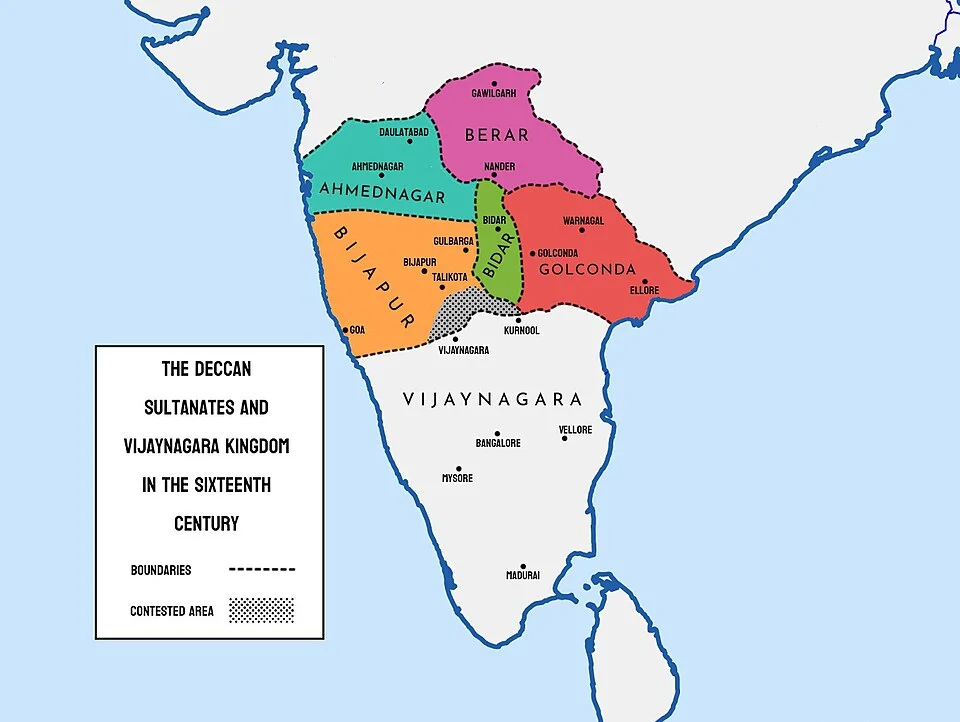
Illustrative map of the Deccan Sultanates and Vijayanagara in the sixteenth century.
Credit: Beylarbey · CC BY 4.0 · sourceResized and converted to WebP; uncropped.
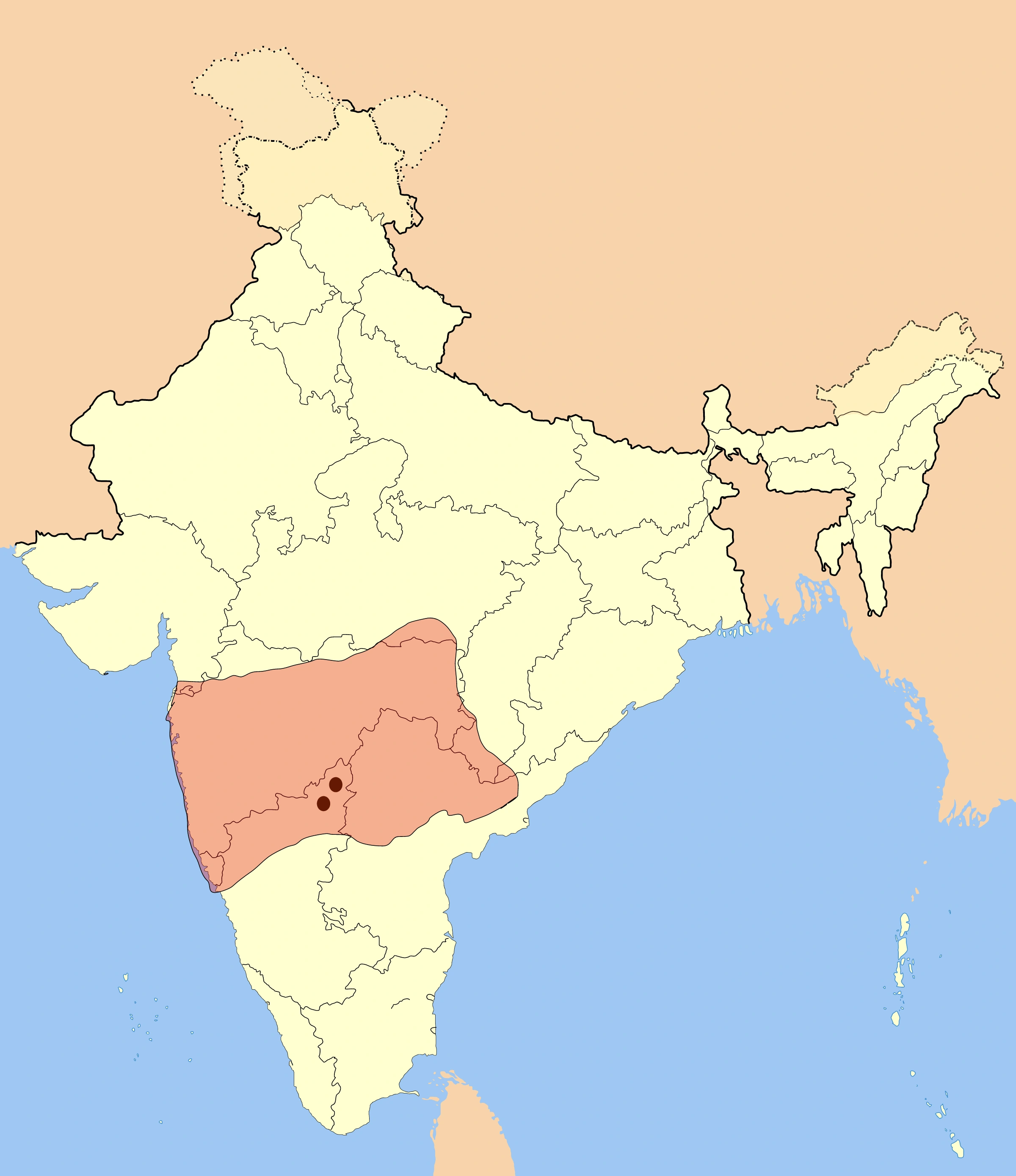
Map study
Bahmani Sultanate: regional background to the later Deccan successor states; this is not a map of their separate later territories.
- Read the source date and legend; distinguish territory, influence and geographic location.
- Historical boundaries and reference memberships are not live political or operational data.
Credit: Mlpkr · CC BY-SA 3.0 · sourceConverted to WebP on an opaque white background; proportionally resized without cropping. Original cartography and legend retained.
1. Bahmani background and the emergence of regional states
The Bahmani kingdom arose in 1347 during the fragmentation of Delhi Sultanate authority in the Deccan. It controlled substantial areas between the northern Deccan plateau and the Krishna-Tungabhadra region. Gulbarga was its first capital; Ahmad Shah I transferred the capital to Bidar in the fifteenth century. Bahmani rulers competed with Vijayanagara for strategic forts, fertile tracts and access to trade routes.
Provincial governors, powerful military households and factional struggles gradually weakened central authority. The execution of the influential minister Mahmud Gawan in 1481 accelerated instability, although it was not the sole cause of disintegration. Rivalries often involved Deccanis, associated with older-established local Muslim elites, and Afaqis, immigrants connected particularly with Iran and adjoining regions. These categories were political and social alignments, not rigid or permanent communities.
By the early sixteenth century, five successor states had emerged. Their independence developed gradually, and conventional foundation dates sometimes refer to the assertion of effective autonomy rather than a single constitutional break. The states inherited Bahmani administrative practices but developed separate dynastic, regional and cultural identities.
- Nizam Shahis: Ahmadnagar, founded by Malik Ahmad in 1490; the city of Ahmadnagar was founded in 1494.
- Adil Shahis: Bijapur, established by Yusuf Adil Shah around 1490.
- Imad Shahis: Berar, established by Fathullah Imad-ul-Mulk around 1490, with its centre at Ellichpur.
- Barid Shahis: Bidar, where Qasim Barid’s ascendancy began in the late fifteenth century and his successors established independent rule.
- Qutb Shahis: Golconda, conventionally dated from Sultan Quli’s assertion of independence in 1518.
Timeline
1347
Foundation of the Bahmani kingdom.
1481
Execution of Mahmud Gawan amid intensifying court rivalries.
Around 1490–1518
Emergence of the five Deccan sultanates.
1565
Deccan coalition defeats Vijayanagara at Talikota.
1574 and 1619
Ahmadnagar annexes Berar; Bijapur annexes Bidar.
1636
Shah Jahan’s settlement marks the final suppression of Nizam Shahi power.
1686–1687
Mughal annexation of Bijapur and Golconda.
2. Warfare, diplomacy and Mughal expansion
The sultanates were neither a permanent alliance nor an undifferentiated political bloc. They fought one another over territory and succession while also forming alliances with Vijayanagara. Control of the Raichur Doab, between the Krishna and Tungabhadra rivers, was a recurrent source of conflict, especially between Bijapur and Vijayanagara. Fortifications, cavalry, artillery and supplies of imported warhorses were critical to regional warfare.
At Talikota in 1565, the combined forces of Ahmadnagar, Bijapur, Golconda and Bidar defeated Vijayanagara’s army under Aliya Rama Raya, who was captured and killed. Berar was not a principal participant in this coalition. The subsequent sack devastated the imperial capital. However, the Vijayanagara state did not immediately disappear: the Aravidu dynasty continued from centres including Penukonda and Chandragiri.
Ahmadnagar annexed Berar in 1574, while Bijapur absorbed Bidar in 1619. Mughal pressure intensified under Akbar. Chand Bibi defended Ahmadnagar during the siege of 1595–96; a settlement ceded Berar to the Mughals. Ahmadnagar fort fell in 1600, but Nizam Shahi resistance continued under leaders such as Malik Ambar. Its final suppression is generally associated with Shah Jahan’s Deccan settlement of 1636.
Aurangzeb annexed Bijapur in 1686 and Golconda in 1687 after major sieges. These victories ended the two surviving sultanates but did not pacify the Deccan. Prolonged warfare against the Marathas imposed growing military and fiscal costs on the Mughal Empire.
Regional political transformation
- 1. Weakening of Bahmani central authority
- 2. Provincial and military elites establish successor states
- 3. Interstate competition and selective alliances with Vijayanagara
- 4. Territorial consolidation and increasing Mughal intervention
- 5. Mughal annexations alongside the rise of Maratha power
3. Administration, economy and social mobility
Agrarian revenue sustained the states, supported by territorial officials, military assignments and locally rooted intermediaries. Deshmukhs and other hereditary officeholders linked courts to rural society. Administrative arrangements varied across kingdoms and periods; Mughal terminology and institutions should not automatically be projected onto every Deccan state.
The courts recruited soldiers and officials from diverse backgrounds, including Deccanis, Persian immigrants, Africans often described as Habshis, and local Hindu elites. Marathi-speaking landed and military families acquired experience in sultanate service. Shahji Bhonsle, Shivaji’s father, served in the shifting political world of Ahmadnagar and Bijapur. These networks contributed to the later emergence of Maratha power without making that outcome inevitable.
Agriculture coexisted with textile production, diamond commerce and coastal trade. Golconda’s eastern connections included the important port of Masulipatnam. The designation ‘Golconda diamonds’ referred to a commercial and political network linked to diamond-producing areas, including mines near the Krishna valley, rather than simply to mines inside Golconda fort.
Portuguese seizure of Goa from Bijapur in 1510 altered western coastal politics. Maritime merchants supplied horses, metals and luxury goods, while Indian textiles connected the Deccan to Indian Ocean markets. Irrigation works, tanks and urban water systems helped sustain settlement in an environment marked by seasonal rainfall.
| State | Dynasty | Principal centre | Key association |
|---|---|---|---|
| Ahmadnagar | Nizam Shahi | Ahmadnagar | Chand Bibi and Malik Ambar |
| Bijapur | Adil Shahi | Bijapur | Ibrahim Rauza and Gol Gumbaz |
| Berar | Imad Shahi | Ellichpur | Annexed by Ahmadnagar in 1574 |
| Bidar | Barid Shahi | Bidar | Annexed by Bijapur in 1619 |
| Golconda | Qutb Shahi | Golconda; later Hyderabad | Charminar and diamond commerce |
4. Religion, language, literature and visual culture
Deccani society combined Persianate court culture with regional linguistic, artistic and devotional traditions. Persian remained important in administration and elite literature, while Dakhni developed as a major literary language. Marathi, Telugu and Kannada continued to shape regional society. Sufi establishments connected towns and courts with wider social networks.
Religious policies differed across rulers and contexts. Shia traditions were influential at several courts, particularly Golconda, while Sunni communities and Hindu officials also formed important parts of political society. Dynastic religious affiliations do not adequately explain alliances, warfare or patterns of patronage.
Ibrahim Adil Shah II of Bijapur, who ruled from 1580 to 1627, was a notable patron of music and the arts. His Kitab-i Nauras reflects a broad devotional and musical vocabulary, including praise of Saraswati and Ganapati. Muhammad Quli Qutb Shah, ruler of Golconda from 1580 to 1612, founded Hyderabad in 1591 and was an important Dakhni poet.
Architecture combined domes, arches, stucco ornament, monumental tombs and locally developed construction practices. Bijapur is associated with Ibrahim Rauza and Gol Gumbaz, the mausoleum of Muhammad Adil Shah. Golconda-Hyderabad is associated with Golconda fort, the Qutb Shahi tombs and Charminar. Deccani painting is distinguished by rich colour, elongated figures, imaginative landscapes and interaction with Persian and regional visual traditions.
5. Historical significance and Prelims distinctions
The sultanates were active centres of state formation and cultural production, not merely an interval between the Bahmanis and the Mughals. Their military recruitment and regional administrative networks helped shape subsequent Maratha and Mughal politics. Their cities also connected inland agrarian resources with global commercial circuits.
For objective questions, distinguish dynasties, capitals, monuments and rulers. The Nizam Shahis of Ahmadnagar must not be confused with the eighteenth-century Asaf Jahi Nizams of Hyderabad. Similarly, the Qutb Shahi dynasty of Golconda was unrelated to Delhi Sultanate ruler Qutbuddin Aibak.
- Talikota: 1565; Khanwa: 1527. These belong to different regional and political contexts.
- Chand Bibi is associated with Ahmadnagar’s defence against the Mughals; Malik Ambar with its later resistance and administrative reconstruction.
- Charminar was built under Muhammad Quli Qutb Shah, not Ibrahim Adil Shah II.
- The Bahmani kingdom and its five successor sultanates are related but are not interchangeable terms.
The Deccan as a Changing Political Region
The metadata identifies a map of the sixteenth-century Deccan Sultanates and Vijayanagara, making it directly relevant to the region’s political geography. Ahmadnagar, Bijapur, Berar, Bidar and Golconda emerged as Bahmani authority fragmented. Their location helps explain competition over forts, agrarian revenues, routes linking the plateau with coastal ports, and strategic zones such as the Raichur Doab between the Krishna and Tungabhadra rivers. However, a map labelled only by century should not be treated as a precise snapshot: frontiers and the independence of individual states changed over time.
These kingdoms did not constitute a permanent political bloc. They fought one another, negotiated with Vijayanagara and sometimes cooperated against it. The alliance at Talikota illustrates contingent cooperation, not an enduring unity of all five sultanates. Regional politics also crossed religious boundaries through military recruitment, diplomacy and service by diverse elites, including Marathi-speaking warrior groups. Persianate court culture interacted with local languages and social practices, contributing to distinctive Deccani traditions. A political map is therefore a starting point for studying regional power, not sufficient evidence for cultural boundaries, population composition or everyday social relations.
- Pair states with dynasties: Ahmadnagar–Nizam Shahi; Bijapur–Adil Shahi; Berar–Imad Shahi; Bidar–Barid Shahi; Golconda–Qutb Shahi.
- For Prelims, distinguish Bahmani fragmentation from later Mughal conquest; the five successor states did not remain independent throughout the same period.
- For Mains, connect geography with revenue, warfare and exchange; corroborate mapped boundaries using dated inscriptions, chronicles and other historical evidence.
Real-world case studies
Malik Ambar: mobility and resistance
Malik Ambar, an Ethiopian-born man who had been enslaved, rose to become the leading minister and military organiser of Ahmadnagar. He combined mobile warfare, alliances with local chiefs and revenue reorganisation to resist Mughal expansion. His development of Khadki, later Aurangabad, illustrates the connection between warfare, administration and urban growth.
Hyderabad: a new Qutb Shahi capital
Muhammad Quli Qutb Shah founded Hyderabad on the Musi River in 1591. Charminar formed a prominent element of the new city’s planned urban core. The move beyond the older fortified centre of Golconda reflected expanding courtly, residential and commercial requirements.
Previous year questions
No source-linked PYQ is available here yet. Use the practice questions below.
Practice questions
Practice MCQ 1
Consider the following pairs: 1. Ahmadnagar — Nizam Shahi 2. Berar — Barid Shahi 3. Golconda — Qutb Shahi. Which of the pairs are correctly matched?
- A. 1 and 2 only
- B. 1 and 3 only
- C. 2 and 3 only
- D. 1, 2 and 3
Practice MCQ 2
With reference to the Battle of Talikota, consider the following statements: 1. It was fought in 1565. 2. Berar was a principal participant in the victorious coalition. 3. Vijayanagara rule continued under the Aravidu dynasty after the battle. Which statements are correct?
- A. 1 only
- B. 1 and 2 only
- C. 1 and 3 only
- D. 2 and 3 only
Practice MCQ 3
Which one of the following rulers is correctly associated with the Kitab-i Nauras?
- A. Ibrahim Adil Shah II
- B. Muhammad Quli Qutb Shah
- C. Yusuf Adil Shah
- D. Muhammad Adil Shah
Mains practice · The Deccan Sultanates were centres of regional state formation and cultural interaction rather than merely successors to the Bahmani kingdom. Discuss. Answer in 250 words.
- Explain Bahmani fragmentation and the emergence of five distinct dynastic states.
- Discuss agrarian administration, local intermediaries and diverse military recruitment.
- Connect coastal commerce, textiles and diamonds with urban development.
- Use Dakhni literature, Ibrahim Adil Shah II, Charminar and Deccani painting as examples.
- Assess their role in Vijayanagara, Mughal and early Maratha political developments.
- Avoid treating religious identity as the sole determinant of alliances.
Further reading
- Satish Chandra, Medieval India, NCERT.
- NCERT, Themes in Indian History, Part II: An Imperial Capital, Vijayanagara.
- Satish Chandra, History of Medieval India, Orient BlackSwan.
- Archaeological Survey of India: official monument information on Bijapur and Hyderabad.
- Telangana Department of Heritage: official resources on Qutb Shahi monuments.
- https://commons.wikimedia.org/wiki/File:Deccan_Sultanates_in_16th_Century.jpg
Preparing for UPSC Civil Services? Get classroom teaching, answer-writing evaluation and mentorship at Pragnya IAS Academy, Ashok Nagar — see why aspirants choose us for IAS coaching in Hyderabad.